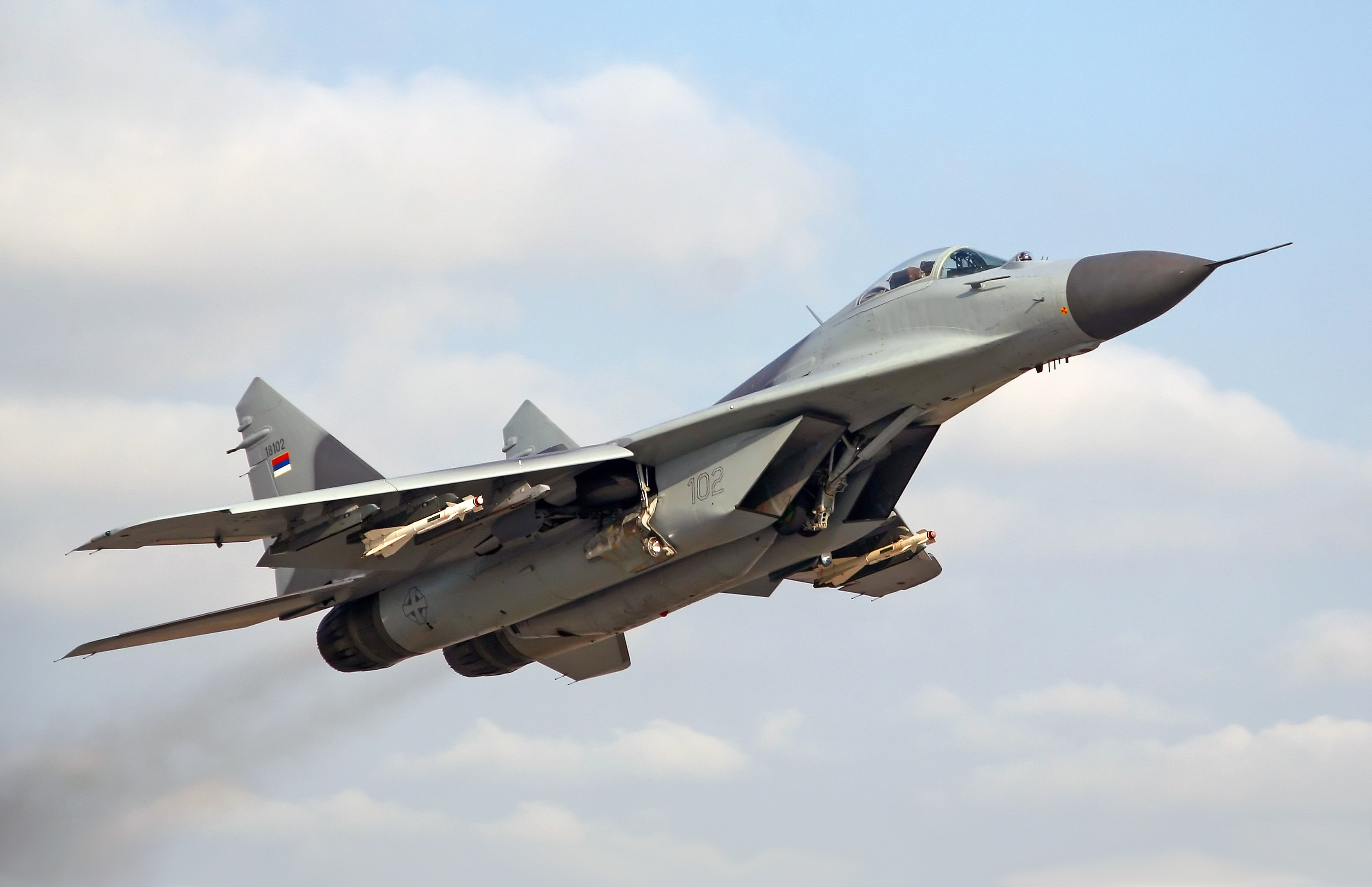
Serbia’s army has received four MiG-29 fighter jets from Belarus. Serbia is currently operating 14 MiG-29.Six MiG-29 fighter jets reached Serbia in October 2017. Now the warplanes are to be modernized in three stages. The country plans to spend a sum from 180 million to 230 million euro for these purposes. Along with MiG-29 fighter jets, Russia’s assistance to Serbia will include 30 T-72 tanks and 30 BRDM-2 combat patrol vehicles.
tass
Translate
Showing posts with label SERBIA. Show all posts
Apr 25, 2018
Serbia receives four MiG-29 fighter jets from Belarus
Oct 17, 2017
Serbia to buy S-300 missile systems, MiG-29 jets from Belarus
The Serbian Ministry of Defenee is planning to purchase S-300 long-range surface-to-air missile systems and seven Mikoyan MiG-29 fighter jets from Belarus.
The deals are to be signed this November during an official visit by Serbian President Aleksandar Vucic to Minsk where he will meet with his Belarusian counterpart, Alexander Lukashenko, a Serbian government source told local daily Tanjug.
The unnamed official said that “the offer that is on the table and which will be announced in November is much more favorable than the one that we obtained from Moscow.”
The value of the planned deal was not disclosed.
defensenews
The deals are to be signed this November during an official visit by Serbian President Aleksandar Vucic to Minsk where he will meet with his Belarusian counterpart, Alexander Lukashenko, a Serbian government source told local daily Tanjug.
The unnamed official said that “the offer that is on the table and which will be announced in November is much more favorable than the one that we obtained from Moscow.”
The value of the planned deal was not disclosed.
defensenews
Oct 7, 2017
Serbia Takes Delivery Of First Of Six MiG-29 Fighters From Russia
A transport plane has delivered two Russian MiG-29 fighter jets to Serbia, the initial shipment of a six-jet deal that could add to East-West tensions in the Balkans.
The warplanes arrived disassembled aboard a massive Antonov An-124 transport plane that landed at a military airport in the Belgrade suburb of Batajnica on October 2.
The MiGs are being provided by Moscow at no charge, but their assembly, repair, and refurbishing costs are expected to near $235 million in total.
The four other jets are set to arrive sometime before October 20, when they are likely to be displayed in Belgrade during a Liberation Day parade. Russian Defense Minister Sergei Shoigu is scheduled to attend.
In March, Serbia’s Aleksandar Vucic, then prime minister and now president, confirmed earlier reports that Russia would provide the six MiG-29 fighters "as a gift."
He added that the planes would enter military service by the end of 2017 after refurbishing and pilot training.
Russia also committed to provide 30 T-72 tanks and 30 BRDM-2 patrol combat vehicles to Serbia for free.
Vucic said on October 2 that Serbia also planned to improve its defenses and has been negotiating with Moscow for the purchase of Russian-made S-300 antiaircraft systems.
rferl
The warplanes arrived disassembled aboard a massive Antonov An-124 transport plane that landed at a military airport in the Belgrade suburb of Batajnica on October 2.
The MiGs are being provided by Moscow at no charge, but their assembly, repair, and refurbishing costs are expected to near $235 million in total.
The four other jets are set to arrive sometime before October 20, when they are likely to be displayed in Belgrade during a Liberation Day parade. Russian Defense Minister Sergei Shoigu is scheduled to attend.
In March, Serbia’s Aleksandar Vucic, then prime minister and now president, confirmed earlier reports that Russia would provide the six MiG-29 fighters "as a gift."
He added that the planes would enter military service by the end of 2017 after refurbishing and pilot training.
Russia also committed to provide 30 T-72 tanks and 30 BRDM-2 patrol combat vehicles to Serbia for free.
Vucic said on October 2 that Serbia also planned to improve its defenses and has been negotiating with Moscow for the purchase of Russian-made S-300 antiaircraft systems.
rferl
Nov 19, 2016
Serbia in Talks With Russia over Acquisition of Six MiG-29
The Serbian government is in talks with Russia over a potential acquisition of six Mikoyan MiG-29 fighter jets and an undisclosed amount of armored vehicles.
The discussed procurements are to intensify Serbia’s military cooperation with Russia, which also offered to sell Belgrade Buk anti-aircraft missile systems on mobile launchers. However, Serbian officials said they cannot afford to purchase the systems, which cost about $60 million per battalion, a government source in Belgrade told local daily Vecernje Novosti.
The Serbian Ministry of Defence considers acquiring new aircraft as one of its top procurement priorities, as the Serbian air force's existing fighter jet fleet is expected to lose its operational capacity in the next two to three years. Should Belgrade decide to obtain the MiG-29s from Moscow, the aircraft are to be overhauled and modernized by the Russian defense industry under a deal estimated to be worth about $50 million.
defensenews
The discussed procurements are to intensify Serbia’s military cooperation with Russia, which also offered to sell Belgrade Buk anti-aircraft missile systems on mobile launchers. However, Serbian officials said they cannot afford to purchase the systems, which cost about $60 million per battalion, a government source in Belgrade told local daily Vecernje Novosti.
The Serbian Ministry of Defence considers acquiring new aircraft as one of its top procurement priorities, as the Serbian air force's existing fighter jet fleet is expected to lose its operational capacity in the next two to three years. Should Belgrade decide to obtain the MiG-29s from Moscow, the aircraft are to be overhauled and modernized by the Russian defense industry under a deal estimated to be worth about $50 million.
defensenews
Jan 16, 2016
Russia and Serbia To Discuss MiG-35 Sale
Russian Deputy Prime Minister Dmitry Rogozin arrived in Belgrade on Saturday evening.
He was taking part in a meeting of the Serbia-Russia Intergovernmental Committee for Trade, Economic, Scientific and Technical Cooperation on January 11-12 but unofficially, one of the reasons for this visit is Serbia's intention to buy MiG-35 warplanes from Russia.
b92.net
He was taking part in a meeting of the Serbia-Russia Intergovernmental Committee for Trade, Economic, Scientific and Technical Cooperation on January 11-12 but unofficially, one of the reasons for this visit is Serbia's intention to buy MiG-35 warplanes from Russia.
b92.net
Mar 13, 2015
Russia, Serbia to Carry Out Joint Air Force Drills
Military pilots from Russia and Serbia will conduct joint training exercises in September 2015, the Russian Defense Ministry said Thursday.
Pilots from both countries will represent tactical and ground-support units in mixed crews.
Aircrew on MiG-29 fighters will perform tasks to intercept air targets, while Mi-8 military transport and combat helicopters will work on tactical landings, covering ground units from the air, firing missiles at ground targets at the site, as well as aircrew search and rescue operations.
Aspiring EU member Serbia has maintained friendly relations with Russia despite the European Union’s numerous sanctions against Moscow, including in the military field, over its alleged involvement in the Ukraine crisis.
sputniknews
Pilots from both countries will represent tactical and ground-support units in mixed crews.
Aircrew on MiG-29 fighters will perform tasks to intercept air targets, while Mi-8 military transport and combat helicopters will work on tactical landings, covering ground units from the air, firing missiles at ground targets at the site, as well as aircrew search and rescue operations.
Aspiring EU member Serbia has maintained friendly relations with Russia despite the European Union’s numerous sanctions against Moscow, including in the military field, over its alleged involvement in the Ukraine crisis.
sputniknews
Sep 9, 2014
Serbia's MiG-29s return to flight ops
Serbia's fleet of three MiG-29 'Fulcrum' fighters returned to flight operations on 2 September after an urgent delivery of batteries from Russia ended a three-month grounding.
Speaking on 31 August, Serbian Prime Minister Aleksandar Vucic said: "We published a tender for procurement of batteries but on the personal insistence of Russian President Vladimir Putin, these batteries have been donated to us. Our planes will be fully operational again in 36 hours and we will have full sovereignty over Serbian skies".
Problems with logistical support for MiG fighters also occurred in 2013, when Vucic was Minister of Defence, with Serbian MiG-29s grounded for a few months due to a slow, bureaucratic logistical system that often caused a lack of simple but crucial spare parts such as ejection seats explosive charges, tyres, and other consumables, including fuel.
The three MiG-29s returned to service are a pair of single-seat MiG-29B and a sole MiG-29UB twin-seater aircraft. The single-seat aircraft perform Quick Reaction Alert (QRA) duties out of Batajnica air base, near Belgrade.
The battery problem arose from Russia's objection to the possibility of India-made batteries being installed on the aircraft, after India won the tender for the purchase with an offer two-thirds cheaper than the Russian one. Faced with possibly losing other critical Russian maintenance and logistical support services for Serbia's MiG-21 and MiG-29 fighters, the Serbian Ministry of Defence stopped the procurement. As a result the Serbian Air Force and Air Defence was left without batteries. The last airworthy Serbian MiG-29 ceased flying on 24 May.
After Serbian Defence Minister Bratislav Gasic made an urgent appeal in Moscow to borrow batteries, Putin agreed to donate them instead.
Serbia depends on Russia when it comes to its small fleet of operational MiG-21 and MiG-29 fighters. With significant Russian assistance in 2007 and 2008, the local Aeronautical Plant 'Moma Stanojlovic' started a general overhaul, a 750 hour/10 year life cycle extension, and limited modernisation on all five Serbian MiG-29s that survived NATO bombardment of 1999.
Four MiG-29s have been upgraded so far with one of them, a single-seat MiG-29B, lost in a fatal crash in 2009. The final single-seat MiG-29B, still being overhauled at 'Moma Stanojlovic', may never fly again because of serious structural problems with its airframe.
The small MiG-29 fleet is supplemented by an outdated life cycle-expired fleet of 19 MiG-21bis and 9 MiG-21UM 'Fishbed' fighters. Of these only a pair of MiG-21bis and a single MiG-21UM are still fit for service, although only one of them is usually airworthy at any given moment.
These obsolete 30-year-old airframes are kept operational with Russian help, in the form of scheduled inspections and time-limited on-condition life cycle extensions by Russian engineers.
Serbia's plans to use a recently announced Russian loan of almost USD1.5 billion for the procurement of MiG-29M/M2 fighters, Mi-17/171 helicopters, 3D-surveillance radars, and S-300PMU2 or S-350E and Pantsir-S1E air defence systems turned into fiasco when, during a visit to Moscow, Gasic revealed that the Russian loan for modernising Serbia's Armed Forces had been frozen and that a planned purchase of new fighters had been delayed.
This has raised questions about the future of the supersonic element of Serbia's Air Force, given its few remaining MiG-21s will soon be unserviceable and its MiG-29s will reach the end of their service lives in 2018.
janes
Speaking on 31 August, Serbian Prime Minister Aleksandar Vucic said: "We published a tender for procurement of batteries but on the personal insistence of Russian President Vladimir Putin, these batteries have been donated to us. Our planes will be fully operational again in 36 hours and we will have full sovereignty over Serbian skies".
Problems with logistical support for MiG fighters also occurred in 2013, when Vucic was Minister of Defence, with Serbian MiG-29s grounded for a few months due to a slow, bureaucratic logistical system that often caused a lack of simple but crucial spare parts such as ejection seats explosive charges, tyres, and other consumables, including fuel.
The three MiG-29s returned to service are a pair of single-seat MiG-29B and a sole MiG-29UB twin-seater aircraft. The single-seat aircraft perform Quick Reaction Alert (QRA) duties out of Batajnica air base, near Belgrade.
The battery problem arose from Russia's objection to the possibility of India-made batteries being installed on the aircraft, after India won the tender for the purchase with an offer two-thirds cheaper than the Russian one. Faced with possibly losing other critical Russian maintenance and logistical support services for Serbia's MiG-21 and MiG-29 fighters, the Serbian Ministry of Defence stopped the procurement. As a result the Serbian Air Force and Air Defence was left without batteries. The last airworthy Serbian MiG-29 ceased flying on 24 May.
After Serbian Defence Minister Bratislav Gasic made an urgent appeal in Moscow to borrow batteries, Putin agreed to donate them instead.
Serbia depends on Russia when it comes to its small fleet of operational MiG-21 and MiG-29 fighters. With significant Russian assistance in 2007 and 2008, the local Aeronautical Plant 'Moma Stanojlovic' started a general overhaul, a 750 hour/10 year life cycle extension, and limited modernisation on all five Serbian MiG-29s that survived NATO bombardment of 1999.
Four MiG-29s have been upgraded so far with one of them, a single-seat MiG-29B, lost in a fatal crash in 2009. The final single-seat MiG-29B, still being overhauled at 'Moma Stanojlovic', may never fly again because of serious structural problems with its airframe.
The small MiG-29 fleet is supplemented by an outdated life cycle-expired fleet of 19 MiG-21bis and 9 MiG-21UM 'Fishbed' fighters. Of these only a pair of MiG-21bis and a single MiG-21UM are still fit for service, although only one of them is usually airworthy at any given moment.
These obsolete 30-year-old airframes are kept operational with Russian help, in the form of scheduled inspections and time-limited on-condition life cycle extensions by Russian engineers.
Serbia's plans to use a recently announced Russian loan of almost USD1.5 billion for the procurement of MiG-29M/M2 fighters, Mi-17/171 helicopters, 3D-surveillance radars, and S-300PMU2 or S-350E and Pantsir-S1E air defence systems turned into fiasco when, during a visit to Moscow, Gasic revealed that the Russian loan for modernising Serbia's Armed Forces had been frozen and that a planned purchase of new fighters had been delayed.
This has raised questions about the future of the supersonic element of Serbia's Air Force, given its few remaining MiG-21s will soon be unserviceable and its MiG-29s will reach the end of their service lives in 2018.
janes
Sep 2, 2014
Russia donates parts for Serbian MiG-29 jets
Late on Saturday, a Russian military transport plane airlifted to Serbia a new batch of aid, including accumulators for MiG jets.
“We announced a tender, but Russian President Vladimir Putin personally insisted on donating them (accumulators),” the president said, adding that his country “will for the first time over a long period get full control over the Serbian air” in terms of “police patrolling”.
inserbia
“We announced a tender, but Russian President Vladimir Putin personally insisted on donating them (accumulators),” the president said, adding that his country “will for the first time over a long period get full control over the Serbian air” in terms of “police patrolling”.
inserbia
May 9, 2013
Serbia Looks to Buy Several MiG-29 Fighters From Russia

Serbia is planning to buy several MiG-29M/M2 Fulcrum fighter jets from Russia, and Serbian pilots are already being trained in flying the aircraft.
en.ria.ru
May 1, 2013
Serbia nears new order for MiG-29s
Serbia is close to finalising a deal with Russia for the purchase of military equipment including six RAC MiG-29M/M2 multirole fighters and two Mil Mi-17 helicopters, according to local media reports.
flightglobal
Apr 20, 2013
Iskander Missiles And Russian Fighter Bomber Squadrons In Serbia?

The military presence of Russia in the Balkans can be the answer to the U.S. system PRO in Europe, wrote Nezavisimaya Gazeta. After informing about the meeting between Serbian Prime Minister Ivica Dacic and Russian Minister of Defense Sergei Shoigu.
inserbia
Apr 5, 2013
New Serbian Trainer / Attack Aircraft, KOVAC

KOBAC (Sparrowhawk) is a new light military trainer aircraft being developed by UTVA. It is a light attack / counter-insurgency (COIN) variant of the LASTA trainer aircraft. The KOBAC aircraft is primarily developed for advanced training in all weather conditions and equipped with the capability to conduct border patrols and strikes against ground-based targets.
The aircraft will be used for the basic training, advanced school-combat training, aerobatics, instrument and tactical flying. The KOBAC aircraft will also be deployed in close air support, counter insurgency and reconnaissance missions.
The KOBAC concept was demonstrated for the first time to the senior military officials in April 2012. A prototype of the aircraft was unveiled to the public in September 2012 during the Batajnica 2012 Air Show, marking the 100 years of Serbian military aviation.
The maiden flight of the first prototype is scheduled for 2013.
airforce-technology
Oct 16, 2012
Serbia wants to sell military equipment to Pakistan
Serbia wants to conclude an agreement with Pakistan that would enable the export of its military equipment to the Asian country
learn more
Sep 15, 2012
Serbian air force marks centenary
Held at Batajnica air base near Belgrade on 2 September, the Serbian air force's centennial air show attracted visiting aircraft from Russia and the Italian and US air forces, along with flight demonstrations involving the host nation's assets.
Highlights included a formation of five of the Serbian air force's newly-delivered Utva Lasta trainers, a tactical demonstration involving four Soko J-22 Oraos and six Soko G-4 Super Galebs, and a mock dogfight involving two RAC MiG-29s and a MiG-21, along with solo displays.
learn more
Sep 11, 2012
Serbia reveals light-attack Kobac
Serbia has revealed a mock-up of a Kobac ("Sparrowhawk") light attack/counter-insurgency version of its Utva Lasta primary trainer.
Shown for the first time in public during an air show to mark 100 years of the Serbian air force on 2 September, the concept has been developed by Utva, the Serbian Military Technical Insitute and national arms trading company Yugoimport.
The main changes from the Lasta include the introduction of a turboprop engine and wingtip fuel tanks, which will enable a projected increase in maximum take-off weight to 1,650kg (3,640lb) and a top speed of 270kt (500km/h) in level flight and 298kt in a dive.
learn more
Jan 24, 2011
La tecnología del J-20 podría proceder del F-117/J-20′s technology might have come from F-117

Según militares balcánicos, el nuevo caza chino de quinta generación, el J-20, podría haber conseguido sus capacidades del F-117, tras el derribo de uno de ellos en 1999, durante la guerra de Kosovo. Agentes chinos, habrían comprado partes del aparato a campesinos en la zona del derribo.
(leer más)
Esta noticia y muchas más en facebook.com/Mirage-C14
_______________________________________
Balkan military officials and other experts have told The Associated Press that China’s new stealth fighter might have copied some of its technology from the F-117.
Chinese agents were active in Serbia when a F-117 was shot down there in 1999.
“At the time, our intelligence reports told of Chinese agents crisscrossing the region where the F-117 disintegrated, buying up parts of the plane from local farmers,” says Adm. Davor Domazet-Loso, Croatia’s military chief of staff during the Kosovo war.
(read more)
More news on facebook.com/Mirage-C14
Etiquetas:
China,
Estados Unidos,
F-117,
J-20,
SERBIA,
UNITED STATES,
USA
Jun 11, 2010
Eurofighter lanza oferta del Typhoon, Serbia se muestra interesada/ Eurofighter submits Tranche 3B offer, as Serbia shows interest
Eurofighter ha realizado una oferta dirigida a asegurar la producción del Typhoon después de 2016, por 124 Tranche 3B, a Alemania, Italia, España y el Reino Unido, además de recoger el posible interés de Serbia, que está buscando unos 20 cazas para sustituir a sus MiG-21 y MiG-29. Una delegación de Eurofighter visitó Belgrado en Abril.
Serbia no ha especificado la cantidad ni el plazo de entrega de su futuro caza, pero podría tratarse de aviones de segunda mano. Italia sigue liderando la oferta por Typhoon realizada a Rumania, intentando que reconsidere la compra de F-16 usados.
(leer más)
_____________________________________
The Eurofighter consortium has made its first move leading to the production of 124 Tranche 3B aircraft for Germany, Italy, Spain and the UK, and been the subject of early interest from the Serbian defence ministry.
This will ensure that the Eurofighter partner companies do not encounter a production gap after completing the programme's last Tranche 3A examples around mid-2016.
Meanwhile, Serbian officials are at the show looking at possible candidates for a domestic fighter requirement likely to total around 20 aircraft. Eurofighter responded to a request for information from Belgrade in April, and a delegation visited the company here on Tuesday.
The RFI from Serbia did not specify the fleet size or delivery time for a future acquisition, which would look to replace the Serbian air force's remaining RSK MiG-21s and MiG-29s. With Belgrade pursuing EU membership, a fighter acquisition could potentially also be achieved by sourcing secondhand aircraft from one of the Eurofighter operating nations.
Italy is already sponsoring a bid to promote such aircraft to Romania, in an effort to persuade the nation to reverse a recent decision to buy used Lockheed Martin F-16s.
(read more)
Serbia no ha especificado la cantidad ni el plazo de entrega de su futuro caza, pero podría tratarse de aviones de segunda mano. Italia sigue liderando la oferta por Typhoon realizada a Rumania, intentando que reconsidere la compra de F-16 usados.
(leer más)
_____________________________________
The Eurofighter consortium has made its first move leading to the production of 124 Tranche 3B aircraft for Germany, Italy, Spain and the UK, and been the subject of early interest from the Serbian defence ministry.
This will ensure that the Eurofighter partner companies do not encounter a production gap after completing the programme's last Tranche 3A examples around mid-2016.
Meanwhile, Serbian officials are at the show looking at possible candidates for a domestic fighter requirement likely to total around 20 aircraft. Eurofighter responded to a request for information from Belgrade in April, and a delegation visited the company here on Tuesday.
The RFI from Serbia did not specify the fleet size or delivery time for a future acquisition, which would look to replace the Serbian air force's remaining RSK MiG-21s and MiG-29s. With Belgrade pursuing EU membership, a fighter acquisition could potentially also be achieved by sourcing secondhand aircraft from one of the Eurofighter operating nations.
Italy is already sponsoring a bid to promote such aircraft to Romania, in an effort to persuade the nation to reverse a recent decision to buy used Lockheed Martin F-16s.
(read more)
Etiquetas:
Alemania,
ESPAÑA,
EUROFIGHTER,
GERMANY,
Italia,
ITALY,
REINO UNIDO .,
SERBIA,
SPAIN,
Typhoon,
UK
Subscribe to:
Posts (Atom)