Translate

Showing posts with label INDONESIAN AIR FORCE. Show all posts

Apr 15, 2026

Indonesia and France Could Quietly Prepare a Second Rafale Expansion

Indonesia and France appear to be laying the groundwork for a second expansion of Jakarta’s Dassault Rafale fleet, even as the first batch of aircraft has yet to be fully delivered.

Discussions between French President Emmanuel Macron and Indonesian President Prabowo Subianto have reportedly included the possibility of a follow-on order, potentially ranging between 18 and 24 additional aircraft. While no formal announcement has been made, the mere presence of the Rafale in high-level talks is a strong signal that the programme is far from complete.

Indonesia is already committed to 42 Rafales under contracts signed between 2022 and 2024. Deliveries have begun, marking a significant shift in the country’s air power posture. But Jakarta’s ambitions go beyond a simple fleet replacement. The Rafale is increasingly positioned as the backbone of a broader modernization effort aimed at building a credible, multi-layered air combat capability.

A second tranche would not be surprising. Indonesia faces the challenge of maintaining air superiority across a vast archipelago, while balancing competing procurement priorities. Alongside the Rafale, Jakarta is also pursuing other high-end platforms, including the Boeing F-15EX Eagle II and the South Korean KF-21 programme. Expanding the Rafale fleet would provide continuity, reduce logistical fragmentation and accelerate operational readiness.

From the French perspective, the logic is equally clear. Securing a follow-on order would consolidate one of Dassault’s most important export successes in recent years. It would also reinforce France’s strategic presence in Southeast Asia, where defence partnerships are becoming increasingly intertwined with geopolitical competition.

However, the key variable remains financing. Indonesia has historically taken a cautious and phased approach to major defence acquisitions, often spreading commitments over several years. Any additional Rafale order will depend on Jakarta’s ability to structure a viable financial package without disrupting other procurement programmes.


Mar 31, 2026

🇮🇩 Indonesia orders 12 PC-24 and signs LOI for PC-21 trainers


The Indonesian Air Force has ordered 12 Pilatus PC-24 aircraft to support transport pilot training, air transport and liaison missions. The contract was signed with PT E-System Solutions Indonesia and includes an option for additional aircraft, as well as ground support equipment, spare parts, training and technical assistance from Pilatus Aircraft.

The PC-24 was selected for its operational flexibility. It is certified for single-pilot operations, features a cargo door and can operate from short and unpaved runways. These characteristics make it suitable for a wide range of missions, including IFR training, transport and liaison duties, while improving access across Indonesia’s dispersed geography.


In parallel, a letter of intent has been signed for the acquisition of 24 Pilatus PC-21 turboprop trainers. The package would include ground-based training systems, spare parts, support equipment and technical assistance, pointing to a broader expansion of the training system.

The PC-24 acquisition is confirmed, while the PC-21 programme remains subject to further negotiations. Together, they indicate a structured approach to training and transport, aligned with the operational demands of a country composed of thousands of islands.

Feb 14, 2026

After M-346 deal, Indonesia in talks with Italy for aircraft carrier Giuseppe Garibaldi


Indonesia appears to be moving closer to acquiring its first aircraft carrier, the retired Italian Navy vessel Giuseppe Garibaldi, as part of a broader effort to enhance its maritime capabilities and expand its naval reach. While no formal contract has yet been signed, the process has entered a substantive negotiation phase involving the Indonesian Ministry of Defence, the Italian Navy, and Italian shipbuilder Fincantieri. 

From Italian Service to Indonesian Flag

The Giuseppe Garibaldi (C551) was built by Fincantieri and operated by the Marina Militare since its commissioning in 1985. After nearly four decades of service, the carrier was retired and decommissioned as newer platforms such as Trieste entered service. 

Now, Jakarta’s defence establishment is seeking to bring the ship into service under the Tentara Nasional Indonesia Angkatan Laut (TNI AL). Brigadier General Rico Ricardo Sirait, head of the Defence Ministry’s public relations bureau, has stated that Indonesia plans to receive Giuseppe Garibaldi as a grant from the Italian government — though ongoing negotiations mean the process is not yet complete. 

Negotiations, Timelines and Retrofits

Both Indonesian and Italian parties continue administrative and technical discussions, with the Indonesian Ministry of Defence expected to allocate funding not only for the transfer but also for retrofit and modernization work to meet Indonesian operational needs. Once transferred, the carrier will likely undergo adjustments to fit the TNI AL’s mission profiles. 

Indonesia’s Navy Chief of Staff, Admiral Muhammad Ali, has stated that the Garibaldi is anticipated to arrive in Indonesian waters before the 81st anniversary of the Indonesian Armed Forces on October 5, 2026, indicating Jakarta’s desire to showcase the milestone at a symbolic national event. 

A Multi-Role Platform for Indonesia

Although originally designed as an aircraft carrier capable of supporting fixed-wing aircraft, Indonesia appears open to employing the Garibaldi for a range of roles. A spokesperson for the Indonesian Navy noted that the carrier could be used primarily for Operations Other Than War (OMSP), such as humanitarian assistance, disaster relief, evacuations, and large-scale logistical support — missions that leverage the vessel’s size, endurance, and onboard facilities. 

At the same time, the Navy does not rule out the possibility of utilising the platform for more traditional power projection roles if strategic needs evolve. 

Following the recent training and defence cooperation momentum between Italy and Indonesia, Jakarta’s decision to move forward with the M-346 advanced jet trainer deal with Leonardo has added a new layer of strategic trust between the two nations. The agreement not only strengthens Indonesia’s pilot training pipeline and transition to modern combat aircraft, but also signals a broader deepening of defence ties that could logically extend into naval cooperation discussions — including the reported talks surrounding the future of the former Italian carrier Giuseppe Garibaldi. In this context, the M-346 deal may be less an isolated procurement and more a stepping stone toward a wider, long-term military partnership.

Strategic and Regional Implications

If finalized, the acquisition of the Giuseppe Garibaldi would mark a historic development for the Indonesian Navy, placing Jakarta among a small group of Southeast Asian states with carrier capabilities and significantly enhancing its maritime reach and operational flexibility in the Indo-Pacific region. 

Despite questions about cost, maintenance and long-term sustainability raised by analysts, Indonesia’s pursuit of a carrier — even a legacy one — reflects broader ambitions to strengthen its blue-water naval profile and respond to both traditional and non-traditional security demands in its vast archipelagic domain. 

Feb 4, 2026

The Indonesian Ministry of Defense signs a Letter of Intent for the M-346 Block 20.

In a strategic move to modernize its air force, the Indonesian Ministry of Defense took a decisive step by signing a Letter of Intent (LoI) on February 4, 2026, with the Italian firm Leonardo. This agreement, sealed during the Singapore Airshow 2026, positions the M-346F Block 20 as the cornerstone for the generational transition of its training and light combat fleet.

Farewell to the Hawk Era


The arrival of the M-346F will mark the end of service for the veteran BAE Systems Hawk (models 109 and 209), which have been the backbone of advanced training in Indonesia for decades. The M-346 will not only take over the training role but, in its "F" (Fighter) variant, will provide multi-mission light combat capabilities, allowing the Indonesian Air Force (TNI-AU) to operate with greater flexibility in air-to-air and air-to-ground missions.

Technological Leap: The Block 20 Standard

The Block 20 configuration chosen by Jakarta represents the technological pinnacle of this model. Its most notable features include:

• AESA Radar: A cutting-edge sensor for high-precision detection and tracking of multiple targets.

• Digital Cockpit with LAD: Two Large Area Displays (LAD) that optimize the human-machine interface.

• Advanced Connectivity: Equipped with Link 16 data link and state-of-the-art electronic countermeasure systems.

• Refueling Capability: Includes an in-flight refueling probe, significantly extending its operational range.

Cooperation and Regional Impact

The agreement covers more than just the purchase of aircraft; it boosts the local industry through a partnership with the Indonesian company PT ESystem Solutions. This collaboration will focus on localizing Maintenance, Repair, and Overhaul (MRO) services, as well as developing specialized human capital within the country.

This announcement comes just one day after Boeing confirmed the end of its campaign to sell the F-15EX to Indonesia, highlighting a shift in priorities toward platforms that balance operational costs with high technological capability.

Jan 27, 2026

Indonesia Receives Its First Rafale Fighters: A Strategic Leap in Southeast Asian Air Power


Indonesia has officially taken delivery of its first Dassault Rafale fighters, marking a historic milestone in the modernisation of the Indonesian Air Force (TNI-AU). The arrival of the first three aircraft on Indonesian soil represents far more than a routine platform induction — it signals a decisive strategic shift in Jakarta’s defence posture amid intensifying geopolitical competition across the Indo-Pacific.

The aircraft, delivered in January 2026, are now stationed at Roesmin Nurjadin Air Base in Pekanbaru, Sumatra. This first batch formally launches Indonesia’s ambitious programme to acquire 42 Rafales, under an agreement signed with France in 2022. With this step, Indonesia becomes the first Southeast Asian country to operate the Rafale, elevating its air combat capabilities into a new strategic tier.

From Patchwork Fleet to High-End Air Power

For decades, Indonesia’s combat aviation structure has been shaped by political non-alignment, resulting in an eclectic fleet comprising:

  • US-made F-16C/D
  • Russian Su-27SK and Su-30MK
  • South Korean T-50 advanced trainers
  • British Hawk light attack aircraft

While this diversified inventory offered diplomatic flexibility, it also created severe challenges in sustainment, logistics, interoperability, and pilot training.

The Rafale represents a deliberate move toward high-end, network-centric air combat capability, offering a fully integrated sensor, avionics, and electronic warfare architecture. Key enhancements include:

  • RBE2-AA AESA radar
  • SPECTRA electronic warfare suite
  • Advanced sensor fusion
  • Long-range precision strike capability

For Indonesia, this transition closes a long-standing qualitative gap and provides a combat system aligned with contemporary high-intensity warfare requirements.

Strategic Context: Geography, Tensions, and Deterrence

Indonesia’s geopolitical geography imposes unique security imperatives. Sitting astride the world’s most vital maritime choke points — the Malacca, Sunda, and Lombok Straits — Indonesia occupies a central position in global trade and naval movement.

Simultaneously, growing strategic competition in the South China Sea, intensified Chinese naval activity, and accelerating regional military modernisation are driving Jakarta toward stronger deterrence and airspace control.

Within this environment, the Rafale delivers:

  • Enhanced air superiority
  • Deep precision strike
  • Robust maritime strike
  • Advanced electronic warfare and ISR

This enables Indonesia to defend sovereignty, deter coercion, and contribute credibly to coalition and multilateral operations.

Rafale at the Apex of a Layered Force Structure

The Rafale will form the technological spearhead of Indonesia’s evolving air combat ecosystem, which also includes:

  • Upgraded F-16C/D
  • Existing Su-27 / Su-30 Flankers
  • T-50 and Hawk trainer fleets
  • Expanded ISR, tanker, and surveillance capabilities

This layered force structure offers operational flexibility, redundancy, and resilience, while allowing Jakarta to maintain strategic autonomy by avoiding reliance on a single supplier.

Notably, Rafale integration also introduces long-range air dominance and strike weapons, including Meteor beyond-visual-range missiles and SCALP cruise missiles, fundamentally reshaping Indonesia’s deterrence posture.

Political and Industrial Dimensions

Beyond operational capability, the Rafale programme reinforces Indonesia’s diplomatic and industrial strategy. The acquisition includes:

  • Technology transfer frameworks
  • Local industrial participation
  • Training and sustainment partnerships

These elements strengthen Indonesia’s domestic aerospace sector and reduce long-term dependency on external support chains.

Politically, Rafale reflects Jakarta’s continued pursuit of strategic non-alignment, preserving manoeuvrability between Western and non-Western defence ecosystems while mitigating sanction exposure and supply vulnerabilities.

Regional Impact: Redefining Southeast Asia’s Air Power Balance


Indonesia’s Rafale induction reshapes the Southeast Asian air power landscape. While Singapore retains regional air dominance through its F-15SG and future F-35 fleet, Indonesia now firmly enters the region’s top tier, surpassing most neighbouring air forces in sensor fusion, strike range, and electronic warfare capability.

This shift enhances Indonesia’s strategic weight, enabling:

  • Greater maritime security enforcement
  • Stronger airspace sovereignty
  • More credible regional deterrence
  • Expanded multinational operational relevance

Indonesia’s first Rafale delivery marks a strategic inflection point rather than a routine fleet upgrade. Jakarta is transitioning from a heterogeneous, sustainment-heavy force into a modern, high-end air power capable of precision strike, maritime dominance, and credible deterrence. In an Indo-Pacific increasingly defined by great-power competition, the Rafale gives Indonesia both strategic autonomy and operational relevance.

Nov 22, 2022

Indonesia's planned purchase of F-15 jets in final stages


Indonesian Air Force planned purchase of Boeing Indonesia’s planned purchase of F-15ID fighter jets is in advanced stages and awaiting final sign-off from the government, the Indonesia’s defense minister said on Monday. Speaking after meeting his U.S. counterpart Lloyd Austin in Jakarta, Prabowo Subianto said that Boeing had agreed to the financial offer proposed and he was confident the package was affordable. In February, the U.S. State Department approved the potential sale of Boeing F-15ID aircraft and related equipment to Indonesia in a deal valued at up to US$13.9 billion. Indonesia has been seeking to overhaul its ageing air fleet for some time, which currently includes U.S.-made F-16 and Russian Sukhoi Su-27 and Su-30 jets.

The Government of Indonesia has requested to buy up to 36 F-15ID aircrafts; 87 F110-GE-129 or F100-PW-229 engines; 45 AN/APG-82(v)1 AESA Radars; 45 AN/ALQ-250 Eagle Passive Active Warning Survivability Systems (EPAWSS); 48 Advanced Display Core Processor (ADCP) II digital computers; 80 Joint Helmet Mounted Cueing Systems (JHMCS); 92 Embedded Global Positioning Systems (GPS)/Inertial Navigation System (EGI) security devices; 40 AN/AAQ-13 LANTIRN navigation pods; 40 AN/AAQ-33 Sniper Advanced Targeting Pods (ATP); 156 LAU-128 launchers; and 40 M61A “Vulcan” gun systems. Also included are Air Combat Maneuvering Instrumentation (ACMI) (P5 CTS); MS-110 Recce Pods; AN/ASG-34 Infrared Search and Track International; AN/ALE-47 counter-measures dispenser; AN/PYQ Simple Key Loaders; Night Vision Goggles (NVG) and support equipment and spares.

militaryleak 

Jan 20, 2018

Indonesia puts KC-46A Pegasus, Airbus A330 MRTT on frame for aerial tanker requirement

The Indonesian Air Force (Tentara Nasional Indonesia – Angkatan Udara) has begun a study to expand the service’s aerial refuelling capabilities, with a view on establishing a formal acquisition programme for two airframes by 2024.
The aircraft types that are being compared in this study are the A330 multirole tanker-transport (MRTT) from Airbus, and what the Indonesians allude to as a militarised version of the Boeing 767 tanker, in reference to the KC-46A Pegasus.
Issues that will be scrutinised in the study include suitability for Indonesian operational requirements, compatibility of refuelling methods with the TNI-AU’s fleet of aircraft, interoperability with existing and future assets, and life-cycle costs.
Prior to June 2015, the TNI-AU operated a fleet of two pod-equipped KC-130Bs, which were delivered in the early 1960s. One of these aircraft crashed in Medan on 30 June of that year after developing engine troubles, and since then the TNI-AU has had to rely on a single airframe of the type for its aerial refueling needs.
janes

Aug 26, 2017

Indonesia Hopes to Sign Su-35 Purchase Deal By End of 2017

Indonesia hopes to sign a contract on the purchase of Russia's Su-35 fighter jets by the end of 2017, Indonesian Ambassador to Russia Mohamad Wahid Supriyadi told Sputnik on Wednesday.
MOSCOW (Sputnik) – Indonesian Ambassador to Russia Mohamad Wahid Supriyadi said Jakarta expects to receive 11 aircraft as part of the countertrade program memorandum of cooperation, which the envoy said is the final stage before the contract is signed.
Russia's Rostec state corporation signed the memorandum with the Indonesian Trading Company earlier in August.
Su-35 is a multi-purpose super-maneuverable fighter of the 4++ generation, equipped with thrust-vectoring engines, ensuring the aircraft’s superiority over other jets of the same type. The jet’s maximum speed amounts to 1,550 miles per hour with a flying range reaching 2,100 miles.
sputniknews

Jan 29, 2017

Indonesia approves acquisition of five Airbus A400Ms

Indonesia has approved a sum of USD2 billion for the acquisition of five Airbus A400M Atlas multirole aircraft to boost the country's military airlift capabilities, multiple sources from within Indonesia's government and defence industry confirmed to IHS Jane's on 18 January.
The airframes will be acquired in the transport and utility configuration, and will be operated across the Indonesian Air Force's (Tentara Nasional Indonesia - Angkatan Udara: TNI-AU's) Aviation Squadrons 31 and 32.
The acquisition, which received an official greenlight from the Indonesian House of Representatives' commission on defence, intelligence, and foreign affairs (Komisi I) in mid-January 2017, was approved with the condition that the final three airframes undergo final fit-out at state-owned PT Dirgantara's facilities in Bandung.
janes

Nov 22, 2015

Hill AFB Prepare to Deliver Indonesian F-16C Block 52 ID

U.S. sells used F-16s to foreign countries, Hill AFB gets planes ready
Pilots and their warplanes at Hill Air Force Base are prepared to fight, when called to duty; but you might be surprised that Hill is getting F-16s ready to fight -- for somebody else.
From Pakistan to Poland -- Thailand to Oman -- Bahrain to Singapore -- two dozen countries have bought F-16s from the United States government.
"Today we've seen plenty of interest in acquiring F-16s," said Greg Brown, Deputy Director of the F-16 Program Office, which has operations at Hill and Wright-Patterson AFB in Ohio.
On the tarmac, and inside a hangar at Hill last week, 2News was shown F-16s for Indonesia, which has bought more than twenty planes in the last couple of years, at a reported price in the range of $700 million.
What does an F-16 go for?
"It depends, if it's a new aircraft, it could be anywhere between $60 - 70 million," said Pamela Lee, F-16 International Branch Chief. A single used one might be half that much; and in the used market, Hill is a highly technical mechanic and body shop. The State Department is the sales office, deciding who can buy, and if a deal flies.
F-16s have gone to stable countries, not perceived as militaristic -- Belgium, Denmark, Norway. But the fighters have also gone to nations wracked by violence and political turmoil.
Iraq, where ISIS may control most cities, has purchased planes -- and may get three dozen F-16s. In September, Iraq is said to have used the jets to drop bombs on ISIS targets.
F-16s have also gone to Egypt, scene of protest, political upheaval, and a coup; though the State Department said sales have been put on a two year "pause."
But what safeguards are there, to ensure American military planes don't wind up in enemy hands?
In interview at Hill and with a State Department spokesman, it emerged that buyers must agree to U.S. monitoring for the life of the plane, and that the F-16 can't be resold without U.S. approval. Further, the United States can withhold technical support, and cut-off buyers.
"At every step of the process, we are taking the potential for misuse of the U.S. defense equipment into account," said State Department spokesman David McKeeby.
The sales goal is, "to further U.S. national security."
He said the sales mean, "We don't have to be everywhere. We can share the burden maintaining global security."
War planes have found up in enemy hands. In the 1970s, Iran flipped from friend to foe.
Iran may still have U.S. F-4s, F-5s and F-14 fighters that may have come through Hill.
2News Brian Mullahy was a passenger in a Hill F-15 for a dog-fight training run over the west desert, a G-force punishing mission. That plane was not exactly like the F-16s delivered to foreign governments. The restoration or the reconfiguration of a fighter jet work-horse can take years.
defense-studies

Sep 4, 2015

Sukhoi Su-35 To Replace Indonesian F-5 Tiger Aircraft

Indonesia has selected Russian Su-35 fighter aircraft to replace 16 F-5 Tiger aircraft.
The Ministry of Defense considered Sukhoi as a replacement for the F-5 Tiger, he said, because Air Force pilots are accustomed to flying Sukhoi.
If the deal goes through, it will be the first export of the Sukhoi Su-35 outside of Russia. China too is reported to be negotiating to buy the aircraft.

Apr 20, 2015

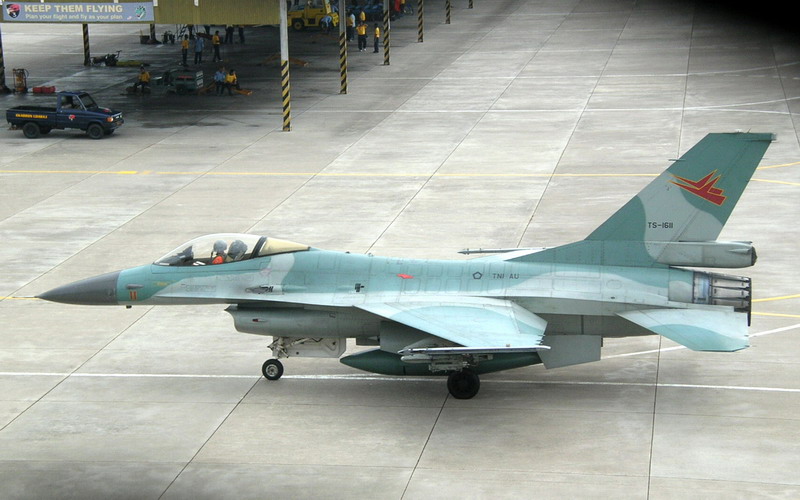
Indonesia grounds F-16 fleet after fire

Indonesia has temporarily grounded its fleet of F-16C and F-16D combat aircraft pending investigations into a fire that claimed one airframe on 16 April.
The aircraft grounded are all used stock received from the US under a Foreign Military Sale (FMS) arrangement for 24 airframes.
Under the deal, Indonesia is to receive 19 F-16Cs and five F-16Ds. The service has taken delivery of five airframes, with the first three delivered in July 2014.
janes

Apr 8, 2015

Indonesia Considering Buying Japan’s US-2 Amphibious Aircraft

Indonesian Defense Minister said Monday his government is considering the possibility of buying the US-2 amphibious aircraft from Japan.
The Indonesian defense minister said the US-2 is well suited for the geographical conditions of Indonesia, a country of thousands of islands.
Noting that both Japan and Indonesia are archipelagic countries that frequently have to contend with natural disasters like earthquakes.
Indonesia is seeking to strengthen its maritime forces, sea patrol functions and search and rescue operations in surrounding waters.
The US-2 can land on and take off from the sea. The aircraft is already in use by the Self-Defense Forces.
In March, Japan and Indonesia signed a defense agreement that stipulates cooperation in several sectors, including maritime cooperation and disaster management.
The US-2 is expected to be on the agenda when the two countries launch “two-plus-two” security talks between their defense and foreign ministers, according to diplomatic sources.
India is also considering purchasing the US-2.
Meanwhile, Indonesia is also assessing the possibility of purchasing the Be-200 multipurpose amphibious aircraft from Russia.
defense-studies

Mar 27, 2015

France Ready to Give Indonesia Technology Transfer on Rafale Deal

France asserted on Wednesday that it was willing to provide an industrial cooperation with Indonesia should the Dassault Rafale jet fighter be selected to modernize the Indonesian Air Force.
French Ambassador to Indonesia said that France was open to all cooperation possibilities involving French aircraft maker Dassault Aviation and state-owned aircraft maker PT Dirgantara Indonesia (PT DI).
Two Rafale jet fighters, a Rafale B double-seater and a Rafale C single-seater, arrived in Indonesia on Monday from the just-concluded 2015 Langkawi International Maritime and Aerospace (LIMA) exhibition in Malaysia.
On Tuesday, the jet fighters performed three flights for Indonesian Air Force pilots who flew on the Rafale B, taking the back seat.
The Rafale is a latecomer in the competition to replace the F-5 E/F operated by the Indonesian Air Force.
The French jet fighter is facing tough competition with contenders including Su-35, F-16 Block 60, JAS-39 Gripen and the Eurofighter Typhoon.
The Indonesian Air Force has repeatedly said it prefers the Su-35, although the final decision will be made by the Defense Ministry.
defense-studies

Mar 25, 2015

France promotes Rafale to replace Indonesia's F-5E

France is promoting its Rafale fighter jet to the Indonesian Air Force (TNI-AU) in a bid to meet the service's requirement to replace its fleet of F-5E aircraft.
The TNI-AU said in a statement that two Rafales - one single-seat and one twin-seat aircraft - landed at the Halim Perdanakusuma Air Force Base in east Jakarta on 23 March to provide two days of "presentations and demonstrations" about the characteristics of the aircraft to the TNI-AU and Indonesian government officials.
janes

Mar 23, 2015

Lockheed close to sign deal with Singapore for F-16 fleet modernisation

Lockheed Martin is reportedly close to signing a contract with Singapore for upgrade of its F-16 Fighting Falcon aircraft fleet.
The F-16V upgrade package features an active electronically scanned array radar, upgraded mission computer, as well as enhancements to the mission computer, vehicle systems, aircraft structure, cockpit, and electronic warfare system.
Lockheed is already competing to modernise South Korea's F-16s, after the country cancelled an upgrade agreement with BAE Systems in late 2014.
The Republic of Singapore Air Force operates 60 F-16C/D block 52 aircraft, which were upgraded with Israeli-built electronic warfare systems.
According to the publication, the presence of Israeli systems raised a doubt whether the company would be able to upgrade the RSAF F-16s as that would require modifications to the systems.
Apart from Singapore and South Korea, the company is also believed to be working to modernise the F-16 fleets of Thailand and Indonesia.
airforce-technology

Mar 15, 2015

Indonesia deploys 4 Su-27s to Papua

Some four Indonesia Sukhoi Su-27 aircraft from Makassar Air base have been deployed on the "Tangkis Petir" (Thunder Repellent) training operation in the fourth sector of the National Air Defense area in Biak Numfor district, Papua.
The training operation began on March 12, 2015, will conclude on March 31, 2015.
antaranews

Feb 12, 2015

Indonesia, Spain agree to extend C295 co-operation

Indonesia and Spain have agreed to extend an agreement between PT Dirgantara Indonesia (PTDI) and Airbus Defence and Space featuring PTDI's licensed production Airbus C295 tactical transport aircraft for the Indonesian Air Force (TNI-AU).
An accord to facilitate such an arrangement, however, has not yet been signed and will depend on Indonesia ordering additional C295 aircraft. The TNI-AU is understood to have a requirement for a further seven units, taking its C295 inventory to 16 aircraft.
janes

Feb 6, 2015

All 21 F-16C/D for Indonesia will be Delivered in 2015

With the F-35 JSF pending arrival, there soon won’t be much use for the F-16 at Hill AFB, but that doesn’t mean other countries don’t want them.
The U.S. Air Force just signed a contract with Sumaria Systems Inc., to support foreign sales of some of their F-16s.
Under the five-year contract, which is expected to be complete by March 31, 2020, Sumaria will provide technical services, conducting studies and analyses and evaluation for the fighter aircraft.
The F-16s will be sold under the Foreign Military Sales program.
Hill has been involved in the foreign sales of F-16s before. In July, the base’s Ogden Air Logistics Center delivered three of what will eventually be 24 F-16 Fighting Falcon aircraft to the government of Indonesia.
The delivery constituted the beginning of a nearly $700 million aircraft acquisition and refurbishment deal between Indonesia and the U.S. where Hill maintenance workers are upgrading the avionics and overhauling the wings, landing gear and other components on each aircraft.
By the end of 2015, the Ogden ALC is scheduled to deliver 21 more F-16s to the Indonesian government.
Although the F-35 arrives at Hill to replace the F-16 in September 2015, the two fighter jets will live under the same roof for a short time.
defense-studies

Jan 9, 2015

Indonesia Planes to Acquire Aerial Tankers

The Indonesian Air Force plans to conduct modernization programs for its aircraft and systems as well as procuring new assets in the 2015-2019 period.
In 2015, the Air Force will conduct the Falcon Star program to extend the structural life and mid-life upgrade (MLU) program to modernize the avionics of F-16 A/B Block 15 jet fighters.
Bagus said there were also plans for the acquisition of cameras and surveillance radars for Boeing 737-2X9 Surveiller maritime patrol aircraft (MPA).
In the medium term, the Air Force is applying for the acquisition of aircraft for multirole tanker transport (MRTT), airborne warning and control (AW&C) and strategic maritime surveillance missions.
The procurement program also includes the purchase of new AIM-9 Sidewinder short-range air-to-air missiles and other modern weapons systems.
thejakartapost