Translate

Showing posts with label SU-24. Show all posts

Nov 27, 2015

Russia to deploy S-400 defense missile system to Khmeimim airbase in Syria

The Russian Air Force base in Latakia will be reinforced with S-400 SAM system, which will soon be deployed there, Russia's Defense Minister Sergey Shoigu said on Wednesday.
Earlier on Tuesday, the Russian Su-24 was shot down by a Turkish F-16 fighter jet near the Turkish-Syrian border. One pilot died in the incident. The second one was rescued and brought to the Russian airbase in Latakia.
Moscow maintains the jet did not violate Turkey's airspace. It ditched on Syria's territory four kilometers from the border.
Shortly afterwards, the MoD announced three steps to be taken following the attack on the Russian Su-24 bomber, including providing aerial cover by fighter jets for every airstrike, boosting air defense by deploying guided missile cruisers off the Latakia coast, and suspending all military-to-military contacts with Turkey.
rt.com

Jun 13, 2015

Russian Fighter Jets Fly over US Ships During NATO Baltic Exercise

Russian ships and fighter jets made their presence known during the opening days of a 17-nation strong NATO exercise in the Baltic Sea by shadowing alliance ship movements and buzzing aircraft over ship formations.
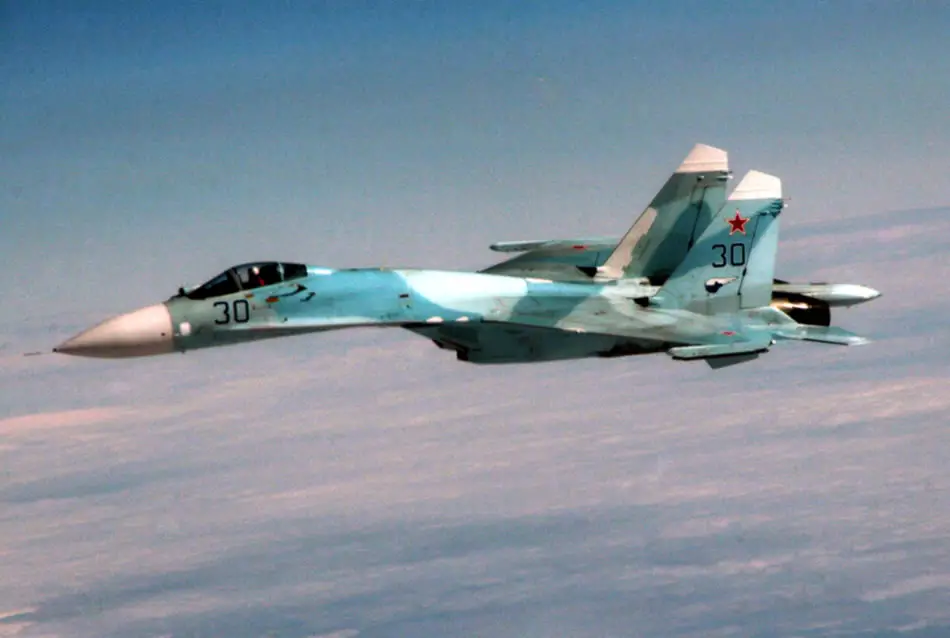
"During our formations shortly after we left port, we had some company from Russian ships shadowing us, and about mid-afternoon we were overflown by two Russian jets. They looked like Su-24s," U.S. 6th Fleet commander, Vice Adm. James Foggo, told reporters June 8. "They made a few passes and then a couple of Russian Corvettes came up on either side of the formation as we were conducting our exercises -- nothing untoward, just showing interest and showing that they know we are here."
The BALTOPS exercise, slated to take place through June 20, is an annually recurring multi-national NATO exercise designed to show the alliance is prepared and ready to defend the Baltic region.
Overall, BALTOPs includes 49 ships, 61 aircraft and one submarine, U.S. Navy officials said.
Exercises are taking place in Poland, Sweden and Germany as well as various parts of the Baltic Sea.
The Su-24 Russian fighter jet flyover comes on the heels of a recent incident in the Black Sea involving a Navy destroyer, the USS Ross.
military

May 25, 2015

Sukhoi delivers new batch of Su-34 bombers to Russian MoD

Russian aircraft maker Sukhoi has handed over the first batch of Su-34 frontline fighter bombers to the country's Defence Ministry under the 2015 State Defence Order.
Last year Sukhoi successfully completed the 2014 State Defence Order and delivered two combat aircraft above the initial yearly plan.
The Su-34s are replacing the Su-24 frontline bombers which are presently in service with the Russian Air Force.
The Russian Defence Ministry has placed an order for over 100 Su-34s to be delivered to the Air Force by 2020.
The multi-role Su-34 fighter bomber is designed to attack land-based, sea- and airborne targets by day and night in all weather conditions.
brahmand

Apr 24, 2015

Argentina And Russia Could Be in Potential Deal With SU-24

The Argentinian President is in Moscow to sign a series of strategic partnership deals with Russia's President Vladimir Putin.
While focussing on trade, energy projects and communication - agreements on military cooperation will also be signed.
Among them could potentially be a deal for Moscow to supply the Argentinians with 12 Sukhoi SU-24 attack aircraft.
forces

Apr 4, 2015

Operation Decisive Storm-Air Power Over Yemen

After Houthi rebels toppled the Yemeni government causing president Abd Rabbuh Mansur Hadi to flee to Aden earlier this month, a Saudi-led coalition of Middle Eastern states launched an air campaign to intervene.
Operation Decisive Storm began on March 26 and has resulted in one of the most extraordinary gatherings of air power seen in recent years, with air arms from the Gulf Cooperation Council nations, except Oman, joined by aircraft from Morocco, Egypt and Sudan, as well as Jordan.
The numbers of aircraft involved are quite extraordinary but perhaps illustrate the concern that Saudi Arabia and its neighbors have for the spread of the Houthi insurgency in the south of the Arabia peninsula.
Saudi Arabia is supporting the operation with 100 aircraft that are likely to include fighters and support aircraft.
Bahrain has deployed between eight and 12 of its F-16s, Qatar has sent 10 of its 12 Mirage 2000s. The United Arab Emirates has deployed 30 aircraft, while Morocco and Jordan have each deployed six F-16s. Jordan’s participation is particularly noteworthy given its heavy involvement in operations against the Islamic State insurgency in Iraq and Syria. Reports state that Kuwait has sent 15 F/A-18 Hornets.
Egypt’s aerial contribution is unclear, but its neighbor Sudan is perhaps the most surprising of the participants, bringing a trio of Sukhoi Su-24 Fencers.
How big a role the Su-24s will play remains to be determined, particularly as the aircraft are not compatible with Western weapons stockpiled at Saudi air bases, forcing the Sudanese to transport bombs and missiles to Saudi Arabia where the aircraft have been forward-based for the campaign.
Pakistan says it is examining a request from Riyadh to join the coalition.
aviationweek

Mar 5, 2015

Russia's SU-30 and SU-24 Performed Mock Up Attacks on NATO Vessels in Black Sea

Russia's Su-30 fighter jets and Su-24 attack bombers are using two NATO ships in the Black Sea to practice penetrating anti-air systems.
The jets are monitoring the movements on the two ships, the USS Vicksburg missile cruiser and the Turkish TCG Turgutreis frigate, which are located in the southwestern part of the Black Sea. On Tuesday, three Su-30 jets and four Su-24 bombers conducted monitoring flights over these ships from the Novofedorovka air base.
Russia's Black Sea Fleet began receiving Su-30 jets in 2014, following Crimea's reunification with Russia. The USS Vicksburg is the flagman of the Standing NATO Maritime Group 2.
sputniknews

Jan 12, 2015

UK Bolsters Falkland Defenses to Counter Argentine Air Ambitions

British military capability planners are eyeing a major improvement to ground-based air defenses in the Falkland Islands amid continuing signs that Argentina is looking to update its Air Force with modern strike aircraft.
Argentina and the UK fought a short but bloody war over the British territory in 1982. The dispute received new life recently by Argentinean President Cristina Kirchener's launching a diplomatic war of words in an effort to eject the British.
Now it has emerged that the British have been planning to replace the aging ground-based system on the Falklands with a package including a battle management command, control, communications, computers and intelligence (BMC4I) system, a new missile and a radar.
As recently as December, unconfirmed reports emerged that Buenos Aires was in talks with the Russians over the possible lease of a squadron's worth of Sukhoi Su-24 Fencer attack jets in a move that would threaten Britain's control of the skies locally.
The reports drew a response from the UK Defence Ministry that it would adjust defense capabilities to the appropriate level to address any threats to the disputed islands, which the Argentinians refer to as the Islas Malvinas.
Britain has maintained forces on the island since the war. The force includes four Typhoon jets, Rapier missiles, naval assets and around 1,200 troops.
Last year, the British spent £63 million (US $95 million) for defense of the Falklands.
It is not possible to say when the Falklands system would enter service, as the project, which is fully funded, is in only its assessment phase.
The British effort to bolster its air defense capabilities on the South Atlantic islands comes as Argentina continues efforts to find a way of updating an Air Force that is pretty much flying the same aircraft as it did when it attacked the Falklands.
The financially hard-pressed Argentineans have made several attempts to buy second-hand combat jets, such as the Mirage 2000, without success.
Recently, Buenos Aires signaled interest in acquiring Saab Gripen NG fighters from a production line being set up in Brazil.
That came to nothing after the UK government warned they would block any sale by refusing to approve the export of the substantial amount of British technology used in the fighter.
Although media reports that the Argentineans are looking at the Su-24 have been denied by Buenos Aires, analysts in the UK said an eventual purchase of a credible combat jet could alter the balance of power in the South Atlantic.
defensenews

Jan 9, 2015

Ukraine returns refurbished combat aircraft to service

Ukraine has returned to service four combat aircraft that have recently undergone refurbishment work.
Two MiG-29 and two Sukhoi Su-27 fighters were handed back to the Ukrainian Air Force.
In addition to the aircraft, about 150 ground vehicles and other weapons systems were handed over to the military.
Since hostilities with Russia began in early 2014, Ukraine has returned scores of aircraft to service that would otherwise have become unairworthy due to a lack of investment in the country's armed forces. These have included MiG-29s and Su-27s, as well as Sukhoi Su-24 and Su-25 strike aircraft, and Antonov An-26 transport aircraft.
Having suffered from chronic underinvestment for years, the Ukrainian Air Force was placed at an instant disadvantage when Russian forces entered Crimea in early 2014. The air force's inability to respond with the assets that it did have was compounded when a number of its bases were overrun and its aircraft seized.
It is thought that 45 aircraft, including MiG-29 fighter and Aero L-39 trainer/light strike aircraft, were lost this way when the 204th Tactical Aviation Brigade at Belbek was overrun by Russian Spetsnaz troops on 21 March.
Further to this, when the Ukrainian Air Force did get involved in hostilities in a meaningful way in the east of the country, it found that this endemic underinvestment manifested itself in outdated and poorly maintained combat aircraft, as well as poorly trained pilots. Combined with a lack of combat experience and poor use of intelligence, this meant that the air force has suffered a high loss rate that continues through to today. At least 20 fighters, transports, and helicopters have been shot down in the past year.
While Ukraine's aircraft inventory remain impressive on paper, the country desperately needs to continue its refurbishment effort if it is to have at its disposal the numbers of serviceable and capable aircraft it requires to combat separatist factions.
janes

Dec 29, 2014

Russia Plans To Offer Argentina Long-Range SU-24 Fighter Bombers, Falklands Defence Under Review After Military Deal between Russia and Argentina

The Argentinian
fighter jet deal involves a lease/lend of 12 Sukhoi Su-24 supersonic, all-weather attack aircraft. They are old but NATO still regards the code-named “Fencer” as a “super-fighter” with an impressive 2,000-mile range and ability to deploy laser-guided missiles.
The aircraft, which Moscow will swap for beef and wheat, would be able to mount air patrols over Port Stanley.
UK Ministry of Defence officials fear Buenos Aires would take delivery of the planes well before the deployment in 2020 of the Navy’s 65,000-tonne aircraft carrier HMS Queen Elizabeth and its F-35B fighters, leaving a “real window of vulnerability”.
Defence cuts have left the Falklands with just four RAF Typhoon fighters, Rapier surface-to-air missiles and fewer than 1,200 troops, supported by a naval warship that visits throughout the year.
The deal involves a lease/lend of 12 Sukhoi Su-24 supersonic, all-weather attack aircraft.
Russia has been increasing its links with Argentina since 2010, when it provided two Mi17.
Buenos Aires needs to replace its decrepit fighter fleet but its attempts over the past two years have failed so far.
In October, Argentina Defence Minister announced the purchase of 24 Saab Gripen fighters, which were to be provided by Brazil, which has just purchased 36, but United Kingdom squashed the deal as some of the jet’s parts are made in the UK Tensions over the islands resurfaced after exploratory seabed drilling revealed the promise of an oil bonanza.
express.co

Nov 19, 2014

Sweden Gripen scrambled after French aircraft entered Swedish airspace

Following unconfirmed reports that a Russian plane entered Swedish airspace on Saturday, the Swedish military has told the aircraft actually came from French Air Force.
"We can confirm that it was a French aircraft and now we have to investigate the details of this".
His comments followed earlier allegations in Sweden's Expressen newspaper that a Russian plane was "a couple of kilometres on the wrong side of the border" but "quickly turned eastward" when a Swedish Jas Gripen plane approached.
Officials in France have yet to comment on the Swedish military's confirmation of a French plane in Swedish airspace.
The claims about a possible Russian violation emerged just a day after Russia's President Vladimir Putin went on German television and insisted that his country had not violated international airspace.
Last month, Swedish intelligence officials released a picture of a Russian jet flying closely beside a Swedish intelligence plane, in what they described as "a growing trend" in international airspace.
The news followed revelations in September that two Russian Su-24 fighter-bombers had been detected flying over Swedish airspace to the south of Öland. The planes were one kilometre inside Swedish territory for about 30 seconds.
Carl Bildt - who was Sweden's foreign minister at the time - described the flights as "the most serious aerial incursion by the Russians during my years as foreign minister".
thelocal.fr

Sep 21, 2014

Two Russian attack planes intentionally violated the Swedish airspace to probe local air defense

On Sept. 17, two Russian Su-24 Fencer combat planes intentionally violated Sweden’s airspace the Expressen newspaper reported.
According to the Swedish media outlet the incursion saw the two aircraft skirt the Polish airspace before heading north, at low altitude, towards the island Öland, in the Baltic Sea. At around 12:00 PM LT, the Russian planes entered the airspace over the Swedish territorial waters south of Öland.
Swedish Defense officials confirmed some Jas-39 Gripen fighters were scrambled from Ronneby airbase, in southern Sweden, to intercept the Russian planes but they did not reach the intruders as the Su-24s, after flying a couple of kilometers on the wrong side of the border, turned again eastbound, most probably towards Kaliningrad.
Even though the Swedish Armed Forces have not officially commented the incident, sources who talked to the Expressen said authorities believe the violation was aimed at probing the Swedish air defense readiness.
Last year Russian Tu-22 bombers conducted some mock attacks on Sweden; more recently an airliner almost collided with a Russian spyplane off Sweden. The increased Russian activity in the area and the crisis with Moscow caused by the situation in Ukraine, pushed Stockholm to move some Gripen jets to Gotlad island, off the eastern coast of Sweden, in the Baltic Sea.
theaviationist

Sep 12, 2014

Canadian Frigate in Black Sea Buzzed By Russian Planes

The Canadian Navy frigate HMCS Toronto was overflown by three Russian planes on Sunday.
The Russian military aircraft circled the HMCS Toronto.
Russian officials quickly questioned the Canadian account.
Russian defense official told ITAR-TASS that a Sukhoi Su-24 Fencer and an Antonov AN-26 transport plane were in the area but did not engage Toronto.
usni

Jun 5, 2014

Russian SU-27 Flew Within 100 Feet of USAF RC-135 in North of Japan

At the height of recent tensions between the US and Russia in April, an armed Russian fighter jet flew within 100 feet of a US Air Force RC-135U and taunted the intelligence-gathering aircraft with an aggressive maneuver over international waters north of Japan.
The April 23 incident involved a Russian SU-27 Flanker over the Sea of Okhotsk along Russia’s east.
The RC-135U is an aircraft retrofitted as a long-range intelligence, surveillance and reconnaissance aircraft.
The Russian fighter “crossed the nose” within 100 feet of the US aircraft and “turned a little bit to expose its belly” to the American pilots and show that it was armed with air-to-air missiles, officials said.
The pilots had no radio communication.
The incident prompted senior US military leaders to contact Russia and express concern.
It was at least the second provocative move by the Russian military in April.
On April 12, a Russian fighter jet made repeated, “provocative,” close-range, low-altitude passes above the US Navy destroyer Donald Cook while it was steaming in the Black Sea. In that incident, the Russian SU-24 Fencer did not appear to be carrying weapons.
defensenews

May 14, 2014

Last U.S. Surface Ship Leaves the Black Sea

The frigate assigned to operations in the Black Sea as part of a U.S. show of support to allies in the region has left, leaving no U.S. surface ships in the region.
USS Taylor (FFG-50) had been in the Black Sea off and on since Feb. 5 overlapping with the guided missile destroyer USS Donald Cook (DDG-75) and the command ship USS Mount Whitney (LCC-20).
Taylor and Mount Whitney were originally in the region to provide support for the 2014 Winter Olympic Games.
Taylor remained in the Black Sea after running aground while attempting to moor in Turkey and then stayed as a show of support to regional U.S. allies after the Russian seizure of Crimea.
The U.S. also sent guided missile destroyer Donald Cook — based at Naval Station Rota, Spain — to the Black Sea on April 10 as show of U.S. military muscle. The French also sent ship signals intelligence ship Dupuy de Lôme (A759) the same day.
The destroyer was buzzed by a Russian Sukhoi SU-24 Fencer on April 12 — two days after entering the region. Donald Cook left the Black sea on April 24.
It’s unclear what NATO naval presence remains in the region.
The Russians have complained the U.S. had violated the so-called 1936 Montreux Convention Regarding the Regime of the Straits.
Montreux rules call for warships from countries with out a coast on the Black Sea to depart after 21 days.
usni

Apr 17, 2014

Provocative Russian military action against U.S. Navy ship

A Russian fighter jet on Saturday made repeated provocative close-range, low-altitude passes above the U.S. Navy destroyer Donald Cook while it was steaming in the Black Sea, heightening Cold War-style tensions.
The Russian SU-24 Fencer made a total of 12 passes above the destroyer that is equipped with the powerful Aegis missile defense system. The incident occurred in international waters about 48 hours after the Navy ship arrived in the Black Sea.
The aircraft did not respond to multiple queries from the Donald Cook’s bridge. The Navy destroyer did not respond and the incident ended after about 90 minutes. The fighter jet did not appear to be carrying missiles under its wings.
This provocative and unprecedented Russian action is inconsistent with international protocols and previous agreements on the professional interaction.
The Donald Cook was never in any danger and is more than capable of defending itself against an SU-24.
The provocative acts come about a month after Russia launched a ground invasion of Ukraine’s Crimea region and the Russian military amassed an estimated 40,000 troops along Ukraine’s eastern border. Russia maintains a large naval base in Crimea.
The Donald Cook was dispatched to the Black Sea last week in an effort to reassure NATO allies, which includes Romania, of U.S. support in the face of Russian aggression.
The ship has now pulled into port in Constanta, Romania, near the Mihail Kogalniceanu Air Base, which is a permanent post for several thousand U.S. troops, including airmen and Marines.
militarytimes

Feb 14, 2014

Angola getting 12, not 18 Su-30 fighters

The Angolan Air Force will receive 12 ex-Indian Su-30 fighter jets from Rosoboronexport and not 18 as was previously reported, with deliveries scheduled to take place from next year.
In October last year it was reported that Angola had purchased 18 former Indian Air Force Su-30Ks. The Su-30s Angola will reportedly receive were offered to a number of other countries, including Belarus, Ethiopia, Vietnam and Sudan. Early last year, Russia was in discussions with Ethiopia to procure the aircraft, as Ethiopia already operates the Su-27, but this seems to have fallen through.
The Indian Air Force has ordered more than 200 Su-30MKIs in a number of batches. The early models delivered were basic aircraft without features like canards and thrust vector controls, and it is these 18 early model aircraft (ten Su-30MK and eight Su-30K fighters delivered between May 1997 and December 1999) that were returned to Russia and replaced with more advanced Su-30MKIs.
India had intended to upgrade these early aircraft but instead used them as part-exchange for new aircraft. They were retired in 2006 and sent to Repair Plant in Belarus in 2011. They remain still there.
The remaining six of the 18 ex-Indian Flankers will be sold to another country with a firm contract for them to be signed soon.
The Angolan Air Force currently flies around half a dozen Su-27s, out of 18 originally delivered. It also has other Sukhoi aircraft in its inventory, the Su-22 and Su-24.
defenceweb

Oct 9, 2013

Syrian Air Force Su-22 leaking fuel after being hit by rebel fire


This video, shot on Oct. 7, allegedly shows a Syrian Arab Air Force Su-22 Fitter hit by rebel fire in the province of Daraa.
Syrian combat planes and helicopters have been particularly active in the last days: on Oct. 5, Su-24 Fencer attack planes and Mi-17 Hip choppers flew towards the border with Turkey and turned back a few miles before violating Ankara’s airspace.
theaviationist

Sep 19, 2013

Latvia Sounds Alarm Over Russian Warplane Flights

Latvia’s defense minister on Wednesday slammed frequent flights by Russian warplanes near the country’s airspace.
Flights by Russian Air Force aircraft are not only a show of force but also part of a military training program, Latvian Defense Minister Artis Pabriks said in an interview broadcast on Latvian TV Wednesday.
“We cannot treat this lightly,” he said. “Obviously, they are not flying there just for the fun of it – because they have nothing better to do.”
On Monday NATO fighters that police Baltic airspace identified eight Russian warplanes flying close to the border of Latvia’s territorial waters, one Il-70 transport aircraft, two Su-24 fighter jets and five Su-34 fighters, the Latvian National Armed Forces press service said.
Last Friday, NATO jets spotted a Russian Il-20 aircraft near the Latvian border.
Despite the widespread media coverage of these concerns there has been no official response from the Russian Defense Ministry.
Since March 2004, when the Baltic States joined NATO, a round-the-clock mission to police Baltic airspace has been conducted on a three to four-month rotation basis from Lithuania's First Air Base in Zokniai, near the northern city of Šiauliai. Deployments usually comprise four fighter planes and between 50 and 100 support personnel.
rian

Sep 8, 2013

Assad launched two Syrian Air Force Su-24 attack planes towards Cyprus to probe British airbase’s air defenses

Last week it was reported that RAF deployed Typhoons to Cyprus, were scrambled from the British base at Akrotiri whereas two Turkish Air Force took off from Incirlik airbase and headed towards the island.
In the following days, more details about the Cyprus incident emerged.
British MoD confirmed yesterday that Typhoon Air Defence Aircraft were launched from RAF Akrotiri to investigate unidentified aircraft over the Eastern Mediterranean; flying legally in international airspace and no intercept was required.
On Sept. 8, The Sunday People / Sunday Mirror revealed that Syrian Su-24 Fencers were actually involved.
“RAF Typhoon fighters won a mid-air showdown with two Syrian warplanes heading towards Britain’s main base in Cyprus, the Sunday People can ­reveal. The dramatic confrontation came after President Bashar al-Assad’s air chiefs sent two Russian-made Sukhoi Su-24s to probe our air defences. The Syrian bombers refused to respond to repeated attempts by the control tower at the UK’s Akrotiri air base to contact them.”
RAF Typhoons from the IX Sqn in QRA (Quick Reaction Alert) duty on the island, were scrambled before the Su-24s, that were flying in international airspace and were spotted by a flying E-3D AWACS could enter the 14-mile air exclusion zone. Otherwise, they would have been intercepted and identificated, and eventually escorted out of the restricted airspace.
Buzzing the enemy airspace to test its reaction time or actively disturbing the enemy training activities is not rare.
For instance, the Turkish RF-4E Phantom shot down by Syria in 2012 was probably violating the Syrian airspace to probe Damascus’s air defense readiness.
theaviationist

Sep 2, 2013

Sudan Adds Precision Bomber Su-24s to Arsenal

DigitalGlobe imagery indicates that Sudan has acquired at least three Su- 24 (“Fencer”) supersonic precision bomber aircraft in recent months. The operational range of the Fencer is a little more than 600 kilometers, which would allow targeted air strikes from their current position in Wadi Seidna military air base into parts of Darfur, South Kordofan and Blue Nile states.
satsentinel