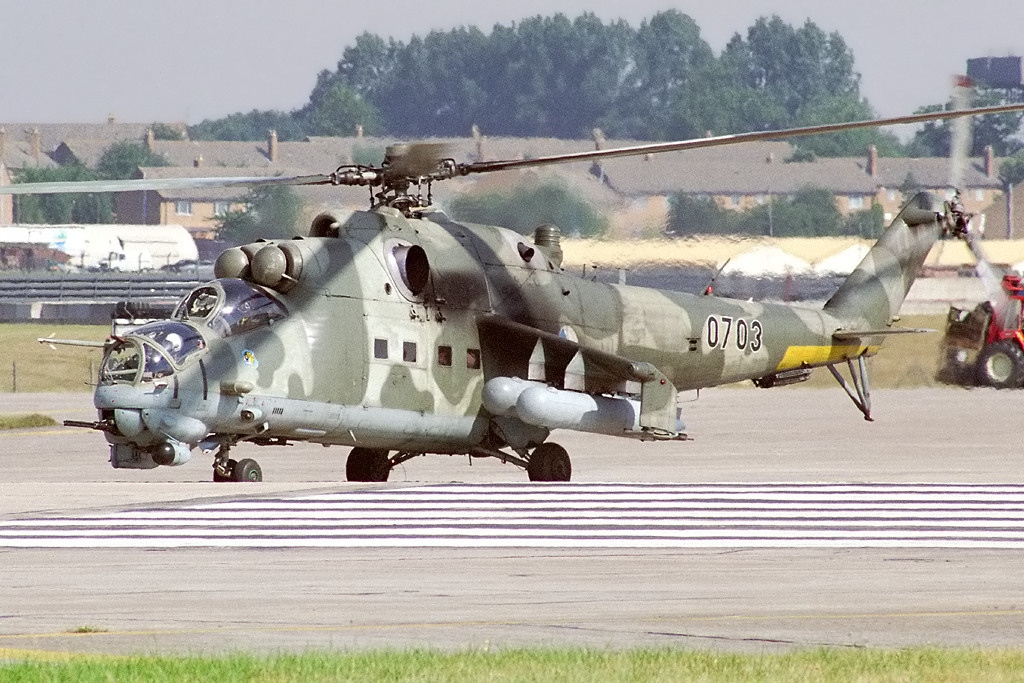
The US Department of State has given its approval to potential deals that could equip the Czech Republic with Bell UH-1Y/AH-1Z or Sikorsky UH-60M Black Hawk helicopters.
Detailed by the US Defense Security Cooperation Agency (DSCA) on 3 May, a possible Foreign Military Sales purchase by Prague could involve either an initial four AH-1Zs or 12 UH-60Ms.
Armaments proposed for the AH-1Z include the Lockheed Martin AGM-114 Hellfire air-to-surface missile and a nose-mounted 20mm cannon, while the UH-60M would feature BAE Systems Advanced Precision Kill Weapon System guided rockets and machine guns.
Prague had previously expressed an interest in acquiring up to 12 UH-1Ys. Bell completed production of the type for the US Marine Corps last year, with no export orders yet secured for the type.
flightglobal
Translate
Showing posts with label MI-24. Show all posts
May 7, 2019
Jan 17, 2015
Croatia to sell surplus military Mi-24Vs, An-32Bs and PC-9s
Croatia is looking to sell a wide range of its surplus Croatian Air Force aircraft.
The country hopes to sell seven Mil Mi-24V 'Hind' attack helicopters, two Antonov An-32B 'Curl' tactical transport aircraft, and six Pilatus PC-9 turboprop trainer aircraft).
The country has set a deadline of 28 January for interested parties to submit a letter of intent.
The principal reasoning behind the sale of the aircraft is financial, caused by the declining state of the Croatian economy and its defence budget, although other reasons are also at play.
Croatia's Mi-24Vs were in limited use after the conflicts of the 1990s, and were withdrawn from service over a decade ago. Their sale has previously been contemplated on multiple occasions, but at least once a prospective sale is understood to have been squashed by active opposition from Moscow.
The two An-32Bs were recently used in Croatian Air Force service, including in both Iraq and Afghanistan, but with the aircraft due to undergo a period of deep maintenance Croatia now seeks to sell them. No official thought was given to their conversion for a naval surveillance role, although such aircraft are sorely missed in Croatia.
The sale of the PC-9s is driven partially by the imbalance between the number of training aircraft Croatia has for its pilots and its meagre number of available supersonic fighter aircraft. However, with Croatia's MiG-21 upgrade programme finally reaching completion, and with demand for foreign pilot training growing, the sale of the PC-9s may be reconsidered in the near future.
janes
The country hopes to sell seven Mil Mi-24V 'Hind' attack helicopters, two Antonov An-32B 'Curl' tactical transport aircraft, and six Pilatus PC-9 turboprop trainer aircraft).
The country has set a deadline of 28 January for interested parties to submit a letter of intent.
The principal reasoning behind the sale of the aircraft is financial, caused by the declining state of the Croatian economy and its defence budget, although other reasons are also at play.
Croatia's Mi-24Vs were in limited use after the conflicts of the 1990s, and were withdrawn from service over a decade ago. Their sale has previously been contemplated on multiple occasions, but at least once a prospective sale is understood to have been squashed by active opposition from Moscow.
The two An-32Bs were recently used in Croatian Air Force service, including in both Iraq and Afghanistan, but with the aircraft due to undergo a period of deep maintenance Croatia now seeks to sell them. No official thought was given to their conversion for a naval surveillance role, although such aircraft are sorely missed in Croatia.
The sale of the PC-9s is driven partially by the imbalance between the number of training aircraft Croatia has for its pilots and its meagre number of available supersonic fighter aircraft. However, with Croatia's MiG-21 upgrade programme finally reaching completion, and with demand for foreign pilot training growing, the sale of the PC-9s may be reconsidered in the near future.
janes
Aug 11, 2014
Poland Retains Su-22s, Wants New Attack Helicopters
Faced with a worsening security situation in neighboring Ukraine, Poland has issued a requirement for new attack helicopters. Meanwhile, the country’s choice of 72 new multirole helicopters remains undecided. Budget shortfalls continue to frustrate the armed forces’ desire for new equipment. Earlier this year, Poland decided to retain one squadron of aging Su-22 strike aircraft for up to 10 more years, since it cannot afford a replacement.
Poland currently operates 28 Mil Mi-24 attack helicopters, the remnants of 52 acquired since 1978. The new proposal is to buy about 32 replacements in two stages, with an initial 20 to be followed by 12 more beginning in 2022. Candidates include the AgustaWestland AW129 or its Turkish sibling, the TAI T-129; the Airbus Helicopters EC665 Tiger; and the Boeing AH-64E Apache. Offers are scheduled to be considered next year.
Meanwhile, the multirole helicopter contract award has been postponed until next year, two years later than originally envisioned. The AgustaWestland AW149, Airbus Helicopters EC725 Caracal and Sikorsky S-70i Black Hawk are in contention, each OEM having partnered with a local company for production and support (PZL-Swidnik, Heli-Invest and Mielec, respectively). The army is slated to receive 48 helicopters for troop transport, with the air force receiving 10 for SAR, and the navy receiving another six for SAR plus six for the ASW role. They will replace about 16 Mi-8s, 10 Mi-14s and 20 Mi-17s that remain in service from much larger numbers acquired previously.
The decision to retain 12 single-seat and six two-seat Su-22Ms for another 10 years was taken last February and was driven by the choice of the Aermacchi M346 as the air force’s new jet trainer. The air force received 110 Su-22s beginning in 1984; 32 remain in service. They have received only minor avionics upgrades.
The Lockheed Martin F-16C/D Block 52 is Poland’s frontline fighter, with 48 delivered between 2006. Poland hopes to share the development cost of future upgrades, such as an AESA radar, with the U.S. Air Force. However, the U.S. F-16 upgrade program faces an uncertain future. The air force also operates two squadrons of MiG-29s.
ainonline
Poland currently operates 28 Mil Mi-24 attack helicopters, the remnants of 52 acquired since 1978. The new proposal is to buy about 32 replacements in two stages, with an initial 20 to be followed by 12 more beginning in 2022. Candidates include the AgustaWestland AW129 or its Turkish sibling, the TAI T-129; the Airbus Helicopters EC665 Tiger; and the Boeing AH-64E Apache. Offers are scheduled to be considered next year.
Meanwhile, the multirole helicopter contract award has been postponed until next year, two years later than originally envisioned. The AgustaWestland AW149, Airbus Helicopters EC725 Caracal and Sikorsky S-70i Black Hawk are in contention, each OEM having partnered with a local company for production and support (PZL-Swidnik, Heli-Invest and Mielec, respectively). The army is slated to receive 48 helicopters for troop transport, with the air force receiving 10 for SAR, and the navy receiving another six for SAR plus six for the ASW role. They will replace about 16 Mi-8s, 10 Mi-14s and 20 Mi-17s that remain in service from much larger numbers acquired previously.
The decision to retain 12 single-seat and six two-seat Su-22Ms for another 10 years was taken last February and was driven by the choice of the Aermacchi M346 as the air force’s new jet trainer. The air force received 110 Su-22s beginning in 1984; 32 remain in service. They have received only minor avionics upgrades.
The Lockheed Martin F-16C/D Block 52 is Poland’s frontline fighter, with 48 delivered between 2006. Poland hopes to share the development cost of future upgrades, such as an AESA radar, with the U.S. Air Force. However, the U.S. F-16 upgrade program faces an uncertain future. The air force also operates two squadrons of MiG-29s.
ainonline
Jul 27, 2014
Peru orders additional Mi-171Sh helos to combat Shining Path
Peru is to acquire a further eight Mil Mi-17 'Hip' transport and assault helicopters to complement the 24 ordered in late 2013.
The Mi-171Sh-variant helicopters are to be used for counterinsurgency (COIN) operations against the Shining Path insurgent group.
While both the Peruvian Air Force and Army field the Mi-171Sh (three helicopters each), this latest batch will reportedly be operated by the air force.
The first helicopters from this previous order will arrive in Peru in the second half of 2014, with the remainder following in 2015. No timeline was provided for the follow-on order of eight helicopters.
In July 2010 the Peruvian Ministry of Defence (MoD) announced that it was buying six Mi-171Sh and two Mi-35P 'Hind' attack helicopters to augment the seven Mi-24/25 'Hind' and eight Mi-17 helicopters that had been in service since 1983 and 1984 respectively.
Both Mi-35P 'Hind' attack helicopters were delivered in April 2011, with the Mi-171s arriving in two separate batches in May and September of the same year. While the Mi-171s have been shared equally between the air force and the army, both Mi-35s joined the air force.
janes
The Mi-171Sh-variant helicopters are to be used for counterinsurgency (COIN) operations against the Shining Path insurgent group.
While both the Peruvian Air Force and Army field the Mi-171Sh (three helicopters each), this latest batch will reportedly be operated by the air force.
The first helicopters from this previous order will arrive in Peru in the second half of 2014, with the remainder following in 2015. No timeline was provided for the follow-on order of eight helicopters.
In July 2010 the Peruvian Ministry of Defence (MoD) announced that it was buying six Mi-171Sh and two Mi-35P 'Hind' attack helicopters to augment the seven Mi-24/25 'Hind' and eight Mi-17 helicopters that had been in service since 1983 and 1984 respectively.
Both Mi-35P 'Hind' attack helicopters were delivered in April 2011, with the Mi-171s arriving in two separate batches in May and September of the same year. While the Mi-171s have been shared equally between the air force and the army, both Mi-35s joined the air force.
janes
Jul 17, 2014
Hungarian Air Force To Issue Helo Tender to replace MI-17
Hungary is planning to issue a tender for a fleet of new helicopters later this year for its air arm.
The country has a national requirement for a fleet of light and medium helicopters not only for the air force but also for use by paramilitary organizations for missions such as search and rescue.
The air force has a need to replace the current fleet of 10 Russian-built Mil Mi-17s and Mi-8s, which the air arm is struggling to maintain and get parts for. The shortfall was partially alleviated with the recent arrival of a trio of secondhand Mi-8s from Russia.
Back in December 2011, the U.S. offered to donate 32 former Marine Corps UH-1N Hueys for use by the Hungarian armed forces, but when officials studied the deal and the likely maintenance cost of the aircraft, they reported that the country would be better off buying new, modern helicopters instead.
Last year the air force also unexpectedly retired its fleet of Mi-24 attack helicopters, now in storage.
The air force is also looking at options to replace its pair of aging Antonov An-26 transport aircraft, but the helicopters will be the first fleet to be renewed.
The country also has great ambitions for its small fleet of Saab JAS 39 Gripens, which are leased from Sweden.
Hungary has 12 single-seat JAS 39s and a pair of twin-seat JAS 39Ds used for training that entered service in 2006. Currently the air force mainly uses the aircraft for quick-reaction alert, defending the airspace of Hungary but also Northern Slovenia. They also have a limited ground-attack role with the AGM-65 Maverick.
aviationweek
The country has a national requirement for a fleet of light and medium helicopters not only for the air force but also for use by paramilitary organizations for missions such as search and rescue.
The air force has a need to replace the current fleet of 10 Russian-built Mil Mi-17s and Mi-8s, which the air arm is struggling to maintain and get parts for. The shortfall was partially alleviated with the recent arrival of a trio of secondhand Mi-8s from Russia.
Back in December 2011, the U.S. offered to donate 32 former Marine Corps UH-1N Hueys for use by the Hungarian armed forces, but when officials studied the deal and the likely maintenance cost of the aircraft, they reported that the country would be better off buying new, modern helicopters instead.
Last year the air force also unexpectedly retired its fleet of Mi-24 attack helicopters, now in storage.
The air force is also looking at options to replace its pair of aging Antonov An-26 transport aircraft, but the helicopters will be the first fleet to be renewed.
The country also has great ambitions for its small fleet of Saab JAS 39 Gripens, which are leased from Sweden.
Hungary has 12 single-seat JAS 39s and a pair of twin-seat JAS 39Ds used for training that entered service in 2006. Currently the air force mainly uses the aircraft for quick-reaction alert, defending the airspace of Hungary but also Northern Slovenia. They also have a limited ground-attack role with the AGM-65 Maverick.
aviationweek
Jul 12, 2014
Poland starts 'Kruk' attack helicopter acquisition programme
Poland officially launched its 'Kruk' (Raven) attack helicopter acquisition programme on 8 July, which will eventually replace the country's ageing Mil Mi-24 'Hind' combat helicopters.
The purchase of 32 new attack helicopters comes under a PLN11.6 billion (USD3.8 billion) priority project that also includes the acquisition of 70 multi-role helicopters.
The main competitors in the tender are expected to be the AgustaWestland/Turkish Aerospace Industries T129; the Boeing AH-64E Apache 'Guardian'; and the Airbus Helicopters EC 665 Tiger.
The country announced in late May that it is planning to accelerate the acquisition of attack helicopters due to the crisis in Ukraine.
The new helicopters will replace Poland's 29 Soviet-made Mil Mi-24D 'Hind-D' and Mi-24W 'Hind-E' combat helicopters. Poland began operating four Mil Mi-24D 'Hind-D' helicopters in January 1979 and purchased 16 Mil Mi-24D helicopters in 1985.
A second batch of 16 Mil Mi-24W 'Hind-E' was acquired in 1986, followed a decade later by the purchase in 1996 of 18 ex-East German Mi-24D helicopters: 16 for operational service, and two to cannibalise for spares.
Under the original draft plans, of the first 20 Kruk helicopters delivered, 12 were scheduled for delivery to the Land Force's 1st Aviation Brigade (1 BLWL) and eight to the Air Force's 7th Special Operation Squadron (7 EDS).
janes
The purchase of 32 new attack helicopters comes under a PLN11.6 billion (USD3.8 billion) priority project that also includes the acquisition of 70 multi-role helicopters.
The main competitors in the tender are expected to be the AgustaWestland/Turkish Aerospace Industries T129; the Boeing AH-64E Apache 'Guardian'; and the Airbus Helicopters EC 665 Tiger.
The country announced in late May that it is planning to accelerate the acquisition of attack helicopters due to the crisis in Ukraine.
The new helicopters will replace Poland's 29 Soviet-made Mil Mi-24D 'Hind-D' and Mi-24W 'Hind-E' combat helicopters. Poland began operating four Mil Mi-24D 'Hind-D' helicopters in January 1979 and purchased 16 Mil Mi-24D helicopters in 1985.
A second batch of 16 Mil Mi-24W 'Hind-E' was acquired in 1986, followed a decade later by the purchase in 1996 of 18 ex-East German Mi-24D helicopters: 16 for operational service, and two to cannibalise for spares.
Under the original draft plans, of the first 20 Kruk helicopters delivered, 12 were scheduled for delivery to the Land Force's 1st Aviation Brigade (1 BLWL) and eight to the Air Force's 7th Special Operation Squadron (7 EDS).
janes
Jun 22, 2014
Iraq Eyes Czech Mi 24 helos To Combat ISIL Militants
The Czech Republic is in talks to sell Russian-built Mil Mi-24 helicopters to the Iraqi Defense Ministry.
Currently, the Czech Air Force operates 17 Mi-24 helos. Of these, seven aircraft could be sold to the Iraqi government, according to Czech ministry officials.
The minister said that, in addition to the helos, the Iraqi government has expressed interest in purchasing Aero L-159 light combat aircraft.
Should the deal go through, the helos will be modernized and Iraqi pilots will undergo training in the Czech Republic. The copters are to be used to bolster Iraqi efforts to combat Sunni insurgents in the country’s north, where militants of the Islamic State of Iraq and the Levant (ISIL) captured several cities this month.
The twin-engine aircraft is a combat helo with transport capabilities. It is enabled with a maximum speed of 310 kilometers per hour, has a load capacity of 2.4 tons, and a flight range of 750 kilometers, according to data from the Czech Defense Ministry. The aircraft is manufactured by the Moscow Mil helicopter plant.
defensenews
Currently, the Czech Air Force operates 17 Mi-24 helos. Of these, seven aircraft could be sold to the Iraqi government, according to Czech ministry officials.
The minister said that, in addition to the helos, the Iraqi government has expressed interest in purchasing Aero L-159 light combat aircraft.
Should the deal go through, the helos will be modernized and Iraqi pilots will undergo training in the Czech Republic. The copters are to be used to bolster Iraqi efforts to combat Sunni insurgents in the country’s north, where militants of the Islamic State of Iraq and the Levant (ISIL) captured several cities this month.
The twin-engine aircraft is a combat helo with transport capabilities. It is enabled with a maximum speed of 310 kilometers per hour, has a load capacity of 2.4 tons, and a flight range of 750 kilometers, according to data from the Czech Defense Ministry. The aircraft is manufactured by the Moscow Mil helicopter plant.
defensenews
Qatari C-17 alleged to have visited Libya
The Libyan Air Force posted a photograph of a military transport on its Facebook page on 15 January, alleging it was a Qatari aircraft that had landed at a base controlled by one of the country's militias.
Much of the Libyan Air Force, including the people who control the Facebook page, is loyal to Khalifa Haftar, a former Libyan Army officer who launched an offensive against Islamist militias in the east of the country in May without approval from the country's weak central authorities.
The aircraft in the photograph is a Boeing C-17 Globemaster III strategic transport aircraft with a Qatari flag on its tail. While the Qatar Emiri Air Force (QEAF) operates four C-17s that were delivered between 2009 and 2012, there is nothing to prove the photograph was taken in Libya.
Flight records obtained by the panel of experts that monitors the UN arms embargo on Libya show that Qatari C-17s visited Tripoli's Mitiga International Airport twice and Binina Airbase outside Benghazi once between 15 January and 16 April 2013.
The panel is attempting to investigate allegations that the aircraft picked up arms shipments in Libya that were flown to Turkey and supplied to Syrian insurgents. It noted in its 19 February report that, after the three Libyan flights returned to Qatar's Al-Ubeid Airbase, the next C-17s to depart flew to Ankara.
Earlier in June, Haftar's spokesman Muhammad Hijazi accused Sudan of supplying Qatari-funded weapons to Islamist militias, saying a shipment had been flown to Mitiga International Airport for a militia loyal to Abdel Hakim Belhaj on 6 June. Belhaj is a veteran commander of the Libyan Islamic Fighting Group (LIFG) who is now the leader of Libya's Al-Watan party. He is widely perceived to be one of the main beneficiaries of Qatari support during and since the 2011 rebellion that overthrew Muammar Ghadaffi in 2011.
The Libyan Air Defence Command, which is also loyal to Haftar, potentially has the ability to detect aircraft flying across the country's southeastern border with Sudan. It announced in October 2013 that it had repaired a P-12/18 surveillance radar and associated operations room in Al-Kufrah: a remote southeastern district that borders Sudan and Chad.
Colonel Alswarmi Khalid Saad, the spokesman for the Sudan Armed Forces, denied that Sudan has supplied weapons to militants in Libya. He added that the two countries now have excellent defence ties and that dozens of Libyans are currently studying at its military college.
The UN panel of experts has reported that Sudan has leased three Mi-24/35 combat helicopters to Libya in contravention of the arms embargo. One of the helicopters crashed in July 2013 and photographs posted on the Binina Airbase's Facebook page indicate that at least one (an Mi-24/35P with serial number 959) of the two survivors is currently operating in support of Haftar's forces.
The latest allegations imply that Qatar is again sending arms to Libya, rather than shipping them out for Syrian rebels. While the extent to which this is happening remains unclear, Libya is another potential arena for the Saudi-Qatari rivalry.
If the Saudi-backed government in Cairo can be persuaded to refuse Qatari military transports permission to fly through Egyptian airspace, then Sudan offers a potential route or transhipment point for weapons going to or from Libya.
This raises the possibility that the MiG-21 fighters operated by the Libyan Air Force elements that are loyal to Haftar could try to intercept transport aircraft flying across the Libyan-Sudanese border with the help of the early warning facility in Al-Kufrah.
janes
Much of the Libyan Air Force, including the people who control the Facebook page, is loyal to Khalifa Haftar, a former Libyan Army officer who launched an offensive against Islamist militias in the east of the country in May without approval from the country's weak central authorities.
The aircraft in the photograph is a Boeing C-17 Globemaster III strategic transport aircraft with a Qatari flag on its tail. While the Qatar Emiri Air Force (QEAF) operates four C-17s that were delivered between 2009 and 2012, there is nothing to prove the photograph was taken in Libya.
Flight records obtained by the panel of experts that monitors the UN arms embargo on Libya show that Qatari C-17s visited Tripoli's Mitiga International Airport twice and Binina Airbase outside Benghazi once between 15 January and 16 April 2013.
The panel is attempting to investigate allegations that the aircraft picked up arms shipments in Libya that were flown to Turkey and supplied to Syrian insurgents. It noted in its 19 February report that, after the three Libyan flights returned to Qatar's Al-Ubeid Airbase, the next C-17s to depart flew to Ankara.
Earlier in June, Haftar's spokesman Muhammad Hijazi accused Sudan of supplying Qatari-funded weapons to Islamist militias, saying a shipment had been flown to Mitiga International Airport for a militia loyal to Abdel Hakim Belhaj on 6 June. Belhaj is a veteran commander of the Libyan Islamic Fighting Group (LIFG) who is now the leader of Libya's Al-Watan party. He is widely perceived to be one of the main beneficiaries of Qatari support during and since the 2011 rebellion that overthrew Muammar Ghadaffi in 2011.
The Libyan Air Defence Command, which is also loyal to Haftar, potentially has the ability to detect aircraft flying across the country's southeastern border with Sudan. It announced in October 2013 that it had repaired a P-12/18 surveillance radar and associated operations room in Al-Kufrah: a remote southeastern district that borders Sudan and Chad.
Colonel Alswarmi Khalid Saad, the spokesman for the Sudan Armed Forces, denied that Sudan has supplied weapons to militants in Libya. He added that the two countries now have excellent defence ties and that dozens of Libyans are currently studying at its military college.
The UN panel of experts has reported that Sudan has leased three Mi-24/35 combat helicopters to Libya in contravention of the arms embargo. One of the helicopters crashed in July 2013 and photographs posted on the Binina Airbase's Facebook page indicate that at least one (an Mi-24/35P with serial number 959) of the two survivors is currently operating in support of Haftar's forces.
The latest allegations imply that Qatar is again sending arms to Libya, rather than shipping them out for Syrian rebels. While the extent to which this is happening remains unclear, Libya is another potential arena for the Saudi-Qatari rivalry.
If the Saudi-backed government in Cairo can be persuaded to refuse Qatari military transports permission to fly through Egyptian airspace, then Sudan offers a potential route or transhipment point for weapons going to or from Libya.
This raises the possibility that the MiG-21 fighters operated by the Libyan Air Force elements that are loyal to Haftar could try to intercept transport aircraft flying across the Libyan-Sudanese border with the help of the early warning facility in Al-Kufrah.
janes
May 17, 2014
Ukraine caught operating Mi-24 in U.N. colors
The United Nations says it's concerned over the interim Ukrainian government's use of military helicopters bearing its signature in military operations. They were used during the operation in Donetsk Region, which is defying Kiev's authority and proclaimed independence.
Three U.N.-painted Mil Mi-24 combat helicopters and one Mi-8 transport helicopter had been spotted assisting government troops in eastern Ukraine.
Ukraine has provided equipment to several U.N. peacekeeping missions, including in the Democratic Republic of Congo.
A U.N. spokesperson told that the helicopters seen may have been aircraft used on these missions that had not been repainted on their return. This would be a violation of the U.N.'s agreement with its member states and made concerns clear about these reports.
He added: "It is the responsibility of U.N. member states to remove all logos and signs bearing the U.N.'s name once such equipment has been repatriated to the home country or is no longer being used for official U.N. purposes."
nbcnews
Etiquetas:
CONGO,
Democratic Republic of Congo,
MI-24,
MI-8,
RUSSIA,
UKRAINE,
UKRAINE AIR FORCE,
UNITED NATIONS
May 5, 2014
Two Ukrainian Mi-24s shot down by MANPADS
Two Ukrainian Mi-24 'Hind' combat helicopters were shot down in eastern Ukraine on 2 May.
Both helicopters were shot down by man-portable air-defence systems (MANPADS), while an Mil Mi-8 'Hip' transport aircraft sustained damage from ground fire. All of the helicopters were attacked overnight close to Slavyansk in the troubled Donetsk region of eastern Ukraine.
Two crew members from the Mi-24s were killed in the incidents, with several more wounded. The pilot of one of the Mi-24s is understood to be badly wounded and to have been captured by pro-Russian forces.
Ukraine has a fleet of about 60 Mi-24 helicopters in service.
Although little information is available on the MANPADS used, they are likely to have been an Igla, either the earlier 9K310 Igla-1 (SA-16 'Gimlet'), or the later 9K38 Igla (SA-18 'Grouse').
Unless equipped with modern defensive aid suites, helicopters are highly vulnerable to MANPADS due to their normally low flight altitude and comparatively low speed.
janes
Both helicopters were shot down by man-portable air-defence systems (MANPADS), while an Mil Mi-8 'Hip' transport aircraft sustained damage from ground fire. All of the helicopters were attacked overnight close to Slavyansk in the troubled Donetsk region of eastern Ukraine.
Two crew members from the Mi-24s were killed in the incidents, with several more wounded. The pilot of one of the Mi-24s is understood to be badly wounded and to have been captured by pro-Russian forces.
Ukraine has a fleet of about 60 Mi-24 helicopters in service.
Although little information is available on the MANPADS used, they are likely to have been an Igla, either the earlier 9K310 Igla-1 (SA-16 'Gimlet'), or the later 9K38 Igla (SA-18 'Grouse').
Unless equipped with modern defensive aid suites, helicopters are highly vulnerable to MANPADS due to their normally low flight altitude and comparatively low speed.
janes
Apr 14, 2014
Czechs plan new light helicopter purchase
The Army of the Czech Republic announced plans to acquire up to 16 new light, multi-purpose helicopters between 2016 and 2020.
The new helicopters will primarily replace the country's Mil Mi-24/35 'Hind' combat support helicopters and PZL W-3 Sokol MEDEVAC/SAR helicopters.
The new light, multi-purpose helicopters will serve in the armed combat support; light troop transport and MEDEVAC/SAR roles according to Gen Pavel.
It hasn't been specified what specific platform is being sought by the ACR, but it was said that it would be in a class slightly smaller than the Sikorsky UH-60 Black Hawk.
The ACR plans to retire its fleet of Russian Mil Mi-24/35 helicopters between 2016 and 2018, when some of the aircraft reach the end of their operational service life while the remainder would require costly mid-life upgrades (MLUs).
janes
The new helicopters will primarily replace the country's Mil Mi-24/35 'Hind' combat support helicopters and PZL W-3 Sokol MEDEVAC/SAR helicopters.
The new light, multi-purpose helicopters will serve in the armed combat support; light troop transport and MEDEVAC/SAR roles according to Gen Pavel.
It hasn't been specified what specific platform is being sought by the ACR, but it was said that it would be in a class slightly smaller than the Sikorsky UH-60 Black Hawk.
The ACR plans to retire its fleet of Russian Mil Mi-24/35 helicopters between 2016 and 2018, when some of the aircraft reach the end of their operational service life while the remainder would require costly mid-life upgrades (MLUs).
janes
Etiquetas:
CZECH AIR FORCE,
CZECH REPUBLIC,
MI-24,
MI-35,
PZL,
PZL W-3A SOKOL
Aug 24, 2013
Russia agrees to sell attack helicopters to Sudan and is negotiating the sale of 18 Su-30 fighters
Sudan and Russia sealed two agreements since 2011 for the sale of two dozen Mi-24 attack helicopters and 14 MI-8 transport helicopters.
The first batch of the shipment was delivered in 2012 in accordance with a contract between two countries a year earlier and the second one was scheduled for delivery this year per a second agreement.
Conditions were attached by Russia to the sale including not using it in Sudan’s restive region of Darfur per United Nations Security Council (UNSC) resolutions banning military flights there.
Russia has already informed the UN Sanctions Committee about the pending sale in a letter sent last February.
In a related issue, a source close to Russia’s agency for defense sales known as Rosoboronexport, said that Sudan is also negotiating the purchase of 18 former Indian Su-30K fighters that are stored in an aircraft repair plant in Belarus.
sudantribune
The first batch of the shipment was delivered in 2012 in accordance with a contract between two countries a year earlier and the second one was scheduled for delivery this year per a second agreement.
Conditions were attached by Russia to the sale including not using it in Sudan’s restive region of Darfur per United Nations Security Council (UNSC) resolutions banning military flights there.
Russia has already informed the UN Sanctions Committee about the pending sale in a letter sent last February.
In a related issue, a source close to Russia’s agency for defense sales known as Rosoboronexport, said that Sudan is also negotiating the purchase of 18 former Indian Su-30K fighters that are stored in an aircraft repair plant in Belarus.
sudantribune
Mar 22, 2013
Mi-24, Legendary Russian Attack Helicopter, Turns 40 This Year
This year marks the 40th anniversary of production of the Mi-24, the first purpose-built Russian combat helicopter, at Rostov Helicopter Plant, today called Rosvertol, a Russian Helicopters company. The design of the Mi-24, a strike and transport helicopter was, was so successful that versions are still in use today: some 1,500 Mi-24s serve with the armed forces of 60 countries worldwide.
In 1978, helicopter test pilot and Hero of the Soviet Union Gurgen Karapetyan set a world helicopter flight speed record of 368.4kmh in an Mi-24. For Russian-made helicopters this record stands to this day.
The Mi-24 was used as the model for development of the Mi-35M, which entered production at Rosvertol in 2005. As well as having substantially superior flight capabilities and manoeuvrability to its predecessor, the Mi-35M can fly combat missions round the clock and in a range of geographies and climates such as high-temperature and high-altitude environments. The Mi-35M is in demand around the world, particularly in Russia and other CIS countries. A new market is South America, where countries have also begun incorporating this unique military machine into their fleets.
defencetalk
Nov 20, 2010
Rusia regala helicópteros a las Fuerzas Armadas de Líbano/ Russia gifts helicopters to Lebanon

Rusia entregará al Líbano seis helicópteros de ataque Mi-24 Hind, así como tanques y artillería.
El ofrecimiento fue hecho por Vladimir Putin al primer ministro libanés, y sigue a la decisión de Estados Unidos de levantar la prohibición de asistencia financiera al ejercito libanés.
Los Mi-24 serían helicópteros retirados por Rusia. Actualmente la Fuerza Aérea del Líbano utiliza unos pocos Bell UH-1H como helicópteros de ataque.
key.aero
Subscribe to:
Posts (Atom)