Translate

Showing posts with label TAI. Show all posts

Nov 1, 2022

Turkey TAI to deliver Hurkus-C combat aircraft to Niger, Chad


Turkish Aerospace Industries has signed a contract to deliver two Hurkus-C light trainer and combat aircraft to Niger and three to Chad.

TAI’s deputy general manager, told media that the firm will deliver the aircraft to Niger by the end of the year, and to Chad in the first quarter of 2023.

Industry sources say the price for a single Hurkus-C is about $40 million to $50 million.

The contract with Niger follows the sale of 12 Hurkus-B aircraft to the African nation under a deal signed in 2021. 

In May, the Libyan Air Force signed an agreement with TAI for the acquisition of the Hurkus-C. No details were given on quantity or delivery timeline.

The Hurkus-C is a tandem two-seat, low-wing, single-engine, turboprop aircraft that can perform close ground support missions. It is able to carry a 1,500-kilogram payload, including Cirit laser-guided missiles, Roketsan’s UMTAS anti-tank guided missiles and Mizrak anti-tank missiles.

It has external fuel tanks and can carry Aselsan’s electro-optical/infrared pod, dubbed the Common Aperture Targeting System.

The Hurkus-B is an advanced version of the Hurkus-A, with integrated avionics. The cockpit avionics of the “B” variant have a layout similar to the American F-16 and F-35 fighter jets.

defensenews 

May 26, 2018

Pakistan signs for T129 attack helos

Pakistan has formally signed for 30 TAI T129 attack helicopters from Turkey, it was disclosed on 24 May.
The confirmation of the anticipated sale to Pakistan was made in the political manifesto that Turkey’s ruling Justice and Development Party (AK Parti) has released ahead of the general election scheduled for June. The manifesto states that “a very short while ago a contract for the sale of 30 attack helicopters was signed with Pakistan”.
Pakistan is known to have evaluated the Turkish-built version of the AgustaWestland A129 Mangusta as part of an ongoing effort to procure a new attack helicopter for the country’s army. With the Pakistan Army having already ordered 12 US-built Bell AH-1Z Vipers, it had since 2014 been trialling the Chinese-built Z-10 and since 2016 the T129.
Gareth Jennings, London - IHS Jane's Defence Weekly

May 28, 2016

TAI in Talks to Upgrade Pakistani F-16s

Tusas Turkish Aerospace Industries (TAI) is negotiating with Pakistan to upgrade 74 Pakistani Air Force (PAF) F-16 fighters, company officials said.
“The negotiations are being held through our Pakistani representative,” a TAI official said. “We are hopeful about an eventual deal in view of our excellent relations with PAF.”
If finalized the deal will involve upgrades on a batch of 74 PAF F-16 aircraft, including 14 fighters Pakistan will acquire from Jordan.
defensenews

Dec 13, 2015

Turkey receives final Peace Eagle AEW&C platform

Turkey received the last of four Boeing 737 Airborne Early Warning and Control (AEW&C) aircraft at the type's main operating station of Konya Air Base on 9 December.
The handover of the aircraft, dubbed Peace Eagle in Turkish service, concludes a delivery process which began last year. The three aircraft previously handed over will now be upgraded with new software to bring them up to a common configuration with this latest addition to the fleet.
While Boeing has not commented on the nature of these upgrades, the company has previously stated it was looking to give the platform the ability to detect and track incoming ballistic missiles. Other improvements proposed that build on the Block 40/45 upgrade for the 707-derived E-3 Sentry Airborne Warning and Control System (AWACS) platform include equipping the aircraft for the airborne command-and-control mission, as well as for the onboard control of unmanned aerial vehicles. The fitting of an infrared search-and-track sensor has also previously been touted by Boeing.
Turkey signed up for the 737 AEW&C programme in May 2003. Under the deal, Turkish Aerospace Industries (TAI), Turkish Airlines, Havelsan, and Aselsan received workshare as part of an offset deal with local industry.
The first fully integrated 737 AEW& C was due to be handed over to Turkey in 2009. That date was not met with Boeing having informed Turkey in November 2006 of a 26-month programme slippage arising from delays caused by software and equipment integration problems. Further delays ensued that it was not until 21 February 2014 that the first example was delivered, with a second following at the beginning of May and a third on 4 September 2014. With the final example now handed over, all four aircraft are assigned to 131 Squadron at Konya.
janes

Aug 19, 2015

Last of Batch of Nine T129s Delivered to Turkish Army

The last in a batch of nine early entry packages of T129 attack helicopters was recently delivered to the Turkish Army.
Tusas Turkish Aerospace Industries (TAI), maker of the T129 under license from the Italian-British company AgustaWestland, said that the chopper was delivered to the Turkish Army on July 31.
TAI started to deliver the T129 to the Turkish Army in April 2014. Under the full program, a batch of 59 helicopter gunships will be delivered. TAI officials say T129 features 97 percent sovereign production.
The Turkish Army deploys the T129 gunships at its southeastern military bases in Turkey to support anti-terror operations against Kurdish rebels fighting for autonomy.
The T129 choppers are Turkey’s first locally made platforms under license. The attack and reconnaissance helicopters are outfitted with an arsenal of Hellfire missiles and guided rockets.
In addition to the Turkish Army, TAI hopes to sell the T129 to foreign markets.
defensenews

Apr 13, 2015

Turkey Confirms KT-1 Trainer Deal with South Korea

Turkey has confirmed that the country will go ahead with a planned purchase of 15 KT-1T basic trainer aircraft from South Korea.
The government decided to buy a follow-on order of 15 KT-1Ts as a stop-gap solution to meet its trainer aircraft needs.
Program for the design, development and production of an indigenous basic trainer aircraft, the Hurkus, is progressing as planned.
The first Hurkus is expected to be delivered to the Turkish military by 2018. Meanwhile, Turkey plans to inaugurate this year a multinational military flight training center. Both trainer aircraft will be used at the planned center after 2018. But KT-1Ts are expected to arrive earlier.
Turkey has signed an agreement with the Tusas Turkish Aerospace Industries (TAI) for an initial batch of 10 Hurkus aircraft.
In 2007, Turkey and KAI signed a contract for the sale of an initial batch of 40 KT-1s, with an option for 15 more.
The industry widely views the Turkish move to buy new KT-1s as a sign of mistrust in TAI's delivery schedule.
defensenews

Feb 3, 2015

Turkey's Anka Block B UAV completes maiden flight

Turkey completed the maiden flight of its Anka Block B unmanned aerial vehicle (UAV) on 30 January.
According to TAI the first flight included a wide degree of autonomy, with take-off, landing, and much of the flight itself being conducted by an autopilot.
The Anka B is the second generation of the indigenous medium altitude long endurance (MALE) UAV. It is also the production standard version, with 10 Anka Block B UAVs having been ordered in October 2013 for the Turkish military.
The Anka B features a more expansive payload to the pre-series/basic Anka Block A.
Turkey announced in July 2012 that it would develop an armed version of the Anka. While the Anka A was unarmed, it is unclear if the Block B aircraft will be able to carry ordnance - either currently or at a later date.
The first flight of the production-standard Anka B comes just over four years after the initial Anka prototype first flew in December 2010.
The Anka programme has suffered some issues, including the crash of the first aircraft in September 2012 and some problems with the Anka A's payload, but it now appears to be moving forward in line with a planned first delivery to the Turkish Air Force in 2016. All 10 Anka Bs are scheduled to be delivered by 2018.
Turkey has positioned itself as the only European country to have a MALE UAV in production.
janes

Jan 9, 2015

Turkey advances TFX fighter project, buy more F-35s, CH-47s

Turkey has decided to advance its TFX indigenous fighter programme, commit to four more F-35s, and to order five additional CH-47s
However, the country has postponed making a final decision on its controversial USD4 billion T-Loramids SAM programme for a further six months
Turkey will push ahead with its indigenous Turkish Fighter Experimental (TFX) project, the country's most senior defence procurement body decided on 7 January.
Speaking following the meeting, Prime Minister Ahmet Davutoglu, who chairs the EC, said that "TFX with twin engines will be a completely indigenous Turkish fighter, and not a copy of any existing fighter. In four years' time the latest the preliminary design phase of the project will be completed. I can proudly say to the Turkish public that our target is to produce the first prototype of TFX in 2023."
Turkish Aerospace Industries (TAI), in co-operation with Saab, had previously completed the conceptual design work of TFX at a cost of around USD20 million. Though Davutoglu stated TFX will be an entirely indigenous design, a request for proposal (RfP) is expected to be released for foreign companies to take part in the fighter's preliminary design work.
janes

Dec 15, 2014

Turkey aspires to produce local fighter jet by 2023

Turkey wants to locally produce a fighter jet by 2023 to fulfill its objective of meeting all defense equipments domestically, Defense Minister Ismet Yilmaz said Sunday.
Yilmaz said in an interview that Turkey produced warships, advanced gunship attack helicopters, training aircraft and high precision cruise missiles completely or largely by its own domestic means.
He said that currently, 55 percent of Turkish Armed Forces’ needs were met domestically and plans were being made to increase this to a near hundred percent by 2023, the year the country marks the centennial of The Republic of Turkey.
worldbulletin

Nov 21, 2014

Pakistan receives surplus Jordanian F-16s

The Pakistan Air Force (PAF) has received into service 'a squadron' of F-16 fighter aircraft from the Royal Jordanian Air Force (RJAF).
The F-16A/B fighters have just recently arrived in Pakistan, and will be used to augment the PAF's existing F-16 fleet, which is heavily involved in counterinsurgency operations along the country's border area with Afghanistan.
The purchase of surplus RJAF F-16s was first mooted in February, with deliveries commencing in April. 12 F-16A and 1 F-16B Block 15 aircraft will be received to increase the size of its jet fleet. All of these aircraft have undergone mid-life upgrades.
Former Jordanian aircraft have been assigned to 19 Squadron at PAF base Mushaf (Sarghoda).
When the deal for the surplus Jordanian aircraft was disclosed earlier in the year, the PAF stated that it had also approached at least two other countries for additional F-16s. The status of these discussions is unclear.
Prior to the Jordanian deal, the PAF fielded 12 F-16C and 6 F-16D Block 50/52 jets, and between 45 and 50 F-16A/B aircraft. These earlier aircraft have now all been upgraded to Block 52 standard by Turkish Aerospace Industries.
janes

Sep 4, 2014

Turkey Delivers Upgraded F-16s to Pakistan

Turkey has delivered the last four F-16 fighter aircraft it upgraded for the Pakistani Air Force.
TAI, said in a written statement that it concluded the Pakistani F-16 upgrade program by delivering the last four aircraft to the Pakistani Air Force.
The program involved avionics and structural modernization for 41 Pakistani F-16s.
TAI, which assembled F-16 fighter jets in Turkey in the 1980s and 1990s, today manufactures parts for Boeing andSikorsky. The company also participates in the multinational JSF program and the A400M.
TAI also has upgraded scores of Turkish F-16s. In a more ambitious program the company has been designing an indigenous Turkish fighter aircraft.
Last December, TAI also won a contract from the Turkish government for the serial production of two versions of the Hurkus basic trainer aircraft, which it developed.
defensenews

Sep 1, 2014

Turkish fighter project faces uncertain future

Design work on a new jet fighter called the TF-X (X standing for experimental) as part of Turkey's ambitious strategy of indigenising arms procurement has now been completed, but the project may not receive a green light to progress any further.
Sweden's Saab has given technical support to Turkish Aerospace Industries (TAI) for the two-year-long, USD2 million effort to produce conceptual studies for the TF-X, the goal being to indigenously build a jet fighter by the year 2023, which marks the 100th anniversary of the establishment of the Turkish Republic.
Among three concepts developed in co-operation with Saab, Turkey reportedly opted for the development of a single-engine, single-seat, 9- g -capable fifth-generation jet fighter.
janes

Jun 18, 2014

Turkey Looks To Have Dual Fighter Fleet by 2023

Turkey’s military officials are hoping to build a new generation, dual fighter jet fleet by their country’s centennial — 2023 — comprising F-35s and indigenous aircraft.
The F-35 has some weaknesses in air-to-air combat, but the TF-X would compensate. TF-X is Turkey’s indigenous fighter under development.
After delays , Turkey last month officially decided to order the country’s first two F-35s. The order is for the first F-35A aircraft with Block-3F configuration under Low Rate Initial Production-10.
Turkey joined the multinational F-35 program as a consortium partner during the concept demonstration phase in 1999.
In January 2013, Turkey indefinitely put off a decision to order the first two F-35s, citing unpredictable costs and technical snags. But procurement officials say the country’s commitment to eventually acquire 100 F-35s remains.
Meanwhile, Prime Minister is expected to give an official go-ahead for the first phase of the development stage of the TF-X this year.
Turkish Aerospace Industries (TAI) already has concluded the preconceptual design work and produced three draft models, one of which would become the first Turkish indigenous fighter jet. For the preconceptual design work, TAI cooperated with Sweden’s Saab. Turkey hopes that it can fly the Turkish fighter by 2023.
Turkey would eventually buy 100 to 150 of the TF-X.
defensenews

Jun 11, 2014

First T-219 Attack Helos Join Turk Army

The first batch of three T-129 attack helicopters coproduced by AgustaWestland and Turkish Aerospace Industries (TAI) joined the Turkish Army’s inventory.
Under the program, AgustaWestland and TAI produced nine T-129 helicopter gunships. The contract was signed in 2007 for an eventual batch of 59 helicopters. The partnership is coproducing five more.
defensenews

Jun 9, 2014

Turkey’s unmanned ambitions shift up gear

Turkey is moving ahead with three different local unmanned aerial vehicles:  TAI Anka, Kale-Baykar’s Bayraktar and Vestel Savunma’s Karayel.
Shortly before parliamentary elections in 2011, several election campaign billboards of the ruling Party featured blue skies with unidentified aircraft, accompanied with the slogan: “Our aircraft is in the skies!”
“Our aircraft” was not in the skies by then, but was crash-landing during a series of flight tests. And “our aircraft” was the Anka, a drone Turkey was trying to indigenously develop and manufacture.
Since then, local efforts have really sent the Anka to the skies, and now, more confident, Turkey’s defense planners have broader ambitions about unmanned systems.
In an April 29 speech, Prime Minister announced Turkey was able to produce unmanned aircraft.
The Anka is a medium-altitude, long-endurance (MALE) drone. Such UAVs can usually operate for 24 hours at an altitude of 10,000 feet. Anka, meaning Phoenix, is the first MALE-type UAV to be produced by Tusaş Turkish Aerospace Industries (TAI).
Late last year, the Turkish government signed up with TAI for an order of 10 Ankas and ground stations. Under the deal, the first serial production deliveries will take place between 2016 and 2018.
Meanwhile, a version dubbed Anka+ would feature a rocket attached to its body and sensors. But TAI has ambitions beyond the Anka.
TAI officials say their work over the past year-and-a-half to build a high-altitude, long-range (HALE) drone would soon yield results. TAI’s HALE-type UAV will be a six-ton aircraft, although the company has yet to sign a contract for the HALE type.
Two more national programs are moving ahead at high speed, both developed by privately owned Turkish companies, the Bayraktar, and the  the Karayel. The deliveries of six Karayel drones, three ground control stations and supportive systems would begin soon. The Karayel successfully flew at an altitude of 21,500 feet in its most recent test flight.
Procurement officials expect deliveries of both the Bayraktar and the Karayel to begin later this year.
hurriyetdailynews

May 29, 2014

Turkey Completes Predesign of Indigenous Helo

Turkish Aerospace Industries (TAI), has completed critical predesign work for what will become the country’s first indigenous utility helicopter, a 5-ton, twin-engine, light helicopter that will start flight tests in five years.
The helicopter will be in the Turkish inventory by 2023.
The Turkish government last year signed a contract with TAI for the design, development and manufacturing of the helicopter. A TAI official said the helicopter is intended to replace Turkey’s aging UH-1s, but it also could be used to meet helicopter training needs of the Army.
Turkey could eventually buy more than 800 helicopters and with exports final sales numbers could reach about 1,200.
TAI also is the prime local contractor of a $3.5 billion program under which Sikorsky will co-produce 109 utility helicopters for the Turkish military. Turkey intends to use know-how and technology transfers from the Sikorsky-led program in its indigenous helicopter effort.
Turkey in 2011 selected Sikorsky Aircraft as its partner company to lead production of the country’s next-generation utility helicopters.
defensenews

May 14, 2014

Turkey Steadily Builds UAV Capabilities

Last year, Turkish government signed up with TAI an order of 10 Ankas UAV and ground stations. Under the deal, the first serial production deliveries will take place between 2016 and 2018.
Recently, Turkey’s procurement planners have moved to add satellite communications capabilities to the Anka.
A version dubbed Anka+ calls for a rocket attached to its body and sensors. TAI has ambitions beyond the Anka and expects to build a high-altitude, long-range (HALE) drone, a 6-ton aircraft.
defensenews

May 6, 2014

Turkish Army Accepts First T-129 Attack Helicopter

After several months of technical snags, the Turkish Army has accepted the first T-129 attack helicopter coproduced by TAI and AgustaWestland.
The first batch of T-129 (T-129A EDH), which Turkey acquired from AgustaWestland, had repeatedly failed acceptance tests since 2012.
The six T-129A EDHs are part of a batch of nine choppers that Turkey ordered in November 2010, increasing its total order to 60.
The T-129s were largely built by AgustaWestland in Italy with an expected delivery in late 2012, one year before the Turkish-built helicopters would start being delivered. The first nine choppers are to be armed by Turkey.
Under the coproduction agreement, Turkey also has full marketing and intellectual property rights for the T-129.
defensenews

Apr 27, 2014

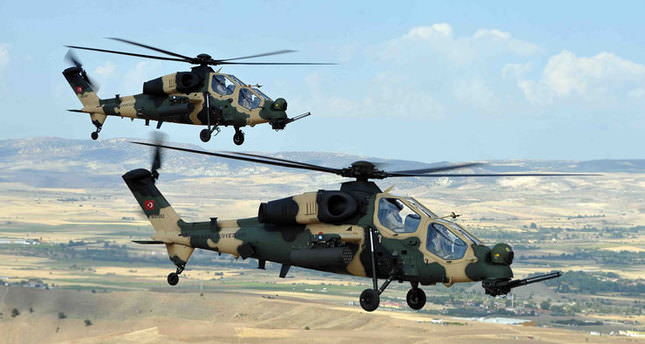
FIRST DOMESTICALLY PRODUCED ATTACK HELICOPTER DELIVERED TO TURKISH ARMY

The Turkey Defense Industry announced that the first T129 ATAK Raid Helicopter (ARH), which is the first helicopter produced in Turkey, was included in the inventory of the Turkish Armed Forces on April 22.
The ATAK was produced within the agreement signed between the Undersecretariat of the Defense Industry and Turkish Aerospace Industries (TUSAŞ) on Sep. 7, 2007, which envisages the supply of nine pieces of T129 ARHs helicopters.
The T129 ARH helicopter with two crews has two LHTEC CTS800-4ATurboshaft engines, each of which has a power of 1.360 horsepower and is able to reach a maximum speed of 288 kilometers an hour. With a maximum take-off weight of 5,000 kilograms, the helicopter has coverage of 556 kilometers. Carrying artillery of 500 projectiles of 20 millimeters on the nose, the T129 ARH helicopter can project 76 missiles with four pods under the wings.
dailysabah

Apr 8, 2014

Turkey Accepts First A400M

Turkey has finally accepted its first A400M tactical transport aircraft from the Airbus consortium, ending a monthslong controversy over whether the aircraft met technical specifications.
The acceptance of the A400M was formalized April 4. The delivery made Turkey the second operator of the A400M.
Following today’s contractual transfer of title, the aircraft will be flown to Kayseri air base in central Turkey, where it will initially be used for training.
Turkey, a partner in the multinational consortium that builds the aircraft, had been wrangling with the group over disputed technical snags that blocked delivery of its first aircraft. Turkey received its first A400M late in 2013.
Airbus Group NV CEO said Feb. 26 in Toulouse, France, that he was frustrated by Turkey’s failure to accept the delivery, even though two planes are flying successfully with French forces.
But Turkey’s chief procurement official, who was removed from office in late March, said that the aircraft failed to meet the acceptance criteria.
defensenews