Translate

Showing posts with label UCAV. Show all posts

Apr 23, 2025

Bayraktar TB3 Proves Naval Strike Capabilities with Autonomous Flights from TCG Anadolu


Baykar’s TB3 drone completes four successful autonomous takeoffs and landings from TCG Anadolu, confirming Turkey’s leap into naval drone warfare.

The Bayraktar TB3 unmanned combat aerial vehicle (UCAV) has marked a historic milestone for Turkey’s naval aviation. Successfully conducting four autonomous takeoffs and landings aboard the TCG Anadolu, the TB3 confirms its readiness for carrier-based operations—ushering in a new era of drone-enabled maritime strike capabilities.

Turkey has taken a major step in integrating unmanned aerial capabilities with naval operations. The Bayraktar TB3 UCAV, developed by Baykar, has completed four fully autonomous flights—including takeoff and landing—from the deck of the TCG Anadolu, Turkey’s first amphibious assault ship and drone carrier.

The milestone confirms the TB3’s ability to operate in maritime environments, adding strategic flexibility to Turkey’s power projection in the region. The TB3 is unique in its class, capable of folding its wings for compact storage aboard ships, and performing precision strike and ISR (intelligence, surveillance, reconnaissance) missions.

Conducted in April 2025, the trials included day and night missions and tested the TB3’s autonomous control systems in takeoff and landing scenarios on a moving deck. The flights were carried out without pilot intervention, showcasing advanced AI flight algorithms and robust naval interface integration.

The TCG Anadolu was originally intended to host F-35B jets, but after the U.S. removed Turkey from the F-35 program, the Turkish Navy shifted toward an indigenous drone-based concept of operations. The TB3, alongside the upcoming jet-powered Kızılelma, now forms the core of this innovative carrier aviation strategy.

This achievement positions Turkey as one of the few nations to successfully integrate UCAVs with naval operations. The TB3's operational readiness aboard Anadolu significantly enhances Turkey’s surveillance and strike capabilities across maritime zones, from the Mediterranean to the Aegean and beyond.

The successful deployment of the Bayraktar TB3 from TCG Anadolu marks a pivotal moment for naval aviation and drone warfare. As Turkey pushes forward with its indigenous defense initiatives, the TB3 stands as a symbol of innovation and strategic autonomy at sea.

Jan 1, 2024

India Performs First Flight of Its UCAV Prototype


The Defense Research and Development Organization (DRDO) of India successfully conducted a test flight of the Autonomous Winged Technology Demonstrator, a high-speed Winged Unmanned Aerial Vehicle (UAV), at the Chitradurga Aeronautical Test Range in Karnataka.

The successful flight demonstration of this autonomous stealth UAV stands as a testament to the maturity in technological readiness within the country. With this tailless configuration flight, India has joined the elite league of nations that have mastered winged technology controls.

This UAV was designed and developed by the DRDO's Aeronautical Development Establishment. The maiden flight of this aircraft was demonstrated in July 2022, followed by six flight tests in various development configurations using two domestically manufactured prototypes. These flight tests led to achievements in robust aerodynamic and control system developments, real-time integrated simulation, hardware-in-loop, and state-of-the-art ground control station. The team optimized avionics systems, integration, and flight operations for the successful seventh flight in the final configuration.


The aircraft prototype, featuring a complex swept-wing platform, was designed and fabricated using locally developed lightweight carbon pre-impregnated composite material. Furthermore, the composite structure, impregnated with fiber interrogators for health monitoring, showcases India's "Make in India" proposition in aerospace technology.

The autonomous landing of this high-speed UAV, without the need for radar/infrastructure/ground pilot, demonstrated a unique capability, enabling takeoff and landing from any runway with predefined coordinates. This was achieved by utilizing onboard sensor data fusion with Indian satellite-based augmentation using GPS Aided GEO Augmented Navigation (GAGAN) receivers to enhance GPS navigation accuracy and integrity.

Defense Minister Shri Rajnath Singh praised the DRDO, Armed Forces, and Industry for the successful test flight of the system. He stated that the successful development of such critical technologies would further strengthen the Indian Armed Forces.


Mar 15, 2022

NEWS 2022 March, 15

Spanish Navy acquires 8 MH-60R, 32 Hellfire Missiles


The State Department has made a determination approving a possibl Foreign Military Sale to the Government of Spain of MH-60R Multi-Mission Helicopters with Support and related equipment for an estimated cost of $950 million. The deal includes; twenty (20) T-700-GE-401C engines (16 installed, 4 spares); thirty-two (32) AGM-114R(N) Hellfire missiles, all up rounds; two (2) Hellfire II Captive Air Training Missiles (CATM); one hundred (100) WGU-59/B Advanced Precision Kill Weapon System (APKWS) II Guidance Sections, all up rounds; and more equipment.

Turkey’s Future Unmanned Fighter “MIUS” On Final Assembly Line


Baykar revealed the latest photos of MIUS (Muharip Insansiz Ucak Sistemi – Unmanned Combat Aircraft System), Turkey's future unmanned jet aircraft, on the final assembly line.

Baykar unveiled the MIUS project on June 2021. The announcement came along with several surprising renderings showing the future Turkish TCG Anadolu helicopter landing dock. This was an unexpected development, as Baykar is reportedly working on the TB3 Bayraktar UCAV to be deployed aboard TCG Anadolu, and MIUS will be a second option for aircraft operations.


AUSTRALIA RECEIVED FIRST F-35 DELIVERIES OF 2022, FLEET RISES TO 48


The Royal Australian Air Force has confirmed its receipt of four additional F-35A Lightning II aircraft, taking the total size of the fleet to 48.

The jets, which touched down in RAAF Base Williamtown late last month, travelled from Andersen Air Force Base in Guam following Exercise Cope North 22.

The jets were accepted by No. 77 Squadron of No. 81 Wing

The arrival of the four additional F-35 jets came amid concern over the fleet’s operational capacity.

Budget estimates documents filed by the Department of Defence revealed the expected flying hours of the aircraft have been revised down over the next four years.

Flying hours have been cut by 25 per cent in the 2021-22 financial year (FY22) and are set to be reduced by 17 per cent in FY23, 14 per cent in FY24, and 13 per cent in FY25.


Russian drone ‘entered Poland's airspace’


A Russian drone flew over Poland before entering Ukrainian air space where it was shot down, Ukraine’s military claimed last night.

In a statement the Ukrainian air force command said that the drone flew into Nato airspace, accusing Moscow of a “provocation”.

The drone first circled over the site in Yavoriv, western Ukraine, which was hit by a salvo of cruise missiles on Sunday, in an apparent attempt to assess the result, it said.

It then delved into Poland before returning to Ukrainian air space, where it was shoot down by Ukrainian defenses

Aug 30, 2015

Neuron UCAV Completes Combat Capability Tests

The flight test campaign in Italy of the Unmanned Combat Aerial Vehicle (UCAV) Neuron has been successfully concluded with the achievement of all established goals, thus allowing an important step forward for the program.
The Neuron is the European full-scale technological demonstrator for UCAV developed by an industrial team led by Dassault Aviation with the collaboration of Finmeccanica-Alenia Aermacchi, Saab, Airbus Defence and Space, RUAG and HAI.
The aircraft has been deployed at the Italian Air Force's Decimomannu Air Base, in Sardinia, Italy, where it has fulfilled a series of important operational tests.
In particular, the 12 highly sensitive sorties have allowed to verify the characteristics of Neuron’s combat capability, its low radar-cross section and low infrared signature, during missions flown at different altitudes and flight profiles and against both ground-based and air radar “threats”, using in this latter case, an Eurofighter Typhoon.
During the deployment in Italy the Neuron has confirmed its already ascertained excellent performance and high operational reliability.
defenseworld

Jun 2, 2015

Taranis UCAV Set for New Flight Tests

A third and possibly final series of flight tests planned for Britain's Taranis unmanned combat air vehicle demonstrator is planned for later this year.
An industry team led by BAE Systems completed two phases of trial flights at Woomera, Australia, between August 2013 and January 2014, and a third series of test flights is now planned for the end of this year.
The British and French governments signed a US $183.4 million FCAS study last year to investigate the feasibility of jointly building an unmanned combat air vehicle (UCAV). Each nation additionally injected a further £40 million into national UCAV technology programs.
A consortium of European nations and companies led by Dassault is conducting flying trials on their own demonstrator UCAV known as Neuron.
defensenews

Mar 10, 2015

nEUROn UCAV finishes successful test campaign in France

With the completion of its 100th flight in February, the nEUROn UCAV technology demonstrator has completed its test campaign in France.
Throughout this entire campaign, the nEUROn and associated equipment demonstrated exemplary availability and reliability.
In the first phase, the purpose of the tests was to open the flight envelope (including with weapon bay doors open), to test the electro-optical sensor and to evaluate datalink performance.
In the second phase, most flights were dedicated to infrared and electromagnetic signature/detection confrontations against operational systems.
These confrontations, which produced all the expected results, were performed under the authority of the French defense procurement agency DGA. The nEUROn, in full stealth configuration, was operated by Dassault Aviation.
Stealth-related data and feedback will serve as a reference for future aircraft projects.
A new chapter now opens for the nEUROn with evaluations that will take place in Italy, then Sweden.
nEUROn is a European program for an unmanned combat air vehicle (UCAV) technology demonstrator, conducted by Dassault Aviation as prime contractor under the authority of French defense procurement agency DGA. It heralds tomorrow’s defense programs, since it federates expertise from across Europe (France, Italy, Sweden, Spain, Greece and Switzerland).
dassault-aviation

Dec 9, 2014

X-47B May Begin Automated Aerial Refueling Demonstrations Next Year

The Navy’s carrier-based unmanned aircraft demonstrator is undergoing preparations for automated aerial refueling testing next year, including a possible flight demonstration using the aircraft itself, said officials from the service and X-47B manufacturer Northrop Grumman.
Thusfar, the Navy had used a surrogate aircraft for AAR testing.
The service in June 2014 awarded a contract modification to Northrop Grumman for aerial refueling research, development, test and evaluation efforts at Naval Air Station Patuxent River in Maryland
The X-47B is the Navy’s first carrier-based drone, capable of almost completely autonomous operations even as the ship moves throughout the seas. The stealthy, tailless aircraft can take off, conduct surveillance and land back on the carrier using a combination of algorithms and sensors that allow it to land on the runway with precision. It first showcased that ability in May 2013 during sea trials on the USS George H.W. Bush when it successfully completed its first touch-and-go and arrested landings.
In August 2014, it returned to the carrier deck once again for its first cooperative flight with a manned aircraft. This time, it flew in pattern with an F-18 Hornet over the USS Theodore Roosevelt.

nationaldefensemagazine

Sep 4, 2014

China confirms CH-4 UCAV in PLA service at 'Peace Mission 2014' drill

The People's Liberation Army Air Force (PLAAF) showcased a CH-4 unmanned combat aerial vehicle (UCAV) during the multilateral 'Peace Mission 2014' exercise featuring Shanghai Cooperation Organisation (SCO) members in Inner Mongolia in late August.
In a rare move, and indicating strong confidence in the platform, state media showed footage of a missile hitting a simulated enemy vehicle.
Feng Aiwang, commander of the exercise's PLAAF battlegroup, said the CH-4 hit every target in several missile firings. The CH-4 (Cai Hong 4 or Rainbow 4), which has been characterised as China's answer to the United States' General Atomics MQ-9 Reaper, operated alongside Z-10 and Z-19 attack helicopters, which also made their 'Peace Mission' debuts.
In a TV interview, Li Pingkun, head of the CH-4 project, said the unmanned aerial vehicle (UAV) could hit targets with a margin of error of less than 1.5 m. Without giving details, he revealed the CH-4 "used several methods to guide missiles or smart bombs onto targets".
The CH-4 has four hard points capable of carrying two AR-1 laser-guided missiles and two FT-5 small guided bombs.
The CH-4, developed by the CAAA and manufactured by the China Aerospace Science and Technology Corporation (CASC), has an 18 m wingspan. The 1,260kg CH-4A, designed primarily for reconnaissance, has a 30-hour endurance and 3,500 km range. The CH-4B has a shorter 14-hour endurance and 1,600 km range but can carry a much larger 345 kg weapon payload. It is unclear which version the PLA operated during 'Peace Mission 2014'.
The CH-4 is believed to be the first CASC-manufacturer UAV to enter PLA service. The rival Yi Long (Wing Loong or Pterodactyl) UCAV produced by AVIC has achieved sales to at least three countries, apparently including Saudi Arabia. Algeria reportedly tested the CH-4 earlier in 2014.
janes

May 11, 2014

Mystery Object in Near-collision May Be Russian UCAV

The Russian UCAV program revealed in 2007 might have reached the flight-test phase. The evidence comes from a near midair, reported by the pilots of two L-29 jet trainers belonging to a civilian flying club near Ulyanovsk. The L-29 pilots rapidly altered heading and altitude to escape collision with an unidentified flying object that they described as “a heavyweight unmanned air vehicle.”
The object was also detected by ATC radar, flying at 270 knots and nearly 7,000 feet. Approaching the L-29s from the rear, it might have flown into them if not for the controller warning the pilots. The object proceeded in the direction of Penza and disappeared from the radar screen. The pilots’ description indicates it was a jet-powered UCAV with swept wings. In theory, it might be an old Tupolev Tu-143 Reis reconnaissance UAV or a newer Tu-300 Korshun experimental UAV made during 1990s. Local media reported that the mysterious object bore greater similarity to the Skat.
Russian defense ministry denied knowledge of the incident. Just days before the incident, defense minister told journalists that funding for new UAV designs has been approved, with deliveries due by 2020. The Russian armed forces already operate about 500 UAVs.
RAC MiG exhibited the Skat UCAV at the MAKS 2007 airshow in Moscow as a full-scale mockup. The maker described it as a stealthy multipurpose UCAV intended for striking pre-located stationary targets and suppression of enemy air defense system in conditions of severe ECM and antiaircraft fire. The UCAV should be able to successfully engage hidden and heavily protected land and sea targets and conduct its operations either autonomously or as part of a larger aviation strike force.
ainonline

Apr 14, 2014

First nEURON formation Flight

First look at the formation flight of the nEUROn unmanned combat air vehicle with a Rafale fighter and a Falcon 7X business jet.
It’s the first time a combat drone has flown in formation with other aircraft. The flight took place on 20 March 2014 over the Mediterranean ocean. Lasting 1 hour, 50 minutes the flight involved four manned aircraft and the UCAV flying alongside each other in a confined space.
aviationweek

Feb 5, 2014

First images of UK’s classified unmanned stealth “superdrone”

Although the footage was shot in August 2013, today BAE Systems released it for the first time.
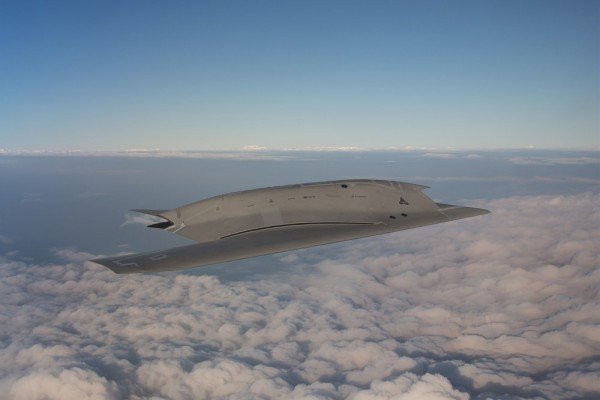
“Taranis“, the technological demonstrator of UK’s stealthy unmanned combat vehicle made its first flight on Aug. 10, 2013. Where the maiden sortie took place remains a secret.
The aircraft flew at the old British Nuclear test range at Woomera, Australia.
The only known thing is that the drone flew under the command of a BAE Systems’ test pilotand “made a perfect take off, rotation, ‘climb out’ and landing.”
Since then, a number of other test flights have taken place in much secrecy.
“Taranis” is an Unmanned Combat Air Vehicle (UCAV), described as “the most advanced aircraft ever built by British engineers”.
It’s a semi-autonomous pilotless system that will feature an intercontinental range and will be able to carry a wide variety of weapons, including PGMs (Precision Guided Munitions) and air-to-air missiles.
The Royal Air Force already operates a fleet of Reaper drones from RAF Waddington airbase.
theaviationist

Oct 3, 2013

X-47B Might Fly into 2015, Next Carrier Tests Could Start in November

The US Navy is making plans that could extend the testing of Northrop Grumman’s X-47B into 2015 with possible new carrier tests as early as next month.
Last week the Navy issued a contract solicitation to extend the testing of the two unmanned aerial vehicles (UAV) — dubbed Salty Dog 501 and Salty Dog 502 — as part of the Unmanned Combat Air System demonstration (UCAS-D) program.
The eventual contract will, “continue X-47B aircraft system, test bed, and flight test support at both shore-based locations and associated carrier detachments”.
The testing could extend into Fiscal Year 2015 and could include an aerial refueling test of a X-47B. The refueling test had previously been planned for a surrogate aircraft. The additional funding could bring tests to Navy facilities and ships on the West Coast.
In the shorter term, tentative plans call for X-47B test onboard aircraft carrier USS Theodore Roosevelt (CVN-71) in November.
Salty Dog 502 made naval history with the first successful carrier landing onboard USS George H.W. Bush CVN-77 in July.
usni

Aug 1, 2013

First flight of Taranis imminent

Testing of the ‘Taranis’, a British unmanned air combat vehicle (UCAV) are believed to be drawing nearer.
Reports in recent weeks state the machine has been delivered to its testing location at Woomera, Australia.
themonitor

Jun 4, 2013

RAC MiG to design Skat-based unmanned combat air vehicle


RAC MiG has signed a research and development contract to build an unmanned combat air vehicle (UCAV) based on its previous Skat design.
The deal, is for an autonomous system which requires minimal oversight once in flight. The Skat - a stealthy flying wing design - is the most sophisticated Russian UAV known. The country has had mixed success with developing unmanned systems, and has in the past purchased systems from Israel.

flightglobal

Jun 3, 2013

Lijian UCAV taxiing test


5/6/2013 marks the first test run on taxiing for the Sharp Sword UCAV, China's first killer drone dubbed as Chinese X-47B.

May 19, 2013

China’s ‘Sharp Sword’ UCAV is Spotted Taxiing


China’s first jet-powered stealth unmanned combat aerial vehicle (UCAV), the Lijian or “Sharp Sword,” was recently spotted undergoing taxiing tests in that country. Analysts interpreted the sighting as indicating that the Lijian’s maiden flight is imminent.
ainonline

Dec 21, 2012

Italy's Alenia keen for involvement in Franco-British UCAV programme


Alenia Aermacchi is keen to become involved in the Future Combat Air System (FCAS) demonstrator programme being jointly developed by the UK and France via their aerospace champions BAE Systems and Dassault Aviation.

flightglobal by Dominic Perry

Dec 2, 2012

NEURON completes maiden flight


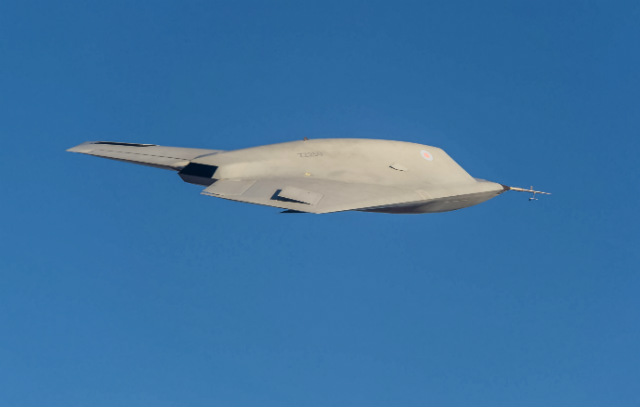
Europe's stealthy NEURON unmanned combat air vehicle (UCAV) completed its maiden flight Dec. 1 from the Istres test center in southern France, marking a major milestone for the technology demonstration project and paving the way for flight test campaigns in Italy, Sweden and France.

Led by the French defense armaments agency DGA and Dassault Aviation, nEUROn's objective is to demonstrate both the airworthiness of a stealthy combat air vehicle and the ability to develop, build and flight-test the UCAV in a relatively limited €400-million ($500-million) budget working across six countries with multiple industrial partners.

Launched by DGA in 2006, nEUROn involves the governments of France, Italy, Sweden, Spain, Greece and Switzerland. In addition to prime contractor Dassault, the program pools the skills and know-how of Alenia Aermacchi, Saab, EADS-CASA, Helenic Aerospace Industry, Ruag and Thales.

Powered by a Rolls-Royce Turbomeca Adour engine, the 10-meter-long nEUROn features a wingspan of 12.5 meters and a dry mass of 5,000 kg. The project is designed to address a number of technological challenges, including the aircraft's capacity to carry and deliver weapons from an internal bay. Today, European aircraft are designed with external loading capabilities for bombs and missiles.

Other technological objectives include development of the air vehicle and its innovative composite structure, demonstration of low-observability technologies, use of high-level algorithms for automated processes and
testing the human factor within the mission loop.

“Through these demonstration missions, the goals are to validate technologies around command and control of an unmanned air vehicle of a size similar to a combat aircraft, with all back-up modes insuring necessary safety and security,” Dassault said in a Dec. 1 statement.

The vehicle will continue flight tests in France before moving to operational trials in Sweden in 2014. Additional weapons firing and stealth capability assessments will will take place at the Perdadesfogu range in Italy.

In addition to technology development, nEUROn is designed to demonstrate a leaner decision-making process that aims to eliminate the complexities that have plagued other international collaborations, such as the Eurofighter
Typhoon, where decision-making has been complicated by the large number of companies and government procurement agencies involved. For nEUROn, Dassault coordinates industrial interests and interacts with DGA as the lead armaments agency, which coordinates the governments' collective position.

Dassault's work on nEUROn includes responsibility for integration and the flight control system. Italy's Alenia is producing the “smart” internal weapons bay with an electro-optical/infrared sensor and Saab of Sweden has
built the central and forward fuselage and is working on other components.

EADS-CASA of Spain built the wings and is involved with data-link integration and the ground station, while Hellenic Aerospace Industry is working on the rear fuselage and exhaust duct and Ruag is developing the weapon interface linking the aircraft system to the armaments.

by Amy Svitak-aviationweek