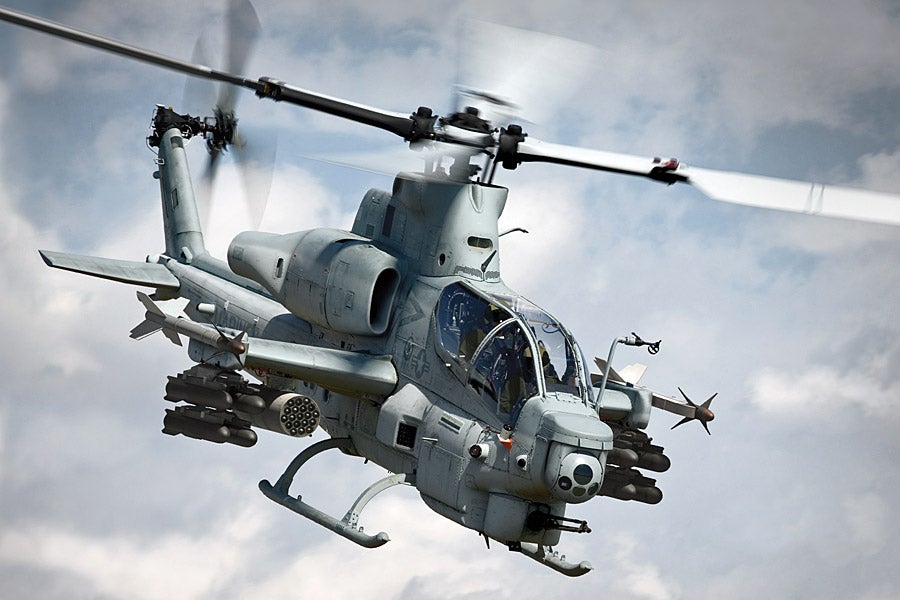
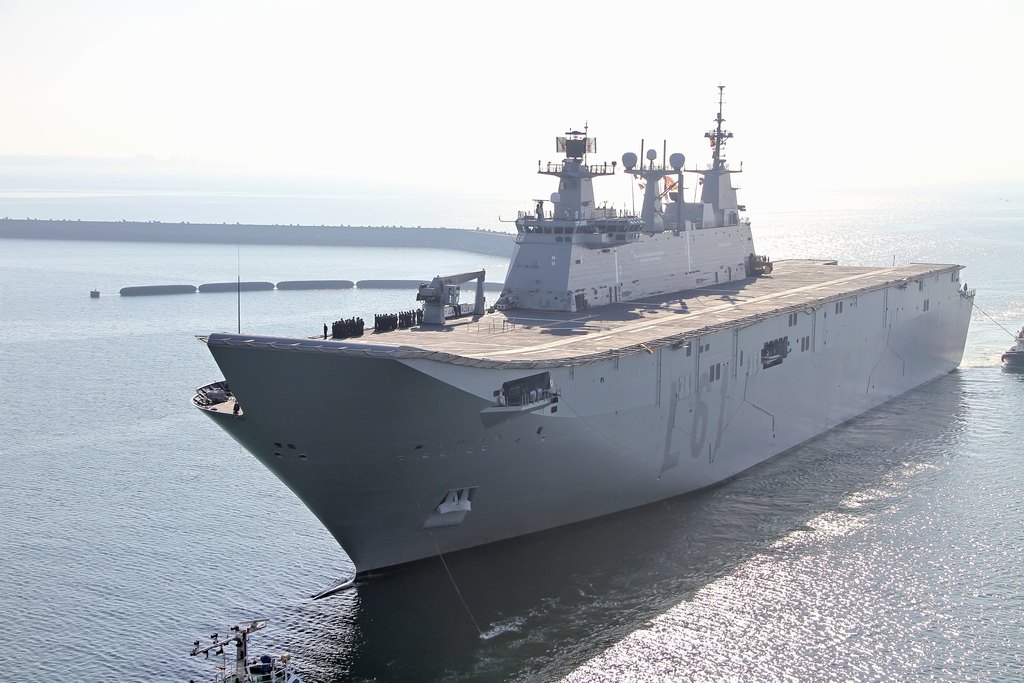
Australia has deployed its Airbus Tiger Armed Reconnaissance Helicopter (ARH) overseas for the first time, with a detachment participating in joint training exercises with Malaysia.
Four Australian Army Tiger ARHs were airlifted to the Royal Malaysian Air Force (TUDM) air base at Subang on a Royal Australian Air Force (RAAF) Boeing C-17A Globemaster III strategic airlifter on 21 April, before embarking for training exercises aboard the HMAS Canberra landing helicopter dock (LHD) amphibious assault ship.
Australia operates 22 Tiger ARH helicopters, with deliveries running from December 2004 through to December 2011. The ARH is a hybrid variant of the Tiger that is based on the French HAP (Hélicoptère d'Appui et de Protection), with an undernose Giat 30-781 30 mm cannon, roof-mounted sight, and provision for underwing 70 mm rocket pods, but with added anti-tank capability.
Apart from being the first overseas deployment of the Tiger, the exercises aboard HMAS Canberra mark a major milestone for the helicopter given that until very recently Australian auditors were recommending that it not be operated aboard ships due to performance limitations.
Gareth Jennings- Jane's 360
Translate
Showing posts with label HMAS CANBERRA. Show all posts
Apr 28, 2019
Dec 13, 2015
Navantia to Manage Australia’s AWD Destroyer Program
Navantia has signed a contract with Australian shipbuilder ASC for providing management services to AWD program. The signing took place in Sydney.
Navantia has been working in three important programs for the ADF since 2007, namely the Air Warfare Destroyers (AWDs), Landing Helicopter Docks (LHDs), and the LHD Landing Craft (LLC), under different contractual schemes to deliver to the best of its ability. ASC has signed a contract with Navantia whereby Navantia will provide the Shipbuilding Management Services (SMS) for the AWD Program.
Navantia will bring it significant experience in AWDs to support ASC in building the AWDs. Navantia is fully committed in delivering this key capability to the Royal Australian Navy, as it has already done with the two LHDs, HMAS CANBERRA and HMAS ADELAIDE, this last unit being commissioned into the RAN on the 4th of December.
defense-studies
Etiquetas:
AUSTRALIA,
AWD,
HMAS CANBERRA,
NAVANTIA,
RAN,
ROYAL AUSTRALIAN NAVY,
SPAIN
Nov 28, 2015
NAVANTIA Delivers Final Batch of Four Landing Crafts to Australia
Navantia has the pleasure in delivering to the Commonwealth in Sydney the final batch of four LLCs. This is a major achievement, where Navantia has played an important role – that of Prime Contractor for the first time in an Australian program. Since 2007, Navantia has been working in three important programs for the ADF, namely the Air Warfare Destroyers (AWDs), Landing Helicopter Docks (LHDs), and the LHD Landing Craft (LLCs), under different contractual schemes to deliver to the best of its ability.
On 16th December 2011, Navantia signed a contract with the then Defence Materiel Organisation (DMO) under JP 2048 Phase 3 to build and deliver twelve LHD Landing Craft (LLCs) to the Commonwealth. All twelve have now been delivered to HMAS WATERHEN in Sydney on or ahead of schedule and to budget. The LLCs were built and tested in Cádiz, Spain, and shipped out to Australia.
Navantia understands that the first eight units are in operation with the RAN and are performing to the full satisfaction of Navy, having achieved various missions during sea trials with HMAS CANBERRA, which has also been commissioned into the RAN. Her sister ship, HMAS ADELAIDE, is due to be commissioned in Sydney on 4th December 2015.
Etiquetas:
AUSTRALIA,
HMAS CANBERRA,
NAVANTIA,
RAN,
ROYAL AUSTRALIAN NAVY,
SPAIN
Oct 24, 2015
Flight trials of Australian Army CH-47D with HMAS Canberra
Australia is using an Army CH-47D Chinook to do First of Class Flight Trial with HMAS Canberra in Jervis Bay.
alert5
Etiquetas:
AUSTRALIA,
CANBERRA,
CH-47D,
HMAS CANBERRA,
RAN,
ROYAL AUSTRALIAN NAVY
May 6, 2015
Australia commissions first two CH-47Fs Chinook
The first two of seven CH-47F heavy-lift helicopters for the 5th Aviation Regiment of the Australian Army were commissioned in a ceremony at RAAF Townsville on 5 May.
The remaining Chinooks will be delivered by the end of July. Initial operating capability (IOC) would be achieved by December 2015 and full operating capability (FOC) by January 2017.Although the new aircraft are being received in a common configuration with the US Army's baseline CH-47Fs, they also incorporate optional Boeing-designed rotor brakes and ship tie-down adaptors to enhance operations from the Royal Australian Navy's (RAN's) two Canberra class landing helicopter docks (LHDs).
janes
Etiquetas:
AUSTRALIA,
AUSTRALIAN ARMY,
BOEING,
CANBERRA,
CANBERRA CLASS,
CH-47,
CH-47F,
CHINOOK,
HMAS CANBERRA,
NUSHIP CANBERRA,
RAAF,
RAN,
ROYAL AUSTRALIAN AIR FORCE,
ROYAL AUSTRALIAN NAVY,
UNITED STATES,
USA
Mar 1, 2015
AH-1Z Propossed as Maritime Attack Platform for Australian Navy Assault Ships
Bell is pitching its AH-1Z Viper helicopter to the Australian Defence Force (ADF) to be utilised as a maritime attack platform aboard its two landing helicopter dock (LHD) amphibious assault ships.
However there is no formal Australian requirement, Bell is briefing the ADF on the Viper's capabilities ahead of an expected decision on whether to upgrade its Airbus Helicopters Tigers to a maritime configuration.
The AH-1Z is already doing all of the missions that the ADF is doing [with the Tiger], and more. It can carry 16 Hellfire [air-to-surface missiles] plus two Sidewinder [air-to-air missiles], and has the cost-per-flight-hour figures that the ADF has been looking for.
While the Australian Army does currently field 22 Tiger helicopters, a decision is expected to be made under Phase 3 of the Project AIR 87 Tiger Armed Reconnaissance Helicopter (ARH) procurement programme on whether to upgrade these helicopters to be able to operate from the decks of the Royal Australian Navy's (RAN's) two Canberra-class LHDs (HMAS Canberra was recently commissioned, while the future HMAS Adelaide is currently under construction in Spain).
The AH-1Z has been built to be resistant to corrosion; its engines are the same as those fitted to the MH-60R maritime helicopter as already selected by the RAN; it has folding [main rotor] blades; there are heavy-duty tie-down points; and its systems are shielded so as to be 'ship-safe'." .
As well as being physically better-suited to the maritime domain, the AH-1Z has the benefit of being in operational service with the US Marine Corps (USMC). With the USMC now regularly rotating through Darwin, the ADF is going to be operating alongside the AH-1Z more and more, and so there are obvious advantages of interoperability and support to be had should Australia choose to also procure the helicopter.
The discussions with the ADF is still in a very informal stage.
janes
Etiquetas:
AH-1Z,
AUSTRALIA,
CANBERRA,
HMAS CANBERRA,
ROYAL AUSTRALIAN NAVY,
SPAIN,
TIGER,
UNITED STATES,
USA
Dec 17, 2014
Royal Australian Navy prepares for March 2015 flight trials on first-of-class LHD HMAS Canberra
The Royal Australian Navy (RAN) will commence first-of-class flight trials on board its newly-commissioned landing helicopter dock (LHD) vessel HMAS Canberra in March 2015.
The ship was commissioned on 28 November and is expected to be cleared to operate the MRH-90 multirole helicopter, the S-70B-2 Seahawk, and the CH-47F Chinook.
Commander Michael Waddell, Officer in Charge of the RAN's Aircraft Maintenance and First deck-handling trials took place on 26 November while the ship was alongside at the RAN's Fleet Base East in Sydney, with an MRH-90 and an S-70B-2, and did not involve flight operations.
The actual flight trials while the ship is at sea will be conducted for about eight weeks from early March 2015.
The trials in March 2015 will only involve the MRH-90 and the S-70B-2.
There are no plans currently to embark any other aircraft on the LHDs besides the MRH-90, the S-70B-2, the Tiger Armed Reconnaissance Helicopter, and the CH-47F. The Tiger and the CH-47F will undergo sea trials on board Canberra in 2016.
Although the Canberra class is currently only intended to operate rotary-wing aircraft, the retention of the ski-ramp forward (a legacy of the design's antecedents in Spain's Juan Carlos I strategic projection ship) has raised the possibility that the ships could, in due course, operate fixed-wing short take-off and vertical landing (STOVL) aircraft.
In May 2014, a spokesman for Defence Minister told that the country will consider acquiring the STOVL variant of the Lockheed Martin F-35 Lightning II Joint Strike Fighter.
janes
Etiquetas:
AUSTRALIA,
CANBERRA,
F-35,
HMAS CANBERRA,
MRH90,
RAN,
ROYAL AUSTRALIAN NAVY,
S-70B
Nov 18, 2014
Think Thank says Australian F-35B purchase wouldn't make sense
Acquiring F-35B (STOVL) fighters to operate from the Royal Australian Navy's (RAN's) two 27,800-tonne Canberra class landing helicopter dock (LHD) amphibious ships would not be justified, a leading think-tank has concluded.
This issue could be addressed in a Defence White Paper expected around mid-2015. However, the Australian Strategic Policy Institute (ASPI) said the benefits of such a capability would be marginal at best and would not be justified by the costs.
The study pointed out that the LHDs - the first of which will be commissioned early in 2015 and the second in 2016 - could not carry a full complement of helicopters and amphibious troops with their vehicles and equipment and simultaneously deploy a useful number of STOVL aircraft and additional support aircraft.
Even in a STOVL-only configuration an LHD would face challenges in generating enough F-35B sorties continuously to protect itself and ships in company against a capable adversary, the study said.
janes
Etiquetas:
AUSTRALIA,
CANBERRA CLASS,
F-35,
F-35B,
HMAS CANBERRA,
JSF,
RAN,
ROYAL AUSTRALIAN NAVY
Oct 6, 2014
Australia has Formally Accepted HMAS Canberra ALHD
Australia has signed on October 3 acceptance of ALHD Canberra, first of two LHD ships Navantia has built for Australia based on the LHD Juan Carlos I designed for the Spanish Navy.
The contract, signed in 2007, includes the construction of 85% of the two ships in the shipyards of Navantia in Ferrol and completion in Australia by BAE Systems.
The ship was transferred to Australia in August 2012 and will be definitely delivered to the Australian Navy on 28 November.
defense-studies
Etiquetas:
AUSTRALIA,
CANBERRA,
CANBERRA CLASS,
HMAS CANBERRA,
JUAN CARLOS I,
LHD,
NAVANTIA,
RAN,
ROYAL AUSTRALIAN NAVY,
SPAIN
Jun 26, 2014
Australia begins training LHD crew with MRH90 helicopters
The Royal Australian Navy has begun training the aviation crew of its first Canberra-class amphibious assault ship (LHD) on MRH90 helicopters.
The training is being conducted on a dummy deck that simulates Canberra's helicopter landing platform. The LHD is able to accommodate up to 11 MRH90 helicopters in its hangar.
Australia procured the first MRH90 (NHIndustries NH90) in 2005, to replace the army and navy's Sikorsky Black Hawk and Sea King helicopters. Australia is due to receive a total of 46 MRH90 helicopters by 2015.
Training procedures include launch and recovery operations from the simulated flight deck and vertical replenishment exercises where an underslung load is moved from one "ship" to another.
janes
Etiquetas:
AUSTRALIA,
CANBERRA,
HMAS CANBERRA,
MRH90,
NH90,
RAN,
ROYAL AUSTRALIAN NAVY
Jun 24, 2014
Australia reveals interest in F-35B
Australian defence chiefs have told that Prime Minister coalition government is considering whether to acquire a number of short take-off and vertical landing Lockheed Martin F-35Bs.
Canberra confirmed in April it will acquire 58 F-35A Lightning IIs for the Royal Australian Air Force, adding to the 14 already on order to replace the RAAF's Boeing F/A-18A/B Hornet.
Australia has long-stated a requirement for 100 air combat aircraft. However, because it acquired 24 F/A-18F Super Hornets in 2009-2010 as a bridging capability between the retirement of the General Dynamics F-111C and the introduction of the F-35A, it has deferred a decision on Phase 2C of the project until the early- to mid-2020s.
The F-35B proposal is being pushed by Abbott’s office, and if acquired the aircraft would be fielded from the Royal Australian Navy’s two new LHD-class vessels – the first of which is to be commissioned as HMAS Canberra later this year.
The two 27,000t LHDs currently under construction in Melbourne, Victoria are based on Spain’s King Juan Carlos 1 (L-61) vessel, built by Navantia. When ordered, the LHDs were intended for amphibious and regional humanitarian assistance missions. They have capacity for a battalion of troops, up to 100 vehicles, four large amphibious watercraft and a dozen or more helicopters to be embarked for such missions.
There has long been an intention to conduct operational ‘cross-decking’ operations with US Marine Corps and UK Royal Navy fixed and rotary-wing aircraft.
HMAS Canberra will be followed by HMAS Adelaide in 2016.
flightglobal
Etiquetas:
AUSTRALIA,
F-35,
F-35B,
HMAS CANBERRA,
JUAN CARLOS I,
NAVANTIA,
RAAF,
RAN,
ROYAL AUSTRALIAN AIR FORCE,
ROYAL AUSTRALIAN NAVY,
SPAIN
May 29, 2014
Australia could buy F-35B
Australia will consider buying the F-35B in addition to the conventional take-off and landing (CTOL) variant to which it has already committed.
The F-35B would be considered within the construct of the Defence White Paper, which is due in the second quarter of 2015.
Prime Minister Tony Abbott has instructed planners working on the White Paper to examine the possibility of buying F-35Bs to operate from the Royal Australian Navy's (RAN's) two Canberra-class landing helicopter dock (LHD) amphibious ships.
The first of the two 27,800-tonne LHDs is currently undergoing delivery trials. The second will be commissioned in 2016.
The government announced on 23 April its decision to acquire a further 58 F-35As to take Australia's total commitment to 72. The first two will be delivered later this year, although they and subsequent deliveries will not arrive in Australia until late in 2018.
It is unclear whether any F-35B acquisition would be in addition to the 72 CTOL variants or be subtracted from that number.
Informed sources confirmed the prime minister's interest in the STOVL aircraft but pointed out that significant upgrades would be necessary to the LHDs to operate F-35Bs on anything more than a cross-decking basis with the US Marine Corps and other partner nations.
These upgrades would need to include heat-resistant deck coating for extended operations, additional fuel and weapons bunkerage, and enhancements to the command and control facilities, which are now focused on amphibious operations involving helicopters and water craft.
janes
Etiquetas:
AUSTRALIA,
CANBERRA CLASS,
F-35,
F-35A,
F-35B,
HMAS CANBERRA,
LOCKHEED MARTIN,
NUSHIP CANBERRA,
RAAF,
ROYAL AUSTRALIAN NAVY,
UNITED STATES,
US MARINES,
USA,
USMC
May 14, 2014
Australia Is Getting Aircraft Carriers, Sort Of
Pretty soon, the Royal Australian Navy will take possession of HMAS Canberra, a 27,000-ton-displacement, flat-deck amphibious assault ship.
The RAN plans to use Canberra and her sister HMAS Adelaide to manage crises across the South Pacific. But could the Canberras also give Australia an offensive naval air capability that it has lacked since the early 1980s?
Could the assault ships, in other words, also be aircraft carriers?
In the early 2000s, Australia and a dozen other countries identified amphibious operations as a significant military shortcoming … and set out to acquire large assault ships to fill the gap.
Australia acquired the license to build two vessels based on Spain’s Juan Carlos, capable of launching both helicopters and landing craft. The Canberras should boost the Australian military’s ability to storm a beach … or help out after a natural disaster.
But they’re also, able to carry jet fighters. While officially an amphibious assault ship, Juan Carlos I also operates up to eight AV-8B Harrier jump jets.
Flying Harriers from the assault ship fulfilled Spain’s interest in maintaining naval light-attack and air-defense capabilities, which it had enjoyed since first acquiring the jump jet in 1987. Looking to the future, Juan Carlos I could also carry F-35B Joint Strike Fighters—if the financially troubled Madrid government ever commits to purchasing the pricey stealth jets.
The Australians don’t have Harriers, nor are they planning to acquire F-35Bs. All the same, they retained the Spanish deck layout for the Canberras—a configuration that makes the Australian ships compatible with fixed-wing fighters, should Australia ever acquire them.
Indeed, a 2004 parliamentary report on Australia’s maritime strategy explicitly argued for the government to buy a few F-35Bs along with the 100 or so land-based F-35As Australia already planned to acquire.
To be clear, effectively operating the high-tech JSF takes more than just a flat deck. The Canberras are amphibious warships first. They can support helicopters just fine, but they lack the munitions and aviation fuel storage to support intensive fixed-wing flight operations.
Training, deck organization and personnel for helicopters differ significantly compared to those for fighters. Moreover, flying JSFs from the Canberras would impair the vessels’ ability to carry out their primary mission by taking up deck space and storage and splitting training time.
So turning the Canberras into carriers is tough. But it’s possible. Flat-deck amphibs are flexible ships. In the 2011 Libya conflict, for example, British and French amphibs launched attack helicopters to strike enemy ground forces ashore—a mission no one envisioned just a few years ago.
There’s no question that the Canberras could launch and recover F-35Bs for short missions.
JSFs would also boost the RAN’s ability to carry out air strikes in lightly-defended airspace, although that would mean risking very expensive aircraft for modest effect on the ground.
Perhaps most importantly, Australian F-35s could plug into coalition operations alongside the U.S. and British navies, both of which are also acquiring F-35s for their full-size, purpose-built supercarriers.
If Australia were to commit to a limited carrier strike capacity in the form of modified amphibs and F-35Bs, it certainly wouldn’t be alone. The U.S. Marine Corps will soon operate JSF jump jets from the Navy’s assault ships. Italy, too, plans to purchase F-35Bs in addition to F-35As … and to deploy the vertical-takeoff fighters from the light carrier Cavour.
Japan and South Korea are getting new flat-deck assault ships. Neither government has formally expressed any interest in putting JSFs on the vessels. But as Russia, India and China both already have flattops and fixed-wing naval fighters—and want to build more—Tokyo and Seoul’s calculations could change.
Does Australia need flattops now? No. But the Canberras may serve in the Australian navy for 30 years or longer. It makes a lot of sense to at least preserve the option of converting them for fixed-wing ops. Time may come when Australia needs to defend its ships from air attack, bomb targets ashore or contribute to a wider coalition operation.
And it’s useful to think beyond the F-35B. It might not be long before ship-launched drones can perform many of the same missions as the manned JSF—and more easily. The Canberras might even make better drone-carriers than JSF-carriers.
Not every navy needs a supercarrier to deploy adequate naval air power. For Australia, the Canberras just might suffice.
medium
Etiquetas:
AUSTRALIA,
F-35,
F-35B,
HMAS CANBERRA,
JUAN CARLOS I,
RAN,
ROYAL AUSTRALIAN NAVY,
SPAIN
Mar 12, 2014
Navantia delivers first four landing crafts to Australia
The first four fast landing crafts (LLC) for the Royal Australian Navy departed on 8th. March on board a cargo from Navantia facilities in Puerto Real. It is scheduled that the cargo arrives destination around mid April.
The rest eight units are being built by Navantia in different steps of construction, and will be delivered in groups of four during the next months.
The main characteristics of the ships are:
Lenght overall: 23.30 m.
Floatation lenght: 21.27 m.
Width: 6.40 m.
Depth: 2.80 m.
Propulsion: two 809 kW diesel engines, two waterjets propellers
Speed: more than 20 knots
Autonomy: 190 miles at full load
Loading capacity flexibility: Abrams vehicle, several Army vehicles, fusiliers’ company or 20 feet container truck.
The contract for the construction of the series of 12 LLC was signed in September 2011. The landing crafts are destined to operate with the ALHD “Canberra” and ALHD “Adelaide”, strategic projection ships, similar to LHD ”Juan Carlos I”, also built by Navantia in cooperation with BAE Systems.
defense-studies
Etiquetas:
AUSTRALIA,
CANBERRA,
CANBERRA CLASS,
HMAS CANBERRA,
JUAN CARLOS I,
NAVANTIA,
RAN,
ROYAL AUSTRALIAN NAVY,
SPAIN
Mar 5, 2014
HMAS Canberra starts Sea Trials
LHD Canberra, one of two Landing Helicopter Dock ships being built for Australia , left BAE Systems Williamstown for Sydney on the first period of sea trials.
The sea trials are the final stage of the project for BAE Systems before acceptance later this year.
The tests includes both platform tests as well as testing the ship’s combat and communication systems, during 16 days.
The second LHD, Adelaide arrived in Williamstown on 12 February and preparation works for the consolidation of the superstructure are well underway.
The LHDs are the largest ship ever to be built for the ADF and operated by the RAN. BAE Systems is the Prime to deliver the project with subcontractors Navantia, which constructed the hulls in Spain.
baesystems
Etiquetas:
AUSTRALIA,
BAE SYSTEMS,
HMAS CANBERRA,
NAVANTIA,
RAN,
ROYAL AUSTRALIAN NAVY,
SPAIN
May 12, 2013
Inside HMAS Canberra
ON the bridge wing of the navy's newest and biggest ever warship, HMAS Canberra, the vast scale of the amphibious assault ship is dramatic and stark.
With Melbourne city silhouetted across a shimmering Port Phillip Bay, the ship's expansive 32-metre wide flight deck stretches for 203 metres as pleasure yachts bob at their moorings more than 30 metres below.
Such is the sheer size of HMAS Canberra that the antennae on top of the ship's stern mast will touch the deck of the Sydney Harbour Bridge.
heraldsun
Etiquetas:
AUSTRALIA,
HMAS CANBERRA,
NAVANTIA,
RAN,
ROYAL AUSTRALIAN NAVY,
SPAIN
Feb 15, 2013
Largest Australian Navy ship named HMAS Canberra
The largest ship ever built for the Australian navy has been officially named.
Hundreds of sailors and navy veterans gathered in the main dock of the vessel at Williamstown, in Melbourne, as it was officially named HMAS Canberra.
When it is fully built, the ship will hold up to 1,400 personnel as well as numerous helicopters and military vehicles.
abc.net
Etiquetas:
HMAS CANBERRA,
NAVANTIA,
ROYAL AUSTRALIAN NAVY,
SPAIN
Morenés visitará hoy en Melbourne al buque 'Cantabria' y asistirá al bautizo del 'Canberra', construido por Navantia
El ministro de Defensa, Pedro Morenés, visitará este viernes en Melbourne (Australia) al buque 'Cantabria' de la Armada, que permanecerá todo el año en este país, y tendrá ocasión además de asistir al bautizo del buque 'Canberra' de la Royal Australian Navy, construido por Navantia con las mismas características del 'Juan Carlos I' de la Armada española.
europapress
Etiquetas:
Armada Española,
CANTABRIA,
ESPAÑA,
HMAS CANBERRA,
JUAN CARLOS I,
NAVANTIA,
ROYAL AUSTRALIAN NAVY
Jan 2, 2013
HMAS CANBERRA TAKING SHAPE
This year is shaping up as a big one for the future HMAS Canberra, Australia's first helicopter landing dock and the third Royal Australian Navy vessel to bear the name of the national capital.
BAE Systems maritime director Bill Saltzer said the vessel now looked like the ship her designers had expected her to become following the recent installation of the Australian-made superstructure blocks on the massive hull.
Read more: http://www.canberratimes.com.au/act-news/ship-starts-to-take-shape-20130101-2c4ie.html#ixzz2GrLcXaWU
nosint
canberratimes
Etiquetas:
AUSTRALIA,
CANBERRA CLASS,
HMAS CANBERRA,
JUAN CARLOS I,
NAVANTIA,
RAN,
ROYAL AUSTRALIAN NAVY,
SPAIN
Subscribe to:
Posts (Atom)