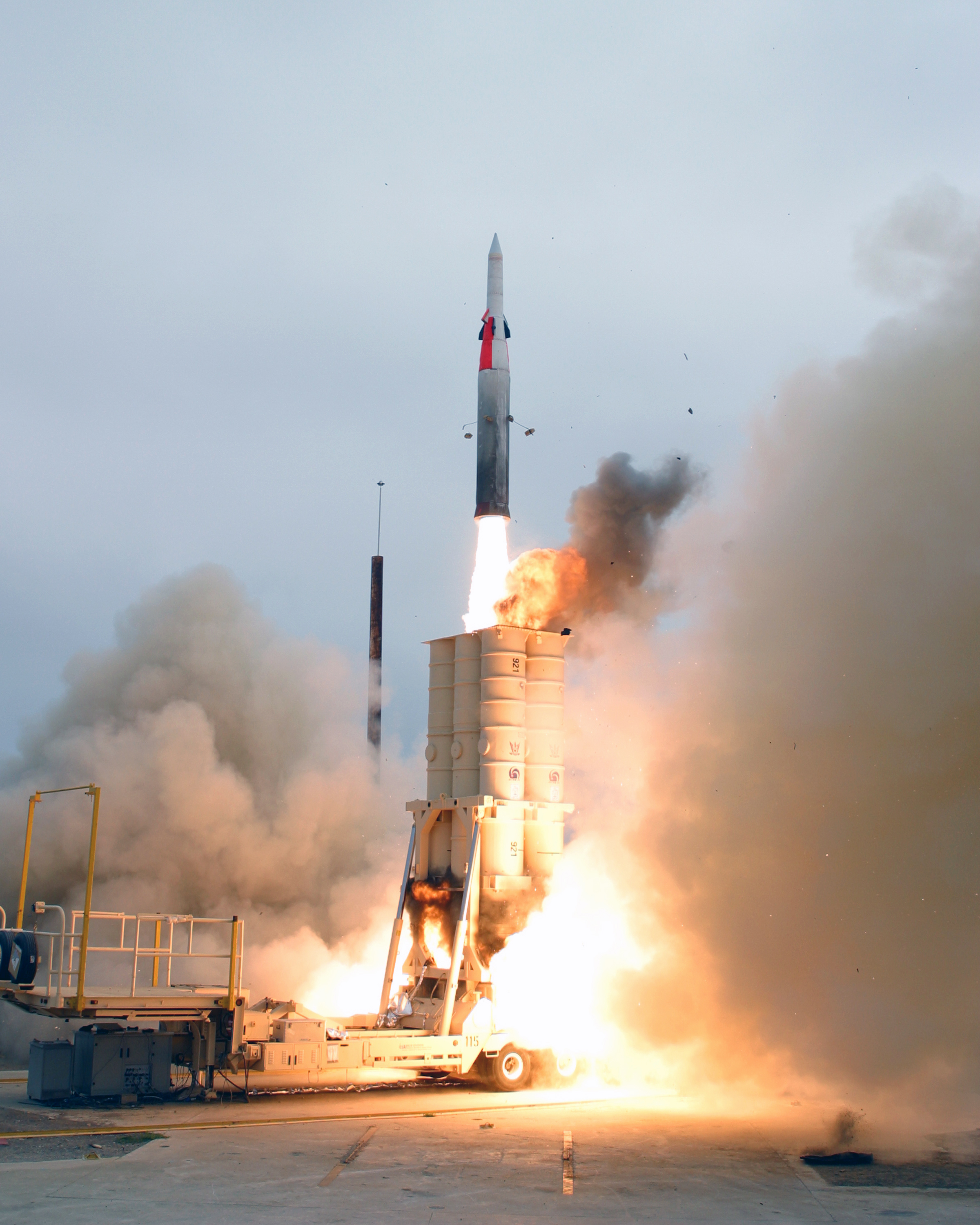
Israel and the United States on Tuesday successfully conducted a joint test of an upgraded Arrow 2 ballistic missile interception system over the Mediterranean Sea.
The Arrow 2 missile was launched and performed its flight sequence as planned.
The two countries carried out similar tests in January, and in September last year, as Washington was considering military action against Syria.
news24
Translate
Showing posts with label ARROW II. Show all posts
Sep 15, 2014
Israel, US test new Arrow 2 missile interceptor
Jan 23, 2014
IAI begins Arrow 3 production
The new Arrow 3 anti-ballistic missile system is a demonstration of Israeli defense industries' prowess. In a world still thrilled with the impressive interception capabilities of Iron Dome, Israel Aerospace Industries Ltd. (IAI) and the Ministry of Defense are trying to do the same thing, but completely differently: to intercept ballistic missiles long before they enter Israeli airspace by neutralizing them in outer space.
20 years ago, Israel unveiled its technological capabilities in response to the missile threat against the home front, making it a global pioneer in missile defense. In 2000, the Arrow system was declared operational, and it seems that as the missile threat expands and grows stronger.
The latest test of the Arrow 3 was successfully completed in early January, giving the green light to complete the system which will add the upper layer to Israel's missile defense. For a decade, the IDF and IAI have been developing the Arrow 3, with generous financial aid from the US.
The IDF campaigned against steep cuts in the defense budget, which included several attempts to add the Arrow to the long list of strategically critical projects that were delayed or frozen for years. A few weeks ago, the IDF proved once again that the best spin is only that: the Arrow program has continued on schedule, with no slowdowns, no cuts, and a lot of determination.
A critical test of the new missile will be carried out in a few weeks. In this test, for the first time, the missile's operators will have to intercept a target missile that will simulate an incoming Iranian Shahab ballistic missile.
Although so far the Arrow 3 has only succeeded in intercepting threats to its R&D funding, the Ministry of Defense and IAI engineers are so convinced that the missile will work that they have decided not to waste precious time and to begin production.
Few interception tests are planned anyway, and if the tests that will be carried out indicate a gap between planned and actual performance, minor software updates should be able to correct them. An announcement that the Arrow 3 is operational is due is 2015.
The Arrow 3 is an evolutionary development of the Arrow 2. The next generation of the Arrow was developed with an eye to the latest threats in the missile arena: the program planner's guiding principle was that if Israel were to face nuclear-tipped missiles, it was best to intercept them as far away as possible. In addition to the environmental importance of intercepting unconventionally armed missiles above the atmosphere, the Arrow 3 gives the ground crew the time needed to fire an interceptor against an incoming missile and to fire a second interceptor if the first one misses.
Under these circumstances, the Arrow 2 will be the second interceptor. Batteries are already deployed at Ein Shemer and Palmachim.
globes.co.il
20 years ago, Israel unveiled its technological capabilities in response to the missile threat against the home front, making it a global pioneer in missile defense. In 2000, the Arrow system was declared operational, and it seems that as the missile threat expands and grows stronger.
The latest test of the Arrow 3 was successfully completed in early January, giving the green light to complete the system which will add the upper layer to Israel's missile defense. For a decade, the IDF and IAI have been developing the Arrow 3, with generous financial aid from the US.
The IDF campaigned against steep cuts in the defense budget, which included several attempts to add the Arrow to the long list of strategically critical projects that were delayed or frozen for years. A few weeks ago, the IDF proved once again that the best spin is only that: the Arrow program has continued on schedule, with no slowdowns, no cuts, and a lot of determination.
A critical test of the new missile will be carried out in a few weeks. In this test, for the first time, the missile's operators will have to intercept a target missile that will simulate an incoming Iranian Shahab ballistic missile.
Although so far the Arrow 3 has only succeeded in intercepting threats to its R&D funding, the Ministry of Defense and IAI engineers are so convinced that the missile will work that they have decided not to waste precious time and to begin production.
Few interception tests are planned anyway, and if the tests that will be carried out indicate a gap between planned and actual performance, minor software updates should be able to correct them. An announcement that the Arrow 3 is operational is due is 2015.
The Arrow 3 is an evolutionary development of the Arrow 2. The next generation of the Arrow was developed with an eye to the latest threats in the missile arena: the program planner's guiding principle was that if Israel were to face nuclear-tipped missiles, it was best to intercept them as far away as possible. In addition to the environmental importance of intercepting unconventionally armed missiles above the atmosphere, the Arrow 3 gives the ground crew the time needed to fire an interceptor against an incoming missile and to fire a second interceptor if the first one misses.
Under these circumstances, the Arrow 2 will be the second interceptor. Batteries are already deployed at Ein Shemer and Palmachim.
globes.co.il
Jan 20, 2014
Israel plans laser interceptor 'Iron Beam' for short-range rockets
Israel plans to deploy a new missile shield known as "Iron Beam" next year which would use a laser to blow up short-range rockets and mortar bombs.
The system is designed to deal with threats that fly on too small a trajectory to be engaged efficiently by Iron Dome, the Israeli interceptor credited with an 80 percent success rate against rockets fired by Palestinian militants.
Both shields are manufactured by state-owned Rafael Advanced Defense Systems Ltd. While Iron Dome launches radar-guided interceptor rockets, Iron Beam's laser will super-heat the warheads of shells with ranges of up to 7 km (4.5 miles).
Iron Dome is complemented by Arrow II, an Israeli interceptor designed to shoot down ballistic missiles at atmospheric heights. Israel plans to integrate them with the more powerful rocket interceptors Arrow III and David's Sling, both of which are still in their testing phases.
The United States has extensively underwritten the projects, seeing them as a means of reassuring its Middle East ally as instability rocks the region.
reuters
The system is designed to deal with threats that fly on too small a trajectory to be engaged efficiently by Iron Dome, the Israeli interceptor credited with an 80 percent success rate against rockets fired by Palestinian militants.
Both shields are manufactured by state-owned Rafael Advanced Defense Systems Ltd. While Iron Dome launches radar-guided interceptor rockets, Iron Beam's laser will super-heat the warheads of shells with ranges of up to 7 km (4.5 miles).
Iron Dome is complemented by Arrow II, an Israeli interceptor designed to shoot down ballistic missiles at atmospheric heights. Israel plans to integrate them with the more powerful rocket interceptors Arrow III and David's Sling, both of which are still in their testing phases.
The United States has extensively underwritten the projects, seeing them as a means of reassuring its Middle East ally as instability rocks the region.
reuters
Jan 6, 2014
US-Israel Arrow-3 Marks Milestone Test
The US-Israel Arrow-3 upper tier intercepting missile passed another developmental milestone with a successful exo-atmospheric maneuvering flight after launch over the Mediterranean Sea on Friday.
The Arrow-3 was successfully launched and flew an exo-atmospheric trajectory through space, according to the test plan.
The fly-out of the two-stage, hit-to-kill missile marked the second in a series of developmental milestones aimed at readying the system for a full-up intercept test in early 2015. It follows a successful maiden flight in February 2013.
Planned for initial fielding in 2015-16, Arrow-3 is designed as Israel’s first line of defense against emerging threats from Iran. Supported by the same fire control radar and battle management systems developed for Israel’s operational Arrow-2, the smaller and much more agile Arrow-3 aims to destroy advanced, maneuvering, unconventionally tipped Shahab-class missiles in space before they re-enter Earth’s atmosphere.
Israel’s planned upper tier layer of Arrow-3 active defense will be buttressed by the Arrow-2, which both countries continue to upgrade for intercepting missions high within Earth’s atmosphere.
Israel Aerospace Industries (IAI) is prime contractor for both Arrow missiles, with significant content produced in the United States by Boeing. IAI also provides the Super Green Pine fire control radar, while Elbit’s Tadiran provides the system’s battle management control center.
defensenews
The Arrow-3 was successfully launched and flew an exo-atmospheric trajectory through space, according to the test plan.
The fly-out of the two-stage, hit-to-kill missile marked the second in a series of developmental milestones aimed at readying the system for a full-up intercept test in early 2015. It follows a successful maiden flight in February 2013.
Planned for initial fielding in 2015-16, Arrow-3 is designed as Israel’s first line of defense against emerging threats from Iran. Supported by the same fire control radar and battle management systems developed for Israel’s operational Arrow-2, the smaller and much more agile Arrow-3 aims to destroy advanced, maneuvering, unconventionally tipped Shahab-class missiles in space before they re-enter Earth’s atmosphere.
Israel’s planned upper tier layer of Arrow-3 active defense will be buttressed by the Arrow-2, which both countries continue to upgrade for intercepting missions high within Earth’s atmosphere.
Israel Aerospace Industries (IAI) is prime contractor for both Arrow missiles, with significant content produced in the United States by Boeing. IAI also provides the Super Green Pine fire control radar, while Elbit’s Tadiran provides the system’s battle management control center.
defensenews
Nov 20, 2013
US-Israel David's Sling Aces 2nd Intercept Test
The US-Israel David’s Sling Weapon System (DSWS) scored a “major milestone” Wednesday with a successful intercept of a short-range ballistic missile target at a test range in southern Israel.
Wednesday’s intercept marks the second test success since the beginning of the year, and aims to ready the system for initial deployment in 2014.
Jointly funded by the US and Israel, David’s Sling is designed to defend against long-range rockets and short-range missiles. Later block versions will extend performance to defend against cruise missiles and other air-breathing targets.
Developed by Israel’s state-owned Rafael Ltd. in conjunction with its US partner Raytheon Co., DSWS will provide an additional layer to Israel’s multi-layer active defense intercepting network. When deployed, it will serve as a bridge between the operationally proven lower-tier Iron Dome and the operational Arrow-2 and planned Upper Tier Arrow-3.
Supporting the DSWS is the Multi-Mission Radar by Elta, a subsidiary of Israel Aerospace Industries, and the Golden Almond battle management and control system developed by Elisra-Elbit Systems.
defensenews
Wednesday’s intercept marks the second test success since the beginning of the year, and aims to ready the system for initial deployment in 2014.
Jointly funded by the US and Israel, David’s Sling is designed to defend against long-range rockets and short-range missiles. Later block versions will extend performance to defend against cruise missiles and other air-breathing targets.
Developed by Israel’s state-owned Rafael Ltd. in conjunction with its US partner Raytheon Co., DSWS will provide an additional layer to Israel’s multi-layer active defense intercepting network. When deployed, it will serve as a bridge between the operationally proven lower-tier Iron Dome and the operational Arrow-2 and planned Upper Tier Arrow-3.
Supporting the DSWS is the Multi-Mission Radar by Elta, a subsidiary of Israel Aerospace Industries, and the Golden Almond battle management and control system developed by Elisra-Elbit Systems.
defensenews
Jun 3, 2013
Israeli Arrow II ready for Syrian missiles
“Syrian batteries are in a high state of operability, ready to fire at short notice,” said an Israel Air Force Colonel in special briefings to international media Friday. He disclosed that Israel tracks every missile fired in the Syrian civil war, since southward launches would give Israel mere seconds to determine it was not the true target.
debka.com
Subscribe to:
Posts (Atom)