Translate

Showing posts with label V-22. Show all posts

Dec 7, 2023

US Military Grounds Entire V-22 Osprey Fleet After Fatal Crash in Japan


The recent crash of a U.S. Air Force CV-22 off the coast of Yakushima Island in Japan, resulting in the loss of all eight crew members on board, has prompted a drastic action: the suspension of all flights of the V-22 Osprey fleet.The recent crash of a U.S. Air Force CV-22 off the coast of Yakushima Island in Japan, resulting in the loss of all eight crew members on board, has prompted a drastic action: the suspension of all flights of the V-22 Osprey fleet. Both the Air Force Special Operations Command and the Naval Air Systems Command have made this decision to mitigate risk while investigating the crash.

Initial inquiries suggest a potential material failure as the cause of the accident, yet the underlying cause of this failure remains undetermined. This uncertainty has led to the temporary halt of Osprey flights in an effort to ensure the safety of future operations.

The V-22 Osprey has had a history marked by operational and mechanical issues, having been involved in several fatal incidents over the past 30 years. This Japan crash adds to a string of unfortunate events, including the deaths of three U.S. Marines in an MV-22 during a military exercise in Australia, along with other fatal incidents in previous years.

Different versions of the V-22 Osprey are employed across various branches – the Marines operate the MV-22, the Air Force utilizes the CV-22, and the Navy operates the CMV-22. Additionally, Japan’s Ground Self-Defense Force employs its own variant, the Japan MV-22.

Following personnel recovery operations, the Air Force Special Operations Command mentioned on Wednesday that their focus would shift toward salvaging the remaining aircraft debris. Six of the eight airmen onboard have been recovered from last week’s crash, with three of them identified. 

The tragic incident has led to an operational standdown of the entire V-22 Osprey fleet by both the Air Force and Naval commands, reflecting the severity of the crash and the need to ascertain the cause before resuming operations. The Osprey, utilized by various military branches and the Japanese Ground Self-Defense Force, has faced a history of mechanical challenges and has been involved in several fatal incidents over the years.

The current priority remains the recovery efforts for both the aircraft wreckage and the crew members affected by the crash. The suspension of Osprey flights continues as investigators work to determine the root cause of the mishap.

May 10, 2020

FIRST OSPREYS FOR JAPAN ARRIVES IN IWAKUNI

V-22 Ospreys bound for Japan Ground Self-Defense Force (JGSDF) units arrive in Japan at Marine Corps Air Station, Iwakuni, May 8, 2020. The V-22 off-load marked the first time JGSDF V-22s arrived on Japanese soil.
dvidshub

Oct 17, 2017

Israel steps back from V-22 purchase

The Israeli air force has frozen its evaluation of the Bell Boeing V-22 Osprey, with a senior defence source indicating that the tiltrotor is unable to perform some missions currently conducted using its Sikorsky CH-53 transport helicopters.
In January 2014, the US Department of Defense notified Congress about its intention to sell six V-22s to Israel. This followed an evaluation conducted by air force personnel, which led to the service seeking a rapid acquisition to support special operations. The proposed purchase met with opposition from elsewhere within Israel's defence ministry, however.
Other potential candidates to replace the Israeli air force's aged CH-53s by around 2025 include Sikorsky's new CH-53K and the Boeing CH-47 Chinook.
Some of the service's current CH-53s have amassed more than 10,000 flying hours, and it expects to continue operating updated examples until 2028.
flightglobal

May 8, 2015

US approves V-22 sale to Japan

The US State Department has approved the possible sale of 17 Bell-Boeing V-22B to Japan.
The sale is intended to enhance the Japan Ground Self-Defense Force's humanitarian and disaster relief capabilities.
The version of the Osprey outlined in the notification is the MV-22B Block C operated by the US Marine Corps. .
Japa announced the selection of the V-22 in November 2014.
The platforms are due to equip a new JGSDF amphibious unit made up of two expeditionary divisions and two brigades.
janes

Apr 20, 2015

US Marines test missiles on V-22 Osprey

In late March, the Marine Corps teamed with the Defense Advanced Research Projects Agency to test-fire a precision-guided missile from an airborne Osprey. In a unique twist, the air crew coordinated the shoot with ground troops operating handheld tablet technology. During the demonstration, a joint terminal attack controller used the mapping software on his tablet to identify a target near an unmanned truck and then communicate its position to a PCAS module inside the Osprey.
Troops in the air and on the ground then confirmed the shot before the Osprey fired.
The munition was a nonexplosive version of the tube-launched AGM-176 Griffin missile. It traveled about 4.5 miles.
marinecorpstimes

Mar 27, 2015

20 Percent of all US Marines Aircraft Are Grounded, F/A-18 Hornets The Most Affected

Nearly one of every five of the Corps' aircraft are unable to fly, making it difficult for Marines to train for deployments.
The shortfall spans across aircraft in the fleet, and it is largely caused by a backlog of aircraft stuck in depots for extensive work and overhauls. The problems date back to the 2013 defense budget cuts.
The problem is most prevalent with F/A-18 Hornets, but also impacts CH-53E, AV-8B Harriers, MV-22B Ospreys, and H-1 Hueys.
The strike-fighter shortfall could reach as high as 134 aircraft. The gap is caused by a service life extension program that has caused a backlog of Hornets in short-staffed maintenance depots.
Legacy Hornets were brought into depots to extend their service life from 6,000 flight hours to as long as 10,000 in order to keep them operational until the F-35B entered the fleet. The Hornets were only designed to last to 6,000 hours, and when engineers opened up the airframe to extend their service life, they found unexpected levels of corrosion that required extensive work.
Sequestration also made it tough to buy spare parts for aircraft, so even aircraft that are in the fleet sometimes can't fly.
marinecorpstimes

Mar 25, 2015

US Navy planning to get its own V-22 Osprey fleet

The US Navy says it plans to obtain its own fleet of 44 V-22 Ospreys, taking possession of eight a year starting in 2020.
The decision to replace the aging fleet of C-2A Greyhound cargo aircraft with the tilt-rotor hybrid was made in an internal working document drafted earlier this year that laid the groundwork for funding.
The Navy V-22 Joint Program Office expects to issue a contract for development of a Navy variant in fiscal 2016 with production beginning in fiscal 2018.
Operating as a basic transport aircraft, the Navy variant will be virtually the same as the Marine Corps MV-22, but will add an extended-range fuel system, high-frequency radio and public-address system.
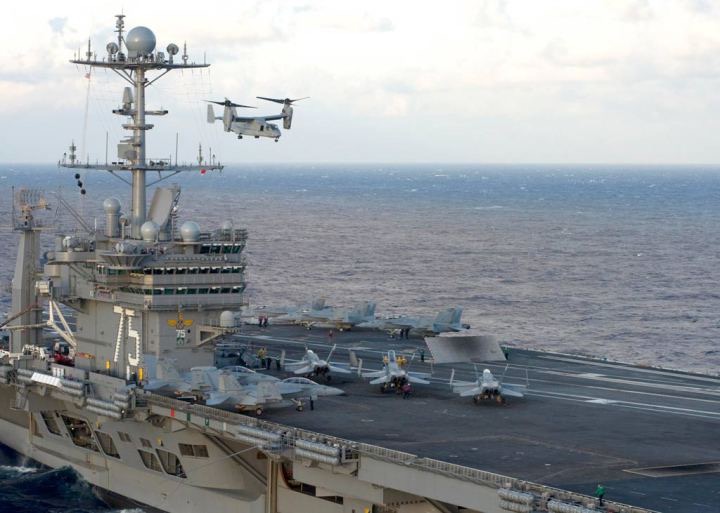
Navy pilots currently train alongside their Marine counterparts to develop a knowledge base for the aircraft. The Osprey already operates off Navy carriers.
The sea-service is the latest entity at home or abroad to enter the market for the V-22 Osprey. The Marine Corps has obtained more than 200 Ospreys to replace aging CH-46E Sea Knight assault support helicopters and has a requirement for 360. Air Force Special Operations’ aircrews have 33 with a requirement of 50.
The aircraft has performed admirably under fire in Iraq and Afghanistan and in humanitarian operations in the Philippines, despite safety concerns that plagued the platform early in its development.
The Japanese government plans to add as many as 17 tilt-rotor aircraft by fiscal 2018, most likely the V-22 Osprey. Israel has also expressed interest.
stripes

Feb 24, 2015

Bell-Boeing Expecting at Least Two International Orders for V-22 Osprey in 2015

V-22 Osprey has yet to land an international contract, but company executives are betting that they will have two foreign customers in hand by the end of the year.
Japan’s ministry of defense announced the purchase 17 Ospreys last year, although there is no contract set in stone yet. Israel had plans to buy the tiltrotor, but that deal remains in flux due to budget constraints.
Additionally, the platform has received significant interest from countries in the Middle East.
The Navy in their fiscal 2016 budget disclosed plans to buy 44 aircraft for what the service calls carrier onboard delivery — that is, flying people, supplies and cargo on and off flattops.
The Navy’s Ospreys will probably be slightly different than those flown by the Marine Corps and special operators.
Northrop Grumman’s C-2 Greyhound has filled the carrier onboard delivery role since 1966. Northrop proposed modernizing the C-2’s wings, engine and avionics, which executives claimed would be at least two times less expensive than buying a new aircraft. Bell-Boeing asserted that the Osprey would be more cost-effective over the long haul.
According to the budget, the Navy plans to procure 22 V-22s in fiscal years 2018 through 2020. That will likely result in another five-year multiyear contract for Ospreys to be signed before the current one ends in September of calendar year 2018.
nationaldefensemagazine

Jan 14, 2015

US Navy Decides to Buy V-22 Ospreys to Replace C-2A

The Navy will buy V-22 Osprey tiltrotors to replace its aging C-2A Greyhound turboprop aircraft in flying carrier on board delivery (COD) missions. The US Navy will buy four V-22s each year from fiscal 2018 to 2020.
The Marine Corps and other Osprey advocates, have argued for years that the Navy should replace its aging conventional take off C-2As with vertical take off and landing V-22s.
The C-2As carry cargo, mail and passengers between aircraft carriers and shore. The first Greyhound prototypes flew in 1964. The Osprey is in service with the Marine Corps since 2007 and the Air Force since 2009, tilts two large wingtip rotors up to take off and land vertically and forward to fly like a turboprop airplane, giving it far greater speed and range than conventional helicopters.
Until the past couple of years, Navy leaders had shown little interest in actually buying their planned 48 Ospreys. But in 2011, the Marine Corps began qualifying its MV-22s for carrier landings, and a six-day “military utility assessment” conducted last summer off the coast of Florida, in which V-22s carried passengers and cargo to and from the USS Harry S Truman (CVN 75), found that: “The V-22 demonstrated an effective, flexible, and safe capability to conduct the COD mission with no modifications and no adverse impact to cyclic flight operations.”
The first dozen HV-22s would be taken from what would have been the Marine Corps share of V-22s built in fiscal 2018-20 under the prospective third multiyear contract. Those first Navy V-22s will be replaced in the Marine Corps inventory in fiscal years 2021, 2022, and 2023 with a dozen Ospreys “that would have been allocated to the Navy,” the memo provides.
breakingdefense

Jan 6, 2015

Israel Angles to Extend US Offer for V-22s

Israel has asked Washington to preserve cut-rate costs and generous terms of a proposed package of up to six V-22 tilt-rotor aircraft pending an ongoing reassessment of procurement priorities driven by last summer's Gaza war.
Proposed prices, delivery schedules and deferred payment allowances guaranteed in a Pentagon-crafted letter of offer and acceptance (LOA) expired Dec. 10.
Israel didn't sign the LOA, but now wants to freeze its terms, which reduced the estimated $1.3 billion package by nearly half, expedited deliveries and allowed deferred payment through low-interest commercial loans essentially secured by the promise of future-year military aid.
defensenews

Dec 29, 2014

V-22 to get a tanker option

This new capability will extend the range of combat aircraft without having to turn to other services or allies for aerial refueling.
This will make the air combat element more independent and flexible since it won't have to rely on other services' tankers, and because the Osprey doesn't require a well-developed airstrip like fixed-wing aircraft.
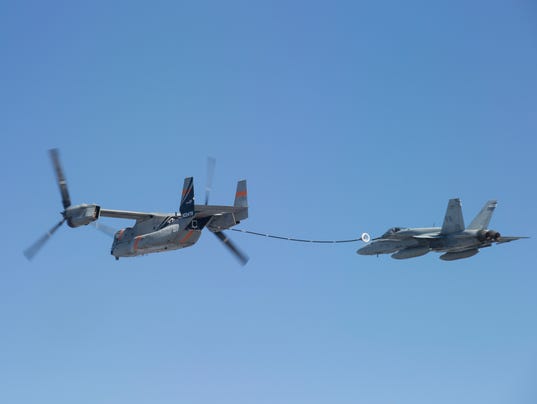
A prototype refueling system was tested in August, 2013 in Texas. In that evaluation, an Osprey equipped with tanks and a refueling hose flew as fighters trailed behind it. The aircraft "safely deployed, held stable, and retracted the refueling drogue as an F/A-18C and an F/A-18D Hornet flew just behind and to the side of the aircraft," Boeing, one of the companies that created the V-22, reported in a news release.
Giving the V-22 this new capability won't pigeon-hole the aircraft as a tanker and the Osprey will primarily be used to fly Marines and their gear. The tanker system is a piece of roll-on, roll-off equipment that will be temporarily installed on a particular aircraft, allowing it to switch between different types of missions.
The tanker capability is one of the latest modifications to the V-22.
marinecorpstimes

Dec 9, 2014

Bell Boeing V-22 Tests Forward-fired Rockets

V-22 Osprey manufacturer Bell Boeing V-22 successfully tested its forward-firing capability last month at the US Army Proving Ground in Yuma, Arizona.
Company officials said the test showed the V-22 can be armed with a variety of forward-facing munitions and can hit targets with a high degree of reliability. That will reduce the Osprey’s reliance on forward arming and refueling points, which are sometimes necessary to supply short-range attack rotorcraft in support of V-22 operations.
The company released a 12-second video which shows a rocket firing with a puff of smoke.
Forward-facing weapons and armor protection are among several quick-turnaround upgrades that US Special Operations Command is pursuing after three Air Force Special Operations Command (AFSOC) Ospreys were shot up over Juba, South Sudan, a year ago, a program official said in May.
defensenews

Nov 21, 2014

Japan announces decision to buy V-22

The Japan Ground Self-Defense has budgeted for FY2015 to buy V-22, according a proposal of the US Government.
"The V-22 was intended to have satisfied all the necessary requirements as of the Ground Self-Defense Force tilt - rotor machine".
mod.go.jp

Nov 4, 2014

Israeli Military Urge MoD To Stick With V-22 Deal

Top military officers are urging Israel Defense Minister not to back out of a Pentagon package of Bell Boeing V-22 tilt-rotors offered at a cut-rate price and under conditions set to expire Dec. 10.
Ya’alon approved the package nearly two months ago, with wholesale backing by the Israel Air Force training to operate the aircraft. The Israel Defense Forces (IDF) General Staff and Mossad intelligence agency also are eyeing them to support special operations, including any prospective missions targeting Iran.
The package was planned for approval by a high-level ministerial committee set for last week — now rescheduled for Nov. 5 due to Ya’alon’s decision to withdraw his support.
Israeli media reported last week that Ya’alon had decided to forgo the offer, with several outlets casting the decision as driven by ongoing tension between US President Barack Obama and Israeli Prime Minister Benjamin Netanyahu over a range of issues pertaining to Israel’s policy on Palestinian peace talks and West Bank settlements.
A Ya’alon adviser confirmed the defense minister’s decision to recommend passing on the V-22 deal in an upcoming meeting of a high-level ministerial committee.
He insisted that Ya’alon’s decision was driven strictly by budgetary pressures and post-Gaza war lessons assigning higher priority — and limited investment funds — to expanding Israel’s inventory of precision weaponry and armored vehicles for maneuvering ground troops.
Meticulously crafted over two years with extraordinary support from Hagel and the senior echelon of the US Navy Department, the Pentagon’s official offer was delivered last week to Israel’s defense procurement mission in New York.
It allows Israel to receive the planes now in production for the US Marine Corps for expedited delivery by the end of 2016 at a price more than $400 million less than initial estimates. In January, the Pentagon notified Congress of the potential sale, then estimated at $1.3 billion.
Israel also secured Pentagon approval to fund the deal through commercial bridge loans to be repaid with future military grant aid.
Israel would have been the first export customer of the Bell-Boeing tilt-rotor.
defensenews

Oct 31, 2014

Israel said to cancel aircraft V-22 Osprey purchase from US

Defense Minister Moshe Ya’alon has canceled a still-unsigned deal with the US for six V-22.
The V-22 Osprey, was seen as part of Israel’s future capacity to move Special Forces troops to countries as distant as Iran.
The aircraft can carry up to two dozen soldiers, can fly roughly 720 kilometers and, crucially, can be re-fueled in midflight.
US Secretary of Defense Chuck Hagel announced the deal during a visit to Israel in April 2013. The deal was to include, Hagel said at the time, anti-radiation missiles, advanced radars for Israel’s F-15s, KC-135 refueling aircraft and, “most significantly,” the V-22.
Ya’alon, decided to cancel the acquisition, against the advice of the IDF chief of General Staff and the Israel Air Force’s commander, on account of budgetary constraints and lessons learned in the wake of the 50-day battle in Gaza this summer, during which a need for improved armored vehicles, for instance, rose to the surface.
The reported decision to cancel the deal came three days after Israeli officials said the army would buy a second squadron of US-made F-35 fighter jets.
timesofisrael

Sep 9, 2014

V-22 To Participate in NATO Exercises

NATO intends to use US V-22 Ospreys in upcoming exercises across the alliance, which could lead to increased interest in the aircraft by European countries.
While there have been conversations about European partners purchasing the American-made Bell-Boeing Osprey, there have not been any “strong bites,” said US Air Force Lt. Gen. Brad Webb, commander NATO Special Operations Headquarters.
The US Air Force bases CV-22 Ospreys at RAF Mildenhall in eastern England.
The US Air Force showed off a CV-22 to alliance defense ministers at the NATO summit on Friday.
defensenews

May 23, 2014

SOCOM Soon Getting More Capable, Deadlier Ospreys and C-130s

US Special Operations Command fixed-wing fleet will add a forward-facing gun and better armor to its 50 CV-22 Ospreys and, Hellfire missiles to the AC-130 fleet, along with new command and control and radio frequency jammers and countermeasures to both platforms that can be rolled on and rolled off, depending on the mission.
After three of AFSOC’s Ospreys were shot up over Juba, South Sudan in December, resulting in the injuries of four Marines on board, the command realized that the birds needed better armor.
SOCOM leadership is also working on beefing up the firepower on the aircraft, testing new forward-firing weapons that it wants to put in place by the end of this year.
defensenews

US Aircraft sent to Italy for possible Libya evacuation

A Marine crisis-response team has deployed additional aircraft to Sicily as it awaits orders for a possible evacuation of American officials in Libya.
Seven Ospreys and three KC-130s from an air base in Spain have been positioned at U.S. Naval Air Station Sigonella with another Osprey arriving soon.
About 180 Marines and sailors with the team were moved last week with six aircraft from Morón Air Base in Spain; there are now 250 Marines there. The move was in response to growing concerns over militia battles in northern Libya and their proximity to Americans at the embassy in Tripoli. Several countries, including Saudi Arabia and Algeria, have already closed their diplomatic missions in Tripoli.
There have been no requests for assistance from the Marines in Sigonella. But if called on to help with evacuations of U.S. diplomatic personnel the team is in a posture and in a location that should they be needed in North Africa, specifically Libya, that they would be ready to do so.
The crisis-response team has been mobilized periodically as threats arise in Africa. The team took part in embassy evacuations in South Sudan last year.
The battles in Libya come after fighters loyal to a former regime general and later rebel leader attacked Islamist militias in the eastern city of Benghazi and the parliament in Tripoli.
stripes

May 6, 2014

Japan and Singapore on the list to buy V-22 Osprey

Japan, Singapore, South Korea and Taiwan are seeking a variety of helicopters, including the V-22 Osprey, to offset China’s maritime threat.
Japan and Singapore have expressed interest in the Bell-Boeing V-22 Osprey.
For Japan, China’s recent agitation over the Japan-controlled Senkaku Islands has raised fears China might attempt to seize the islands by force.
This has put Japan’s Defense Forces on notice: Improve range and capacity in its vertical-lift capability or risk losing the Senkakus, and possibly part of the Ryukyu Island chain, to China.
Japanese defense industry and government reports indicate the country is looking to procure 17 V-22s within the next five years.
Singapore is on the list to buy V-22s . The problem for Singapore is how to use Osprey to its full potential.
Singapore does not have an expeditionary force capability, though the military participates in regional humanitarian and disaster relief missions.
defensenews

Apr 19, 2014

Navy Set to Pick Presidential Helicopter Contractor

The Navy plans to select the contractor who will build the next generation presidential helicopter next month.
It appears the service will only have one contractor to choose from, Sikorsky, after two other teams dropped out of the bidding process. AgustaWestland and Northrop Grumman had planned to offer the AW101 helicopter, and Boeing had discussed offering modified versions of the V-22 Osprey and the CH-47 Chinook. Both dropped out.
That would leave Sikorsky as the lone bidder with the company set to offer its S-92 helicopter to replace the aging VH-3D Sea King.
The Navy plans to build a fleet of 21 operational aircraft and 2 test aircraft for the president. Marine Helicopter Squadron One will fly the new aircraft. Full operational capability is expected in 2022 and the first test aircraft will be delivered in 2016.
The Navy’s selection of a new contractor will come five years after the former contract with Lockheed Martin and AgustaWestland to building the helicopter was canceled. Cost overruns had ballooned by so much.
The former helicopter was so advanced it was supposed to survive a nuclear blast.
Five years later the Navy is ready to start anew, likely with the same company who built the aging presidential helicopter.
dodbuzz