Translate

Showing posts with label NAVANTIA. Show all posts

Jan 25, 2026

Spain’s Forgotten Aircraft Carrier: The SAC-220 and the Return of Conventional Carrier Ambitions


As Spain quietly re-evaluates the possibility of building a future conventional aircraft carrier, a largely forgotten chapter of national naval history suddenly becomes highly relevant. In the mid-1990s, Spanish shipbuilder Bazán (later IZAR, today Navantia) developed a fully-fledged CATOBAR aircraft carrier design known as SAC-220, a project that was not only technologically mature but actively offered on the international export market.

Three decades later, as Spain once again considers returning to fixed-wing naval aviation beyond the Harrier era, SAC-220 stands as a striking reminder that Spain once seriously pursued indigenous aircraft carrier design — and nearly exported it worldwide.

The SAC-220: Spain’s Ambition to Enter the Carrier Market

The SAC-220 was conceived during the 1990s as a medium-sized conventional aircraft carrier, intended to fill the niche between light STOVL carriers and large fleet carriers. The concept targeted navies seeking affordable access to fixed-wing carrier aviation without the extreme financial and industrial burden of supercarriers.

Technically, SAC-220 represented a mature and coherent design. It featured a CATOBAR configuration, enabling the operation of conventional fixed-wing aircraft using catapults and arresting gear — a capability Spain itself never operated operationally.

Key Technical Characteristics:

  • Length: 241.8 m
  • Beam: 29.5 m
  • Full-load displacement: ~27,000 tons
  • Propulsion: CODAG/COGAG
  • Power output: 76,000–88,500 hp
  • Max speed: 25.5–26.5 knots
  • Range: 7,500 nautical miles at 15 knots
  • Air group: ~20 fixed-wing aircraft + 4 ASW helicopters
  • Sea state: Flight ops up to Sea State 5

Bazán also developed a smaller derivative version — SAC-200, displacing roughly 24,000 tons, aimed at even more cost-sensitive customers.

Designed for Export: Argentina, Brazil, India and China

Rather than serving Spanish requirements, SAC-220 was conceived primarily as an export product. Spain already operated the STOVL carrier Príncipe de Asturias, making a CATOBAR design unnecessary domestically. Instead, Bazán targeted countries seeking low-cost carrier capability.

Argentina

The original conceptual customer was the Argentine Navy, which sought a replacement for the aging ARA 25 de Mayo. SAC-220 would have restored Argentina’s fixed-wing naval aviation capability following the Falklands War. However, Argentina’s severe economic crisis during the 1990s rendered such a purchase impossible.

Brazil

Brazil also evaluated the design as a replacement for Minas Gerais, but ultimately opted for the ex-French carrier Foch (São Paulo) in 2000, acquiring it at a fraction of the cost despite its limited remaining service life.

India

India emerged as a potential industrial partner, with discussions linked to the modernization of Cochin Shipyard. While SAC-220 was examined, New Delhi eventually turned toward Russian carrier solutions and later indigenous designs.

China

Perhaps most intriguingly, China was offered SAC-220 during a period when the PLAN was intensively studying aircraft carrier operations. Despite China’s later massive carrier program, the design was reportedly declined — likely due to financial constraints, technical uncertainty, and Beijing’s preference for absorbing foreign technology through study rather than direct acquisition.

Technical Strengths and Design Limitations

SAC-220 aimed to provide credible conventional carrier aviation within a compact hull, but inevitably faced structural compromises.

Analysts and forum specialists highlighted:

  • A relatively narrow beam, limiting deck space
  • Single or dual catapult layouts with constrained recovery zones
  • Tight margins for high-performance fighters

Despite this, SAC-220 would have been fully capable of operating aircraft such as the F-18 Hornet, A-4 Skyhawk, Super Étendard, MiG-29K, and even E-2 Hawkeye-type AEW platforms, something far beyond the reach of STOVL carriers.

Operationally, it was intended for sea control, limited power projection, and regional deterrence, rather than global strike operations.

Pocket Carrier Logic: Strategic Sense in Small Fleets

SAC-220 belonged to the concept of “pocket carriers” — vessels below 30,000 tons designed to deliver strategic relevance at manageable cost.

Lifecycle cost estimates at the time placed SAC-220 in the $350–400 million range, dramatically lower than contemporary fleet carriers. Even adjusted for inflation, such platforms remain financially accessible compared to full-size carriers.

For medium naval powers, SAC-220 offered:

  • Fixed-wing strike capability
  • Organic air defence
  • ASW and maritime surveillance
  • Strategic autonomy

All without the budgetary shock of supercarriers.

Why SAC-220 Failed — And Why It Matters Today

Despite aggressive marketing, no contracts were secured. Economic crises in Argentina and Brazil, strategic hesitation in India, and long-term planning cycles in China sealed the project’s fate.

Spain itself focused instead on the Buque de Proyección Estratégica (BPE) concept, which later became Juan Carlos I, prioritizing amphibious assault and helicopter operations over fixed-wing aviation.


Yet today, Spain once again faces a strategic inflection point:

  • Harrier retirement approaching
  • F-35B acquisition abandoned
  • Increasing expeditionary commitments
  • NATO power projection demands
  • Rising Mediterranean and Atlantic security pressure

In this context, Spain’s historical experience designing SAC-220 suddenly gains new relevance.

SAC-220 and the Modern Spanish Carrier Debate

Spain is now actively studying the construction of a future conventional aircraft carrier, likely larger than Juan Carlos I and capable of operating fixed-wing aircraft.

Unlike the 1990s, today Spain benefits from:

  • A mature shipbuilding industry (Navantia)
  • Extensive LHD & carrier design experience
  • Deep NATO interoperability
  • Industrial partnerships, notably with Turkey and HÜRJET

The SAC-220 design philosophy — compact, efficient, affordable — fits remarkably well with modern Spanish strategic logic.

Rather than seeking a supercarrier, Spain appears more inclined toward a medium-sized conventional carrier, optimized for:

  • Mediterranean operations
  • NATO task groups
  • Maritime security
  • Limited expeditionary strike

The SAC-220 was far more than an unrealized drawing-board project. It represented a serious, credible attempt by Spain to enter the elite club of aircraft carrier designers.

Today, as Spain reopens the carrier debate, SAC-220 provides both technical legacy and strategic inspiration.

A future Spanish conventional carrier may not resemble SAC-220 in form, but its design philosophy — efficiency, affordability, and strategic autonomy — remains strikingly relevant.

In many ways, Spain’s future carrier may finally realize a vision first sketched more than 30 years ago.

Jun 25, 2025

🇪🇸 Spain Plans Its First Conventional Aircraft Carrier in Historic Naval Leap


Spain commissions a feasibility study for its first conventional aircraft carrier, shifting from STOVL-only platforms and signaling a major evolution in naval air power.

Spain Prepares for Its First Conventional Aircraft Carrier.

In a historic shift for its naval strategy, Spain is preparing to build its first conventional aircraft carrier, a development that would significantly upgrade its maritime airpower capabilities. The Spanish Navy (Armada Española) has formally commissioned state-owned shipbuilder Navantia to conduct a feasibility study for what could become the largest warship in Spain’s history—surpassing the current LHD Juan Carlos I.

This initiative marks a clear evolution from the Navy’s original plan to operate up to three STOVL-capable amphibious assault ships to now embracing a mixed fleet that includes one conventional fixed-wing aircraft carrier. The envisioned carrier could resemble the French Charles de Gaulle, weighing around 40,000 tons and measuring over 260 meters in length.

Currently, the Juan Carlos I supports STOVL (Short Take-Off and Vertical Landing) aircraft such as the AV-8B Harrier II, now reaching the end of their service life. The only modern replacement available for such aircraft is the F-35B by Lockheed Martin, which limits operational flexibility and market competition.

A conventional aircraft carrier, using catapults and arrestor wires, would expand Spain’s fighter options to include the F-35C, F/A-18F Super Hornet, and Rafale M, among others. These aircraft offer longer range, heavier payloads, and more advanced sensors compared to STOVL types.
The move also aligns Spain with NATO partners like France and the U.S., both operating advanced carrier-borne aircraft. Furthermore, it opens the door to future integration of sixth-generation jets from the Future Combat Air System (FCAS) project, being jointly developed by France, Germany, and Spain.
Navantia's study will explore key systems including:

- Catapult-assisted take-off and arrested recovery (CATOBAR) systems
- Aircraft support for 25–30 fixed-wing manned fighter jets
- Integration of Class 3 UAVs with capabilities for early warning

Pending government approval, the first steel cut could take place by 2035, with the ship entering service around 2040. When complete, the new carrier will be larger and more capable than the Juan Carlos I (26,000 tons, 231 meters), marking a leap forward in Spanish naval aviation.
Spain’s future carrier air wing may include a mix of:

- Carrier-capable fighter jets (F-35C, Rafale M, or F/A-18F)
- Unmanned aerial vehicles (UAVs) for surveillance and ASW
- Future FCAS naval variants (anticipated post-2040)

This development ensures that Spain will always have two naval aviation platforms operational, even when one is undergoing extended maintenance addressing a crucial limitation faced by navies operating a single carrier-type vessel.
It also reflects a broader trend across Europe: modernization of naval forces and an increased focus on blue-water capabilities. With rising geopolitical tensions and renewed interest in power projection, Spain is positioning itself as a stronger and more autonomous player within both NATO and the EU.
The construction of a conventional aircraft carrier not only reflects Spain’s technological ambition and industrial capacity, but it also enhances the country's strategic relevance in the Atlantic and Mediterranean theaters. This evolution is emblematic of a new chapter for the Spanish Navy and for European naval power as a whole.

Jan 7, 2024

Turkey confirms the construction of a second aircraft carrier based on Navantia's Juan Carlos I


In a meeting of the Turkish Defense Industry Executive Committee, chaired by President Recep Tayyip Erdoğan, held at the Presidential Complex, the committee assessed the current state of the Turkish defense industry, outlined future objectives, and deliberated on crucial projects.

Decisions were made during the meeting, including the initiation of the design phase for an Aircraft Carrier as part of military ship projects. 

According to the known plans before the plans were finally confirmed for the construction of a new Turkish aircraft carrier, which will be an upgraded version of the TCG Anadolu. This project is based on Navantia's previous work, the Spanish company that designed the Juan Carlos I. However, there is no mention of new submarines in these plans, despite a potential collaboration agreement between Turkey and Spain for a medium-term program based on the design of the Spanish Navy's S-80.

The disagreement between Ankara and Washington over Turkey's purchase of Russian S-400 missile systems led to Turkey's exclusion from the F-35 fighter jet program. As a result, for now, only unmanned fixed-wing aircraft can operate on the TCG Anadolu.

The TCG Anadolu, with a deck of over 200 meters in length and a displacement of 28,000 tons, is the world's first ship to carry armed drones. This vessel was designed to accommodate unmanned models like the TB3 Bayraktar and Kizilelma, and possibly the light combat aircraft Hurjet in the future. Additionally, it is equipped to operate helicopters.

Plans were also approved for constructing ships such as MİLGEM 9-10-11-12th ships (I-class frigates), offshore patrol vessels, new types of landing ships, new generation minehunters, and Turkish Type Fast Attack Crafts (FACs).

Additionally, the decisions covered a wide range of initiatives, including new missiles, radars, electronic warfare, communications, various weapons, ammunition and equipment, air defense systems, and satellite and space systems.

The defense industry has significant contribution to the Turkish economy, noting a record-breaking figure of $5.5 billion, indicating a 27% increase compared to the previous year, demonstrating the growing confidence in Turkish defense industry products, with export destinations increasing from 176 to more than 185 countries.

Turkey is fully commited to achieve a fully independent defense industry, utilizing domestic and national technologies. It confirms the expansion of the Turkish Navy, particularly mentioning the official confirmation of the Aircraft Carrier project, expected to be a larger and more capable version of the TCG Anadolu.

However, there was no mention regarding to the TF-2000 destroyer project, raising questions about the decision's coverage, but there are ongoing and upcoming projects in shipbuilding, including the construction of Hisar-class offshore patrol ships and the Turkish Type Fast Patrol Boat project.


Nov 17, 2022

UK selects Harland & Wolff, Navantia and BMT team for support ships


The UK MoD has chosen Team Resolute – comprising Harland & Wolff, Navantia and BMT – as its preferred bidder for a £1.6 billion ($1.9 billion) project to build three new Fleet Solid Support (FSS) ships.
The decision represents a long-awaited conclusion to a programme vital for future UK Carrier Strike Group operations.
Navantia UK, a subsidiary of the Spanish shipbuilder, is prime contractor for the programme that will see finished ships assembled at Harland & Wolff’s Belfast shipyard.
Subject to final ministerial approval,  the Team Resolute consortium comprising BMT, Harland & Wolff and Navantia UK has been selected ahead of Team UK to build the three Fleet Solid Support Ships. This decision has been announced earlier than expected and will prove to be controversial.
TR says the majority of the blocks and modules for the ships will be constructed at Harland & Wolff’s facilities in Belfast and Appledore, with components to be manufactured in their other delivery centres in Methil and Arnish. Final assembly for all three ships will be completed at Harland & Wolff’s shipyard in Belfast. Build work will also take place at Navantia’s shipyard in Cadiz in Spain, in a collaboration that allows for key skills and technology transfer from a shipbuilder with recent experience in naval auxiliary construction. Precisely how this work share will be split will be the most contentious aspect of this contract award.
Harland and Wolff will have to rely heavily on Navantia – the prime contractor of the consortium, having only a small workforce and no recent track record in naval shipbuilding. It appears TR is now committed to constructing a much larger percentage of each vessel in the UK than had initially been the case.

Apr 30, 2020

Spain Awards Lockheed Martin $519m For F-110 5 Aegis & SPY-7 Radar Systems

The U.S. Navy, on behalf of Foreign Military Sales (FMS) customer Spain, has awarded Lockheed Martin a $519.1 million contract to support AEGIS and SPY-7 systems for the future F-110 frigates of the Spanish Navy.
The contract covers the procurement of AEGIS fire control loop development, Solid State S-Band Radar Processing Group, tools and test equipment, and spares for five new multi-mission frigates operating the AEGIS combat system.This FMS contract will support the in-development Bonifaz-class (F-110) Frigates of the Spanish Navy and their SPY-7 radar.
The contracted work will be performed mostly in the US and is expected to be completed by April 2030.
Spain is obligating $90.7 million in FMS funding at the time of the award.
Navantia and the Spanish Ministry of Defense have signed the contract for the construction of five F-110 frigates for the Spanish Navy in April 2019.
F-110 frigates are set to replace the Spanish Navy’s Santa Maria-class frigates which have been in service for over 30 years. F-110 frigates will be fitted with the Aegis combat system integrating a new solid-state S-band radar by Indra. Lockheed Martin and Indra have been collaborating since 2009 to develop a state-of-the-art S-band solid state radar for Spain’s F-110 Frigate Program.
navalnews

May 7, 2019

General Dynamics unveils their guided missile frigate proposal for U.S. Navy, based on Spanish F-100 design

Major United States shipyard General Dynamics Bath Iron Works, has unveiled their guided missile frigate proposal under the FFG(X) program for the U.S. Navy.
The concept of new guided missile frigate was unveiled during annual Sea-Air-Space, the largest maritime exposition in the United States.
In February 2018, the U.S. Navy awarded General Dynamics Bath Iron Works a $14.9 million contract for the concept design of the Navy’s planned Guided Missile Frigate (FFG(X)).
Bath Iron Works’ proposed design is based on a family of AEGIS Guided Missile Frigates designed by the Spanish shipbuilder Navantia.
The Navy’s initial request for proposals in November required that frigate designs be based on an existing hull form that is already in service. The Navy has said the requirement will make the planned production of 20 frigates more affordable and bring the ships to the fleet more quickly. The Detail Design and Construction award is planned to be in 2020.
Bath Iron Works designed the Navy’s prior frigate, the Oliver Hazard Perry class, and built many of the hulls. Bath Iron Works partnered with Navantia in the 1980s to adapt the Oliver Hazard Perry design for construction by the Spanish shipbuilding industry and for use by the Spanish Navy.
defence-blog

Jul 1, 2018

Spain cleared to buy Aegis systems for new F-110 frigates

The US State Department has approved a potential sale of five Aegis shipsets for the Spanish Navy’s new F-110 frigates.
A contract for the construction of five frigates is expected to be awarded this year and Navantia is already working on some elements of the ships’ systems and design.
The potential sale of US military equipment to Spain is worth an estimated $860.4 million and includes five MK7 Aegis weapon systems with computing infrastructure, fire control systems, baseline VII MK 41 vertical launching systems.
navaltoday

May 7, 2016

Australia is spending $640 million on naval supply ships made in Spain

The Turnbull government’s massive spend on Australia’s naval capability continued today after signing a deal to spend $640 million on two naval replenishment ships built in Spain .
Unlike recent announcements by the prime minister about building submarines and other ships in Australia, today’s decision to give the contract to Madrid-based Navantia was low key.
Defence minister Marise Payne confirmed Navantia as the preferred tenderer, beating South Korea’s Daewoo, for the two auxiliary oiler and replenishment (AOR) vessels in March.
Australia’s current supply ship, HMAS Success, launched in 1984, will reach its end of life in 2021, and needs to be replaced urgently.
The navy’s other supply ship, HMAS Sirius, is a former commercial oil tanker commissioned in 2006 and does not have the capability for other supplies. Navantia, which build the Royal Australian Navy’s two newest vessels, the landing helicopter dock ships, Canberra and Adelaide, will build two 19,500-tonne dual tanker and supply ships.
The contract stipulates that $130 million of the build will involve local industry for combat and communication systems, and elements of the onboard cranes. And an initial $250 million, five-year sustainment contract, also signed with Navantia, will be undertaken in Australia.
businessinsider

Dec 13, 2015

Navantia to Manage Australia’s AWD Destroyer Program

Navantia has signed a contract with Australian shipbuilder ASC for providing management services to AWD program. The signing took place in Sydney.
Navantia has been working in three important programs for the ADF since 2007, namely the Air Warfare Destroyers (AWDs), Landing Helicopter Docks (LHDs), and the LHD Landing Craft (LLC), under different contractual schemes to deliver to the best of its ability. ASC has signed a contract with Navantia whereby Navantia will provide the Shipbuilding Management Services (SMS) for the AWD Program.
Navantia will bring it significant experience in AWDs to support ASC in building the AWDs. Navantia is fully committed in delivering this key capability to the Royal Australian Navy, as it has already done with the two LHDs, HMAS CANBERRA and HMAS ADELAIDE, this last unit being commissioned into the RAN on the 4th of December.
defense-studies

Nov 28, 2015

NAVANTIA Delivers Final Batch of Four Landing Crafts to Australia

Navantia has the pleasure in delivering to the Commonwealth in Sydney the final batch of four LLCs. This is a major achievement, where Navantia has played an important role – that of Prime Contractor for the first time in an Australian program. Since 2007, Navantia has been working in three important programs for the ADF, namely the Air Warfare Destroyers (AWDs), Landing Helicopter Docks (LHDs), and the LHD Landing Craft (LLCs), under different contractual schemes to deliver to the best of its ability.
On 16th December 2011, Navantia signed a contract with the then Defence Materiel Organisation (DMO) under JP 2048 Phase 3 to build and deliver twelve LHD Landing Craft (LLCs) to the Commonwealth. All twelve have now been delivered to HMAS WATERHEN in Sydney on or ahead of schedule and to budget. The LLCs were built and tested in Cádiz, Spain, and shipped out to Australia.
Navantia understands that the first eight units are in operation with the RAN and are performing to the full satisfaction of Navy, having achieved various missions during sea trials with HMAS CANBERRA, which has also been commissioned into the RAN. Her sister ship, HMAS ADELAIDE, is due to be commissioned in Sydney on 4th December 2015.

Jan 6, 2015

Turkey's Future LHD Could Be Modified as an "Aircraft Carrier" to Deploy F-35B Jets

Turkish-German media Deutsch Tuerkische Zeitung is reporting that during the last meeting of the Turkish National Security Council (in presence of the Turkish President) the decision was made to built the future LHD (Turkish designation: LPD Project) as an aircraft carrier capable to deploy the F-35B, the short takeoff and vertical landing (STOVL) variant of the Lockheed Martin built Joint Strike Fighter. The vessel should be delivered to the Turkish Navy by 2019.
Turkey's Undersecretariat for Defense Industries (SSM) announced in December 2013 that it selected Sedef shipyard as winner of its LPD tender and that final contract negotiations with this shipyard could begin. Sedef shipyard in Turkey offers a design based on Juan Carlos LHD under the collaboration with Spain's Navantia.
navyrecognition

Oct 29, 2014

New Spanish Frigate F-110 Detailed

Spanish shipbuilder Navantia Tuesday revealed details of the F-110, a new guided-missile project to replace the Spanish Navy’s Santa Maria-class frigates in the 2020s.
The aim, he said, is to move to a detailed design and construction contract in 2016, with the first of five new frigates entering service in 2022.
Developed jointly by the Spanish Navy and Navantia, the multi-mission frigates will have a variety of warfare capabilities, ranging from anti-air, -surface and –submarine warfare, to power projection and asymmetric warfare features.
Major design details still need to be decided.
The ships will probably be armed with a five-inch gun and vertical-launch missile systems, likely two 8-cell launchers.
A large hangar and flight deck aft will be sized for two helicopters, plus unmanned aircraft systems.
defensenews

Navantia gets deal to study frigates for Australia

Navantia, the Spanish state-owned ship builder, announced on 23 October that it had signed a deal to study the SEA 5000 future frigate programme.
The contract is designed to support research into adding radar systems to its F-105 frigate as Australia prepares to buy eight ships, and is looking at using assistance from Navantia to build the ships domestically instead of reaching a deal with an overseas supplier. The UK's Type 26 frigate and Italian variant of the FREMM are considered likely overseas competition.
The contract is for nine months of work.
janes

Oct 13, 2014

Navantia signed a contract with Australia for the analysis of two logistics ships

Navantia signed a contract with the BMD of Australia to carry out a risk assessment, technically called Desing Risk Reduction Study (RRDS ), a new logistics ship AOR Australian.
Company officials explained that this study will last for approximately eight months and to analyze the feasibility of a redesigned combat supply ship ( BAC ) based on the specific requirements of the ship from Australian Cantabria , designed and built by Spanish public shipyards for the Spanish Armada .
Navantia has been shortlisted, along with South Korea's DSME as a possible supplier of ships.
In the Australian market, recently the Commonwealth of Australia has accepted the Canberra , first of two amphibious ships ALHD built by Navantia and the company BAE Systems .
The BAC Cantabria , delivered by Navantia in 2010, was deployed for several months in Australia with a mission to integrate and operate with the Royal Australian Navy (RAN).
infodefensa

Oct 6, 2014

Australia has Formally Accepted HMAS Canberra ALHD

Australia has signed on October 3 acceptance of ALHD Canberra, first of two LHD ships Navantia has built for Australia based on the LHD Juan Carlos I designed for the Spanish Navy.
The contract, signed in 2007, includes the construction of 85% of the two ships in the shipyards of Navantia in Ferrol and completion in Australia by BAE Systems.
The ship was transferred to Australia in August 2012 and will be definitely delivered to the Australian Navy on 28 November.
defense-studies

Sep 25, 2014

Spanish firm Navantia called in to salvage Australian Air Warfar Destroyer program

The Australian government will install a senior team of shipbuilders from Spanish firm Navantia to work on the Air Warfare Destroyers as it attempts to salvage the troubled $8.5 billion project.
The move is one of the first steps in the government’s recovery plan for what Defence Minister David Johnston has described as a “disgraceful mess of a project” and a “skunk” that has been plagued with cost overruns of more than $500 million and delays of up to two years.
Additional personnel from systems contractor Raytheon are also expected to be embedded into the workforce. Navantia, which was excluded from the original AWD ­Alliance consortium and blamed for many of the project’s initial design flaws, will provide direction for the workforce alongside ASC.
The move comes after a government review by former US secretary of navy Don Winter and Australian shipbuilder John White reportedly recommended installing BAE Industries to take control of the project.
Government sources say the move is a small step in a “long, tortuous and complex” process that may yet see BAE take on a greater role.
Navantia and BAE are jockeying for work on the Future Frigate program to replace the navy’s eight Anzac-class frigates. BAE is understood to be reluctant to take over the AWD project without a guarantee of work on the Future Frigate program for which it wants to build its Type-26 global combat ship. Navantia wants to build a Future Frigate based on the AWD hull.
theaustralian

Jun 25, 2014

Navantia upgrades Algerian amphibious ship

Spanish shipyard Navantia has handed over the amphibious ship LSTH Kalaat Beni Rached to the Algerian Navy after a major 18 month long upgrade, in Ferrol, Spain, on June 12 after complete overhauls of engines and systems, life extension repairs and the integration of a new command and control system, new gun and targeting systems and the structural modernisation of the vessels for greater performance and safety.
Navantia received the Algerian contract in July 2012, covering Kalaat Beni Rached (BDSL 473) and her sister ship Kalaat Beni Hammad (BDSL 472). The latter arrived in Ferrol earlier this month for her overhaul.
The two amphibious logistics ships were built in the United Kingdom in the 1980s. They feature a bow ramp to land vehicles with, a large internal vehicle storage area and ramps fore and aft. Although a hangar is not fitted, a helicopter deck can operate heavy helicopters.
Algeria is in the process of expanding its navy in recent years as it faces problems such as smuggling, illegal migration and indigenous terrorism. These threats mainly affect Algeria's harbours and maritime communication routes and ships passing through the Straits of Gibraltar. The country is also maintaining a strong navy to deter its neighbours, notably Morocco.
In April 2012 it emerged that Algeria had signed a contract with the China Shipbuilding Trading Company for three light frigates, after ordering two Meko A200N frigates from Germany’s ThyssenKrupp Marine Systems in March 2012. The three light frigates will displace around 2 800 tons fully loaded, and will be powered by MTU diesel engines. Algeria has also ordered two new Tiger class corvettes from Russia. The Tiger corvette (Project 20382) is an export model of the Project 20380 Steregushchy class, which is the Russian Navy’s newest corvette class.
In January Italian shipyard Fincantieri launched the Algerian Navy’s Kalaat Beni-Abbes landing helicopter dock ship, which will be delivered to Algeria later this year. Algeria may order a second of the type in the coming months.
defenceweb

Jun 24, 2014

Australia reveals interest in F-35B

Australian defence chiefs have told that Prime Minister coalition government is considering whether to acquire a number of short take-off and vertical landing Lockheed Martin F-35Bs.
Canberra confirmed in April it will acquire 58 F-35A Lightning IIs for the Royal Australian Air Force, adding to the 14 already on order to replace the RAAF's Boeing F/A-18A/B Hornet.
Australia has long-stated a requirement for 100 air combat aircraft. However, because it acquired 24 F/A-18F Super Hornets in 2009-2010 as a bridging capability between the retirement of the General Dynamics F-111C and the introduction of the F-35A, it has deferred a decision on Phase 2C of the project until the early- to mid-2020s.
The F-35B proposal is being pushed by Abbott’s office, and if acquired the aircraft would be fielded from the Royal Australian Navy’s two new LHD-class vessels – the first of which is to be commissioned as HMAS Canberra later this year.
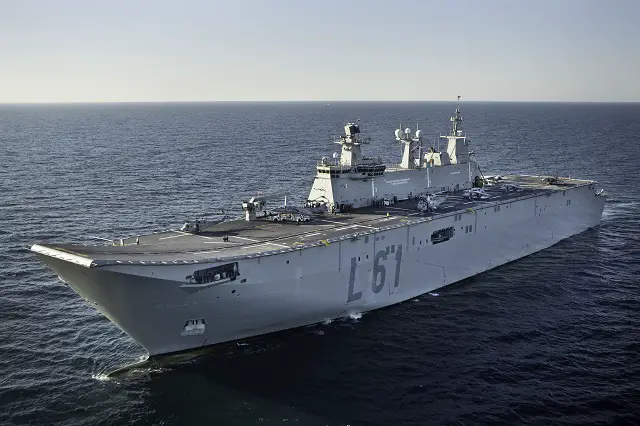
The two 27,000t LHDs currently under construction in Melbourne, Victoria are based on Spain’s King Juan Carlos 1 (L-61) vessel, built by Navantia. When ordered, the LHDs were intended for amphibious and regional humanitarian assistance missions. They have capacity for a battalion of troops, up to 100 vehicles, four large amphibious watercraft and a dozen or more helicopters to be embarked for such missions.
There has long been an intention to conduct operational ‘cross-decking’ operations with US Marine Corps and UK Royal Navy fixed and rotary-wing aircraft.
HMAS Canberra will be followed by HMAS Adelaide in 2016.
flightglobal

Jun 9, 2014

Navantia to assist Brazil in repair of Venezuelan OPV

Navantia has signed an agreement with Brazilian company ECOVIX-ENGEVIX to assist with the repair of the Venezuelan offshore patrol vessel (OPV) Warao (PC 22).
The Spanish state-owned company, which built the Avante 2400-class vessel known as the Patrullero Oceanico para la Vigilancia de la Zona Economica Exclusiva (POVZEE) by the Venezuelan Navy, said it will be providing technical support and replacement parts for the vessel's propulsion and control systems.
The 2,400 tonne Warao was taking part in the 'Venbras 2012' bilateral exercise with sister ship Kariña (PC 24) and Brazilian Navy ships when it ran aground.
janes

Jun 7, 2014

Australian Navy in urgent need of replenishment vessel, Spain Navantia and Daewo in the tender.

Australian Navy is in urgent need of large replenishment oiler.
Within a year of taking office the Government is moving decisively to tackle Labor’s Defence mess and to ensure that Australia does not face major capability gaps as a result of Labor’s defence cuts and failure to take crucial decisions, including on maritime capability.
Navy will be properly equipped in the years ahead and Australian industry will have the long-term strategic direction.
Replenishment vessels are considered essential to support sustained naval deployments. Navy’s current replenishment ship HMAS Success is in urgent need of replacement, and HMAS Sirius only provides limited replenishment capability.
In light of the urgent need to forestall a capability gap in this crucial area; the current low productivity of shipbuilders involved in the AWD program; and value for money considerations, the Australian Government has given First Pass approval for Defence to conduct a limited competitive tender process between Navantia of Spain and Daewoo Shipbuilding of South Korea for the construction of two replacement replenishment vessels based on existing designs.
The Government has committed $78.2 million to bring forward preliminary engineering and design work necessary to keep open the option of building the future frigate in Australia. In parallel, the Government is reviewing Australia’s shipbuilding requirements, capabilities and capacities in order to inform a long-term strategic naval plan that provides the ADF with leading-edge capabilities and Australian taxpayers with value for money.
The Government has brought forward an open competition with Australian industry to construct more than 20 replacement Pacific Patrol Boats. This important project will boost the maritime security and resource and fishery protection capabilities of partner countries in the South West Pacific and generate additional work for yards around Australia.
defense-studies