Translate

Showing posts with label ROYAL ARMY. Show all posts

Feb 2, 2026

Cómo el Reino Unido preparó la defensa de Gibraltar de posibles ataques de España y la Unión Soviética en los 80

(Del Artículo original publicado en el blog 'Thin Pinstriped Line')

En las primeras horas de mayo de 1982, tras indicios de que una fuerza anfibia española —oficialmente en maniobras— había comenzado a navegar cada vez más cerca de Gibraltar, el Gobernador ejerció sus poderes para ordenar la salida de buques de guerra de la Royal Navy y desplegar al Royal Army en las calles del Peñón, con el objetivo de defenderlo ante una posible invasión española.


Esto puede sonar al argumento de una novela barata de la Guerra Fría, pero estuvo sorprendentemente cerca de suceder. Este artículo analiza cómo, durante la década de 1980, el Reino Unido planificó activamente la defensa de Gibraltar tanto frente a una agresión soviética como española, en circunstancias tan improbables como delicadas.

En 1982, las relaciones entre el Reino Unido y España seguían siendo tensas debido a la cuestión de Gibraltar, especialmente tras el cierre de la frontera terrestre por parte de España en 1969. A lo largo de los años setenta existió una preocupación real de que España pudiera intentar algún tipo de acción militar limitada, lo que llevó a desarrollar planes detallados para defender “el Peñón” el tiempo suficiente como para permitir que prevalecieran soluciones diplomáticas.


La invasión argentina de las Islas Malvinas incrementó de forma notable estas preocupaciones, dado el papel militar clave que desempeñaban las instalaciones británicas en Gibraltar en el apoyo a la Fuerza de Tareas enviada al Atlántico Sur.

En abril de 1982, los Jefes de Estado Mayor británicos revisaron con urgencia los planes y capacidades necesarias para mantener Gibraltar a salvo, tanto frente a un posible ataque argentino como para disuadir a España de aprovechar una eventual distracción del Reino Unido, tanto a corto como a medio plazo.

Los planes para reforzar el Peñón se conocían como Joint Tactical Plan (JTP) 52, y estaban diseñados para responder al riesgo de una agresión española. Tal y como señalaban los propios mandos:

“El plan contempla el refuerzo de Gibraltar ante una amenaza directa contra el Peñón, no un plan de contingencia para una guerra con España. Naturalmente, si los acontecimientos escalaran hasta un nivel tan desafortunado, se asignarían las fuerzas apropiadas según dictara la situación”.

Una de las principales preocupaciones inmediatas fue la presencia de una fuerza anfibia española con unos 4.000 infantes de marina embarcados, operando a apenas 35 millas de la colonia entre el 26 de abril y el 4 de mayo. Aunque la amenaza se consideraba extremadamente improbable, no podía descartarse por completo.

Para reducir este riesgo, se desplegaron en Gibraltar dos aviones de ataque SEPECAT Jaguar de la RAF y un helicóptero Lynx de la Royal Navy, proporcionando una capacidad básica de ataque antibuque frente a unidades españolas que pudieran representar una amenaza para el Peñón.

El comandante en jefe en Gibraltar estaba lo suficientemente preocupado como para ordenar formalmente la puesta en marcha de “preparativos encubiertos para hacer frente a cualquier intento —admitidamente extremadamente improbable— de asalto anfibio contra Gibraltar”.

Estas medidas incluían la preparación discreta de buques de la Royal Navy para hacerse a la mar con muy poco preaviso, con el fin de vigilar a la fuerza anfibia si se desplazaba hacia el este, fuera de la zona de ejercicios, en dirección a Gibraltar. De continuar ese movimiento, las unidades del Ejército pasarían a un estado de máxima alerta, con las tripulaciones aéreas ya en cabina.

Las reglas de enfrentamiento (ROE) propuestas establecían que la Royal Navy no abriría fuego hasta que el “enemigo” disparase primero o hubiese desembarcado en Gibraltar y abierto fuego allí. Resulta especialmente significativo que estas ROE se refiriesen explícitamente a las tropas españolas como “enemigo en territorio de Gibraltar”.

España, por supuesto, no invadió Gibraltar. Sin embargo, el episodio llevó al Ministerio de Defensa británico a una revisión urgente de las defensas necesarias para hacer frente a “la situación en la que un comandante español local pudiera decidir intentar una aventura no autorizada y sin apoyo contra el Peñón”.

Las conclusiones fueron preocupantes: existía una clara insuficiencia de artillería antiaérea —dependiendo todavía de cañones Bofors de 40 mm de la Segunda Guerra Mundial para defender el aeródromo—, una capacidad limitada de contrabatería frente a la artillería española (16 piezas de 105 mm y misiles antiaéreos) y una notable carencia de radares de vigilancia.

El gran dilema residía en equilibrar la necesidad de defender y reforzar Gibraltar con la de gestionar las tensiones locales y las relaciones diplomáticas. Un refuerzo militar demasiado visible podría incrementar las tensiones y dañar seriamente las relaciones bilaterales. Por ello, todas las medidas debían aplicarse manteniendo un perfil lo más bajo posible.

Tras el final de la Guerra de las Malvinas, el Reino Unido continuó preocupado por la defensa de Gibraltar, tanto ante el riesgo de una “aventura” española no autorizada como frente a una posible guerra general con la Unión Soviética. Durante varios años, la RAF mantuvo un destacamento permanente de dos Jaguar en Gibraltar para proporcionar apoyo aéreo cercano inmediato, mientras que la Royal Navy desplegó un Lynx equipado con misiles antibuque y sensores de vigilancia.

A esto se sumaban visitas regulares de otros aviones de la RAF. La idea era sustituir una presencia permanente visible por destacamentos rotatorios, manteniendo al mismo tiempo un mensaje claro de disuasión. También se contempló el despliegue de misiles Exocet como refuerzo de la defensa de la OTAN en el Estrecho.


El Ministerio de Defensa deseaba desplegar estos sistemas hacia 1985, pero la primera ministra Margaret Thatcher optó por la cautela, buscando no poner en riesgo las relaciones con España sin dejar de cumplir los compromisos con la OTAN.

El despliegue de Misiles antibuque Exocet


Según puede determinarse, el Exocet fue desplegado en Gibraltar hacia 1986, cuando la amenaza española ya había disminuido notablemente. De hecho, en 1983 el Comité Conjunto de Inteligencia había concluido que:

“No existe probabilidad de un ataque a nivel de brigada contra Gibraltar. Sin embargo, siempre existirá la posibilidad de que un comandante local intente una acción de bajo nivel contra el Peñón. Es poco probable que tal operación cuente con el apoyo de mandos superiores o del Gobierno español, pero no puede garantizarse una alerta temprana”.

El Ministerio de Defensa consideraba que, con las defensas existentes, el Reino Unido podría resistir con éxito un ataque limitado:

“Para hacer frente a la amenaza española, actualmente hay en Gibraltar un batallón de infantería regular, equipado con misiles MILAN y morteros, apoyado por una compañía y seis piezas LIGHT GUN del Regimiento de Gibraltar. Un asalto sorpresa de infantería española podría ganar algo de terreno, pero gracias a las excelentes posiciones defensivas del Peñón, el ataque debería detenerse rápidamente cerca del aeródromo”.

La Amenaza de la Unión Soviética 

Aun así, la amenaza soviética seguía siendo prioritaria. El Ministerio de Defensa evaluaba que, en caso de guerra, Gibraltar sería un objetivo clave para la URSS mediante el minado de accesos al puerto o al Estrecho, la infiltración de fuerzas especiales desde submarinos o buques mercantes, ataques con misiles lanzados desde submarinos y ataques aéreos con bombarderos medios empleando bombas y misiles de largo alcance.

Para demostrar a la OTAN el compromiso británico con la defensa del Estrecho, se decidió finalmente desplegar el Exocet en algún momento de 1985. Los registros sobre su servicio son escasos, pero todo indica que estuvo operativo a finales de los años ochenta y que ya había dejado de emplearse de forma rutinaria en torno a 1991, tras el colapso de la amenaza.

La retirada definitiva del Exocet del servicio de la Royal Navy en 1997 marcó también el fin de su presencia en Gibraltar, en un contexto en el que la amenaza española había desaparecido por completo.

Esta historia ilustra las dificultades de planificar para contingencias impensables. Resulta casi increíble que, hace apenas 40 años, el Reino Unido considerase que existía una amenaza militar remota pero creíble contra Gibraltar y planificase activamente cómo defenderse de un ataque sorpresa español. Afortunadamente, las relaciones bilaterales actuales son mucho más sólidas, y este escenario pertenece hoy al ámbito del “qué hubiera pasado si”, no a las salas de planificación militar.

Artículo original publicado en el blog 'Thin Pinstriped Line'


Jan 10, 2023

Ukraine Russia War Day 321

UK considering supplying Ukraine with Challenger 2 tanks to fight Russian forces


The UK is considering supplying Ukraine with British tanks for the first time to fight Russia's invading forces.

Discussions have been taking place "for a few weeks" about delivering a number of the British Army's Challenger 2 main battle tank to the Ukrainian armed forces, a Western source with knowledge of the conversations said.

sky

USA weighs sending Stryker combat vehicles to Ukraine


The U.S. is considering sending Stryker armored combat vehicles to Ukraine in an upcoming aid package to help Kyiv fend off an expected Russian spring offensive, according to two people familiar with the discussion.

The news follows the Biden administration’s announcement last week that it will send 50 Bradley Fighting Vehicles, a powerful tracked armored vehicle that carries an autocannon, a machine gun and TOW missiles.

politico


Pentagon awards $40M ‘Vampire’ contract for Ukraine’s drone defenses


The Pentagon has awarded L3Harris Technologies a $40 million order to send Ukraine “Vampire” counter-drone systems by mid-year, the company announced Monday.

L3Harris said it will install 14 kits onto vehicles the U.S. government provides Ukraine. Vampire, which stands for Vehicle Agnostic Modular Palletized ISR Rocket Equipment, consists of a laser-guided-missile launcher that can quickly be installed in a civilian truck bed.

defensenews


Aug 30, 2015

UK To Remanufacture their 'Apaches' to AH-64E Version

The United Kingdom has requested the remanufacture of fifty WAH-64 Mk 1 Attack Helicopters to AH-64E Apache Guardian Helicopters with one hundred and ten (110) T-700-GE-701D Engines (100 installed and 10 spares), the refurbishment of fifty-three (53) AN/ASQ-170 Modernized Target Acquisition and Designation Sights (M-TADS) (50 installed and 3 spares), the refurbishment of fifty-three (53) AN/AAR-11 Modernized Pilot Night Vision Sensors (PNVS) (50 installed and 3 spares), the refurbishment of fifty-two (52) AN/APG-78 Fire Control Radars (FCR) (50 installed and 2 spares) with fifty-five (55) Radar Electronics Units (Longbow Component) (50 installed and 5 spares), fifty-two (52) AN/APR-48B Modernized Radar Frequency Interferometers (50 installed and 2 spares), sixty (60) AAR-57(V) 3/5 Common Missile Warning Systems (CMWS) with 5th Sensor and Improved Countermeasure Dispenser (50 installed and 10 spares), one hundred and twenty (120) Embedded Global Positioning Systems (GPS) with Inertial Navigation (100 installed and 20 spares), and three hundred (300) Apache Aviator Integrated Helmets.
dsca

Mar 23, 2015

UK mothballs 16 AH-64 Apache fleet with end of Afghan ops

The UK has mothballed a quarter of its AgustaWestland-Boeing WAH-64 Apache Longbow AH.1 helicopters following the end of combat operations in Afghanistan.
In January, 16 of the British Army's 66 Apaches were placed into storage, leaving a force of 50 helicopters now operating out of Wattisham Airfield in Suffolk.
Currently, the Apache is fielded by 653 (operational conversion unit), 662, and 663 Squadrons of 3 (Attack) Regiment, and 656 and 664 Squadrons of 4 (Attack) Regiment.
The MoD is also assessing its options for maintaining the UK's attack helicopter capability out to 2040 and beyond.
In early March the MoD released a request for information (RfI) for remanufacturing the army's current AH-64D Block 1-standard helicopters into the latest variant AH-64E.
A decision on the way forward is expected in March 2016.
janes

Mar 12, 2015

AgustaWestland lobbying against United Kingdom's possible AH-64E Buy

The UK's efforts to sustain its Apache attack helicopter capability are being seriously hampered by lobbying from AgustaWestland.
With the British Army's 66 AgustaWestland-Boeing WAH-64D helicopters soon needing replacement due to obsolescence, the Ministry of Defence's (MoD's) preferred option of buying the new AH-64E directly from the United States is being delayed by AgustaWestland lobbying for work on any such procurement programme.
Boeing has offered to sell the AH-64E to the UK at GBP20 million (USD30 million) per aircraft (taking advantage of a US Army multi-year procurement package). If the helicopters were to be licence-built or modified by AgustaWestland, as was the case when the WAH-64D Block I helicopters were first acquired in the 1990s, this sum would more than double to GBP44 million.
Deciding how to proceed is becoming ever more urgent for the MoD, as the processing chips that drive the early-model Apache systems are no longer made, and the stockpile that Boeing has built up is expected to be depleted by around 2017.
Defence chiefs fear that delays of this nature may result in a capability gap between the older WAH-64Ds having to be retired around this date, and a replacement being introduced. The process has now been put back until after the General Election on 7 May, and a decision will not be taken until March 2016. This could mean a replacement platform not entering service until about 2020.
The AH-64E is understood to be the favoured option.
janes


Sep 30, 2014

UK deploys Watchkeeper UAV to Afghanistan

The first operational flight of the WK450 Watchkeeper tactical unmanned aerial vehicle (UAV) has taken place in Afghanistan only three months before UK forces are due to withdraw from the Southwest Asian country.
janes

Aug 7, 2014

AW-159 Likely to be Philippines Navy First ASW Helicopters

There is a strong possibility that the AgustaWestland AW-159 "Wildcat" will be selected as the Philippine Navy's (PN's) first anti-submarine warfare (ASW) helicopter as revealed a military source Tuesday.
The AW-159 (previously called the Future Lynx and Lynx Wildcat) is an improved version of the Westland Super Lynx military helicopter.
The helicopter has been ordered for the Royal Navy and British Army.
It is to enter service with the British Army in 2014 and with the Royal Navy in 2015.
Money for the two ASW helicopters will be sourced from Armed Forces of the Philippines Modernization Trust Fund.
Acquisition of the two ASW helicopters is under the Medium Term Development Capability Plan for 2013 to 2017.
The AW-159 ASW will be assigned to the BRP Gregorio Del Pilar and BRP Ramon Alcaraz.
The acquisition process for these ASW helicopters is expected to go on full gear once the PN completes its five AW-109 order deal from AgustaWestland by the third quarter of 2014.
defense-studies

May 27, 2014

UK To Acquire Missile Warning System for Helos, Fixed-Wing Craft

Britain is buying a BAE Systems third-generation (Gen 3) common missile warning system (CMWS) that helps protect helicopters and fixed-wing aircraft against small arms fire and rocket-propelled grenades, as well as missiles.
The military will replace some second-generation systems and outfit new aircraft. Platforms, including Apache, Chinook, Wildcat and Merlin helicopters, will receive the equipment.
The contract will ensure armed forces will have around 300 systems in total. The system would be used predominantly on rotor-wing aircraft, but one fixed-wing platform would also be outfitted.
Small arms and rocket-propelled grenades have been a constant threat to air crews in Afghanistan.
defensenews

Mar 21, 2014

AH-64E looking increasingly likely for UK

The UK looks increasingly likely to procure the Boeing AH-64E.
The government is currently considering options to sustain the British Army's Apache fleet until its planned out of service date in 2040.
The 66 WAH-64D Block I helicopters in the UK inventory are rapidly becoming unsupportable, as the US Army and Boeing shift their attention to the AH-64D Block II and AH-64E fleets as operated by the US and most international customers.
Given the success of the Apache in Afghanistan and Libya, the British Army has made clear its desire to upgrade its current WAH-64D Block I helicopters with the latest variant AH-64E. The deputy commander of the tri-service Joint Helicopter Command (JHC), said that the army "rather hopes" that the AH-64E will be the chosen successor, for fielding before 2020.
The MoD is currently undertaking a capability sustainment programme to sustain the UK's attack helicopter capability out to 2040 and beyond.
janes

Mar 10, 2014

THALES’S WATCHKEEPER GIVEN RELEASE TO SERVICE BY UK MINISTRY OF DEFENCE

Watchkeeper, the unmanned aircraft system (UAS) developed by Thales for the British Army, has been given a Release To Service by the UK’s Ministry of Defence (MOD).
Watchkeeper is the first UAS to be awarded a full Release To Service (RTS), and is the only UAS of its type allowed to fly in UK airspace. The RTS follows rigorous safety and airworthiness reviews to ensure the system can be operated safely by the British Army. It will support British Army operations by allowing training on the system in the UK.
thalesgroup

Feb 28, 2014

British Army to start Watchkeeper flights in April

The British Army is within weeks of performing its first training flightsWatchkeeper unmanned air system.
The type “should commence flying from Boscombe Down in early March 2014.
The first flights from the MoD/Qinetiq flight test centre will be conducted in association with the Thales UK/Elbit Systems joint venture responsible for developing the tactical UAS.
Once these have been completed an initial release to service is expected to be authorised to allow the first military flights by the army from early April 2014.
The army’s Watchkeeper system will eventually comprise 54 air vehicles, 15 ground control stations and associated equipment.
flightglobal

Oct 17, 2013

UK To Purchase 200 StarStreak Missiles From Thales UK

Britain’s Defense Ministry has signed a deal with Thales UK to purchase a new batch of StarStreak short-range surface-to-air missiles.
The contract for 200 missiles will boost weapon stockpiles available to the regular and reserve units that already use the Mach 3 velocity missile, which can travel at more than 1 kilometer per second.
The British deploy the weapons on tracked vehicles, as well as from lightweight firing posts.
Aside from the British military, the ground-based air defense system has also been purchased by South Africa and most recently Thailand.
A military team from Thailand has been in Northern Ireland recently for training ahead of delivery of the main production consignment, scheduled for the fourth quarter of this year.
defensenews


British military flying in Germany ends after 68 years

British military flying in Germany has ended after 68 years with a ceremonial fly-past of the last Lynx helicopters on Friday.
The withdrawal of the remaining choppers is part of a sharp reduction of Britain’s 20,000-strong military presence in Germany. In March was that all British troops would be withdrawn from their bases in Germany by 2020. 15,000 servicemembers will be pulled out in the next three years.
The last three Lynx helicopters of the 1st Regiment Army Air Corps based in Germany left their base at Gütersloh on Friday.
At the height of the Cold War, the Royal Air Force had hundreds of aircraft — including several squadrons of nuclear bombers — in West Germany, and operated dozens of air bases throughout the country.
stripes.com

Oct 8, 2013

Watchkeeper UAV edges towards UK acceptance

The British Army’s late-running Watchkeeper unmanned air system has cleared a major hurdle on its way to delayed service introduction, with the UK Military Aviation Authority (MAA) having approved a statement of type design assurance.
With this MAA approval now in place, Thales/Elbit Systems joint venture UTacS and the army will next seek to secure military type certification for the Watchkeeper before it can be introduced by Royal Artillery batteries.
The MoD in mid-September announced that an interim intelligence, surveillance, target acquisition and reconnaissance service being provided by Thales in Afghanistan using Elbit’s Hermes 450 UAS (below) has passed 70,000 flying hours. Operated from Camp Bastion in Helmand province since 2007 under an urgent operational requirement deal, air vehicles are currently organised in five “task lines”. Roughly 1,460 flights per year are currently being conducted with the fleet.
flightglobal

Feb 5, 2013

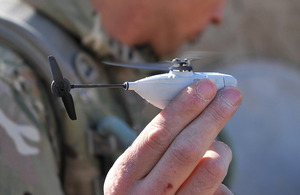
British troops in Afghanistan using palm-sized nano UAV


British troops in Afghanistan are the first to use state-of-the-art handheld nano surveillance helicopters.

The Black Hornet Nano Unmanned Air Vehicle measures around 4 inches by 1 inch (10cm x 2.5cm) and provides troops on the ground with vital situational awareness.

The Black Hornet is equipped with a tiny camera which gives troops reliable full-motion video and still images. Soldiers are using it to peer around corners or over walls and other obstacles to identify any hidden dangers and the images are displayed on a handheld terminal.

gov.uk

Jan 28, 2013

Royal Navy Wildcat makes flight debut


The UK Ministry of Defence has released images showing the first flight of a production example of the Royal Navy's new AgustaWestland Wildcat HMA2 helicopter.

Performed from the airframer's Yeovil production site in Somerset, the milestone was reached by aircraft ZZ397, which was previously due to have been accepted by the navy in mid-December 2012.

AgustaWestland will produce 28 Wildcats for the RN and 34 for the British Army under a programme worth more than £1.6 billion ($2.5 billion), with the type to enter use with the services in 2015 and 2014, respectively. The manufacturer will also deliver training and support services under a £250 million agreement signed during 2012.

Also being marketed to potential international customers as the AW159, the Wildcat won its first export competition in January 2013, when the South Korean navy selected the type for an initial eight-aircraft requirement. A contract signature for the roughly $560 million deal is expected soon, with deliveries sought from 2015.

Dec 6, 2012

British Army's fleet of Apache helicopters 'could be scrapped' by 2017


Britain’s Apache gunships have been in use since 2001, seeing action in Afghanistan -and in Libya.
Despite the helicopters’ successes on the frontline, defence sources suggested that the Army Air Corps fleet of 66 Apaches could eventually be cut to around 50 aircraft fit for operations.
Britain’s American-made AH-64D helicopters face becoming redundant because the US has decided to stop using the AH-64D model and adopt a newer variant, the AH-64E.
That means essential technical support for the British Apache fleet will be withdrawn from 2017.

telegraph

UK AND SPANISH PARAS IN JOINT EXERCISE


Soldiers from Britain’s Parachute Regiment have participated in a joint military exercise in Spain alongside their Spanish airborne counterparts.
The exercise, the first of its kind in Spain with the 1st Parachute Infantry Bandera ‘Roger de Flor’, is aimed at preparing the paratroopers to be deployed anywhere in the world as the first soldiers on the ground.

The Ministry of Defence said Exercise Iberian Eagle marked a significant transition for the soldiers of B Company, 3rd Battalion The Parachute Regiment (3 PARA), as they resumed their role as part of the Army’s high-readiness Airborne Task Force (ABTF), having served their last operational tour in Afghanistan.

Gibraltar Chronicle

Nov 19, 2012

007 joins UK Forces in Afghanistan for Skyfall screening


Soldiers, sailors and airmen serving at Camp Bastion in Helmand, southern Afghanistan, met 007 star Daniel Craig when he visited the base.

mod.uk

Sep 10, 2012

Royal Marines ready for Afghanistan deployment

40 Cdo will be based in Nahr-e Saraj, one of the biggest districts in central Helmand, supporting and mentoring the Afghan National Security Forces in preparation for transition in 2014 rather than fighting insurgents.

learn more