Translate

Showing posts with label GREYHOUND. Show all posts

Feb 24, 2015

Bell-Boeing Expecting at Least Two International Orders for V-22 Osprey in 2015

V-22 Osprey has yet to land an international contract, but company executives are betting that they will have two foreign customers in hand by the end of the year.
Japan’s ministry of defense announced the purchase 17 Ospreys last year, although there is no contract set in stone yet. Israel had plans to buy the tiltrotor, but that deal remains in flux due to budget constraints.
Additionally, the platform has received significant interest from countries in the Middle East.
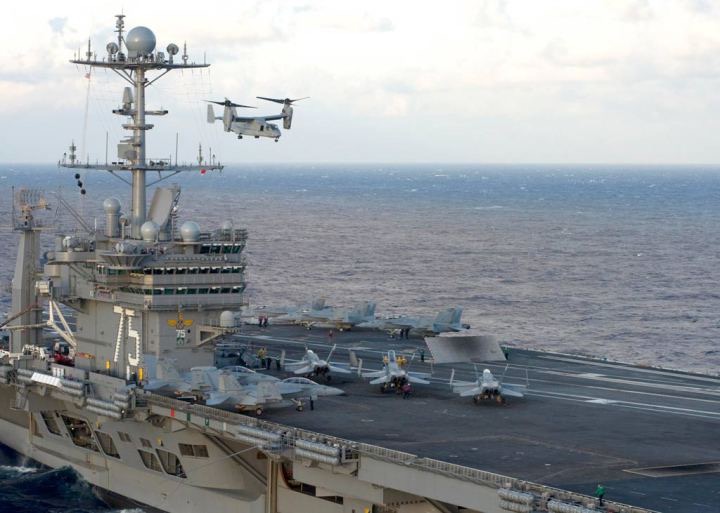
The Navy in their fiscal 2016 budget disclosed plans to buy 44 aircraft for what the service calls carrier onboard delivery — that is, flying people, supplies and cargo on and off flattops.
The Navy’s Ospreys will probably be slightly different than those flown by the Marine Corps and special operators.
Northrop Grumman’s C-2 Greyhound has filled the carrier onboard delivery role since 1966. Northrop proposed modernizing the C-2’s wings, engine and avionics, which executives claimed would be at least two times less expensive than buying a new aircraft. Bell-Boeing asserted that the Osprey would be more cost-effective over the long haul.
According to the budget, the Navy plans to procure 22 V-22s in fiscal years 2018 through 2020. That will likely result in another five-year multiyear contract for Ospreys to be signed before the current one ends in September of calendar year 2018.
nationaldefensemagazine

Jan 14, 2015

US Navy Decides to Buy V-22 Ospreys to Replace C-2A

The Navy will buy V-22 Osprey tiltrotors to replace its aging C-2A Greyhound turboprop aircraft in flying carrier on board delivery (COD) missions. The US Navy will buy four V-22s each year from fiscal 2018 to 2020.
The Marine Corps and other Osprey advocates, have argued for years that the Navy should replace its aging conventional take off C-2As with vertical take off and landing V-22s.
The C-2As carry cargo, mail and passengers between aircraft carriers and shore. The first Greyhound prototypes flew in 1964. The Osprey is in service with the Marine Corps since 2007 and the Air Force since 2009, tilts two large wingtip rotors up to take off and land vertically and forward to fly like a turboprop airplane, giving it far greater speed and range than conventional helicopters.
Until the past couple of years, Navy leaders had shown little interest in actually buying their planned 48 Ospreys. But in 2011, the Marine Corps began qualifying its MV-22s for carrier landings, and a six-day “military utility assessment” conducted last summer off the coast of Florida, in which V-22s carried passengers and cargo to and from the USS Harry S Truman (CVN 75), found that: “The V-22 demonstrated an effective, flexible, and safe capability to conduct the COD mission with no modifications and no adverse impact to cyclic flight operations.”
The first dozen HV-22s would be taken from what would have been the Marine Corps share of V-22s built in fiscal 2018-20 under the prospective third multiyear contract. Those first Navy V-22s will be replaced in the Marine Corps inventory in fiscal years 2021, 2022, and 2023 with a dozen Ospreys “that would have been allocated to the Navy,” the memo provides.
breakingdefense

Apr 12, 2014

Lockheed Revives an Old Idea for New Carrier Cargo Plane

The Northrop Grumman C-2A has been a familiar sight aboard US aircraft carriers for decades, shuttling people and cargo from ship to shore in the carrier-on-board-delivery (COD) role. The venerable aircraft are wearing out, and an unusually intense competition between Northrop Grumman and Bell Boeing already has garnered attention, even though the program to buy 35 replacement aircraft is not expected to officially begin until next year at the earliest.
Now, a third player has entered the COD fray, with Lockheed Martin offering refurbished and remanufactured versions of its S-3 Viking antisubmarine aircraft, nearly all of which were retired by early 2009. Ninety-one of the aircraft remain in storage at Davis-Monthan Air Force Base in Arizona.
Those aircraft still have quite a bit of life on them, having flown an average of 9,000 hours.
Designed in the early 1970s as a carrier-based anti-submarine aircraft, the Viking was used in its later service years as a tanker. Lockheed’s COD proposal — dubbed the C-3 — would replace the S-3’s fuselage with a wider version, but retain the original wings, tail assembly, engines and crew compartment.
A refurbished and remanufactured aircraft, would have a flying life greater than 10,000 hours.
The aircraft would be big enough to transport Pratt & Whitney jet engines for the F-35 joint strike fighter.
With an unrefueled range of 2,400 nautical miles carrying a 10,000-pound load, the C-3 would have twice the range of a new C-2, and triple the range of an Osprey.
Of the 91 S-3s in storage, 87 are useable. A number of spare General Electric TF-34 turbofan engines used by the S-3 also are in storage.
Lockheed has also proposed refurbishing S-3s for the Republic of Korea, which is seeking an anti-submarine aircraft. Those planes would not be rebuilt as in the C-3 proposal, but retain their original fuselages.
defensenews

Jul 15, 2013

US Navy Eyes C-2, H-60 Replacement Programs

A Sikorsky-Boeing team is expected to submit a proposal for the US Army's Future Vertical Lift initiative that may include counter-rotating co-axial main rotors and a pusher propeller, as in this concept from the team. Similar technologies could be included in a future US Navy MH-XX helicopter.
The Sikorsky H-60 Seahawk helicopter and Northrop Grumman C-2 Greyhound carrier-on-board delivery (COD) plane are longtime stalwarts of US Navy operations. The 35 Greyhounds constantly shuttle passengers and cargo to and from the fleet’s aircraft carriers, while some 460 H-60s of various models carry out a wide range of missions.
Both aircraft types will become due for replacement, and the way ahead for each has yet to be determined.
The newest C-2A dates from 1990, and the service is planning to award a replacement contract in 2016. Among the contenders are an updated version of the C-2A from Northrop, and a COD version of the Bell-Boeing MV-22 Osprey tilt-rotor aircraft.

defensenews

Apr 10, 2013

Battle brews over US Navy C-2A Greyhound replacement


A battle is brewing between Northrop Grumman and Bell-Boeing over the US Navy's nascent requirement to replace its ageing fleet of Northrop Grumman C-2A Greyhounds.
Bell-Boeing, with the strong backing of the US Marine Corps, is urging the USN to replace its C-2s with its V-22 Osprey tiltrotor. While the navy is officially on board to buy 48 Ospreys, the service has never found a niche for the machine nor has it allocated funding to pay for those aircraft.
For Bell-Boeing, an opportunity arose when a USN analysis of alternatives showed that the only suitable follow-ons to the Greyhound for the carrier onboard delivery (COD) mission were the V-22 or a modernised C-2. A draft request for proposal might be issued as early as 2014.

flightglobal