watch
watch
Translate
Showing posts with label TU-95. Show all posts
Apr 8, 2020
Dec 6, 2017
Russian Air Force sends TU-95M Strategic Bombers to Indonesia as part of a Navigation Exercise
The Russian Air Force has for the first time sent strategic bombers to visit an airport in eastern Indonesia on Tuesday, as the Russian military increases its presence in Southeast Asia following years of relative inactivity.
In a statement, Russia’s Defence Ministry said two Tupolev Tu-95MS Bears flew from the Amur region, in Russia’s far east, to Frans Kaisiepo Airport in Biak, on the northern coast of Indonesia’s eastern province of Papua as part of an international visit.
The ministry said that during the flight, the Tu-95MS bombers were refueled in the air by Ilyushin Il-78 tankers over the Pacific Ocean, adding that “the flight was carried out in strict accordance with the International Air Law.”
The bombers were supported by two Ilyushin Il-76MD airlifters that had landed at Biak the day before. The Indonesian Air Force, in announcing the visit, said that the bombers were conducting a long-range navigation exercise.
Mike Yeo-defensenews
May 6, 2017
US F-22s intercept Russian bombers escorted by fighters near Alaska
Two Russian bombers, flanked by a pair of fighter jets, were intercepted by stealth US F-22 aircraft off the coast of Alaska on Wednesday, according to North American Aerospace Defense Command (NORAD).
The Russian TU-95 Bear bombers and their SU-35 fighter jet escorts stayed in international airspace but did fly as close to 50 miles from Point Hope, Alaska.
In the U.S. Air Force fleet
This is the first time Russian bombers have been accompanied by fighters in these types of flights since 2015, a US official told CNN.
A Russian A-50 Mainstay surveillance plane also later flew into the area but remained in international air space and was not intercepted.
The US military sees these flights as routine and pose no concern, according to the US official.
cnn.com
Oct 15, 2016
Russian Tu-95 and Tu-22M3 Bombers to Patrol Airspace Between Hawaii and Japan
A new division of Tu-95MS and Tu-22M3 strategic bombers will soon appear in the Russian Far East to patrol the area over the Pacific Ocean inside the Japan – Hawaii – Guam triangle.
Military experts see the creation of a new air group as a clear signal to the Asia-Pacific nations and the US that Russia is serious about is current pivot to Asia.
It will be already the second heavy bomber air group in the Russian Aerospace Forces after a division of Tu-160, Tu-95MS and Tu-22M3 bombers that have been so successful mopping up terrorists in Syria, was added last year.
The newly-formed division will include dozens of strategic and long-range bombers to be deployed in Irkutsk and Amur regions.
Soviet missile-carrying bombers patrolled those areas keeping an eye on “enemy activity.” These regular patrols were called off during the 1990s and early 2000s, but now it looks like Russian bomber flights inside the Japan-Guam-Hawaii triangle are back.
Since 2014 Russian Tu-95MS bombers have regularly been spotted off the coast of Japan which scrambled fighter planes to intercept the Russian “Bears” (NATO reporting name for the Tu-95MS). In November a pair of Tu-95MS bombers circled the US island of Guam in the Western Pacific without straying into US airspace. Even though Guam is not a US state, it has been a US unincorporated territory since 1898. This Russian military beef-up in the Pacific means that Moscow is serious about its current pivot to Asia.
sputniknews
Etiquetas:
HAWAII,
Japan,
RUSSIA,
RUSSIAN AIR FORCE,
TU-22M3,
TU-95,
UNITED STATES
Apr 17, 2016
Russian Air Force Modernised Bombers TU-95M TU-160 M1 To Debut on Victory Day Parade
The Russian Aerospace Forces (VKS) is to showcase its modernised strategic bombers at the Victory Day flypast over Moscow for the first time on 9 May.
Rehearsals on 13 April saw a Tupolev Tu-160M1 'Blackjack' bomber and three Tu-95MS 'Bear' bombers with external weapons pylons for the carriage of Kh-101/102 cruise missiles practising their overflights of the capital city ahead of the annual event
janes
Rehearsals on 13 April saw a Tupolev Tu-160M1 'Blackjack' bomber and three Tu-95MS 'Bear' bombers with external weapons pylons for the carriage of Kh-101/102 cruise missiles practising their overflights of the capital city ahead of the annual event
janes
Jan 29, 2016
Russia carries out more long-range bombing sorties over Syria
Russian long-range bombers returned to action over Syria after a pause of just over two months in an attempt to drive back Islamic State forces besieging a government-held city in the east of the country.
The Russian Ministry of Defence (MoD) announced on 25 January that Tupolev Tu-22M3 ('Backfire') bombers flew 18 sorties to engage Islamic State assets in the eastern province of Dayr al-Zawr (Deir ez-Zour) between 22 January and 24 January.
The MoD released a video showing two bombers taking off from a Russian airbase and each dropping about 12 FAB-250-270 unguided bombs, purportedly over Syria.
The previous round of long-range bomber strikes announced by the Russian MoD took place on 17-20 November and included Tu-95MS and Tu-160 bombers launching cruise missiles in addition to Tu-22M3s dropping unguided bombs.
janes
Dec 6, 2015
Russian Bombers Circle Guam
Russian bombers circled the U.S. military hub on the Pacific island of Guam last week in the latest case of Moscow’s nuclear saber rattling.
“On Nov. 25th, two Russian bomber aircraft circumvented Guam, transiting international airspace,” said Army Maj. Dave Eastburn, a Pacific Command spokesman.
The latest bomber flights around the island were the fourth time in the past three years that Russian bombers circumnavigated Guam.
Earlier incursions took place on Dec. 13 and Nov. 12, 2014, and Feb. 12, 2013. During the 2013 incident, U.S. F-15 jets were scrambled to intercept the bombers.
Eastburn declined to specify the exact type of bombers involved in the circumnavigation and sought to play down the incident, noting that the flights “in no way” violated U.S. airspace around the island.
Other officials said the bombers were Tu-95 Bear H nuclear-capable bombers.
One defense official said Japanese jet fighters intercepted the bombers during an earlier stage of the Guam overflight.
Tu-95s are known to carry Russia’s new long-range Kh-55SM cruise missiles, which can be armed with either nuclear or conventional warheads and have a range of up to 1,800 miles.
The command said in a statement no U.S. jets were dispatched to intercept the Russian bombers since the aircraft were flying in international airspace.
freebeacon
Etiquetas:
F-15,
GUAM,
RUSSIA,
RUSSIAN AIR FORCE,
TU-95,
UNITED STATES,
USA,
USAF
Nov 19, 2015
Russian strategic bombers hit ISIS positions with cruise missiles, smart bombs
Russia’s Defense Ministry has released new videos of retribution attacks on Islamic State (IS, formerly ISIS) with strategic bombers launching smart bombs and cruise missiles.
Strategic aviation was scrambled shortly after confirmation that the Russian passenger plane that crashed in Egypt's Sinai Desert on October 31 was downed by a terrorist bomb.
On November 17, crews of Tu-160, Tu-95MS and Tu-22M3 long-range bombers of the Russian Aerospace Forces carried out strikes with air-based cruise missiles on the ISIS objects on the territory of Syria.
rt.com
Jul 14, 2015
Russian TU-95 Crashes In Far East Russia
A Tupolev Tu-95MS aircraft has crashed in the region of Khabarovsk in the Russian Far East.
The Defense Ministry says the strategic bomber crashed on the morning of July 14 during a training flight 80 kilometers from the regional capital, Khabarovsk.
The plane did not have any bombs aboard and fell in a remote place. The plane's crew managed to eject from the aircraft before it crashed.
It is the second military plane to have crashed in the Khabarovsk region in the last eight days. On July 6, a SU-24M bomber crashed while taking off on a training mission, killing two pilots aboard.
The Defense Ministry launched an investigation into that crash and grounded all Su-24 bombers until the end of the inquiry.
rferl
Jun 9, 2015
Russian Air Force Grounds Tu-95 Fleet after fire in engines
A Tupolev Tu-95 overran the take-off runway in Russia's Amur Region, the press service of the Russian Defense Ministry reported Monday.
"The accident occurred during a practice flight at the Ukrainka airfield in the Amur region at 17:00 Moscow time. The Tu-95 ran over the runway during acceleration. There was no ammunition onboard. According to preliminary information, engine fire was the cause behind the accident," the ministry said.
Flights of Tu-95 strategic bombers have been suspended, the ministry said.
"The commander-in-chief of the Russian air forces has ordered to suspend Tu-95 flights for a period of investigation," the press service said.
tass
Jun 4, 2015
Russia to complete Tu-160 upgrades ahead of time
Russia is to complete a major upgrade of its Tupolev Tu-160 'Blackjack' strategic bomber fleet a year earlier than previously announced, with the final aircraft now set to be delivered back to the air force in 2019.
The work, is geared at replacing all of the aircraft's Soviet-era equipment with modern systems.
The first phase, now completed, involved bolstering the aircraft's nuclear armament with the capacity to carry 12 conventionally armed Raduga NPO Kh-555 (AS-15 'Kent') long-range cruise missiles and laser-guided bombs. The first such upgraded aircraft was delivered back to the air force in April 2008.
The second phase is focused on replacing the radar, as well as the electronic navigation and communication systems. The first flight of a Tu-160 fitted with these new systems took place out of the Kazan Aircraft Plant (KAPO) east of Moscow in November 2014. The aircraft's engines are also to be upgraded under this effort at a later date.
The modernisation programme to the 16 bombers in the air force's inventory is now expected to be completed in 2019, rather than 2020 as previously stated.
Russia's new PAK-DA bomber is expected to make its maiden flight in 2019, before being inducted into service in the 2023-25 timeframe to replace the Tu-160, Tu-22M3, and Tu-95 platforms.
janes
May 29, 2015
Russian MiG-31 Successfully Downs Cruise Missile in Military Drills
A Russian MiG-31 (Foxhound) interceptor successfully downed a cruise missile that was fired by a Tu-95MS (Bear) strategic bomber over the Pemboi Range in Russia’s northwestern region, the Russian Defense Ministry’s Central Military District’s press service said Thursday.
sputniknews
sputniknews
Apr 5, 2015
Norway Reverts to Cold War Mode as Russian Air Patrols Spike
From his command post burrowed deep into a mountain of quartz and slate north of the Arctic Circle, the 54-year-old commander of the Norwegian military’s operations headquarters watches time flowing backward, pushed into reverse by surging Russian military activity redolent of East-West sparring during the Cold War.
“It is more or less the same as when I started,” said General Lunde, who began his career tracking Soviet warplanes as a Norwegian Air Force navigator in the early 1980s.
After a long hiatus following the December 1991 collapse of the Soviet Union, when Moscow grounded its strategic bombers for lack of fuel, spare parts and will to project power, President Vladimir V. Putin’s newly assertive Russia “is back to normal behavior,” General Lunde said.
Last year, Norway intercepted 74 Russian warplanes off its coast, 27 percent more than in 2013, scrambling F-16 fighters from a military air base in Bodo to monitor and photograph them. This is far fewer than the hundreds of Soviet planes Norway tracked off its coast at the height of the Cold War. However, last year’s total was a drastic increase from the 11 Russian warplanes Norway spotted 10 years earlier.
“Russia has created uncertainty about its intentions, so there is, of course, unpredictability,” Norway’s defense minister, Ine Eriksen Soreide, said in an interview in Oslo, adding that the military was being restructured to deal better with new risks, particularly in the Arctic.
Nobody expects Russia to invade. So far, its warplanes have taken care not to stray into Norwegian airspace, unlike in the Baltics, where they regularly violate borders.
But the spike in Russian military activity along Norway’s coast has added an unexpected measure of verisimilitude to a new television thriller called “Occupied,” which, based on an idea by Norway’s pre-eminent crime writer, Jo Nesbo, explores how the country would respond to conquest by Russia. The multipart series is scheduled to air in September. When Mr. Nesbo first proposed the idea years ago, he was told it was much too far-fetched.
Russian air activity along the borders of NATO, the northern parts of which are patrolled by fighters based in Bodo, increased 50 percent from 2013 to last year, according to the alliance. At the same time, Russia sharply increased so-called snap military exercises, training maneuvers that, in violation of established procedure, were either announced at the last minute or kept secret.
nytimes
Etiquetas:
F-16,
FINLAND,
NATO,
NORWAY,
ROYAL NORWEGIAN AIR FORCE,
RUSSIA,
RUSSIAN AIR FORCE,
TU-95
Mar 25, 2015
Russian Tu-95 Bomber Intercepted By Japanese Air Force Jets
A Russian Tu-95 bomber was intercepted off the coast of Japan on two separate occasions on Mar. 20, according to the Japanese Ministry of Defense, which released the details of the incident on Monday. The bomber was spotted over the Korean Strait between South Korea and Japan’s Kyushu Island before being intercepted by F-15J fighters and escorted away from the busy strait.
The same bomber was then tracked flying north from the East China Sea from the west to the north of Japan before crossing the disputed Kuril Islands into the Sea of Okhotsk and back into Russian territory.
While media coverage of Russian warplane activity has concentrated on the Baltic regions, Japan has seen a large increase in Russian activity over the last year. The Japanese Air Force intercepted Russian warplanes 369 times in the last three months of 2014, four times as many as 10 years ago. The country has also intercepted a near-equal number of Chinese jets in that time.
At the current pace, the amount of scrambles by the Japanese air force is expected to reach 944 for the year to Mar. 31, which will exceed the amount of 30 years ago at the height of the Cold War.
Russian military activity has increased significantly near Latvia’s territorial airspace and territorial waters in recent weeks
Last week, Spanish and Italian NATO jets intercepted Russian aircraft in international airspace near Latvia.
ibtimes
Mar 12, 2015
U.S. asks Vietnam to stop helping Russian bomber flights
The United States has asked Vietnam to stop letting Russia use a former U.S. base to refuel nuclear-capable bombers engaged in shows of strength over the Asia-Pacific region, exposing strains in Washington's steadily warming relations with Hanoi.
The request, comes as U.S. officials say Russian bombers have stepped up flights in a region already rife with tensions between China, U.S.-ally Japan and Southeast Asian nations.
The planes had conducted "provocative" flights, including around the U.S. Pacific Ocean territory of Guam, home to a major American air base.
It is the first time that U.S. officials have confirmed the role of Cam Ranh Bay, a natural deep-water harbor, in Russian bomber plane activity that has increased globally.
The planes that circled Guam were refueled by Russian tankers flying from the strategic bay, which was transformed by the Americans during the Vietnam War into a massive air and naval base.
Vietnam's willingness to allow Russia to use Cam Ranh Bay reflects Hanoi's complex position in a geopolitical tug-of-war that frequently pits China and Russia on one side and the United States, Japan and much of Southeast Asia on the other.
The Vietnamese government did not immediately respond to a request for comment on the U.S. request.
Russia's Defense Ministry said on Jan. 4 that Russian Il-78 tanker aircraft had used Cam Ranh Bay in 2014, enabling the refueling of nuclear-capable TU-95 "Bear" strategic bombers, a statement also reported in Vietnam's state-controlled media.
Last year, NATO conducted more than 100 intercepts of Russian aircraft, about three times as many as in 2013.
Russian bomber patrol flights, a Cold War-era practice, were cut back after the fall of the Soviet Union but President Vladimir Putin revived them in 2007.
Russia said in November it planned to send long-range bombers on patrols over North American waters but the Pentagon played this down at the time as routine training in international airspace.
reuters
Etiquetas:
GUAM,
RUSSIA,
RUSSIAN AIR FORCE,
TU-95,
UNITED STATES,
USA,
VIETNAM
Mar 5, 2015
Russian Tu-95 flights forced Irish Aviation Authority to divert civil flights
Commercial jets had to be diverted in mid-air or else prevented from taking off to avoid potential collisions with two Russian bear bombers which “cloaked” their presence during their latest incursion into Irish-controlled airspace.
The Tu-95 bombers, which flew just 40km off the coast, criss-crossed into major civilian airline traffic lanes, including incoming flights from North America on February 18.
The Irish Aviation Authority (IAA) admitted that on February 18 the Russian bombers — which flew at 8,200m around the west, south, and east coasts, had caused problems for civilian aircraft operating in our airspace.
The IAA said its air traffic controllers were notified by British counterparts that they needed to take action to ensure the safety of commercial aircraft, because yet again the Russian bombers had entered Ireland airspace with their transponders turned off.
The first Russian incursion into Irish-controlled airspace was 88km off the coast. The second was much nearer, just 19km outside our sovereign airspace and the incursion lasted from 3pm to 7pm.
In both cases, the bombers travelled toward British airspace, where they were met by RAF Typhoon jets.
It is believed that the Russians were testing British air defences and sending a message to London that they did not want any political interference in their internal affairs or in Ukraine.
irishexaminer
Etiquetas:
EIRE,
IRELAND,
RAF,
RUSSIA,
RUSSIAN AIR FORCE,
TU-95,
UK,
UNITED KINGDOM
Feb 23, 2015
Spanish Eurofighters eye the Russians at 300 meters
Planes from Group 11 of the Spanish Air Force have been in control of NATO’s Baltic Air Policing Mission (BAPM), based in Ämari, since January 1 and will continue there until May 4.
So far, the Eurofighters have conducted 108 patrols, clocking up nearly 200 hours of flight time. Only one flight had to be canceled because of technical problems.
But the fears are real and the tension exists.
Along the icy waters of the Baltic, two old Cold War adversaries can look directly into each others’ eyes at distances sometimes as close as 300 meters – that is how near Spanish Eurofighters have come to Russian aircraft during the interceptions that have taken place.
These testy encounters have occurred about half-a-dozen times when Russian Ilyushin and Antonov transport planes – modified for spying or electronic warfare – fly from St Petersburg to the Russian enclave of Kaliningrad Oblast, between Lithuania and Poland.
Although the Russian jets have not violated Baltic airspace, they ignore international air navigation rules by not filing a flight plan, turning off their transponders so they can’t be identified, or refusing to communicate with civil aviation authorities.
The Spanish Eurofighters usually intercept and escort them under the orders of NATO’s Combined Air Operations Center (CAOC), based in Uedem, Germany.
Commander Eladio Daniel Leal said the tensest moments usually occur when the alarm goes off and “you just don’t know who you are going to encounter, or how they are going to react.”
NATO has been helping the Baltic nations patrol their airspace since 2004 as none of them has an air force of their own.
Besides the Spanish EF-2000s, fighter jets have also been dispatched from Italy, Poland and Belgium.
According to NATO figures, more than 400 interceptions of Russian planes by the Alliance’s jets occurred last year – more than double the number in 2013.
Last month, two Russian Tupolev Tu-95 bombers ventured as far as the English Channel, setting off an emergency dispatch of British and French jets.elpais
Etiquetas:
BALTIC,
EJERCITO DEL AIRE,
EUROFIGHTER,
NATO,
RAF,
RUSSIA,
RUSSIAN AIR FORCE,
SPAIN,
TU-95,
Typhoon,
UK
Feb 19, 2015
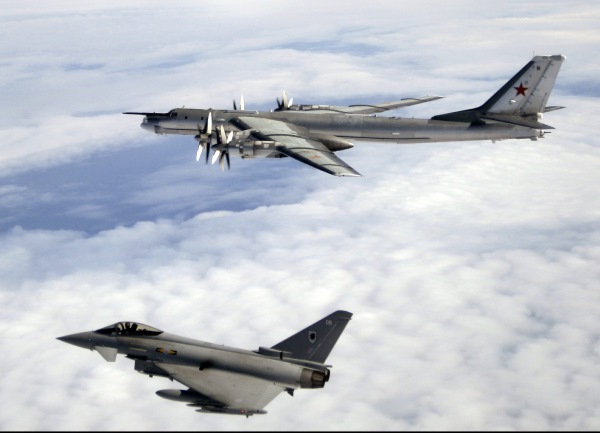
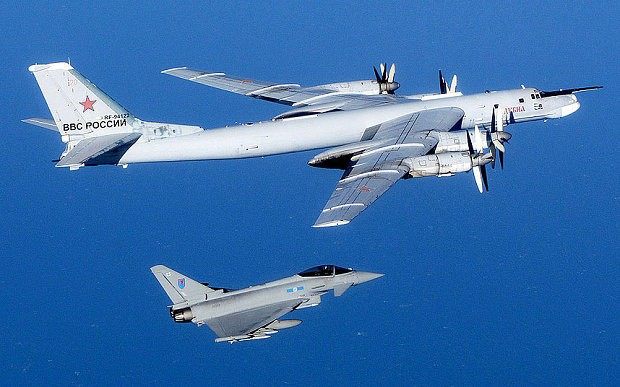
RAF jets scrambled after Russian bombers seen off Cornwall
RAF jets were scrambled on Wednesday after two Russian military aircraft were seen off the Cornwall coast. The Russian Bear bombers did not enter sovereign airspace
On the same day, Defence Secretary warned that Russia's President posed a "real and present danger" to three Baltic states.
Prime Minister said the Russian action should not be dignified with "too much of a response".
He added: "I think what this episode demonstrates is that we do have the fast jets, the pilots, the systems in place to protect the UK.
"I suspect the Russians were trying to make some sort of a point."
Appearance of Russian aircraft near the UK coast was a show of strength from the Russians, and such incidents were carried out with political intent because they would be reported on.
bbc
Etiquetas:
RAF,
RUSSIA,
RUSSIAN AIR FORCE,
TU-95,
UK,
UNITED KINGDOM
Feb 12, 2015
NORAD: Russia Increasing Arctic Long Range Air Patrols
While Russian military aircraft have stepped up their activity everywhere from the North Sea to the Baltic to the Black Sea in the last year they have also been spotted more frequently closer to the U.S. territory in the Arctic, the head NORAD told on Tuesday.
Flights of Tupolev Tu-95 Bear ‘H’ Bombers have increased recently and they’ve been very aggressive in the Arctic in the amount of flights, not aggressive in how they fly.
Since the March seizure of the Ukrainian region of Crimea by Russian forces Moscow has significantly stepped up air patrols in Europe, Asia and near the Americas.
The flights extend as far North as the edge of American air space near Alaska and as far South as U.S. holdings in Guam.
In December, two Royal Canadian Air Force CF-18 Hornets intercepted a two Bears near the Beaufort Sea entering a U.S. and Canadian Air Defense Identification Zone (ADIZ).
NATO interdicted a record number of Russian flights in 2014 and the Russians claim likewise the U.S. has stepped up its own flights near Russian territory.
usni
Etiquetas:
CANADA,
CF-18,
F-18 HORNET,
NORAD,
ROYAL CANADIAN AIR FORCE,
RUSSIA,
RUSSIAN AIR FORCE,
TU-95,
UNITED STATES,
USA,
USAF
Feb 2, 2015
Russian TU-95 intercepted by RAF Typhoons was carrying a nuclear missile designed to destroy Trident submarines
Tensions between Russia and the UK have heightened after it was revealed that the Russian bomber intercepted by RAF fighter jets was carrying a nuclear missile designed to destroy Trident submarines.
The TU-95 aircraft were spotted on long range radar flying down from Scotland towards the English Channel, where they were close to entering British airspace.
The ‘seek and find’ nuclear warhead missile which can destroy the British Vanguard submarines which form the country’s nuclear deterrent.
The Prime Minister and Defence Secretary were informed of the development after a Norwegian listening post intercepted conversations from the Russian bomber’s cockpit which confirmed the bomber’s nuclear payload.
The missile was not armed, but it is shows the Russians taking the next provocative step in their increasingly chilly relations with the West.
The Russian Ambassador to the UK was summoned by the Foreign Office to account for the incident on Friday, which many say was deliberately planned to coincide with the Alexander Litvinenko inquiry where the two murder suspects are Russians, protected by the Kremlin from extradition to face trial.
breitbart
Etiquetas:
NUCLEAR WEAPON,
RAF,
RUSSIA,
RUSSIAN AIR FORCE,
TU-95,
Typhoon,
UK,
UNITED KINGDOM
Subscribe to:
Posts (Atom)