Translate

Showing posts with label SPANISH AIR FORCE. Show all posts

Dec 7, 2020

Spain’s first PC-21 enters ground testing phase

Pilatus has conducted the first engine run of a PC-21 trainer for the Spanish air force. 

Photographed at the airframer’s Stans site in Switzerland on 2 December, the lead aircraft has already been painted, and carries the air force registration E.27-01. 

Madrid on 30 January 2020 signed a €204 million ($247 million) contract to acquire 24 of the turboprops, along with simulators and support services. 

At that time, it said the first six aircraft would be delivered in 2020. Spain will use the Swiss-built type to begin replacing an aged inventory of 60 CASA C-101 jet trainers, which Cirium fleets data shows have been in use for up to 40 years. 

May 10, 2020

Spanish Air Force Airbus A400M suffers birdstrike while landing at Zaragoza Air Base

On 7 May, a Spanish Air Force (Ejército del Aire) Airbus A400M Atlas military transport was damaged following a bird strike. The aircraft was on approach to Zaragoza Air Base, located around 262 km northeast of Spain’s capital Madrid.
Nobody got injured in the incident but the aircraft suffered substantial damage to its under-fuselage near one of the aft wheel wells.
aviation24

Sep 9, 2018

Pilot Error Behind Firing of AIM-120C in Estonia During Nato Baltic Air Policing

An internal Spanish military investigation has concluded that the accidental firing of an air-to-air missile in Estonian airspace by a NATO jet on 7 August resulted from pilot error, according to Spanish daily El País, quoted in Estonian daily Postimees.
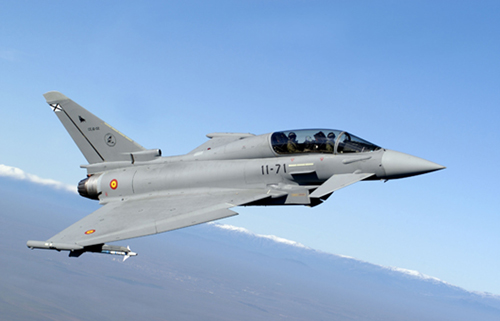
While the overall investigation into the incident continues, anonymous military sources claim that fault lies with the pilot in the misfiring of an AIM-120 Advanced Medium-Range Air-to-Air Missile (AMRAAM), from a Spanish Airforce Eurofighter Typhoon.
The paper claims that investigative tests show the pilot initiated the missile firing sequence during training. Normally, safety mechanisms should stop the actual launching in such cases, so the incident is reportedly rare.
However, weapons systems on the Typhoon multi-role, multi-national fighter are particularly complex and varied.
The missile was fired over Pangodi village, near Tartu, and is thought to have impacted in or near the Endla bog, about 100 km north. The Estonian/Russian border lies about 60 km east of Pangodi. The plane was flying at around a 6,000-metre altitude at the time.
Six hundred hectares of Endla bog was searched in the following days using equipment, with a further 200 hectares checked visually, yielding no trace of the missile or its debris. No reported casualties or material damage resulted from the incident, though brush fires broke out in the aftermath of impact.
Other investigations into the misfiring are still ongoing.
news.err.ee

Aug 8, 2018

Spanish Air Force Eurofighter accidentally fires AIM-120C missile in Estonia

Estonia’s military says it is looking for the remains of a missile that a Spanish fighter jet accidentally fired while drilling in the air space of the Baltic country and NATO ally.
The military said that the Eurofighter Typhoon from the Spanish Air Force — part of NATO's Baltic air-policing mission — erroneously launched an AMRAAM-type air-to-air missile in a practice area in southern Estonia Tuesday afternoon.
The missile carried explosives of up to 10 kilograms (22 pounds) and was last located around 40 kilometers (24 miles) north of Estonia's second city of Tartu. It has a built-in self-destruct for such accidents, but may have landed on the ground.
Estonian Prime Minister Juri Ratas said on Facebook “thank God no human casualties,” calling the incident “extremely regrettable.”
militarytimes

Jul 29, 2018

SPANISH AIR FORCE A400M IN YIBUTI FOR THE FIRST TIME, SUPPORTING COUNTER PIRACY EUNAVFOR MISSION "ATALANTA"


An Airbus A400M from Spanish Air Force has landed at Yibuti for the first time, in support of Destacamento Orión, that operates an P-3 Orion in support of EUNAVFOR counter piracy Mission "Atalanta" in Indian Ocean.
A400M has brought back home members of 31º rotation or Destacamento Orión.
twitter

Apr 11, 2018

Draken International Signs Agreement with Paramount Aerospace Systems to Regenerate 22 Mirage F1M Aircraft Ex Spanish Air Force

Draken International, a global leader in advanced adversary air services, has signed an agreement with Paramount Aerospace Systems, a subsidiary of Paramount Group, for the overhaul and ongoing engineering support of their recently acquired fleet of Mirage F1M aircraft from the Spanish Air Force.
Draken acquired 22 Mirage F1M and F1B fighter jets in an effort to enhance adversary services for its US Department of Defense and allied nation customers. The Mirage F1Ms were predominantly flown by the Spanish Air Force and received a full radar and avionics suite modernization in the late 1990s. This acquisition along with the most recent purchase of twelve supersonic radar equipped South African Denel Cheetah fighter jets increased Draken’s fleet size to over 150 fighter aircraft.
With the completion of the procurement phase, the Mirage F1Ms will now undergo reassembly, restoration and airworthiness certification by Paramount Aerospace Systems at Draken’s Lakeland, FL maintenance facility. Paramount Aerospace specializes in the modernization of fixed wing platforms including leading the previous modernization of the Mirage F1M while still in Spanish Air Force military service. Paramount possesses extensive capabilities on the Mirage F1 with full airframe and engine overhaul capability, as well as the ability to upgrade and modernize avionics and mission systems.
prweb.com

Jan 23, 2018

Spain Receives Latest Standard Eurofighter Typhoon with Enhanced Air-to-Surface Capabilities

Photo credits to AirbusDS
The aircraft were manufactured at the Getafe Final Assembly Line in the P1Eb FW (Phase 1 Enhanced Further Work) configuration which marks a key step in the overall Eurofighter evolution plan.
This same configuration is being retrofitted to in-service aircraft by other Eurofighter nations. It provides increased integration of a variety of air-to-surface weapons and enhanced targeting among other improvements.
Spanish procurement agency DGAM took delivery of the aircraft on 22 December and they were subsequently ferried to Albacete air force base to enter service. The remaining six of the 73 aircraft currently contracted by Spain will be delivered to the same P1Eb FW standard during 2018 and 2019.
airbus

Aug 5, 2017

Finland suspects Spanish fighter jets of airspace violation

The Finnish Ministry of Defence reported on Tueday that it suspects two Spanish F-18 fighter jets of having violated Finnish airspace.
According to the Ministry of Defence's report, the airpace violation took place over the Gulf of Finland south of Upinniemi at approximately 9 a.m. on Tuesday, reported Finnish public broadcaster Yle (link in Finnish).
The Finnish Border Guard is investigating the incident.
Five F/A-18 Hornets of the 15th Wing of the Spanish Air Force have been stationed in Estonia since Spain took over the rotating Baltic Air Policing mission based out of Ämari Air Base this May.

Feb 12, 2017

Spain to keep flying old C101 Aviojet trainers

The Spanish government has given the go-ahead for a spares package contract for the air force's CASA C101 Aviojet advanced trainer and light attack aircraft, effectively extending its in-service life for a further four years.
An air force spokesman told Jane's on 7 February that they had "no further information at this time" on the acquisition of a replacement for the aircraft, which was first mooted eight years ago.
The bidding process approved by the cabinet is for up to EUR20 million (USD22 million) to be spent on parts for the aircraft and their engines, half of which will cover the period up to the end of 2018 and the remainder for a potential extension of the contract for a further two years.
The single engine Aviojet first entered service in 1980. They were built by the then state-owned plane maker Construcciones Aeronáuticas SA (CASA), which later became part of the pan-European Airbus group.
Spain received 88 C101EBB Aviojets, which are also used by the air force's Patrulla Aguila (Eagle Patrol) acrobatic display team.
The export standard C101BB aircraft was also sold to Honduras (4) and Chile (12), which also received 23 of the longer ranger C101CC version, as did Jordan (16).
janes

May 15, 2015

Spanish Air Force Takes Over Airbus A400M Crash Probe

Spain's air force has taken over the investigation of the crash of an Airbus A400M military cargo plane near Seville which killed four men.
The Spanish government intially charged a civilian team made up of experts from the transport and defense ministries to probe the crash, the first of an A400M airlifter.
The civilian team "took the decision to withdraw because they understood that the plane has specific characteristics due to its military configuration which they were unfamiliar with".
Spain's military air crash investigation agency, CITAAM, took charge of the investigation at the beginning of the week.
The A400M plane that crashed in a field and burst into flames just north of Seville's airport on Saturday was several minutes into a test flight before it was due to be delivered to Turkey in July.
Spain on Tuesday became the fifth country to ground its A400Ms pending the outcome of the crash investigation, following similar decisions by Britain, Germany, Turkey and Malaysia.
France, which has six of the planes in active operation, said it would only carry out the most pressing flights until more details emerge on why the plane went down.
German newsweekly Der Spiegel reported that the plane experienced multiple engine failure, citing comments by one of the crash survivors.
defensenews

Sep 1, 2014

A400M acts as tanker aircraft for first time

The Airbus A400M Atlas transporter has successfully acted as an air-to-air refuelling tanker aircraft for the first time.
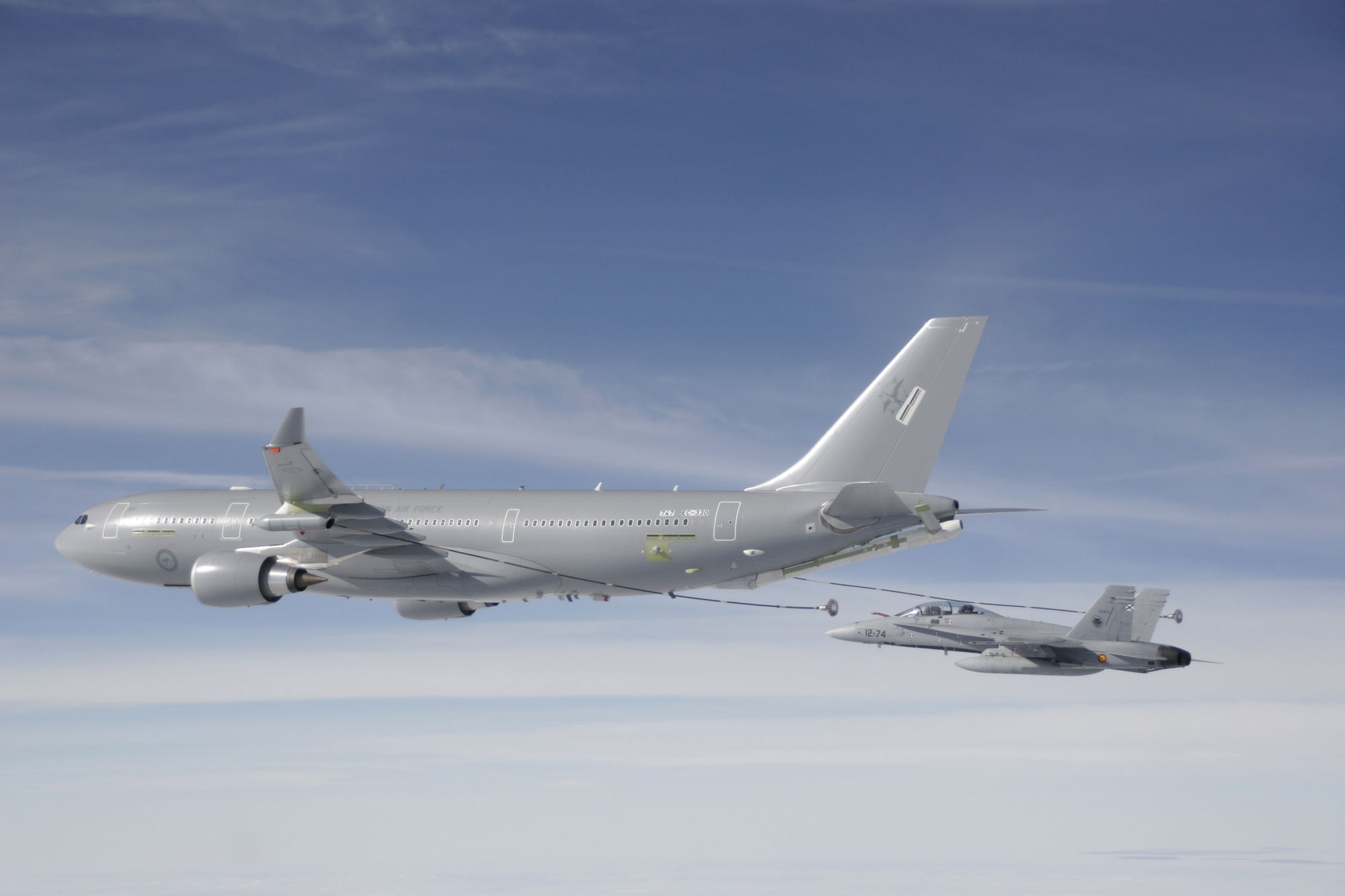
A company-owned A400M refuelled a Spanish Air Force Boeing EF-18A Hornet fighter aircraft. Airbus said that the tanker test programme included 33 dry contacts and 35 wet contacts, including the transfer of 18.6 tonnes of fuel, across five flights.
The latest air-to-air refuelling milestone for the A400M follows the aircraft acting as a receiving aircraft for the first time in July, when it was refuelled by an Airbus A330 Multi Role Tanker Transport (MRTT).
The A400M is designed to act both as a tactical/strategic airlifter and as an air-to-air refuelling platform. To act as a tanker, two probe and drogue refuelling kits can be installed on the aircraft's wings.
Alternatively the aircraft can operate as a centreline refuelling aircraft with the installation of a palletised refuelling drogue kit in the aircraft's cargo hold. Two additional fuel tanks may also be installed in the aircraft's hold, if required.
janes

Aug 13, 2014

Spain Ala 14 Eurofighter Typhoons’ role in Exercise Anatolian Eagle in Turkey


Twelve Eurofighter Typhoons belonging to the Royal Air Force and the Ejército del Aire (Spanish Air Force) took part in the international edition of Anatolian Eagle, from June 9 – 20 at Konya airbase, Turkey.
The Spanish Typhoons were tasked with pure Fighter Sweep missions: their role was to conduct offensive counter air missions, destroying all the enemy aircraft within the area of responsibility and to clear the way for incoming attack planes.
Depending on the length of the sortie, the aircraft flew with two or three drop tanks, an AIS (Airborne Instrumentation Sub-system) pod for the flight data downlink to the ground ACMI sensors, and a dummy IRIS-T air-to-air missile.
For the Ala 14 pilots, who were taking part in their first expeditionary experience with the Typhoon, their participation in Anatolian Eagle was an important opportunity to validate and enhance their reference tactics, share knowledge and improve cooperation with personnel from different nations, and fly the Eurofighter in a challenging scenario, with up to 60 aircraft flying at the same time, in a large, almost unrestricted airspace.
theaviationist

Jun 13, 2014

Spain strengthens the NATO’s deployment in the Baltic with four Eurofighters

Spain has put at the disposal of the NATO four Eurofighters, that could join the forces deployed by the NATO in the Baltic.
The Spanish Executive also offered a Boeing 707, as well as a frigate for the Baltic operation and another one for the Mediterranean area and the Horn of Africa.
The inventory of means promised to the NATO is completed by the activation of a mechanized squad and an additional frigate within the framework of the rapid operational force, as well as the headquarters of Bétera (Valencia).
thediplomatinspain

Jun 9, 2014

Eurofighter Jet Crashes In Spain, Pilot Killed

A Eurofighter jet crashed while attempting to landing at an air base in southwestern Spain on Monday, killing its pilot, an air force captain.
The Moron air base is shared by Spain and the US Air Force, but only Spain operates the Eurofighter jet.
defensenews

Jan 28, 2014

Spanish Air Forces Rotate Aircraft Crew In Djibouti

The 33rd Spanish Air Forces Maritime Patrol and Reconnaissance Aircraft (MPRA) crew joins the EU Naval Force (EU NAVFOR) Somalia Operation Atalanta. The 32nd and 33rd crew rotations performed their hand over in Djibouti on January 23rd.
Spanish MPRA detachment is composed of 44 people. The aircrew and maintenance members usually join the mission for a two months period.
During the last two months with the EU’s counter-piracy Operation Atalanta, the outgoing personnel of the 32nd rotation, usually based in Palma de Mallorca with the Spanish Air Forces Wing 48, has flown 25 night and day sorties.
With more than 200 flying hours, they have flown over 26.000 nautical miles. This comes up to at least one trip all around the world.
Spanish detachment of the EU Naval Force MPRA “Orion” has been able to fly without cancelling any tasked mission since June 2012. Their contribution to the EU’s counter piracy operation has been of enormous value, and their achievements are based on their outstanding willingness and enthusiasm.
eunavfor

Jan 6, 2014

Spanish Navy withdraws 25% of their Harrier by cuts and Only 10% of Army is combat Ready - La Armada da de baja el 25% de sus cazas Harrier por los recortes. Solo el 10% del Ejército está listo para combatir


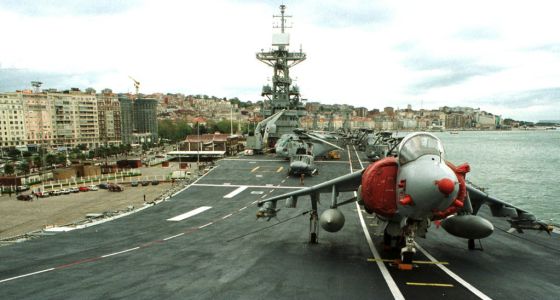
Budget cuts have not only forced the Navy to terminate the Prince of Asturias, the only aircraft available to it (which will be supplied , in part, by the strategic projection ship Juan Carlos I, suitable for takeoff and decision aircraft ) , but a quarter of its fleet of Harrier aircraft.
Four of the 16 Harrier will be out of service due to the lack of funds for modernization and the high cost of maintenance. These older units , four AV- 8B Harrier that had not been transformed into the AV- 8B Harrier II Plus version includes a radar, among other improvements. The fleet will be thus reduced to 12 units (plus training ) whose operational life is expected to conclude in 2020. Thereafter , Spain should buy a replacement if you want to continue to have embarked aviation , which is not guaranteed , as the only candidate today is the U.S. F-35 with a prohibitive price .
The Air Force also runs the risk of losing one of its main capabilities : strategic refueling . One of two Boeing 707 that fulfilled this function and has been discharged and the other should be in two years. The Air Force has five KC -130 Hercules refueling , but its performance is not comparable to the B- 707. The solution is to buy two Airbus 330 tanker aircraft , but each one costs about 200 million and so far there is no budget . Meanwhile, Spain will not contribute, as the conflict in Libya ( 2011) , strategic refueling aircraft . Ejército del Aire is going to lost this ability.

Furthermore only 10% of the Spanish Armed Forces are ready to fight .
The Spanish Armed Forces in 2014 facing its most difficult year due to the continuing budget cuts in recent years . Restrictions continue in the medium term and the current structure is unsustainable.
The Spanish Armed Forces have launched a plan to ensure the operability of the core of the Armed Forces, called Joint Task Force , which will prevail in the allocation of scarce resources.
Since 2008 the defense budget was reduced by 32 %, from 8.494 million to 5.745 in 2014. The military got two outstanding loans that only served to settle debts with military industries. The money was not intended to pay maneuvers , fuel or ammunition to ensure operability.
Until now, the lack of resources has been supplied with funds for missions abroad , financed outside the regular budget starting with expandable in 2013 has touched 800 million . These missions have served to units participating in the same receive intense training , complete their templates and cover their deficiencies in equipment and supplies. The RG -31 armored mine or Lynx have bought with that extra money.
The Defense Ministry plan goes through concentrating resources on a force of "high quality" to give a " quick and effective" response when the government demands. Joint Action Force must be prepared to intervene in a maximum of one month from receiving the activation command Although some of their units , the rapid reaction , have a period of less deployment . in five , 15 or 20 days.
Joint Force will be part fighter and transport, frigates or armored units and special operations , but will not always be the same , when a ship is in dry dock for maintenance or fault will replace another of the same characteristics.
The joint force will total about 10,000 soldiers. Ie about 8 % of the 123,000 diponibles .

_________________________________________________________________________________

Los recortes presupuestarios no solo han obligado a la Armada a dar de baja prematuramente al Príncipe de Asturias, el único portaviones de que disponía (que será suplido, en parte, por el buque de proyección estratégica Juan Carlos I, apto para el despegue y toma de aeronaves), sino la cuarta parte de su flota de aviones Harrier.
Cuatro de los 16 Harrier quedarán fuera de servicio, ante la falta de fondos para modernizarlos y el alto coste de su mantenimiento. Se trata de los aparatos más antiguos, los cuatro Harrier AV-8B que no habían sido transformados a la versión AV-8B Harrier II Plus que incorpora un radar, entre otras mejoras. La flota quedará así reducida a 12 unidades (más una de entrenamiento) cuya vida operativa está previsto que concluya en 2020. A partir de entonces, España debería comprar un sustituto si quiere seguir contando con aviación embarcada, lo que no está garantizado, pues el único candidato hoy por hoy es el F-35 estadounidense, con un precio prohibitivo.
También el Ejército del Aire corre el riesgo de perder una de sus principales capacidades: el reabastecimiento estratégico en vuelo. Uno de los dos Boeing 707 que cumplía esta función ya ha sido dado de baja y el otro debería serlo en dos años. La Fuerza Aérea dispone de cinco Hércules KC-130 para reabastecimiento, pero sus prestaciones no son comparables a las del B-707. La solución es comprar dos aviones cisterna Airbus 330, pero cada uno cuesta unos 200 millones y hasta ahora no hay presupuesto. Mientras, España no podrá aportar, como en el conflicto de Libia (2011), un avión de reabastecimiento estratégico. Está a punto de perder esta capacidad.

Por otra parte solo el 10% del Ejército está listo para combatir.
Las Fuerzas Armadas españolas se enfrentan en 2014 a su año más difícil debido a los persistentes recortes presupuestarios de los últimos años. Las restricciones seguirán a medio plazo y la estructura actual es insostenible.
Las Fuerzas Armadas Españolas han puesto en marcha un plan destinado a garantizar la operatividad del núcleo de las Fuerzas Armadas, la llamada Fuerza Conjunta, a la que se primará en la asignación de recursos escasos.
Desde 2008 el presupuesto de Defensa se ha reducido un 32%, pasando de 8.494 millones a 5.745 en 2014. Las Fuerzas Armadas consiguieron dos créditos extraordinarios que solo sirvieron para saldar deudas con las industrias militares. El dinero no fue destinado a pagar maniobras, combustible o munición para garantizar la operatividad.
Hasta ahora, la falta de recursos se ha suplido con los fondos destinados a las misiones en el exterior, que se financian al margen del presupuesto ordinario con una partida ampliable que en 2013 ha rozado los 800 millones. Estas misiones han servido para que las unidades que participaban en las mismas recibieran un intenso entrenamiento, completasen sus plantillas y cubrieran sus carencias en equipos y pertrechos. Los blindados antiminas RG-31 o Lince se han comprado con ese dinero extra.
El plan del Ministerio de Defensa pasa por concentrar los recursos en una fuerza de “alta calidad" para dar una respuesta “rápida y efectiva” cuando el Gobierno lo demande. La Fuerza de Acción Conjunta deberá estar preparada para intervenir en un máximo de un mes desde que reciba la orden de activación. Aunque algunas de sus unidades, las de reacción rápida, dispondrán de un plazo de despliegue inferior: en cinco, 15 o 20 días.
De la Fuerza Conjunta formarán parte aviones de caza y transporte, fragatas o unidades blindadas y de operaciones especiales, pero no serán siempre las mismas; cuando un buque esté en dique seco por avería o mantenimiento lo sustituirá otro de las mismas características.
La Fuerza Conjunta contará en total con unos 10.000 militares. Es decir, en torno al 8% de los 123.000 disponibles.

El País-Spanish Navy withdraws 25% of their Harrier by cuts
El País-Only 10% of the Army is ready to fight


Jan 4, 2014

Argentine Mirage F1 buy reportedly stalls


Argentine sources have told IHS Jane's that the planned procurement of 16 Dassault Mirage F1M fighters from the Spanish Air Force has stalled and could possibly be cancelled. Local media reports indicated that the Argentine Air Force (FAA) has begun analysing other options, including second-hand Dassault Mirage 2000s from France or Brazil, but appears to be leaning towards an Israeli offer of 18 IAI Lahav Kfir Block 60 multi-role fighters for USD500 million, with a possible delivery date some 15 months after a contract signature.
The deal's cancellation has not been confirmed, but its causes could, if it happens, include a mixture of technical and political concerns.
janes

Dec 5, 2013

Spanish Air Force Has A330 MRTT Ambitions

The Spanish air force is looking to purchase a trio of Airbus Military A330-200 multi-role tanker-transports (MRTTs) to replace its aging Boeing KC-707 tankers.
The purchase of new tankers is now one of the air arm’s top priorities.
But the country’s financial troubles are having major effects on equipment programs for the entire Spanish armed forces, and there is no funding for the project.
Spain is hopeful the current air force budget will begin to increase in 2016 from an expected record low in 2014. Spanish officials hope their buy will come off the back of an expected European Defense Agency (EDA) purchase of tankers expected during the second half of this decade. EDA hopes to have an agreement signed in late 2014 allowing for the possible procurement of tankers in conjunction with Occar, the European armament cooperation agency, for initial operations in 2020 and a full operational capability in 2021.
But Spain wants its own sovereign aircraft that it can configure to transport Spanish royal family members, who currently use a pair of Airbus A310s in a VIP configuration.
Air force officials had hoped the A330s could be purchased by adjusting the air arm’s order for the Airbus A400M airlifter, but Airbus Military would not allow such a change. Spain has 27 of the new transport aircraft on order, but the financial constraints mean it is currently budgeting to operate only 14, and may store the other 13. It has previously said it may try to sell the aircraft.
Spain’s first A400M is due to roll off the Seville line in 2014 and enter service in late 2015. The air force will then receive four or five aircraft per year until 2022.
Spain will use the A400M to replace its C-130 and KC-130 Hercules transports and tankers. Spain had planned to retire its C-130s in 2016. But delays with the A400M have pushed that aircraft’s introduction back, forcing the air force to embark on a C-130 life-extension program.
aviationweek

Spain to operate fewer A400Ms, but seeks 3 A330 MRTT tanker purchase


Spain’s air force expects to be able to employ only around half of the A400M tactical transports on order from Airbus Military, but hopes to widen its fleet renewal effort to also introduce a new fleet of A330-based tankers.
Ejército del Aire (Spanish Air Force) will receive 27 A400M aircraft, but due to budget restrictions it's planne to operate and maintain only 14.
Madrid’s first A400M is due to be delivered in January 2016, followed at a rate of four or five per year for its air force until 2022. Despite the smaller than expected size of the future active fleet, Ejército del Aire wants to operate the type in a multi-role configuration, featuring defensive aids and satellite communications equipment, and a modular air-to-air refuelling kit.
The Spanish air force also hopes to acquire three A330 multi-role tanker transports from Airbus Military, with these to represent its contribution to a proposed pooled fleet being eyed by the European Defence Agency. To also be suitable for national VIP transport tasks, the type would provide a replacement for the air force’s current Boeing 707s, although no funding has yet been allocated for such an order.
The acquisition of a new tanker is one of two top priorities for the Spanish air force, with the other being a plan to acquire a medium-altitude, long-endurance unmanned air system capability.
Longer term, the air force would like to acquire a multi-role successor for its existing Airbus Military C295/CN235 medium transports, with airborne early warning and electronic warfare as potential applications beyond the airlift role.
flightglobal