Translate

Showing posts with label MIG-35. Show all posts

Apr 7, 2018

India re-opens competition to supply 110 fighters

A global competition to sell more than 100 fighters to the Indian air force re-opened for the third time in a decade on 6 April.
The IAF released a 73-page request for information to six companies to supply 110 single- and twin-seat fighters over a maximum of 12 years.
Facing a 3 July deadline, responses are expected from the Boeing F/A-18E/F Block III, Dassault Rafale F3R, EurofighterTyphoon, Lockheed Martin F-16 Block 70, United Aircraft Corp MiG-35 and Saab Gripen E.
It will be a familiar competition for the six bidding teams. The same teams squared off in 2009 for the Medium Multi-Role Combat Aircraft (MMRCA) contract for 126 fighters. India selected the Rafale, but cancelled the contract seven years later.
Instead, the IAF awarded Dassault a contract to deliver 36 Rafales in 2016, and launched a competition for a contract to build 114 single-engine fighters, which limited the field to the F-16 and Gripen.
The IAF scrapped that contest two months ago under pressure from the Indian Congress to consider single- and twin-engined fighters.
The new RFI re-opens the competition to twin-engined fighters made in the USA, Western Europe and Russia.
The RFI sets no standards for the number of engines in the IAF’s future fighter, and repeatedly references the singular or plural term, “engine/s”, in requests for data about the propulsion system.
About 82 of the 110 fighters should be single-seat aircraft and the rest should be two-seat versions, the RFI says.
A maximum of about 16 or 17 fighters can be built outside the country, but the rest must be built within India by local companies or an Indian production agency, the document shows.
As expected, technology transfer and “Made in India” will be priorities in the IAF’s bid evaluations. The bidders must describe in their responses to the RFI how they will use Indian companies as suppliers for systems and aircraft production.
flightglobal

Jan 16, 2016

Russia and Serbia To Discuss MiG-35 Sale

Russian Deputy Prime Minister Dmitry Rogozin arrived in Belgrade on Saturday evening.
He was taking part in a meeting of the Serbia-Russia Intergovernmental Committee for Trade, Economic, Scientific and Technical Cooperation on January 11-12 but unofficially, one of the reasons for this visit is Serbia's intention to buy MiG-35 warplanes from Russia.
b92.net

Jun 13, 2015

Experts skeptical about Russia's Tu-160 bomber production plans

Recent declarations by Russian officials regarding plans to re-start production of the Tupolev Tu-160 strategic bomber, combined with various other announced procurements, are being met with scepticism by a number of experts. The two reasons most commonly cited for this are that Russian industry lacks the numbers of qualified personnel necessary to support so many procurements taking place simultaneously and that the funding available is nowhere close to what would be required.
The Russian deputy defence minister for procurement, Yury Borisov, told news outlets on 4 June that the envisioned new-build Tu-160 would essentially be a new aircraft due to its onboard systems being several generations beyond the 1980s-era avionics suite of the original Tu-160. "This aircraft would be designated the Tu-160M2," he said, adding that, "according to our plans, this will most likely happen sometime after 2023".
In addition to the plan for a modernised Tu-160, another initiative calls for 130 Mikoyan MiG-31 interceptors to be brought up to the MiG-31BM configuration. Central to that upgrade is the installation of a new avionics suite, modernised crew stations fitted with state-of-the-art displays and a new variant of the onboard radar set.
In addition, the chief of staff of the Russian Air Force (VVS), Colonel General Viktor Bondarev, is also calling for large numbers of Sukhoi Su-30MK, Su-35 and T-50/PFI fifth-generation fighters, Su-34 fighter-bombers, and a new domestic version of the MiG-35 that was formerly proposed for export to India.
A commonly cited weakness of today's Russian defence sector is that the workforce is only a small fraction of its former, Soviet-era size, with a commensurate drop in its capacity.
janes

Jan 15, 2015

Russia to build more Arctic airfields

Russia is to have 14 operational airfields in the Arctic by the end of the year.
Ten airfields will be constructed by the end of 2015, in addition to the four already in use.
Separately, Russia has announced it is to boost its military capabilities in the annexed Crimea region, and in its Baltic enclave of Kalingrad.
While the United States has been pivoting its forces and its strategic focus to the Asia-Pacific region to better counter China, Russia has been increasingly focusing its efforts in the Arctic.
As the melting Arctic sea ice has opened up trade routes and potential oil reserves, Russia, more than the other four nations of Canada, Denmark, Norway, and the United States that each claim parts of the Arctic Circle's outer ring, has been beefing up its military presence in the region.
In May 2012, Russia's Ministry of Defence announced that several Arctic air bases that had fallen into disuse with the end of the Cold War would be reopened. Airfields at Novaya Zemlya, Naryan-Mar, Ostrov Greem-Bell (Graham Bell Island), and Rogachyovo have since been made operational. While the re-opening of these Arctic bases has been largely symbolic in the context of national claims on the region's resources, MiG-31 'Foxhound' interceptors have been based near Murmansk to provide additional air defence coverage of the region.
In addition to opening up the bases and the basing of the MiG-31s at Murmansk, Russia is expected to deploy a number of Pantsir-S1 ground-based air defence systems in the region, and is also upgrading its Mil Mi-8 'Hip' helicopters to function in the harsh conditions.
Russia is also increasing its special forces presence in the Arctic by more than 30%, with the revamped 61st Independent Naval Infantry Regiment to be stationed alongside the re-formed 200th Independent Infantry Brigade at Sputnik Base, Pechenga, inside the Arctic Circle (16 km from the Norwegian border and 65 km from the Finnish border).
Overarching all of this is the formation of Russia's Arctic Joint Strategic Command, which was activated on 1 December 2014. This new command, which is based on the Northern Fleet and headquartered at Severomorsk, is being equipped with assets and personnel transferred from Russia's Western, Central, and Southern (but not Eastern) Military Districts, with which it will be on a par.
janes

Oct 22, 2014

Syria Says It Shot Down 2 of 3 'Islamic State Warplanes'


Syria’s air force has destroyed two of three warplanes reportedly seized by fighters of the Islamic State group in the north of the country accordin Information Minister.
The jihadists were reported to have seized the three planes, believed to be MiG-21 and MiG-23 jets, from Syrian military airports now under IS control in the northern provinces of Aleppo and Raqa.
defensenews

Oct 9, 2014

Russia eyes Peruvian MiG-35 sale

Russia's RSK-MiG is seeking to sign a contract with Peru for "more than 10" of the MiG-29-series fighter aircraft's most modern derivative, the MiG-35.
The MiG-35C-9.61 is similar to aircraft that are supposed to be procured by the Russian Air Force - though this order has been delayed to 2016 - and the version that was previously offered to the Indian Air Force for its Medium Multi-Role Combat Aircraft programme.
RSK-MiG's general director, revealed the potential Peruvian deal and said Lima was offered the aircraft a solution to replacing some of its current MiG-29s, many of which are close to 30 years old and are reaching the end of their operational service life.
janes

Jun 9, 2014

Russian Fighters and missiles for China Still On Hold

Russian industry officials are denying media reports that Beijing and Moscow are finalizing a deal on the sale of advanced Russian fighters and surface-to-air missiles to China.
Widely reported by other media outlets, announced that the head of Sukhoi, confirmed that a deal with China to procure Su-35S fighters and S-400 SAMs was close to concluding.
But Russia’s United Aircraft Corporation (UAC) denies anything beyond the sale of commercial aircraft during his visit to China.
UAC’s communications department, wrote in a news release that sale of the Su-35 was not in discussion with Chinese officials. However, UAC and China did sign a cooperation agreement to build wide-body long-range commercial airliners on May 20.
This does not mean that a deal on the multirole combat aircraft is dead, only that no agreement has been made.
S-400 and Su-35 deals might be sped up because of the growing importance of strategic ties with China for Moscow after the Crimean crisis. Taking into account production cycles, the first S-400s are unlikely to reach China before 2016.”
Whether the sale goes forward today or next year, it will spell trouble for Taiwan and Japan’s efforts to defend the Senkaku Islands in the East China Sea. The 400-kilometer range S-400 will allow China to strike any aircraft over Taiwan. This will give China effective control of Taiwan’s airspace during a war. At present, China’s 300-kilometer range S-300s can hit aircraft only in a small section of Taiwan’s northwest coastal area.
The S-400 will make it difficult for Tokyo to control the Senkaku’s airspace. The disputed islands are controlled by Japan, but also claimed by China as the Diaoyu Islands are within 350 kilometers of China’s coast.
Taiwan is also facing a fighter shortage as older aircraft, such as the roughly 50 F-5s and 55 Mirage 2000s, begin retiring within the next 10 years. What remain are 126 upgraded indigenous defense fighters (IDFs) and 144 F-16A/B fighters. Taiwan has initiated an upgrade program for the F-16s, but still insists the US release 66 F-16C/D fighters on hold since 2006.
One response for Washington would be to sell Taiwan the General Electric F404 or F414-class small turbofan engine that would allow Taiwan to develop its indigenous defense fighter into a very short take-off, supersonic climbing fighter.
defensenews

Jun 7, 2014

RAC MiG contemplating a fifth-generation fighter based on MiG-35

RAC MiG is contemplating building a fifth-generation fighter which would use its current MiG-35 platform as a "foundation" for the introduction of new technologies.
RAC MiG President didn't detailed how advanced studies are, but believes it is very likely that the new combat type will be developed, and to be ordered.
The development wouldn't bring MiG into conflict with its sister airframer Sukhoi, which is developing its own stealthy type, the T-50/PAK-FA.
The two aircraft are quite different projects and each would be targeted to resolve different missions.
The maximum take-off weight of the current MiG-35 is around 5t lighter than that of the larger T-50, providing greater efficiency for the majority of projected missions.
However, in the meantime RAC MiG is still waiting for confirmation of a long-awaited order from Russia's defence ministry for the present MiG-35.
All the relevant documentation covering the deal for an undisclosed number of aircraft is with the Russian ministry of Defence.
Export orders are also being pursued, with Egypt recently linked to a commitment for 24 examples of the Klimov RD-33MK-powered type.
Additionally, in April RAC MiG received an order for 16 additional MiG-29SMTs for the Russian air force, which will keep the production line active until work can start on the newer model.
flightglobal

Feb 6, 2014

India, Dassault Rafale Deal Appears Stalled


Negotiations over the deal to sell 126 Dassault Rafale jets to India have stalled, according to Indian Defence Ministry. The sticking point involves issues governing license-production of the jets at state-owned Hindustan Aeronautics Ltd. (HAL).
A series of meetings held over the past three months have failed to resolve the stalemate, meaning it is unlikely the deal will be finalized during the current New Delhi administration.
At the beginning of the year, Rafale-maker Dassault met with the MoD, Indian Air Force and HAL to break the impasse. A planned visit by HAL Chairman R.K. has been postponed, putting a question mark over the entire program.
A Dassault executive said the company was informed at the last minute about the postponement of the HAL team visit to Paris.
However, a senior HAL executive said the visit was postponed due to a sudden company board meeting at home. The visit has just been postponed, not canceled.
At issue is the Indian Air Force’s insistence that HAL provide guarantees on the delivery schedule for the Rafale aircraft. According to the tender, 108 of the 126 jets are to be license-produced at HAL.
HAL in turn has shifted the onus of providing guarantees to Dassault, which initially refused before agreeing to help HAL adhere to the delivery schedule.
However, HAL has failed to take responsibility and guarantee the work of its sub vendors, which includes state-owned companies.
At the same time, the framework governing work share has not been finalized because the Indian side wants a greater percentage of subsystems and auxiliary work in the license production deal. The French say HAL will need to absorb Western technologies, so the work share can increase only as the license production progresses.
The Air Force, having suffered delays from HAL, is adamant that the delivery schedule is followed. Air Force sources say the delay in procurement of the fighter will severely affect the fleet strength of the force. The service had to search for a fighter aircraft in the overseas market because the homegrown light combat aircraft, proposed to replace Russian MiG fighters, is more than 15 years behind schedule.
Rafale was shortlisted alongside the Eurofighter Typhoon after the first round of competition; the US-made F-16 and F/A-18, Sweden’s Gripen and Russia’s MiG-35 were ejected after the technical evaluation.
After the flight trials and life cycle cost phase, Rafale was selected due to its low cost. Contract negotiations began in early 2012, with the goal of signing a contract in the current financial year ending in March.
defensenews

Aug 26, 2013

Russian Air Force MiG-35 Deal ‘On Track’

Russia is not abandoning the purchase of MiG-35 fighter jets and could sign a deal next week at Moscow’s MAKS International Aviation and Space show, which will run from August 27 through September 1, while first deliveries could start in 2015-2016, he said.
Russian Air Force had postponed the purchase of 37 MiG-35’s until 2016 because the defense industry cannot fulfill the contract, and would buy 16 MiG-29SMT fighter jets instead.
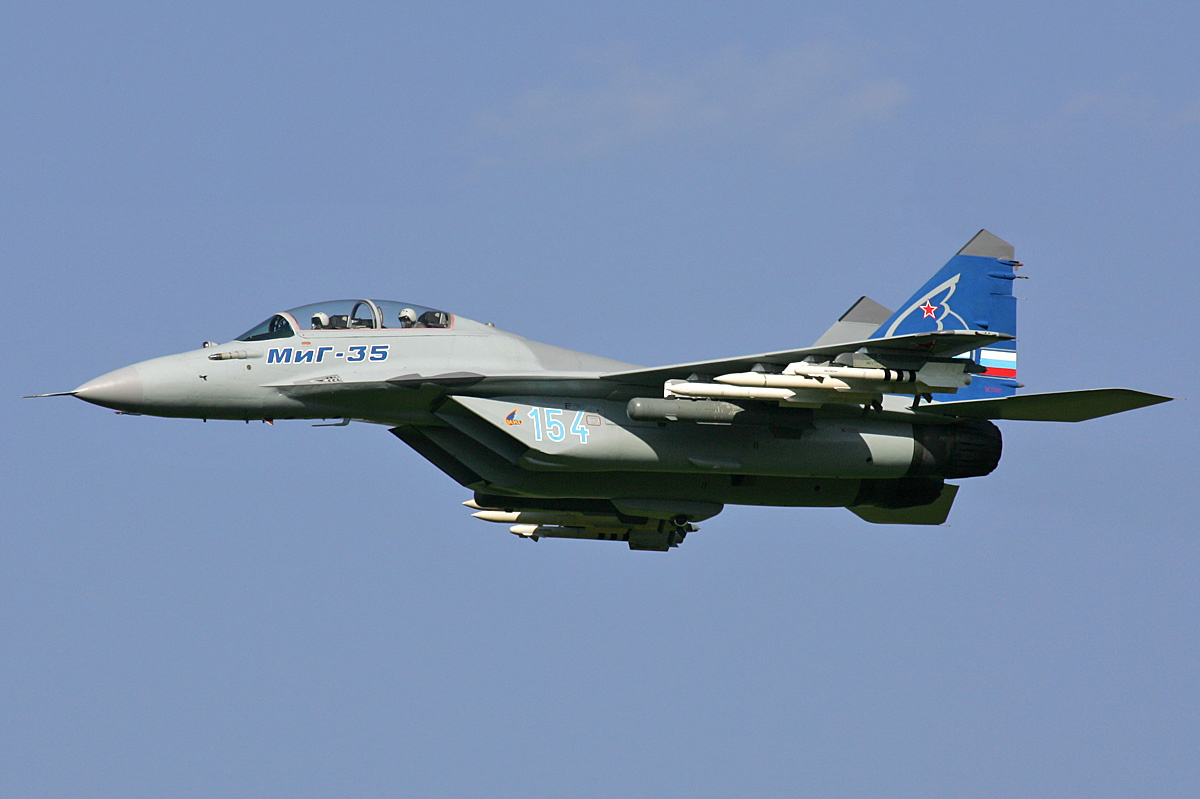
The Mikoyan MiG-35 (Fulcrum-F) is a 4++ generation fighter jet and a modification of the MiG-29M. It is equipped with air-to-air and air-to-surface guided missiles, as well as the Zhuk-A radar system.
ria-military-news/

Aug 24, 2013

Russian Military to Buy 16 MiG-29SMT

The Russian Defense Ministry and the MiG aircraft corporation have agreed the purchase of 16 MiG-29SMT fighter jets until 2016. The agreement is part of the government’s effort to keep the struggling combat aircraft maker afloat following the announced delay of the contract on the purchase of 37 MiG-35 fighters until after 2016. The MiG corporation will have three years to perfect the design of its MiG-35 aircraft and prepare its smooth transition to mass production.
rian

Jul 11, 2013

Russia to Get New Su-35, MiG-35 Jets Within 3 Years

New MiG-35 and Su-35 fighter jets will be delivered to the Russian Air Force in large numbers within the next three years.
en.ria

Mar 27, 2013

Peru mulls replacing aged air force jets


Peru is in talks with Spain and warplane suppliers as part of a low-budget plan to replace aging air force aircraft with second-hand Eurofighters and comparable fighters.
Cost is a major issue for Peruvian President Ollanta Humala, who is looking at competitively priced fighter jets that will fit the national budget.
Peru's cut-price fighter jet competition contrasts with Brazil's multibillion-dollar FX-2 replacement jet fighter program, which has gone on for more than two years without a decision on a final choice.
Peruvian news media said the government would be looking to replace aging fighter jets with Spanish Eurofighters -- or a mixed inventory that could include France's Rafale, Boeing's F/A-18E/F Super Hornet, SAAB's Gripen NG and Russian MiG-35 and Sukhoi Su-30/35.
Industry analysts said Peru was unlikely to buy new aircraft because of cash constraints.
spacemart