Translate

Showing posts with label BULGARIA. Show all posts

Feb 20, 2026

U.S. Tankers Spotted in Sofia, Bulgaria as Analysts Point to Iran Strike Preparations


Recent movements of U.S. military aircraft in  Europe have drawn growing attention from defense analysts, after multiple U.S. Air Force aerial refueling tankers and transport aircraft were observed operating from Sofia International Airport in Bulgaria.

Local media and open-source flight tracking data indicate the presence of KC-135 refueling aircraft, alongside strategic airlifters such as C-17s, at Sofia International Airport. The sightings come amid heightened tensions between Washington and Tehran and a broader repositioning of U.S. forces across Europe and the Middle East.

Analysts: Supporting a Potential Iran Operation

While neither the Pentagon nor the Bulgarian government has officially designated Sofia as a launch base for combat operations, defense analysts and regional observers suggest the deployments are consistent with preparations for a potential future strike on Iran.

Aerial refueling tankers are a critical enabler for long-range air operations, particularly for missions originating outside the Middle East. Their forward positioning in Southeastern Europe would significantly expand the operational reach of U.S. bombers and strike aircraft if political authorization were granted.

Bulgaria’s geographic position allows for flexible routing toward the Eastern Mediterranean and the Middle East, while remaining within NATO territory—an increasingly important consideration as access to some traditional bases faces political or legal constraints.

Bulgarian officials have so far framed the activity as routine allied movement linked to NATO readiness and regional security. However, similar tanker deployments have historically preceded or accompanied major U.S. air operations, including in Iraq and Syria.

Crucially, there is no official confirmation that Sofia is being turned into a permanent staging base for strikes against Iran. What is visible, however, is a clear increase in logistical readiness, with refueling assets positioned well ahead of any potential decision to escalate militarily.

Strategic Context

The reported activity in Bulgaria coincides with:

  • Expanded U.S. naval and air presence in the Middle East
  • Political friction over access to bases such as Diego Garcia
  • A renewed emphasis on dispersing and hardening U.S. basing options across NATO territory

Taken together, analysts argue these moves suggest contingency planning rather than imminent action, but planning that clearly keeps Iran in focus.

The presence of U.S. aerial refueling tankers at Sofia International Airport is confirmed by multiple reports and observations. While officially described as routine or defensive, analysts increasingly interpret the deployment as logistical preparation for a potential future U.S. strike on Iran, should the political decision be made.


Jan 19, 2024

Production for the first 7 F-16 Block 70 fighter jets for Bulgaria has begun


Lockheed Martin has confirmed progress in the manufacturing of the first seven F-16 Block 70 fighter jets destined for the Bulgarian Air Force. This confirmation took place during an official ceremony at Lockheed Martin's Greenville facility in the United States, coinciding with the visit of the Bulgarian Minister of Defense, Todor Tagarev.

The acquisition of these aircraft is part of the Bulgarian Air Force's modernization efforts, aiming to replace its aging fleet of Soviet-origin fighter aircraft, specifically the MiG-29s. With the confirmation of the purchase of a total of eight F-16 Block 70s in 2019, Bulgaria embarked on a process to incorporate more advanced aircraft in line with contemporary defense needs.


In 2022, the Bulgarian government also approved the purchase of a second batch of eight F-16 Block 70 aircraft, authorized by the United States Department of State for a total amount of USD 1.673 billion. This decision was subsequently endorsed by the Bulgarian Parliament in November 2022.

During the Minister of Defense's visit to Lockheed Martin's facilities, the company reported that the first seven F-16 Block 70 fighter jets are in various stages of production. Additionally, it was emphasized that the inaugural test flight of the first F-16 Block 70 for the Bulgarian Air Force is scheduled for this year.

Bulgaria will become the second country in Europe to integrate the most modern version of the F-16, following Slovakia, and this development will represent a significant step in interoperability with NATO. The complete delivery of all eight aircraft in each batch is expected to be finalized by the year 2027.


Jan 11, 2024

Slovakia Receives First Batch of Advanced Block 70 F-16s


Lockheed Martin has formally delivered the first two of 14 F-16 Block 70 Fighting Falcon fourth generation fighter jets to Slovakia.

The manufacturer announced the deliveries in a statement in which an executive noted that the move marks a “crucial starting point in bolstering the country’s defense capabilities.”

The first tranche of aircraft will not arrive in country until mid-2024, and all deliveries are set to run through 2025.


Slovakia, which shares its eastern border with Ukraine, is set to become the first European operator of the Block 70 configured jets, initially agreeing to the 14 aircraft order for €1.58 billion ($1.8 billion) in December 2018. Lockheed originally rolled out the first Slovak F-16 Block 70 jet from Greenville in September 2023.

Lockheed Martin added that it has 135 of the Block 70 aircraft on backlog, which it expects to increase by eight units once a Bulgarian order has been agreed. Production of Bulgarian aircraft, based on an original order for eight aircraft is underway, with deliveries expected to begin in the last quarter of 2024. Bahrain got its first Block 70 last March 2023.

The Block 70 fighter jets are integrated with Northrop Grumman’s advanced APG-83 Active Electronically Scanned Array (AESA) radar and a high resolution Center Pedestal Display.

Foreign customers have been hungry for the Block 70 jets, particularly in the wake of Russia’s invasion of Ukraine, as well as in response to the growing threat posed by China. Buyers like Taiwan have seen the schedule for their Block 70 F-16s slip, prompting congressional outcry and calls to speed up deliveries to the island nation.


Dec 16, 2023

Spanish Armada's Frigate 'Victoria' Heads for Rescue Mission of Hijacked Bulgarian Ship in the Arabian Sea


On Friday, the Spanish Navy's frigate Victoria embarked on a rescue mission for a Maltese-flagged vessel potentially seized by pirates in the Arabian Sea. The Foreign Ministry stated their inability to establish contact with the ship's crew, leaving the perpetrators behind this alleged abduction unknown.
Currently, the frigate is heading towards the location where the ship suspected of piracy was sighted. This marks the second incident in recent weeks involving the Spanish vessel. Previously, it intercepted another Iranian-flagged fishing vessel assaulted by criminals in the same area.
Spain's participation in the EU-led mission, EUNAVFOR Atalanta, aims to safeguard maritime security. The mission's social media account reported the recent episode, stating, "Based on preliminary information, the Spanish-flagged vessel Victoria is swiftly advancing towards the presumed pirate-seized ship to gather further intel and evaluate subsequent actions, in coordination with the Bahraini Navy."
The Rota Naval Base Operations Center in Spain received an alert on Thursday regarding the alleged hijacking of the Maltese-flagged merchant ship "RUEN," approximately 500 nautical miles east of Socotra Island in the northwestern Indian Ocean.
Bulgaria's government later confirmed the ship's identity, indicating it has 18 crew members from Bulgaria, Myanmar, and Angola. The vessel belongs to Bulgaria's state-owned company, Navibulgar. However, the identity of the group behind the ship's seizure—whether pirates or Houthi rebels, a militia linked to Iran controlling Yemen's west coast—remains uncertain. Foreign Ministry sources informed EFE news agency that communication with the abducted crew is impossible due to disconnected satellite phones.
EUNAVFOR closely monitors and assesses the situation alongside maritime security partners and combined maritime forces. The frigate speeds toward the area for enhanced intel gathering and evaluating further actions in coordination with security partners.
This incident is the Victoria's second engagement since joining the mission on September 22. Previously, it intervened in tracking the Iranian fishing vessel Al-Meraj 1 on suspicion of piracy, enabling Somali police forces to act against suspects and liberate the fishing crew unharmed, as confirmed by Atalanta's commander, Vice Admiral Ignacio Villanueva Serrano.
The mission, operational for fifteen years, protects merchant vessels, including those from the World Food Programme, navigating areas prone to pirate attacks in Somalia, Kenya, or Sudan.
EUNAVFOR continues to monitor recent piracy-related events in the Operational Area, the Northwestern Indian Ocean, and the Red Sea, urging registration at the Maritime Security Centre - Horn of Africa Voluntary Reporting Portal for a more effective response in collaboration with ATALANTA, Armed Forces, and security partners. Although the operation has stabilized the situation, recent incidents highlight the persistent threat.
Bulgarian officials emphasize the lack of identification of attackers and emphasize the need for discretion in negotiations. Navibulgar assured that there's no immediate threat to the crew and has contacted their families. Captain Dimitar Dimitrov, President of the European Confederation of Maritime Captains' Associations, hinted at a possible piracy attack due to the scarcity of information, emphasizing the necessity of discreet negotiations for resolutions.

Nov 26, 2022

Rafale, MIrage 2000 or Gripen likely to be Bulgaria interim fighter aircraft


The Bulgarian government looks to be edging closer to reaching an agreement for an interim fighter aircraft after holding talks with Sweden and France, while the southeastern European nation awaits American F-16s.
The potential acquisition of the jets was prompted by Lockheed Martin when it delayed delivery of F-16 Block 70 aircraft to Sofia from 2023 to 2025.
Bulgaria requires an “interim” type to replace an aging MiG-29 fleet that’s expected to be unserviceable due to maintenance issues from the end of 2023 onward.
Until the F-16s reach full operational capability around 2028-2030, interim fighters will have to be used for the purpose of carrying out the Air Policing mission in the airspace of Bulgaria.
The interim fighter acquisition started out with Bulgaria sending letters to the United States, Sweden, France, Israel, the Netherlands, Spain and Italy, detailing the possibility of leasing second-hand aircraft. The Netherlands, Spain and Italy have all since confirmed they are unable to meet the request, according to the Bulgarian MoD spokesperson. 
“Sweden and France have responded favorably to our request,” spokesperson said. “We have initiated talks with [both]… to explore the possibilities for [the] interim fighter acquisition. We have not received any offers yet.”
Sweden could offer Saab JAS 39 Gripen C/D aircraft with France in a position to either pitch its Mirage 2000 or Rafale jets. Both the Swedish and French governments have not responded to requests for comment.
breakingdefense 

Nov 6, 2022

Bulgarian parliament approves deal to buy 8 additional F-16 Block 70

Bulgarian lawmakers have voted to approve the purchase of eight F-16C/D Block 70 fighter jets for the country’s Air Force, the acquisition is to be worth close to $1.3 billion.

The Minstry of defence said that the first F-16 deal from 2019 lacked sufficient weapons, air-to-ground missiles, and precision weapons for the aircraft.

Under the second contract, the plan is to have additional spare engines, additional radar stations, additional containers for targeting, and additional weapons delivered.

Bulgaria’s military would not be able to protect the country’s airspace after 2023 when its outdated Soviet-designed Mikoyan MiG 29 fighters are to be withdrawn from service.

The first eight F-16 Block 70 fighter jets that will arrive in 2025.

With this air power gap in mind, Bulgaria disclosed it had requested fighter jet lease offers from four countries to secure its air-combat capabilities until the first eight American F-16s become operational in 2027 or 2028. Bulgaria’s seeks to evaluate offers from the United States, France, Sweden and Israel, with France and Sweden having submitted their replies.

defensenews 

Sep 22, 2020

USAF's F-16s from 555TH FS 'Triple Nickel' Aviano AB head to Bulgaria for Thracian Viper exercise

Six F-16s from the 555th Fighter Squadron at Aviano Air Base in Italy arrived in Bulgaria Friday for training exercises with the Bulgarian, Greek and Romanian air forces. 
Other airmen and units from U.S. Air Forces in Europe-Air Forces Africa ― including airmen from the 435th Air Ground Operations Wing at Ramstein Air Base, about 150 airmen from the 555th, and additional Aviano airmen ― are also joining the 555th for Thracian Viper 20, USAFE said in a Friday release. 
Thracian Viper, which began Friday and will run until Sept. 25, is a multilateral training exercise that aims to improve the allies' ability to work with and fight alongside Bulgaria, the release said. It is taking place at Graf Ignatievo Air Base in Bulgaria. 

Apr 10, 2020

US awards Lockheed $512 million for Bulgarian F-16 production

The US government has awarded Lockheed Martin $512 million to produce eight F-16 Block 70 fighters for Bulgaria.
The project is expected to be completed by 31 January 2027, says the US Department of Defense in a contract announcement.
The work will take place in Fort Worth, Texas and at Lockheed’s new F-16 line in Greenville, South Carolina.
Sofia approved the deal in July 2019. The Foreign Military Sales (FMS) package includes six single-seat aircraft and a pair of two-seat aircraft.
The new fighters – Bulgaria’s biggest military procurement since the fall of Communism – will be used to replace its ageing fleet of RAC MiG-29s, which were delivered in the late 1980s and early 1990s.
The original FMS deal, announced in June 2019, totals $1.67 billion. In addition to the eight fighters, it also includes a broad range of sensors, weapons, training devices, software, training, support, and spares.
flightglobal

Sep 23, 2018

F-16 Block 72 Viper Has Been Offered to Bulgaria

Lockheed Martin offered to the Bulgarian Government the purchase of the F-16V Block 72 fighter, known as Viper
The senior manager at the U.S. company announced that the company is ready to offer to the Bulgarian Government systems, simulators and service till the end of their life cycle. The F-16V Block 72 fighter is fourth generation with renovated radar and information systems operating in real time, systems protecting the aircraft against crash on the land, systems following the life cycle of the pilot and saving him/her in case of loss of consciousness, as well as systems with big range of operation and accuracy of the firearms.
novinite

Oct 12, 2017

Italy Eurofighters to stay in Bulgaria for two extra weeks

Italian Air Force Eurofighter Typhoon jet fighters will continue to guard Bulgarian air space for a further two weeks, after the Bulgarian government decided on October 11 to extend the mission initially planned to end on October 15.
In June 2017, Bulgaria’s government authorised the participation of the four Italian Air Force aircraft in air policing, from July 15 for three months.
The Eurofighters are based at the Graf Ignatievo Air Force Base. A team of 110 people from the Italian Air Force is participating in the mission.
The Italian Air Force is involved in the air policing mission in co-operation with Bulgarian Air Force MiG-29s. Each party to the mission is bearing the costs of it own force’s participation.
Italy was one of three bidders to submit proposals to Bulgaria in 2016 to supply fighter jets to the Air Force, offering second-hand Eurofighters. The bid was ranked second, behind the offer by Saab to supply newly made-to-order Gripens. However, Bulgaria’s jet fighter acquisition process, meant to ensure Nato-standard replacements for the Air Force’s ageing Soviet-made MiGs, is currently stalled amid domestic political machinations.
sofiaglobe

Jan 3, 2016

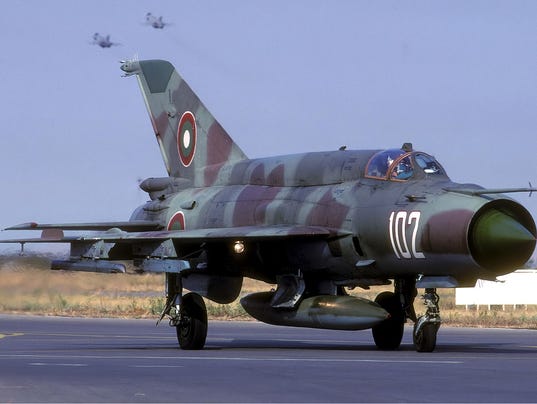
Bulgaria retires last MiG-21 fighters

The Bulgarian air force on 18 December held a ceremony to mark the retirement of its last Mikoyan MiG-21 fighters.
Involving the nation's last three serviceable examples – two single-seat MiG-21bis's and a two-seat MiG-21UM1 trainer – the event marked the end of regular flight operations, although the former pair will remain available to conduct quick reaction alert sorties until 31 December. The fighters will then be kept in storage at Graf Ignatievo air base, ready to be returned to airworthy status should the need arise.
Bulgaria's MiG-21 fleet had originally been slated for retirement in 2012, but the type's availability was continued through two life-extension efforts. This was deemed necessary due to airworthiness problems experienced by the air force's Mikoyan MiG-29 fleet.
A potential further extension of the remaining MiG-21s has been rejected due to the cost of overhauling the aircraft, which were manufactured in 1981 and 1982. Instead, the air force has opted to direct its efforts and available funds towards maintaining its struggling MiG-29 fleet.
flightglobal

Oct 2, 2015

Bulgaria To Allow NATO To Patrol Its Airspace

Bulgaria will amend its legislation to allow military aircraft of other NATO member states to conduct policing of the country’s air space jointly with the Bulgarian Air Force.
The planned changes will be made in such a way as to guarantee that Bulgaria won’t relinquish sovereignty of its air space to other countries.
The projected amendments are being called for by a need to enhance NATO’s capabilities to police the air space of the countries on its eastern flank, including Bulgaria, as recommended by the Alliance’s Summit in Wales last year.
Six Bulgarian Air Force MiG-29 fighter jets will have their engines overhauled in Poland. The agreement drew fire from the Russian producer of the aircraft RSK MiG who said that Poland has no licence or documentation whatsoever to repair MiG-29s.
Bulgaria needs to have at least one fighter squadron of 12 aircraft in order to maintain high level of combat readiness as a NATO member state. Currently, there are four flight-worthy MiG-29s with enough flying capacity in the Bulgarian Air Force.
Only two MiG-29s could remain flight-worthy and with enough flying capacity after the middle of next year unless the engines of other MiG-29 are repaired.
novinite

Sep 8, 2015

Bulgaria blocks Russian 'aid' aircraft from airspace

Bulgaria refused Russian aircraft permission to cross its airspace late last week, amid fears that Russia is boosting its military support to Syria.
Bulgaria's foreign ministry said it suspected the aircraft were not carrying aid, as Russia claimed.
A spokenwoman for the ministry, said Bulgaria had not come under pressure from its Nato allies.
Russia has been a key ally to Syrian president Bashar al-Assad during his four-year civil war with rebels groups.
"The planes were said to carry humanitarian aid but we had information - that we had every reason to trust - that the declared cargo was not the real one," said Ms Zhoteva.
She said the decision to deny the Russian aircraft permission was taken late last week but did not give details about how many planes were involved.
bbc.com

May 5, 2015

Bulgaria may sign deal with Russian firm on repairs to two MiG-29 fighters

Having said earlier that Bulgaria would not extend a costly contract with a Russian firm to maintain the country’s ageing fleet of MiG fighter aircraft, Defence Minister said that Bulgaria could sign a deal on having two repaired.
For several years, Bulgaria has faced the issue of replacing its non-Nato-standard Russian-made jet fighters with Western military aircraft.
No government has made a decision on the jet fighter acquisition, with part of the debate being whether to buy new fighters or to acquire second-hand ones.
Bulgaria could get a donation of second-hand US jet fighters from Washington.
sofiaglobe

May 2, 2015

Bulgaria May Withdraw MiG-29s From Service

Bulgarian Defense Minister has announced the Air Force likely will pull its 12 MiG-29 fighter jets out of service rather than proceed with what he called an "overpriced" maintenance and repair deal with Russia.
Signing an extended deal, until 2019, would be unfavorable to Bulgaria, and so he refused to sign the contract.
The proposed cost was triple the actual value of such a contract, according to the minister.
The aircraft are currently serviced by Russian Aircraft Corporation MiG. That deal is scheduled to expire in September.
The Defense Ministry has shortlisted three offers to acquire new combat aircraft, which include a US bid of F-16s, which were withdrawn from service, the Eurofighter Typhoon, and Sweden's Gripen
When Bulgaria joined NATO in March 2004, Sofia vowed to replace six of its MiG-21 aircraft and acquire eight new fighters by 2016.
defensenews

Mar 7, 2015

Pakistan offers JF-17 Fighters to Bulgaria

Bulgaria is to be offered the JF-17 Thunder combat aircraft.
The fighter is to be offered by Pakistan as an alternative to the several Western aircraft types that are all vying to be selected by Bulgaria as it looks to replace its ageing MiG-29 'Fulcrum' and Sukhoi Su-25 'Frogfoot' platforms.
No details pertaining to costs or potential delivery timelines were revealed.
The Bulgarian government has stated that it will choose to buy new or secondhand Western fighters, or commit to a further MiG-29 upgrade.
Contenders for secondhand jets include surplus Block 25 F-16s from the US Air National Guard, F-16 midlife upgrade aircraft from Belgium, early tranche Eurofighter Typhoons from the Italian Air Force, or surplus Saab Gripens from Sweden.
Although widely offered for export with countries such as Argentina, Serbia, and even Saudi Arabia, the JF-17 has yet to secure its first international customer.
While Bulgaria's economic situation would appear to make it a good candidate for the approximately USD30 million fighter (a comparable Western type would likely cost double this at least), its status as a NATO member would not.
As one of the alliance's newest members, Bulgaria is striving towards achieving full interoperability with its NATO partners, and indeed this is one of the primary reasons that it is looking to replace its Soviet-era MiGs and Sukhois. The JF-17 is not a NATO-compatible aircraft .
janes

Jan 30, 2015

Bulgaria Eyes New Fighter Jets

Bulgaria is considering buying new fighter jets.
Defense Minister aims to visit the US in the first quarter of this year to discuss the potential procurement.
The defense investment strategy presented by the country's previous government states Bulgaria aims to acquire new fighter jets to replace its Soviet-built aircraft. When the country joined NATO in March 2004, Sofia vowed to replace six of its Mikoyan MiG-21 aircraft and acquire eight new fighter jets by 2016.
Due to the "inflated" cost of maintenance, the Bulgarian ministry would also no longer rely on Russian Aircraft Corporation MiG to repair and service the country's 12 MiG-29 fighter jets, and could instead opt for awarding a new contract to a Polish defense company.
The current contract is set to expire in September, and the Defense Ministry is negotiating with Poland, which offers preferential conditions to Bulgaria.
defensenews

Nov 29, 2014

Bulgaria will not buy new jet fighters before 2017

The saga of Bulgaria’s long-delayed purchase of new military jet fighters to meet Nato requirements is set to continue unresolved for a few more years because the state will give no investment loans or state guarantees for large projects before 2017.
This has emerged from a transcript of the Bulgarian cabinet’s November 26 meeting, at which Prime Minister and his ministers agreed only to support a project to construction a gas interconnector link with Greece.
The cabinet declined for now to give financial support to two major projects, the Defence Ministry’s 800 million leva modernisation project and the Regional Development Ministry’s plan to repair and modernise the road network, which has a price tag of about 300 million leva. Both would require a state loan.
Bulgaria joined Nato in 2004 and committed to having eight multi-purpose jet fighters at Nato’s disposal by 2016. Four should be available for operations and four to guard Bulgarian airspace, part of the alliance’s integrated air defence system.
Bulgaria still is using Soviet-era Russian MiG aircraft, incompatible with the needs of Nato and which pose huge problems in maintenance and because of the need to bring in spare parts from Russia.
Should the fighters not be replaced, Turkey and Romania, also both Nato members, would have to continue to assist in guarding Bulgarian airspace.
sofiaglobe

Oct 13, 2014

Greece poised to sell some of its F-16 fighters to Bulgaria

Greece is in talks with the US and Bulgaria about selling some of its old F-16 fighter jets to Bulgaria and leasing new ones from Washington.
NATO asked Bulgaria in February to update its air force’s capability and the country’s defense officials have approached Athens about the possibility of buying between six and eight Fighting Falcon planes. The issue was first discussed when the country’s two defense ministers met in March.
There is a precedent for such a deal as Portugal sold 12 of its F-16s to Romania for 880 million dollars in October 2013. Sources said the Hellenic Air Force would like the jets sold to be replaced by Block 52s but the US does not want to lease these airplanes.
focus-fen

Oct 8, 2014

Bulgaria To Choose New Fighter Planes Within 6 Months

Bulgaria must choose new fighter planes for its air force in the next six months.
The country can choose among three offers – new Gripen fighters, used Eurofighter from Italy or used F16 from Portugal.
novinite