Translate

Showing posts with label 'IZUMO'. Show all posts

Apr 29, 2018

Study Concludes that Japan Izumo-class Vessels able to operate F-35B

The Defense Ministry commissioned a study into the possible conversion of the Maritime Self-Defense Force's Izumo helicopter carrier into a full-fledged aircraft carrier in case Japan was required to provide rear-line support for a U.S.-led war.
The ministry in April 2017 asked Japan Marine United Corp., a Tokyo-based company that built the vessel, to look into ways to improve the capabilities of the Izumo.
Japan Marine United submitted its report to the Defense Ministry in March and the ministry released details, with some bits blacked out, on April 27.
The report states that the Defense Ministry's precondition for the study was to look into how the Izumo could be used to provide rear-line support to the U.S. military.
The company was asked to provide estimates for the cost and construction schedule if changes were made to allow U.S. F-35B stealth fighter jets to land vertically on the deck and to use elevators to transport aircraft to their hangars.
asahi

Mar 4, 2018

Japan Authorizes study on operating F-35B from Izumo

Defense Minister Itsunori Onodera dropped a bombshell admission March 2 by saying he authorized studies into whether advanced F-35B stealth fighter jets can be deployed on the Maritime Self-Defense Force's Izumo helicopter carrier.
Such activity would fly in the face of war-renouncing Article 9 of the Constitution that prohibits Japan from maintaining more than the bare minimum to protect itself.
Aware of the political ramifications of his comment in the Upper House Budget Committee session, Onodera added, "No decision has yet been made about whether the F-35B will actually be attached to the Izumo."
The Izumo is the largest vessel in the MSDF fleet and any move to refit it into an aircraft carrier would face an uproar from the opposition parties.
Akira Koike of the Japanese Communist Party called Onodera's comment "an important admission" in light of the government's past refusal to possess an aircraft carrier due to the nation's exclusively defensive posture.
"But he (Onodera) is now saying consideration is being given to fundamentally change the posture of the nation," Koike said.
The U.S.-made F-35B is the most advanced stealth fighter jet and unlike the F-35A now used by the Air SDF, it can take off from a short runway and also land vertically like a helicopter.
In the Upper House Budget Committee session, Onodera said, "Regarding the Izumo, research has been conducted on which among the latest aircraft could possibly take off and land on it. The most representative aircraft is the F-35B. (The research) is intended to accumulate fundamental information regardless of the conclusion reached in the future."
But he stopped short of stating whether the Constitution banned the possession of any aircraft carrier. He would only say "attack" aircraft carriers that had many aircraft capable of loads with extreme destructive power or anti-land attack capabilities would not be allowed.
asahi

Jan 7, 2018

Proposal to convert MSDF's Izumo into aircraft carrier merges at Japan´s Defense Ministry

The regular review of Japan's National Defense Program Guidelines is fast approaching, and attention is likely to be focused on the Self-Defense Forces' offensive strike capability.
Within the Defense Ministry, there is even a proposal circulating to convert the Maritime Self-Defense Force (MSDF)'s Izumo helicopter carrier into a regular aircraft carrier. The idea is unlikely to be adopted, as it would risk shaking the foundations of Japan's defense-only policy. However, discussions on how best to prepare the SDF with defense capabilities have heated up noticeably within the administration of Prime Minister Shinzo Abe, as China continues to emerge as a major military power and North Korea forges ahead with its ballistic missile and nuclear arms programs.
The current National Defense Program Guidelines were approved by the Cabinet in 2013, along with the five-year "Mid-term Defense Program" plan specifying equipment acquisition priorities. The guidelines will expire in mid-2020.
The proposal to convert the Izumo into a true aircraft carrier apparently emerged primarily from among the Defense Ministry's uniformed personnel, taking advantage of Prime Minister Abe's policy of reviewing both the defense program outline and midterm defense buildup plan.
mainichi.jp

Mar 26, 2015

Japan Navy Commissions Izumo 'helicopter carrier' as largest ship in MSDF fleet

The Japan Maritime Self-Defense Force on March 25 officially commissioned the largest ship in its fleet.
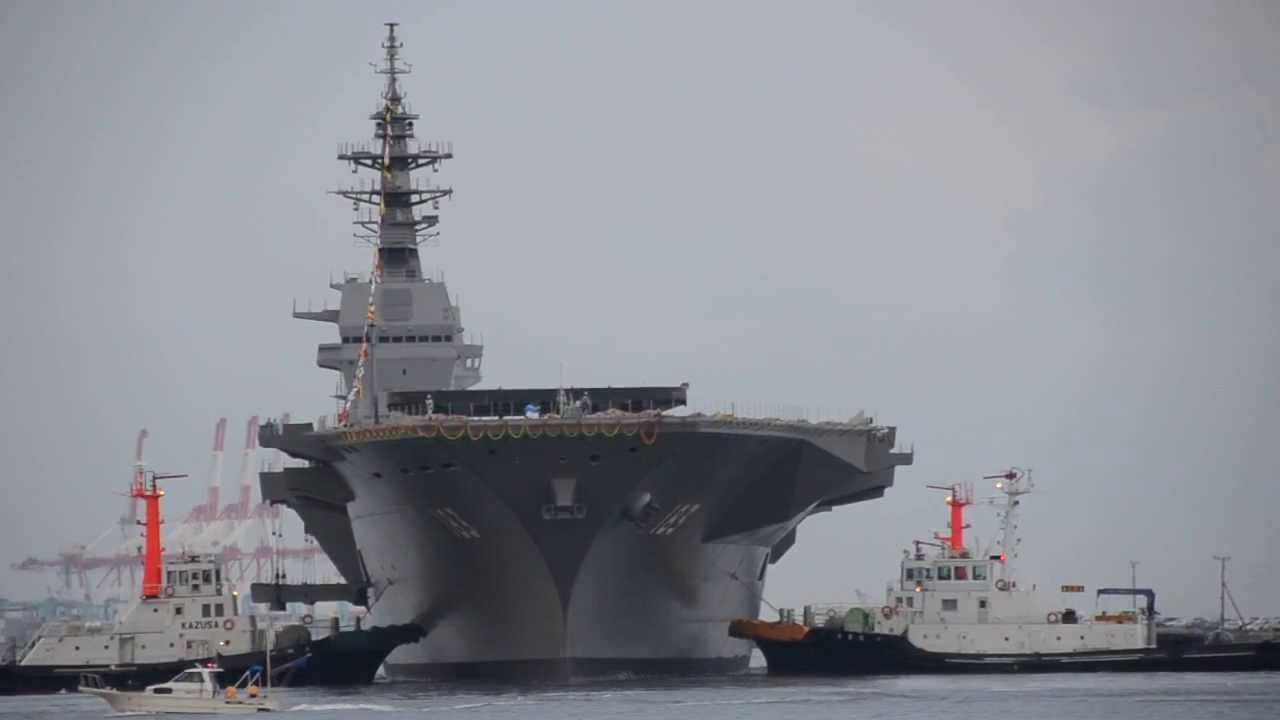
The Izumo measures 248 meters in length, and she is described as a semi-aircraft carrier. It is 51 meters longer than the destroyer Hyuga, which was the largest ship in the MSDF fleet until now.
Jane's Fighting Ships,describes the Izumo as a helicopter carrier.
The Izumo has five landing spots on its flight deck for reconnaissance helicopters. It can carry up to nine helicopters at a time, five more than the Hyuga.
The Osprey transport aircraft that the Ground SDF will deploy in the fiscal year beginning in April can also land on the Izumo.
The Izumo joined the MSDF's Escort Flotilla 1, which is based in Yokosuka, Kanagawa Prefecture.
Construction on the ship began in fiscal 2010.
asahi

Sep 30, 2014

Japan puts helicopter carrier Izumo on sea trials

The Japan Maritime Self-Defence Force (JMSDF) has begun sea trials of its helicopter carrier JS Izumo (DDH 183).
The 248 m-long vessel, which displaces 24,000 tonnes at full load, is the largest Japanese military ship built since the Second World War and can carry up to 14 helicopters. Izumo and its yet unnamed sister ship (DDH 184) will replace the JMSDF's two Shirane-class destroyers, JS Shirane (DDH 143) and JS Kurama (DDH 144), inducted in March 1980 and 1981 respectively.
janes

Oct 18, 2013

South Korea Navy wants 3 more Aegis ships

South Korea Navy has requested three more Aegis destroyers to strengthen the country’s defense against North Korea and to cover territorial disputes in the region.
If the plan gets the go ahead, the ships will be built between 2020 and 2025.
Under a Navy buildup project started in 2004 to bolster defense against North Korea, South Korea began to build Aegis destroyers and currently has three 7,600-ton warships ― the King Sejong the Great, the Seoae Ryu Seong-ryong and the Yulgok Yi I.
However, the Navy has sought to increase its fleet to cope with rising regional tension in the wake of North Korea’s third nuclear test conducted earlier this year and ongoing territorial disputes between China and Japan.
In addition, a growing arms race in the region is also behind the request.
China deployed its first aircraft carrier to the eastern port city of Qingdao in September last year, while Japan unveiled its biggest warship since World War II, the huge flat-top “destroyer” Izumo that can carry up to 14 helicopters, pushing the Korean Navy to come up with countermeasures.
A 166-meter-long Aegis destroyer is equipped with the latest radar system as well as missiles and torpedoes in vertical launch systems. With 300 crew members, it can also carry two mid-sized helicopters and sail at a top speed of 30 knots with a range of 1,000 kilometers.
koreatimes

Aug 6, 2013

Japan navy to unveil biggest warship since World War II


Japan is set to unveil its biggest warship since World War II on Tuesday amid tensions with China following maritime skirmishes between the two nations over disputed islands.
Tokyo's military is holding a ceremony in the port city of Yokohama to show off its new 248-metre (810-feet) helicopter carrier, which will be a centrepiece of its naval power.
channelnewsasia