Translate

Showing posts with label PLAAF. Show all posts

Jan 7, 2024

Pakistan announces its intention to acquire the J-31/FC-31 “Gyrfalcon,” China’s upcoming fifth-generation stealth fighter jet.


The Chief of the Pakistan Air Force has disclosed the force's intention to acquire the Chinese fifth-generation fighter jet J-31/FC-31 "Gyrfalcon" in the near future.

During a ceremony at an airbase, Air Chief Marshal Zaheer Sidhu, head of the Pakistan Air Force, provided an overview of the latest additions to the PAF's arsenal, including Chinese 4.5-generation J-10C fighters, C-130H military transport aircraft, as well as Airbus-319, Boeing 737, Piper M-600 transport planes, and Beechcraft King Air 350i aircraft. The Air Chief also highlighted recent additions of modern radars, unmanned aerial systems such as Bayraktar TB2 and Akinci (of Turkish origin), and indigenous Shahpar-II drones, along with loitering munitions, swarm drones, and long-range vectors, significantly bolstering the country's air defense capabilities.

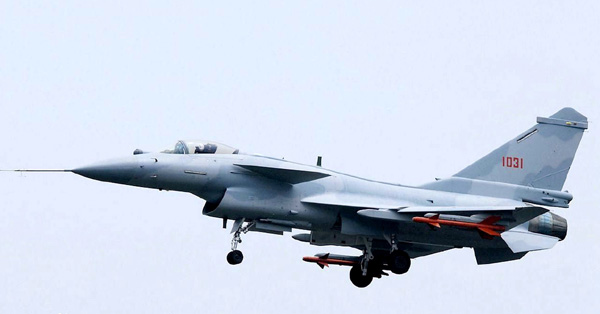
The Pakistan Air Force became the first export customer for the J-10C "Vigorous Dragon" and now seeks to become the first foreign operator of the FC-31 "Gyrfalcon" (export designation for the J-35 for the Chinese Navy), a fifth-generation stealth fighter aiming to compete in capabilities with the American F-35.

As per the PAF chief's statements, "the groundwork has already been laid for the acquisition of the stealth combat aircraft J-31."

Similar to how the induction of the J-10C was Pakistan's response to the arrival of the Dassault Rafale in the Indian Air Force (IAF), the PAF aims to continue maintaining technological balance with its adversary, which is developing its own fifth-generation fighter jet program, by adopting the Chinese FC-31.

The recent announcement comes as somewhat surprising, considering that in August 2023, it was announced that Pakistan was close to finalizing an agreement to participate in the development of the Turkish fifth-generation fighter KAAN, which was expected to make its maiden flight on December 27 but was ultimately postponed to an undefined date.

While the longstanding strategic partnership between Beijing and Islamabad is robust, enabling Pakistan to access the latest Chinese military export technology ahead of others, it remains challenging to believe that the FC-31 will bear the PAF insignia in the "near future," given that the aircraft is not yet in production, nor is the J-35, a crucial future component of the air wing for the conventional take-off and landing aircraft carrier 'Fujian'.


Mar 16, 2022

NEWS 2022 March, 16

USAF F-35 have encountered with PLAAF's J-20 over East China Sea 


A top USAF general said that F-35s have had at least one encounter with Chengdu J-20s, and that the Shaanxi KJ-500 airborne early warning & control (AEW&C) aircraft has a key role in long-range air-to-air kill chains. He did not, however, told when the F-35/J-20 encounter took place.

“It’s a bit early to say what they intend to do with the J-20, so really all we’ve seen it do is air superiority,” he said.

flightglobal

USAF B-21 'Raider' begins ground test phase

The first B-21 'Raider' has entered the ground test phase, paving the way for its expected rollout this year and subsequent first flight.

Northrop Grumman has six of the stealthy aircraft in various stages of production

The next step will involve getting the B-21 ready for flight. This includes carrying out engine runs as well as low-speed and then high-speed taxiing.

After that, the actual first flight from Plant 42 to Edwards Air Force Base in California will take place. Formal flight testing will be held at Edwards.

defensenews

Apr 20, 2019

Russia completes deliveries of SU-35 fighter aircraft to China

Russia has completed the delivery of 24 Sukhoi Su-35 'Flanker-E' multirole fighter aircraft to China's People's Liberation Army Air Force (PLAAF).
Russian defence conglomerate Rostec had previously been quoted as saying that China had received the first 4 Su-35 platforms in 2016 and a further 10 in 2017 as part of a contract for 24 aircraft estimated to be worth about USD2.5 billion.
In November 2015, Rostec announced that Beijing had signed the contract to purchase the Su-35s, making China the first foreign customer of the Russian-built aircraft, which is claimed to be an upgraded and highly manoeuvrable '4++ generation' fighter with characteristics and performance close to those of upcoming 'fifth-generation combat aircraft'.
The Russian-Sino agreement reportedly includes not only the sale of the aircraft but also the delivery of, among other things, ground support equipment and spare engines
janes

Oct 13, 2018

China confirms Development of ‘new long-range strategic bomber’, The 'Hong-20' 'H-20'

China’s official state-run media has confirmed the designation of the country’s newest long-range strategic bomber, with analysts speculating that the prototype is expected to make its first flight soon.
In a documentary reportedly broadcast in August, China Central Television referred to the “Hong-20” as the “new long-range strategic bomber” under development for the People’s Liberation Army Air Force, or PLAAF, confirming for the first time the H-20 designation that has previously been used elsewhere to describe the program.
The documentary added that “great progress” is being made on the Hong-20’s development, although it did not provide other details. “Hong” is the standard abbreviation for the term “Hongzhaji,” or bomber in Chinese, although this is usually shortened to just the “H” in Western literature.
It’s been reported that Chinese military officials said a new strategic bomber should be capable of striking targets beyond the second island chain without aerial refueling while carrying a payload of at least 10 metric tons, leading to speculation that targets such as Hawaii would be within range of cruise missiles launched by the new bomber.
The bomber is expected to complement the Xian H-6K in Chinese service. A development of the Soviet-era Tupolev Tu-16 Badger, the H-6K features more powerful engines and a totally revised, modern avionics suite. It is also capable of launching cruise missiles.
defensenews

Feb 10, 2018

China PLA scrambles Su-35s, J-20s to S China Sea as US Navy sails in

Beijing has responded to the US Navy’s ramped-up presence in the South China Sea – an aircraft carrier strike group led by the USS Carl Vinson has been scheduled to call at Vietnamese ports next month – with squadrons of advanced fighters including Su-35s and J-20s that will soon start patrolling the 3.5-million-square-kilometer sea.
Further incidents involving US and Chinese forces appear inevitable after the China News Service revealed that the US guided-missile destroyer Hopper came within 12 nautical miles of Scarborough Shoal (Huangyan Island) last month, and was intercepted by the Chinese missile destroyer Huangshan. CNS said the US warship steered away from the area after a brief standoff.
Similar encounters in the air are set to become frequent as well, as the People’s Liberation Army has dispatched an unconfirmed number of Su-35 multirole fighters to the sea for joint combat cruise missions.
This is “a pragmatic action for the air force to fulfill its mission in the new era and conduct combat training exercises” above the South China Sea, said a statement by the PLA Air Force on its Weibo social media account.
It is also rumored that several J-20s already in service with the PLAAF will fly south to join Russian-made counterparts to test the 4.5th generation fighter’s operational reliability.
atimes

Sep 30, 2017

China’s J-20 stealth fighter jet is in service

China has officially commissioned the Chengdu J-20 stealth fighter into service, the country’s defense ministry has announced.
Wu Qian, a spokesperson for the country’s Ministry of National Defense, also said in a media conference on Thursday that flight tests are being conducted as scheduled. The type is currently in low rate production for China’s People’s Liberation Army Air Force, or PLAAF, with at least six examples known to be undergoing operational testing since late 2016 with the service’s 176th Air Brigade at Dingxin Airbase in China’s Gansu Province.
The J-20 is classified by the PLAAF as a fourth-generation — broadly equivalent to fifth-generation in the West — medium- and long-range fighter jet with stealthy characteristics, although these are mainly confined to the frontal aspect of the design
defensenews

Mar 11, 2017

China J-20 stealth jet enters service

China has put into service its new generation J-20 stealth fighter, a warplane it hopes will narrow the military gap with the United States, as senior naval officers said the country was building a "first class" navy and developing a marine corps.
Chinese President Xi Jinping is overseeing a sweeping modernization of the country's armed forces, the largest in the world, including anti-satellite missiles and advanced submarines, seeking to project power far from its shores.
In a report late on Thursday, state television's military channel confirmed that the J-20 had now entered service, though it gave no other details.
The aircraft was shown in public for the first time in November at the Zhuhai airshow and was first glimpsed by Chinese planespotters in 2010.
However questions remain whether the new Chinese fighter can match the radar-evading properties of the Lockheed Martin F-22 Raptor air-to-air combat jet, or the latest strike jet in the U.S. arsenal, Lockheed's F-35. The F-22, developed for the U.S. Air Force, is the J-20's closest lookalike.
China showed off another stealth fighter it's developing, the J-31, at the last Zhuhai airshow in 2014, a show of muscle that coincided with a visit by U.S. President Barack Obama for an Asia-Pacific summit.
China hopes the J-31, still in development, will compete with the U.S.-made F-35 stealth aircraft in the international market.

Jan 13, 2017

China receives first four Su-35s

Beijing has taken delivery of four Sukhoi Su-35 fighters: the first installment in an acquistion that will see it receive 24 examples.
News of the jets' arrival in China was revealed in a report by state news organ China Daily.
The report, citing the People’s Liberation Army Air Force, claimed that Moscow was apparently “eager to complete the Su-35 deal” owing to the “commissioning” of the Chengdu J-20 fighter, which made its public debut with a flying display at Airshow China in Zhuhai in November 2016. Negotiations between Beijing and Moscow for the Su-35 deal dragged on for several years prior to this point.
flightglobal

Jan 2, 2016

China Builds Its Own'Wild Weasel' To Suppress Air Defenses, The J-16D

While China's Anti-Access/Area Denial (A2/AD) operations rely on heavy air defenses, Chinese air force planners may also have to account for enemy surface to air missiles, all the more with Taiwan and Japan embarking on a new buildup of missile shields. In December, one of the responses was revealed: the Shenyang J-16D.
The J-16D is a J-16/Su-30 multi-role fighter optimized for "Wild Weasel" missions. Starting in the Vietnam War, Wild Weasels are fighters designed to take on surface-to-air missile batteries in a SEAD (Supression of Enemy Air Defense) role. Armed with anti-radiation missiles (which lock on and target radars by their electronic emissions) and electronic intelligence and electronic warfare jammers, they are designed to engage and suppress defenses, opening the way for traditional air attacks.
Compared to the baseline J-16, the J-16D has removed its Infrared Search Tracking sensor and 30mm cannon to accommodate more electronics inside its fuselage. It also has several antennas mounted around its fuselage. The J-16D also two large ELINT pods on its wingtips, similar to those on the E/A-18 Growler, to collect enemy radar and electronic activity. Additionally, the J-16D has smaller radome, likely to include an active electronically scanned array (AESA) radar optimized for electronic warfare, including signals collection and jamming. The J-16D will be fitted with large AESA jamming pods, a development of current jammers on JH-7A attack aircraft; its attack ability will come from YJ-91, LD-10 and other anti-radiation missiles.
popsci

Jul 14, 2015

China Wants to Develop a New Long-Range Stealth Strategic Bomber

China needs to develop a new long-range strike bomber capable of attacking targets farther out in the Pacific. This is the principal conclusion of a meeting of Chinese military officials, according to AFP citing a full-page China Daily article published last Tuesday as its source.
In the meeting the People’s Liberation Army Air Force (PLAAF) was also referred to as a “strategic force” a title usually reserved for the People’s Liberation Army (PLA) Second Artillery Corps – Beijing’s “de facto strategic missile force,” according to China Daily.
The new bomber should be capable of striking targets as far as the “second island chain” – an area stretching from the Kurils in the North through Japan, the Bonins, the Marianas, the Carolines and Indonesia in the South – the paper further states.
The PLA’s definition of a long-range strategic bomber is a minimum range of 8,000 km (5,000 miles) without refueling and the capacity to carry a payload of more than 10 tons of air-to-ground ammunition.
This definition would correspondent to the sparse details available on China’s prospective subsonic stealth bomber – the H-20 (or H-X) – which could enter service by 2025 some analysts note.
H-20 is believed to be able to evade modern air defense systems and penetrate deep into the enemy territory. Some analysts argue that the primary mission of the new bomber will be do attack U.S. aircraft carrier strike groups.
The PLAAF currently operates approximately 15 H-6K nuclear-capable bombers, a locally built version of the Russian Tupolev Tu-16 Badger which can “reach Okinawa, Guam and even Hawaii from China’s mainland, depending on the bombers armament.
thediplomat

May 25, 2015

China will have to purchase Su-35 fighters To Fill The Gaps In Its Air Force

China needs Russian Su-35 fighters, despite the fact that Beijing has carried out flight testing of it own latest fighter J-11D.
J-11D was derived from J-11B, which is analogue of Su-27 manufactured in China. Probably the most outstanding feature of J-11D is the fact that it is fitted with avionics installed on the more advanced J-16 fighter. The jet is fitted with radar with an active electronically scanned array (AESA).
China needs Su-35 in order to fill the gap in the fleet of its air forces. Even if China increases output to two J-11 jets per month it won’t be enough to reduce the gap between Chinese air forces and air forces of other countries. In addition, it is unclear, when J-11 will be able to compete with other fifth-generation fighters.
Su-35 is the “4++”-generation fighter derived from Su-27.
ruaviation

Apr 8, 2015

China Is Building The World's Largest Seaplane AG600 To Control South China Sea

China is building the world’s largest seaplane, the Jiaolong (Water Dragon) AG600. Capable of landing and taking off on water (and land), the Chinese-built aircraft could make it easier for Beijing to press its claims in the South China Sea, according to experts quoted in a Defense News article.
With a maximum take-off weight of 60 tons, the Jiaolong AG600 will become China’s largest amphibious airplane when it enters Chinese services in either 2016 or 2017. The aircraft is powered by four turboprop WJ-6 engines and has a range of 5,500 kilometers. The alleged top speed of the aircraft is 348 mph (555 km/h).
The AG600 is currently being built by China Aviation Industry General Aircraft Co. (CAIGA), which is also developing two other seaplanes. The company announced that it had completed the front fuselage assembly for the prototype. The civilian version of the plane can be used for a wide range of tasks including emergency rescue operations, forest firefighting, transport missions, and maritime surveillance.
Yet the aircraft will also be able to execute a host of military assignments, including long-range patrols, anti-submarine warfare tasks, and mine-laying missions. Additionally, the AG600 would be capable of quickly shuttling cargo and personnel to the contested Spratly Islands, where China is currently constructing artificial outposts on Hughes Reef, Johnson South Reef and Gaven Reef, all of which are surrounded by shallow waters.
China began developing the AG600 in 2009. Some report note that around 60 planes will be build in the years ahead.
thediplomat

Mar 25, 2015

China's KJ-500 AEW&C 'enters service'

Images from Chinese military issue websites indicate the KJ-500 AEW& C aircraft has started to enter service with the PLAAF.
This is the first image of one with an official serial number (30471), confirming its service entry.
janes

Feb 26, 2015

J-10B Will Be Soon Inducted to China's Air Force

China's air force will soon commission the J-10B fighter jet, the most advanced military aircraft the country has ever developed on its own.
Several pictures showing 14 of the planes lined up outside an unidentified aircraft factory have been circulating on military websites. Experts said their gray paint scheme indicates that they will soon be delivered to the People's Liberation Army air force.
It is also possible and feasible that the J-10B's upgraded version will be chosen by the navy to serve on an aircraft carrier.
The J-10B is an improved variant of the J-10A, which is manufactured by the Chengdu, a subsidiary of the State-owned giant Aviation Industry Corp of China.
Western military sources said the jet had its first flight in December 2008, and mass production started in 2013.
The new fighter has an increase of at least 30 percent in overall capability compared with its predecessor.
The aircraft has a maximum takeoff weight of 19 metric tons and can carry a payload of up to 8 tons. Its combat radius can reach to about 1,000 kilometers.
ecns.cn

Feb 17, 2015

Former China PLAAF Pilot says Argentina has bought J-10 'Typhoon beater'

A former PLAAF pilot has published an article on China Military Online advocating that Argentina buys the J-10B combat aircraft
Argentine-Chinese talks on aerospace co-operation have previously focused on the less capable JF-17 FC-1.
China Military Online, the website of the semi-official PLA Daily newspaper, has published an analysis advancing the case for China to supply the Argentine Air Force with the J-10B combat aircraft rather than the CAC/PAC JF-17/FC-1. The article was published a week after the visit to China by Argentine president Cristina Fernandez de Kirchner early this month and the reported establishment of a joint Chinese-Argentine fighter aircraft working group.
janes

Dec 14, 2014

Su-35 Fighter Jets Could be Supplied to China from Russia Next Year, Official Says

A top official with Russian contractor Sukhoi said Russia will supply “standard” versions of the Su-35 combat aircraft to China.
Sukhoi first deputy director general Boris Bregma said that a “contract will be signed at the end of 2014 or at the beginning of 2015.”
“There are no obvious political or technical reasons hindering the signing of the contract. The only thing to be done is the elaborate consideration of some details and technical issues,” he added.
Bregma said the adaptation of the fighter jet, “Sinification,” will be performed as part of a supplementary contract. They include Chinese-language interfaces and different enhancements.
theepochtimes

Dec 13, 2014

China Stealth Jet Maker Walks Back Boast It Could ‘Take Out’ F-35

In early November, as President Xi Jinping hosted U.S. President Barack Obama in Beijing, China's military officials in the south of the country took the occasion to unveil China’s new stealth fighter jet, the J-31. The message, analysts say, was unmistakable: watch this, Yanks.
In an interview, manufacturer, AVIC CEO, told state media that “the J-31 can definitely take out the F-35 when it takes to the skies.”
Analysts have said the J-31 is similar to the F-35. There are allegations that the Chinese product was developed using information stolen from Lockheed and six sub-contractors.
It isn’t the first time a Chinese stealth jet program has met been accused of copying specs from a U.S. competitor. Analysts have said the J-20 looks an awful lot like the U.S. F-22 Raptor jet and suggested China likely learned some of its stealth technology from pieces its agents obtained of the wreckage of a U.S. F-117 shot down by a Serbian antiaircraft missile during the 1999 Kosovo war. Chinese officials have denied these claims.
blogs.wsj.com

Dec 1, 2014

China moves ahead to develop sixth-generation fighter

China is moving ahead to develop a sixth-generation stealth fighter after it finishes the fifth-generation J-20 and J-31.
The United States is the first nation to forge plans for the design of a sixth-generation fighter. In an official statement, the US Navy claimed that a sixth-generation fighter — called FAXX — will replace the F/A-18E/F Super Hornets and EA-18G Growler by 2030. A source from the US military said that the Department of Defense has already prepared a budget for the development of FAXX in 2015.
Russia has recently gotten on board with its own next generation fighter program. A research team was established in northeastern China's Shenyang much earlier than Russia for the country's 6th-gen program.
China is the only nation capable of designing two types of fifth-generation fighters in such a short period of time. With experience gained from the development of the J-20 and J-31, China has enough resources to carry out its next-gen program. China's next fighter is likely to be an unmanned aerial vehicle.
While the definition of "sixth-generation" is not clear yet, most believe such an aircraft must be equipped with a laser or railgun.
wantchinatimes

Nov 23, 2014

China building airstrip-capable island on Fiery Cross Reef-Spratly Islands

China is building an island at least 3,000 m long on Fiery Cross Reef that could be the site for its first airstrip in the Spratly Islands in the South China Sea.
Satellite imagery of the island taken on 8 August and 14 November shows that in the past three months Chinese dredgers have created a land mass that is almost the entire length of the reef.
Fiery Cross Reef lies to the west of the main Spratly island archipelago and was previously under water; the only habitable area was a concrete platform built and maintained by China's People's Liberation Army Navy (PLAN).
The new island is more than 3,000 m long and between 200 and 300 m wide: large enough to construct a runway and apron. The dredgers are also creating a harbour to the east of the reef that would appear to be large enough to receive tankers and major surface combatants.
The existing structure on the reef's southwestern edge was home to a PLAN garrison and had a pier, air-defence guns, anti-frogmen defences, communications equipment, and a greenhouse. The concrete structure is currently not attached to the new island, but if previous Chinese land reclamation projects in the Spratlys are any guide, it is only a matter of time before it is joined up.
The Spratly Islands are claimed by Brunei, China, Malaysia, the Philippines, Taiwan, and Vietnam. All but Brunei occupy islands or have built structures on reefs and shoals to assert their claims.
China has been at a distinct disadvantage compared with other claimants in the Spratly Islands as it is the only claimant not to occupy an island with an airfield. Taiwan has Itu Aba (Taiping) island, the Philippines has Pagasa island, Malaysia has Swallow Reef (a reef on which it reclaimed land and built an airstrip), and Vietnam has Southwest Cay.
The work at Fiery Cross thus brings parity but is likely to cause alarm among the other claimants. China has previously shown it is willing to spend blood and treasure to assert its territorial claims in this region. Given its massive military advantage over the other claimants in terms of quantity and quality of materiel, this facility appears purpose-built to coerce other claimants into relinquishing their claims and possessions, or at least provide China with a much stronger negotiating position if talks over the dispute were ever held.
janes.com

Nov 18, 2014

China raised issue of U.S. spy flights during military talks

China raised the thorny subject of U.S. military spy flights during talks that led to agreements this week on reducing friction between the two militaries, but was told U.S. missions in international airspace and waters would continue, the Pentagon said.
The closed-door conversations underscore China's sensitivity to surveillance by U.S. P-8 Poseidon spy planes and other aircraft, especially off Hainan Island, home to a major Chinese submarine base. A Chinese intercept of a P-8 plane in international airspace off Hainan in August was described as dangerous by Washington.
U.S. President Barack Obama announced the military agreements on Wednesday after meeting his Chinese counterpart Xi Jinping in Beijing.
They require each country to notify the other of major military activities, including exercises, as well as cover rules of behavior for air and maritime encounters.
At one point during the discussions, Chinese officials had raised the matter of U.S. military spy flights that, in Beijing's view, have come too close to Hainan.
China sees the airspace around Hainan as part of its 200-nautical mile exclusive economic zone, which, in its view, ought to be restricted. The U.S. military says it has the right to fly any kind of mission it chooses in international airspace, which begins 12 nautical miles from a country's coastline.
The incident in August, when a Chinese fighter jet intercepted a P-8 Poseidon plane some 135 miles (215 km) east of Hainan, highlighted the risks as the two militaries rub up against each other in the South China Sea and Pacific Ocean.
The Chinese jet made several passes, crossing over and under it. At one point, it flew wingtip-to-wingtip and then performed a barrel roll over the top of the spy plane, U.S. officials have said. China has said the pilot kept a safe distance.
reuters