Translate

Showing posts with label X-47B. Show all posts

May 11, 2015

Lockheed urges more X-47B testing

Lockheed Martin wants to see the continuation of the X-47B demonstrator programme led by Northrop Grumman as the US Navy’s unmanned carrier-launched airborne surveillance and strike (UCLASS) competition enters a “waiting period” with no firm requirements so far revealed.
Lockheed’s director of unmanned systems strategy, says that industry and the navy still have much to learn about unmanned operations within a battle carrier group that is swarming with manned aircraft.
flightglobal

Apr 23, 2015

US Navy X-47B first to complete autonomous aerial refueling

The X-47B successfully conducted the first ever Autonomous Aerial Refeuling of an unmanned aircraft April 22, completing the final test objective under the Navy's Unmanned Combat Air System demonstration program.
The X-47B connected to an Omega K-707 tanker aircraft and received over 4,000 pounds of fuel using the Navy's probe-and-drogue method.
During the test, the X-47B exchanged refueling messages with a government-designed Refueling Interface System (RIS) aboard the tanker. The aircraft autonomously maneuvered its fixed refueling probe into the tanker’s drogue, also known as the basket, the same way a Navy pilot would refuel a manned aircraft.
navair

Apr 20, 2015

X-47B engages tanker to prepare for refuelling test

The X-47B UCAS-D on 15 April connected with the fuel probe of a refuelling aircraft in flight, the US Navy (USN) announced on 16 April.
The X-47B connected with an Omega Aerial Refueling Services K-707 tanker, but did not receive fuel during the test. The effort marked a final preparation for an actual in-flight refuelling of the UCAS-D.
In that final test the X-47B is expected to use a new optical sensor to guide its fuel probe into the tanker aircraft's drogue.
janes

Feb 3, 2015

US Navy Plans UCLASS Fielding Date for 2020-2022

The US Navy has pushed its planned fielding date for its carrier-based unmanned aerial vehicle (UAV) from 2020 to 2022.
In addition to the delay in initial fielding, the service has decided to push the request for proposal of the air segment of UCLASS into Fiscal Year 2016.
The Navy included a modest $135 million for research and development efforts for the program, a significant drop from the FY 2015 request of $403 million.
The previous UCLASS funding is shackled to legislation that require several studies and reports to Congress on the Navy’s intentions for the final platform.
news.usni.org

Dec 9, 2014

X-47B May Begin Automated Aerial Refueling Demonstrations Next Year

The Navy’s carrier-based unmanned aircraft demonstrator is undergoing preparations for automated aerial refueling testing next year, including a possible flight demonstration using the aircraft itself, said officials from the service and X-47B manufacturer Northrop Grumman.
Thusfar, the Navy had used a surrogate aircraft for AAR testing.
The service in June 2014 awarded a contract modification to Northrop Grumman for aerial refueling research, development, test and evaluation efforts at Naval Air Station Patuxent River in Maryland
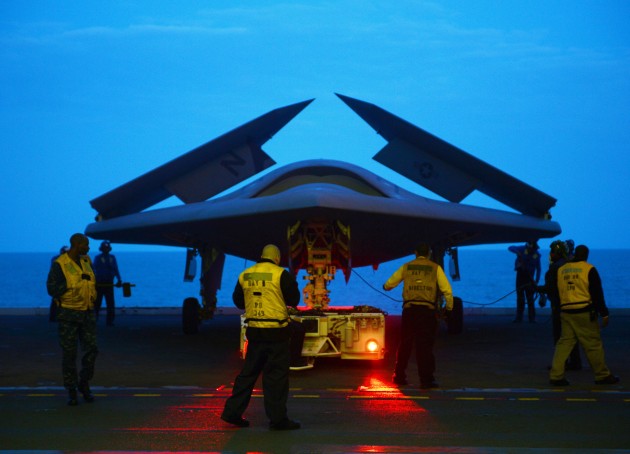
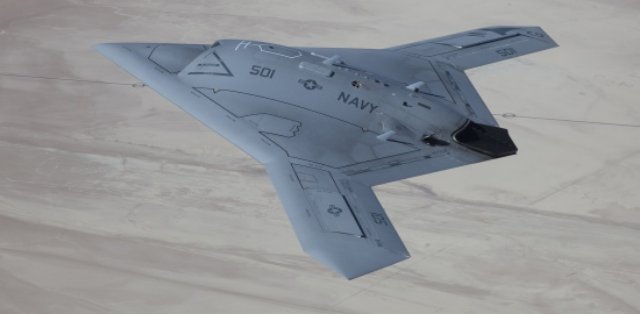
The X-47B is the Navy’s first carrier-based drone, capable of almost completely autonomous operations even as the ship moves throughout the seas. The stealthy, tailless aircraft can take off, conduct surveillance and land back on the carrier using a combination of algorithms and sensors that allow it to land on the runway with precision. It first showcased that ability in May 2013 during sea trials on the USS George H.W. Bush when it successfully completed its first touch-and-go and arrested landings.
In August 2014, it returned to the carrier deck once again for its first cooperative flight with a manned aircraft. This time, it flew in pattern with an F-18 Hornet over the USS Theodore Roosevelt.

nationaldefensemagazine

Jul 16, 2014

Pentagon Delays Navy’s Carrier Drone Program

The Pentagon has delayed the carrier-launched drone program amid ongoing reviews of the program’s requirements.
A planned competition among defense companies has been put on hold as the Pentagon examines plans for the drone and responds to criticism from lawmakers that the initial requirements have been too narrowly configured.
A formal Request For Proposal, or RFP, which had been planned for release by the Navy later this month, has been delayed by a few weeks.
The Navy plans to deliver a carrier-based drone by 2020, called the Unmanned Carrier Launched Airborne Surveillance and Strike, or UCLASS, system.
Criticism of the requirements has come, in large measure, from analysts, defense officials and lawmakers.
Through the engineering of stealth platforms such as the B-2 bomber, the Air Force has extensive experience designing low-observable or stealth aircraft.
Analysts have questioned whether the platform can adapt over time or whether features like stealth and electronic attack need to be engineered into the original design at from the start.
In particular, low-observable or stealth specifications are needed to help the UCLASS evade increasingly sophisticated enemy air defenses and a broadly scoped payload or weapons delivery capability is needed to maximize its effectiveness for future engagements.
Furthermore, the UCLASS drone will need to overcome what the Pentagon refers to as anti-access/area-denial, or A2/AD threats, meaning adversaries with increasingly sophisticated long-range missiles and air defenses, among other things.
One source explained if the UCLASS is configured to carry the extra fuel needed for longer-endurance missions, then it will need to be built with a larger vertical signature and therefore have a less-stealthy design. For this reason, advocates for more expansive requirements have favored planning for more aerial refueling of the drone in order to ensure that it is engineered with a stealthy, low-observable design.
While not willing to comment publically on plans for stealth or low-observability for UCLASS, Navy program officials have maintained that the program’s requirements do call for a weaponized strike platform as well as an ISR vehicle. However, the weapons capability is something that is described as incremental, meaning it will be engineered into the platform over time, Navy officials explained.
Critics however, have questioned whether this is possible and favored building an original design at the beginning of the program with stealth and weaponry factored into the construction and engineering.
Last summer, the Navy awarded four contracts valued at $15 million for preliminary design review for the UCLASS to Boeing, General Atomics Aeronautical Systems, Lockheed Martin and Northrop Grumman.
dodbuzz

Apr 18, 2014

Navy Issues Restricted UCLASS Draft Request for Proposal

The U.S. Navy released a long-awaited draft request for proposal (RFP) for the Unmanned Carrier Launched Airborne Surveillance and Strike (UCLASS) aircraft.
Secretary of the Navy signed-off on the draft RFP.
The purpose of the draft RFP is to solicit industry to design, develop, assemble, deliver, test and integrate the air segment into the UCLASS system.
The UCLASS draft RFP was planned to have been released in the middle of 2013, but the document was repeatedly delayed due to disagreements about the technical specifications for the aircraft.
The final RFP is expected later this year.
The draft RFP as released to the four industry teams—General Atomics, Boeing, Lockheed Martin and Northrop Grumman.
The UCLASS would also have a light strike capability to eliminate targets of opportunity.
usni.org

Apr 14, 2014

X-47B completes night flight


The X-47B clocked its first night flight at Naval Air Station Patuxent River on Apr. 10.

Feb 15, 2014

US Navy’s UCLASS Could Be Air to Air Fighter

The U.S. Navy’s future Unmanned Carrier-Launched Airborne Surveillance and Strike (UCLASS) aircraft could have an air-to-air role according the service’s director of air warfare.
The UCLASS, which is primarily being designed for the intelligence, surveillance and reconnaissance (ISR) and strike roles, could be used as a flying missile magazine which could supplement the firepower of the F/A-18E/F and F-35C Joint Strike Fighter in air-to-air combat as a robotic wingman of sorts.
Using an unmanned aircraft such as the UCLASS in an air-to-air role will have some disadvantages too. Air superiority fighters, particularly the Lockheed Martin F-22 Raptor and Boeing F-15C Eagle, use a combination of high altitudes and high supersonic speeds to impart the maximum possible launch energy to the AMRAAM to engage targets at extended ranges.
The UCLASS, however, is expected to be subsonic aircraft. As such, it will not be able to impart as much launch energy to the AMRAAM as a Boeing F/A-18 Hornet would—which itself flies at lower speeds and altitudes compared to a genuine air superiority platform like the Eagle.
usni

Nov 25, 2013

US Navy Completes Initial Development of New Carrier Landing System

The U.S. Navy has completed the initial development of the Joint Precision Approach and Landing System (JPALS).
The system is designed to aid pilots landing in inclement weather conditions and will eventually replace the current Instrument Carrier Landing System (ICLS).
The Navy had tested the JPALS onboard the USS George Bush (CVN-77) earlier in July to verify the system’s capability to support manual landings. The latest testing onboard the Roosevelt was to demonstrate the system’s ability to support automatic “hands-off” landings on board a carrier.
While the initial development is now complete, the Navy still has work to do to finish all seven increments of the JPALS capability. The system will also eventually support flight operations onboard amphibious assault ships and U.S. Air Force airfields.
NAVAIR’s immediate focus however will be to continue developmental work for supporting the F-35C and unmanned aircraft onboard a carrier. JPALS is particularly important for the Unmanned Carrier Launched Airborne Surveillance and Strike (UCLASS) program.
While the Northrop Grumman X-47B Unmanned Combat Air System Demonstrator (UCAS-D) uses a similar prototype ship-relative GPS-based landing system technology, it is not the same system as an operationally deployable JPALS..
The Navy will be the first service to field the new landing system on the F-35C.
Eventually, the USAF and the USMC will also use the JPALS for their operations.
usni

X-47B completes round of carrier tests


The U.S. Navy has finished another round of carrier tests for the X-47B Unmanned Combat Air System Demonstrator. The UAV demonstrated deck handling, carrier landings in high winds, and control systems.
The tests, which took place Nov. 9-19, also marked first time two X-47Bs operated at sea at the same time. While one UAV operated around the carrier Theodore Roosevelt, another conducted flights between ship and shore.
The Navy will continue testing of the X-47B through fiscal 2014.
navytimes

Nov 14, 2013

US Navy resumes X-47B flight testing


The US Navy has expanded its test activity using Northrop Grumman’s X-47B unmanned combat air system demonstrator, with the type having been operated from its aircraft carrier the USS Theodore Roosevelt on 10 November.
The event demonstrated the integration of the latest in naval aviation technology with the most advanced and capable carrier. The aircraft performed precise touch-and-go manoeuvres, took part in flightdeck handling drills and completed arrested landings and catapult launches.
Under previous plans, two X-47Bs flown as part of a risk-reduction activity ahead of the navy’s unmanned carrier-launched airborne surveillance and strike aircraft programme were to have been retired earlier this year, following the completion of flight trials aboard the USS George H W Bush.
flightglobal

Nov 11, 2013

X-47B lands on USS Theodore Roosevelt


USS Theodore Roosevelt became the third aircraft carrier to trap and launch the X-47B on Nov. 10.

Oct 3, 2013

X-47B Might Fly into 2015, Next Carrier Tests Could Start in November

The US Navy is making plans that could extend the testing of Northrop Grumman’s X-47B into 2015 with possible new carrier tests as early as next month.
Last week the Navy issued a contract solicitation to extend the testing of the two unmanned aerial vehicles (UAV) — dubbed Salty Dog 501 and Salty Dog 502 — as part of the Unmanned Combat Air System demonstration (UCAS-D) program.
The eventual contract will, “continue X-47B aircraft system, test bed, and flight test support at both shore-based locations and associated carrier detachments”.
The testing could extend into Fiscal Year 2015 and could include an aerial refueling test of a X-47B. The refueling test had previously been planned for a surrogate aircraft. The additional funding could bring tests to Navy facilities and ships on the West Coast.
In the shorter term, tentative plans call for X-47B test onboard aircraft carrier USS Theodore Roosevelt (CVN-71) in November.
Salty Dog 502 made naval history with the first successful carrier landing onboard USS George H.W. Bush CVN-77 in July.
usni

Sep 25, 2013

UCAS X-47B centennial flight


The X-47B (AV-2) conducted the 100th flight for the Navy's Unmanned Combat Air System Demonstration (UCAS-D) program on Sept. 18. The Navy UCAS program successfully completed all objectives for the carrier demonstration phase with the X-47B in July.

Sep 20, 2013

Lawmakers want USN to reexamine UCLASS approach

The chairman and ranking members of the House Armed Services seapower and projection forces subcommittee, urge Mabus in the Sept. 17 letter to make sure the aircraft — the next step from the X-47B – are designed to be part of a carrier air wing, projecting power as part of the carrier group. Some on Capitol Hill and in the Navy fear that senior Pentagon officials are eager to turn UCLASS into a counter-terrorism tool, sort of a super Predator.
breakingdefense

Sep 12, 2013

US Navy begins unmanned refuelling trials

The US Navy has begun its first unmanned air-to-air refuelling trials, only weeks after the first unmanned aircraft carrier landings.
For the refuelling trials, software from the Northrop Grumman X-47B was uploaded to a manned surrogate aircraft, a contractor-flown Learjet 25B, refueling from a Boeing 707. Though a pilot was on board the Learjet, the aircraft flew autonomously.
Surrogates are often used as stand-ins for unmanned aircraft, especially on the X-47B programme, which has used both the Learjet and a surrogate Boeing F/A-18.
Testing began on 28 August, flying out of Niagara Falls, New York.
flightglobal

Jul 17, 2013

X-47B fails landing attempt again

The X-47B unmanned jet, which successfully landed twice last week on an aircraft carrier, was unable to repeat the feat Monday.
The aircraft nailed its first two landing attempts July 10 on the USS George H. W. Bush, but a third landing that day was aborted when the aircraft’s systems detected a problem with an onboard computer. Following its programming, the aircraft then flew to a “divert” field.
navytimes

Jul 11, 2013

X-47B Completes Second Carrier-based Arrested Landing

The X-47B Unmanned Combat Air System (UCAS) demonstrator completed its first carrier-based arrested landing on board USS George H.W. Bush (CVN 77) off the coast of Virginia July 10.


navy.mil

Jul 10, 2013

X-47B to trap on board USS George H.W. Bush

Wednesday is a big day for the U.S. Navy. It is the day X-47B “Salty Dog 502” departs Naval Air Station Patuxent River, Md., and heads for USS George H.W. Bush (CVN 77), sailing off the coast of Virginia, to make an arrested landing aboard for the first time.
navylive