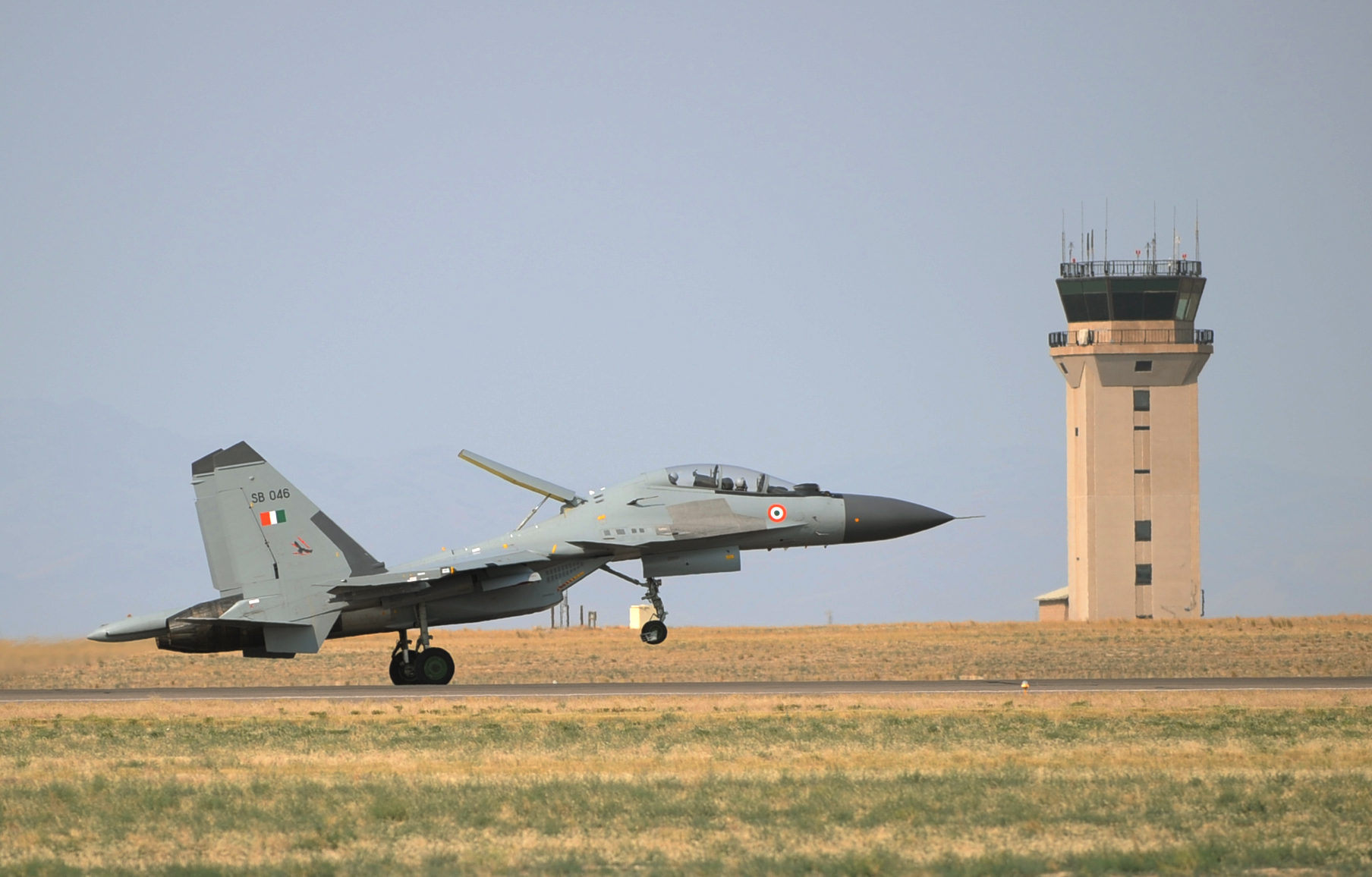
Sweden is looking to export its Gripen fighter jets to India, seizing an opportunity after India Prime Minister effectively killed an $11 billion deal with France's Rafals two months ago.
Swedish Defense Minister said he would pitch Saab's Gripen in a meeting on Wednesday with Indian counterpart. He's also planning to meet with state-run Hindustan Aeronautics Ltd.
The single-engine Gripen lost out to Dassault's twin-engine Rafale jets in India's 2007 tender for 126 planes.
Saab is not the only manufacturer that has been given new hopes by the disintegration of Dassault's deal. Boeing's F/A-18 Super Hornet, Lockheed Martin's F-16 Fighting Falcon, United Aircraft's MiG-35 and the Eurofighter Typhoon were all part of the original tender process.
India's air force currently has 240 MiG's in its fleet of about 25 squadrons. It estimates that at least 45 squadrons are needed to repel a joint attack from Pakistan and China, according to an Indian parliament committee report released in December 2014.
chicagotribune
Translate
Showing posts with label HAL. Show all posts
Jun 13, 2015
May 29, 2015
First Live Firing of a Harpoon missile from an Indian Air Force Fighter
The Indian Air Force launched an anti-ship Harpoon missile from a fighter plane for the first time at a pre-designated target in the Arabian Sea last week. The missile, was launched on May 22 from a Jaguar maritime strike fighter that flew 200 nautical miles off the west coast to carry out the mission.
The fighter belonged to the IAF’s maritime strike squadron.
An official confirmed it was the “first live firing” of the Harpoon from a warplane in India after integration by state-owned Hindustan Aeronautics Limited.
The navy tested the Harpoon last year when a Boeing P-8I long range maritime reconnaissance aircraft launched the subsonic missile to take out a ‘target’ in the Bay of Bengal.
India has bought a package of 24 Harpoon Block II missiles for its navy and another 22 for the IAF.
India is also looking at arming its Shishumar class submarines with the all-weather Harpoon missiles.
hindustantimes
Etiquetas:
AGM-84,
HAL,
HARPOON,
INDIA,
INDIAN AIR FORCE,
INDIAN NAVY,
JAGUAR,
P-8I,
UNITED STATES
May 28, 2015
HAL and BAE sign Hawk upgrade MoU
HAL and BAE Systems have signed an agreement to support Hawk Mk 132 advanced jet trainers (AJTs) and SEPECAT Jaguar fighters.
A Memorandum of Understanding (MoU) signed by the two companies features the upgrade of the Hawk Mk 132s, the development of a "combat" Hawk aircraft for Indian and export markets, as well as "maintenance solutions" to support Indian Armed Forces' Hawk and Jaguar fleets.
janes
A Memorandum of Understanding (MoU) signed by the two companies features the upgrade of the Hawk Mk 132s, the development of a "combat" Hawk aircraft for Indian and export markets, as well as "maintenance solutions" to support Indian Armed Forces' Hawk and Jaguar fleets.
janes
May 27, 2015
India to review safety of Su-30MKI fighter fleet
India is to conduct a safety assessment of its fleet of S030MKI fighters following the loss of an aircraft on 19 May.
A high-level review of the more than 200 Su-30MKI aircraft fielded by the Indian Air Force is due to be held in the coming days.
The review follows the crash of an Su-30MKI during a training exercise in the far east of the country. Both crew members were reported to have ejected safely.
Since receiving the first of its Su-30MKIs in 2002, the IAF has lost six to accidents. Most recently, the fleet was grounded following a double uncommanded ejection that occurred in October 2014. The findings of an investigation into that incident have not been disclosed.
With the Su-30MKI making up nearly a third of the IAF's fast jet fleet, Indian Defence Minister was quoted by India's Zee News as saying, "We are not grounding the fleet (...) We can't ground the fleet after every accident."
India has received 205 of an expected 270 Su-30MKI aircraft, with deliveries set to run through to 2019. Of these 270, 222 are being assembled by HAL in India.
With many of the IAF's older types slated for retirement, the Su-30MKI will soon become the service's most numerous combat aircraft. In future, it will comprise the backbone of IAF's combat capability along with the Dassault Rafale and the indigenous Tejas Light Combat Aircraft.
janes
May 25, 2015
India Ends MMRCA Deal and Will Only Buy 36 Rafales To France
India's defence minister has said Delhi will not buy more than the 36 Dassault Rafales to which it committed in April.
The announcement confirms the end of the MMRCA tender and the government's commitment to the Tejas LCA programme
India will neither licence-build additional Dassault Rafale fighters nor acquire more than the 36 it recently agreed to buy in flyaway condition.
The money India had saved by acquiring 90 fewer Rafales would be diverted to buying 200-odd indigenous Tejas Light Combat Aircraft (LCA).
The LCA will replace 10 to 12 MiG-21 and MiG-27 squadrons to be retired from 2022.
India had been in negotiations with Dassault since 2012 to acquire 126 Rafales.
Of these, 18 were to have been bought off the shelf and 108 licence-built by Hindustan Aeronautics.
janes
May 4, 2015
US offers Scorpion to India
US defence secretary two-day visit to India in early June is expected to raise the levels of bilateral strategic and defence co-operation between India and the USA.
The US is expected to offer the Textron AirLand Scorpion light-attack and intelligence, surveillance, and reconnaissance (ISR) aircraft currently being developed to the Indian Air Force (IAF).
Air Chief Marshal Arup Raha of India Air Force who is believed to have expressed interest in the Scorpion, believes the twin-seat platform can double as an intermediate jet trainer (IJT). The IAF badly needs an IJT due to delays to the Sitara (Star) platform, which Hindustan Aeronautics Limited (HAL) has been developing since 2005.
janes
Etiquetas:
HAL,
INDIA,
INDIAN AIR FORCE,
SCORPION,
TEXTRON,
UNITED STATES,
USA
Apr 18, 2015
India's Plans Unclear After Rafale Decision
Following India's sudden decision to buy 36 Rafales from France straight off the production line last week, the next steps in New Delhi's plan to eventually outfit its Air Force with 126 of the Dassault jets remain unclear.
36 jets will be purchased through a government-to-government deal. Since India made Dassault the preferred bidder for the $12 billion program in 2012, the plan had been to purchase 18 jets and build the remaining 108 in India through a license.
Indian Defence Ministry sources said the deal was struck by the Prime Minister's Office and therefore no details are available. MoD spokesman Sitanshu Kar refused to comment on how the rest of the deal will play out.
MoD sources say they learned of the direct purchase of the 36 Rafales when Modi made the announcement at the April 10 press conference.
French Defense will probably go to India in the next few weeks to negotiate the deal.
The French authorities and Dassault are staying silent on the details of the deal, which caught all by surprise.
Pending a formal announcement of the cancellation of the ongoing request for proposals , speculation abounds on what will happen to this big-ticket purchase program, dubbed the "mother of all deals."
Analysts say India will order more Rafales over the proposed 36.
With the future of the project unclear and the increased direct purchases of the Rafale, possibilities have emerged on how the Indian Air Force will buy the remaining 90 fighters. There is no clarity on what happens next.
Analysts say the Russians could receive increased orders for SU-30MKI aircraft.
defensenews
Mar 30, 2015
Dassault Says Work on India Rafale Sale 95% Done
The deal to purchase 126 Rafales is now "95 percent completed," with the French company working with the Indian authorities to review thousands of contract pages.
India is Dassault Aviation's first export client.
Dassault sees Indian work on the Mirage as helping prepare the ground for the proposed local assembly of Rafales. The Indian partner, HAL, will continue the modernization contract for the remaining 49 Mirages.
HAL would be the local co-contractor for assembling the Rafale.
defensenews
Etiquetas:
DASSAULT,
FRANCE,
HAL,
INDIA,
INDIAN AIR FORCE,
MIRAGE 2000,
RAFALE
Mar 26, 2015
The first two Refurbished Mirage 2000 I/TI have been delivered to India
Acceptance ceremony of the first two Indian Air Force Mirage 2000 I/TI was held at Istres, Dassault Aviation’s Flight Test Centre.
The signing of the contract for the upgrade of Indian Mirage 2000 fleet occured in July 2011. The maiden flight of its first upgraded Mirage 2000 was completed successfully on the 5th October 2013, following a two year development phase dedicated to the equipment kit provided by Thales including the radar, the electronic warfare suite and the mission computer.
The first phase of the programme was completed on schedule in France. The rest of the fleet will be upgraded in India under the responsibility of HAL with the complete support and involvement of Dassault Aviation and Thales teams.
dassault-aviation
Etiquetas:
DASSAULT,
FRANCE,
HAL,
INDIA,
INDIAN AIR FORCE,
MIRAGE 2000
Feb 24, 2015
BAE Systems in talks to weaponise India's Hawks
The Indian Air Force is in negotiations with BAE Systems to weaponise its fleet of Hawk Mk 132 advanced jet trainers so they could be deployed on strike co-ordinated armed reconnaissance and close air support missions.
The IAF is evaluating the feasibility of integrating its largely licence-built Hawk Mk 132s with a range of weapon systems that are fitted onto its SEPECAT Jaguar fighters.
This includes MBDA's Advanced Short Range Air-to-Air Missiles, Rafael Litening targeting pods, and a range of smart weapons.
By 2016-17 the IAF will operate 106 Hawks and the Indian Navy another 17, making India the largest operator of the type. The IAF plans to acquire another 20 Hawks for its aerobatics team, disbanded in February 2011 after its HAL-built Surya Kiran HJT-16 Mk I and Mk II aircraft were diverted to train fighter pilots.
IAF fighter pilots begin their instruction on Pilatus PC-7 Mk II tandem-seat basic turboprop trainers for 55 hours before moving onto the Kiran HJT-16 Mk I and Mk II intermediate jet trainers for another 70 hours. Thereafter, they graduate to Hawk Mk 132s for two 'semesters' of 135 hours before going on to operate fighters.
janes
Etiquetas:
BAE HAWK,
BAE SYSTEMS,
HAL,
INDIA,
INDIAN AIR FORCE,
PC-7,
PILATUS,
UK,
UNITED KINGDOM
Feb 16, 2015
Irkut aims to complete Su-30MKI deliveries to India in 2015
Irkut Corp. has stated that it will complete deliveries in 2015 of Su-0MKI multirole fighter kits to India's state-owned HAL as part of the Russian group's technology transfer obligations.
HAL has been licence building the Su-30MKI aircraft for the Indian Air Force (IAF) since 2000. At the conclusion of deliveries later this year, Irkut would have transferred a total of 222 kits for assembly at HAL's Nashik facility.
HAL is now manufacturing Su-30MKI parts from raw materials.
janes
HAL has been licence building the Su-30MKI aircraft for the Indian Air Force (IAF) since 2000. At the conclusion of deliveries later this year, Irkut would have transferred a total of 222 kits for assembly at HAL's Nashik facility.
HAL is now manufacturing Su-30MKI parts from raw materials.
janes
Etiquetas:
HAL,
INDIA,
INDIAN AIR FORCE,
RUSSIA,
RUSSIAN AIR FORCE,
SU-30MKI
Feb 9, 2015
HAL awarded contract for 14 Do-228s for Indian Air Force
HAL has been awarded a contract to provide 14 Do-228 twin-turboprop light transport and utility aircraft to the Indian Air Force (IAF).
The contract, includes six spare engines, one flight simulator, and associated equipment.
The Do-228s will join 40 that began to enter IAF service in 1987.
HAL has licence-built 125 Do-228s for a variety of customers, including the Indian Navy and coastguard, and Seychelles and Mauritius.
janes
The contract, includes six spare engines, one flight simulator, and associated equipment.
The Do-228s will join 40 that began to enter IAF service in 1987.
HAL has licence-built 125 Do-228s for a variety of customers, including the Indian Navy and coastguard, and Seychelles and Mauritius.
janes
Etiquetas:
DO-228,
HAL,
INDIA,
INDIAN AIR FORCE,
INDIAN NAVY,
SEYCHELLES
Jan 17, 2015
Indian Air Force finally gets Tejas,after a wait of 32 years
Thirty-two years after the project was sanctioned, the first indigenously -built Tejas Light Combat Aircraft (LCA) was on Saturday handed over by indian Defence Minister to the Indian Air Force.
The handover signals the start of a process of induction of the fighters being built at India.
The aircraft that has been handed over has got Initial Operational Clearance-II, which signifies that Tejas is airworthy in different conditions.
The Final Operational Clearance (FOC) is expected by the year-end.
Twenty aircraft will be built by 2017-2018, to make the first squadron of the aircraft. The LCA programme was initiated in 1983 to replace the ageing MiG-21s in IAF's combat fleet but has missed several deadlines due to various reasons.
indiatoday
Jan 12, 2015
HAL hands back first overhauled Su-30MKI to Indian Air Force
HAL delivered its first overhauled Su-30MKI to the Indian Air Force on 9 January.
The overhauled Su-30MKI is now capable of operating for another 14 years or 1,500 hours of flying time.
A second overhauled Su-30MKI was also ready for delivery to the IAF. The company also announced its intent of imminently increasing its capacity to overhaul 15 Su-30MKIs annually and of doubling this number by 2030.
Each Su-30MKI undergoes three overhauls during its 25-year operational life or 6,000 hours of flying time.
The IAF acquired 50 Su-30K variants in the late 1990s, and thereafter replaced them with the more advanced Su-30MKI export version through direct imports and licensed production by HAL. By around 2020 the IAF aims to operate 272 Su-30MKIs, making it India's single largest fighter type.
With the IAF reduced to just 34 fighter squadrons from its sanctioned strength of 42, the procurement of 126 Dassault Rafales in limbo, and older Russian platforms such as the MiG-21 retiring shortly, the number of Su-30MKIs in IAF service is likely to increase significantly.
However, the Su-30MKI's serviceability rate of around 50% - among the lowest of the IAF's fighters - poses serious operational problems, and for which the air force is entirely dependent on HAL to improve.
Official sources said of the 193 Su-30MKIs in service today, only around 106 were operationally available. The remaining 87 were in various stages of repair, overhaul or fitment by HAL - and to a limited degree by the IAF.
janes
Russia, India Complete Draft Project for FGFA
Russia and India have completed the preliminary design for the Sukhoi/HAL Fifth Generation Fighter Aircraft (FGFA).
While the Russian version of the fifth generation fighter jet is operated by a single pilot, the Indian Air Force prefers aircraft that are operated by two pilots.
The Sukhoi PAK FA (T-50) is the Russian Air Force’s first stealth fighter, intended to succeed the Sukhoi Su-27, as well as the Mikoyan MiG-29 fighter jets. The aircraft conducted its first test flight in 2010 and deliveries are set to begin in 2016. The FGFA, developed jointly by Russia’s Sukhoi and India’s Hindustan Aeronautics Limited, is a derivative from the PAK FA.
sputniknews
Etiquetas:
FGFA,
HAL,
INDIA,
INDIAN AIR FORCE,
PAK FA,
PAK FA T-50,
RUSSIA,
RUSSIAN AIR FORCE,
SUKHOI
Nov 14, 2014
HAL LCH TD3 Indian Stealth Attack Helicopter makes first flight
The Light Combat Helicopter's third trial aircraft, LCH TD-3, made its first flight on Wednesday.
The twin-seater Technology Demonstrator-3 took off at 3.20 p.m. from the helipad of the Helicopter Division of HAL and flew for 20 minutes. A Dhruv helicopter, also created by HAL, escorted it.
HAL is expected to produce 179 LCHs for the Air Force and the Army.
TD-1 was first flown on March 29, 2010 followed by TD-2 on June 28, 2011.
TD-3 will be continuously test flown for further evaluations, especially with weapons. It will be assessed in very cold and very hot weathers, and in high altitudes and mountainous areas. Later it would be used to fire with a turret gun and rocket.
The four TDs must make nearly 900 flights before the copter gets its IOC, or preliminary flight worthiness clearance. TD-1 and 2 have together flown for 388 flights or 285 hours. TD-3 would need to make 100 flights over the next five months.
thehindu
Nov 10, 2014
Fifth-gen fighter: India asks Russia to resolve FGFA tech-sharing, costing
In what could be a sign of fatigue in a long-lasting military relationship, India has conveyed to Russia that it cannot carry on with the proposed project to jointly develop and manufacture the next generation of fighter jets till Moscow addresses concerns about technology sharing and costing.
India and Russia are on the verge of inking one of the biggest defence manufacturing deals to develop and produce the fifth generation fighter aircraft (FGFA). Its research and development (R&D) will cost $11 billion with India paying half of it. This will be followed by a potential $30 billion deal to make some 200 planes for the Indian Air Force. As negotiations have dragged on for four years since the FGFA was first announced, India has raised issues of technology; its transfer; New Delhi’s role in development of the plane and the actual per-unit cost of the plane.
New Delhi says since it is paying 50 per cent of the cost, it should be doing half the work on the FGFA. At present, the Defence Ministry-owned public sector undertaking Hindustan Aeronautics Limited (HAL) — under the proposal — is mandated to do only 13 per cent of the work.
India has asked Russia to convey the tentative cost on per-plane basis. Since six prototypes are flying, this would not be a problem. But so far, there has been no answer, a source said. The intellectual property rights of the plane would be held by Russia, which has so far, refused to fit HAL-supplied pieces without certification, meaning if India has to re-fit its own pieces, it will need the nod from Moscow.
tribuneindia
Etiquetas:
FGFA,
HAL,
INDIA,
INDIAN AIR FORCE,
PAK FA T-50,
RUSSIA
Final version of Tejas PV6, 2-seater trainer takes to sky in maiden flight
The final version of the two-seater trainer version of Tejas (PV-6) made its maiden flight, in a milestone for India's overall indigenous Light Combat Aircraft Tejas Programme.
This is the 16th Tejas variant to have flown as part of the project that has been in the pipeline for over two decades.
The PV6 has absorbed all the major design modifications undertaken during the last 2,500-plus flights in the programme.
This is the final prototype and will lead to final production of the trainer aircraft.
The aircraft has a new communication system, radar, EW sensors and new navigation systems for automatic landing.
economictimes
Oct 5, 2014
First series production Tejas aircraft completes maiden flight
HAL has successfully conducted the maiden test flight of the first series production standard Tejas light combat aircraft (LCA).
Tthe aircraft took off without any telemetry support and landed safely in less than 30 minutes.
The flight test takes the indigenously built aircraft closer to final clearance and induction into the Indian Air Force (IAF).
HAL chairman said: "The aircraft is now ready for IAF operations.
airforce-technology
Sep 4, 2014
Indian deal for 20 more Hawks faces more delays
A contract for 20 more BAE Systems Hawk Mk 132 Advanced Jet Trainers (AJTs) for the Indian Air Force's (IAF's) aerobatics display team, approved three years ago by the Indian Ministry of Defence (MoD), is unlikely to be signed before 2016.
The MoD was "processing" the request for proposals (RfP) for the 20 Hawks. The kits would be sent to Hindustan Aeronautics Limited (HAL) for licence-building sometime over the next 12-16 months.
BAE Systems said commercial discussions with HAL for the aircraft were continuing, but did not elaborate.
HAL, however, said it would be unable to begin work on the 20 Hawks until mid-2016, when it completed delivery of the 36 AJTs it is currently building for the IAF and the Indian Navy (IN).
These are part of a second batch of 57 Hawks acquired by India in July 2011, 40 of which are for the IAF and 17 for the Indian Navy. In 2003 the IAF procured 66 Hawks: 24 were bought off the shelf and the remaining 42 were licence-built by HAL.
Since 2005-06 HAL claims to have built and delivered 63 Hawks.
Before the RfP for the 20 supplementary Hawks is cleared, the MoD needs to clarify its position on Rolls-Royce, whose Adour Mk 861 turbofan engines power the AJT.
The MoD suspended all dealings with Rolls-Royce in early March after the then Congress Party-led government began a federal inquiry against it for employing proscribed agents to secure Indian contracts.
The new BJP government reversed this order in July, permitting Rolls-Royce to continue its participation in numerous ongoing Indian military programmes and service contracts, including the Hawk. However, under an advisory released in late August, all new MoD tenders involving foreign materiel vendors facing such partial bans are to be stayed until investigations into their alleged wrongdoing is completed.
The Hawks will replace the HAL-built Surya Kiran Mk II aircraft that the IAF's Surya Kiran Aerobatics Team (SKAT) operated for 15 years until it was disbanded in February 2011 and its assets diverted to train fighter pilots following a shortage of such platforms.
janes
Etiquetas:
AJT,
BAE HAWK,
HAL,
INDIA,
INDIAN AIR FORCE,
INDIAN NAVY,
ROLLS ROYCE
Subscribe to:
Posts (Atom)