Translate

Showing posts with label JAPAN NAVY. Show all posts

Mar 23, 2022

NEWS 2022 March, 23

USA Sending Ex-Soviet Air Defense Missiles Systems to Ukraine


The Pentagon over the years has acquired Soviet equipment as part of a clandestine program, and now such weapons are going to Ukraine

The U.S. is sending some of the Soviet-made air defense equipment it secretly acquired decades ago to bolster the Ukrainian military as it seeks to fend off Russian air and missile attacks, U.S. officials said.

The systems, which said include the SA-8, are decades old and were obtained by the U.S. so it could examine the technology used by the Russian military and which Moscow has exported around the world.

wsj


Japan spots Russian amphibious ships traveling between its islands


Japan says Russian amphibious ships transiting through a narrow strait between its islands could be moving fresh forces from Russia’s far east to Ukraine.

Four landing ship tanks, including one with its deck full of military trucks, were seen sailing in the Pacific Ocean westbound in the middle of last week, according to a news release from the Joint Staff’s Public Affairs office within Japan’s Defense Ministry.

The ships were the Alligator IV-class Nikolay Vilkov; the Ropucha I-class Oslyabya and Admiral Nevelskov; and the Ropucha II-class Peresvet. All four belong to the Russian Navy’s Pacific Fleet and make up the entirety of its major amphibious units.

Photos released by the ministry showed the top deck of the Nikolay Vilkov packed with at least 17 military trucks..

The ships were then detected by Japan on the morning of March 16, 220 kilometers northeast of Cape Shiryazaki.

The vessels were watched from the Japan Maritime Self-Defense Force’s destroyer JS Shiranui and P-3C maritime patrol aircraft.

The route taken by the Russian ships appears to suggest they were heading from Petropavlovsk-Kamchatsky in Russia’s Kamchakta Peninsula to Vladivostok, where they will most likely be loaded onto westbound trains if they are indeed bound for Ukraine.

defensenews

Jul 15, 2020

US approves sale of 105 F-35 Joint Strike Fighter aircraft to Japan

The US Department of State has approved a potential USD23.11 billion Foreign Military Sale (FMS) to Japan of 105 Lockheed Martin F-35 Lightning II Joint Strike Fighter aircraft along with related equipment and services, the US Defense Security Cooperation Agency (DSCA) announced on 9 July.
Tokyo, which has already ordered 42 conventional take-off and landing (CTOL) F-35A aircraft, has requested to buy 63 more units of this variant along with 42 units of the short take-off and vertical landing (STOVL) F-35B.

Apr 29, 2018

Study Concludes that Japan Izumo-class Vessels able to operate F-35B

The Defense Ministry commissioned a study into the possible conversion of the Maritime Self-Defense Force's Izumo helicopter carrier into a full-fledged aircraft carrier in case Japan was required to provide rear-line support for a U.S.-led war.
The ministry in April 2017 asked Japan Marine United Corp., a Tokyo-based company that built the vessel, to look into ways to improve the capabilities of the Izumo.
Japan Marine United submitted its report to the Defense Ministry in March and the ministry released details, with some bits blacked out, on April 27.
The report states that the Defense Ministry's precondition for the study was to look into how the Izumo could be used to provide rear-line support to the U.S. military.
The company was asked to provide estimates for the cost and construction schedule if changes were made to allow U.S. F-35B stealth fighter jets to land vertically on the deck and to use elevators to transport aircraft to their hangars.
asahi

Jan 7, 2018

Proposal to convert MSDF's Izumo into aircraft carrier merges at Japan´s Defense Ministry

The regular review of Japan's National Defense Program Guidelines is fast approaching, and attention is likely to be focused on the Self-Defense Forces' offensive strike capability.
Within the Defense Ministry, there is even a proposal circulating to convert the Maritime Self-Defense Force (MSDF)'s Izumo helicopter carrier into a regular aircraft carrier. The idea is unlikely to be adopted, as it would risk shaking the foundations of Japan's defense-only policy. However, discussions on how best to prepare the SDF with defense capabilities have heated up noticeably within the administration of Prime Minister Shinzo Abe, as China continues to emerge as a major military power and North Korea forges ahead with its ballistic missile and nuclear arms programs.
The current National Defense Program Guidelines were approved by the Cabinet in 2013, along with the five-year "Mid-term Defense Program" plan specifying equipment acquisition priorities. The guidelines will expire in mid-2020.
The proposal to convert the Izumo into a true aircraft carrier apparently emerged primarily from among the Defense Ministry's uniformed personnel, taking advantage of Prime Minister Abe's policy of reviewing both the defense program outline and midterm defense buildup plan.
mainichi.jp

Jun 27, 2015

Philippines confirms its interest in getting P-3C, helicopters from Japan

The Department of National Defense on Thursday confirmed reports that it is planning to acquire a P-3C patrol aircraft from Japan to boost the military’s capabilities especially in monitoring the nation’s maritime boundaries.
Several P3-C Orion aircraft from Japan’s Self Defense Force are participating in ongoing military exercises in Philippines.
The aircraft, together with a Philippine Navy Islander spotter plane, conducted a joint patrol exercise near the Recto (Reed) Bank off the South China Sea (West Philippine Sea).
Aside from the Orion aircraft, Galvez said the Philippines is also eyeing to acquire helicopters from Japan.
manilatimes

Jun 6, 2015

The Philippines Could Acquire P-3C Orion From Japan

Japan and the Philippines agreed to strengthen security ties and discussed transferring military equipment and technology on Thursday in Tokyo's latest move to strengthen cooperation with Southeast Asian countries to counter China's maritime ambitions.
Japanese Prime Minister Shinzo Abe and visiting Philippine President Benigno Aquino also agreed to expand joint training and exercises between their militaries and to co-operate in building up the Philippines Coast Guard.
China has become increasingly assertive in the South China Sea, building artificial islands in areas over which the Philippines and other countries have rival claims.
The Philippines has already handed the Tokyo government a list of Japanese military equipment it wants to acquire such as P-3C maritime surveillance aircraft, a senior Philippine naval officer has said.
reuters

Mar 26, 2015

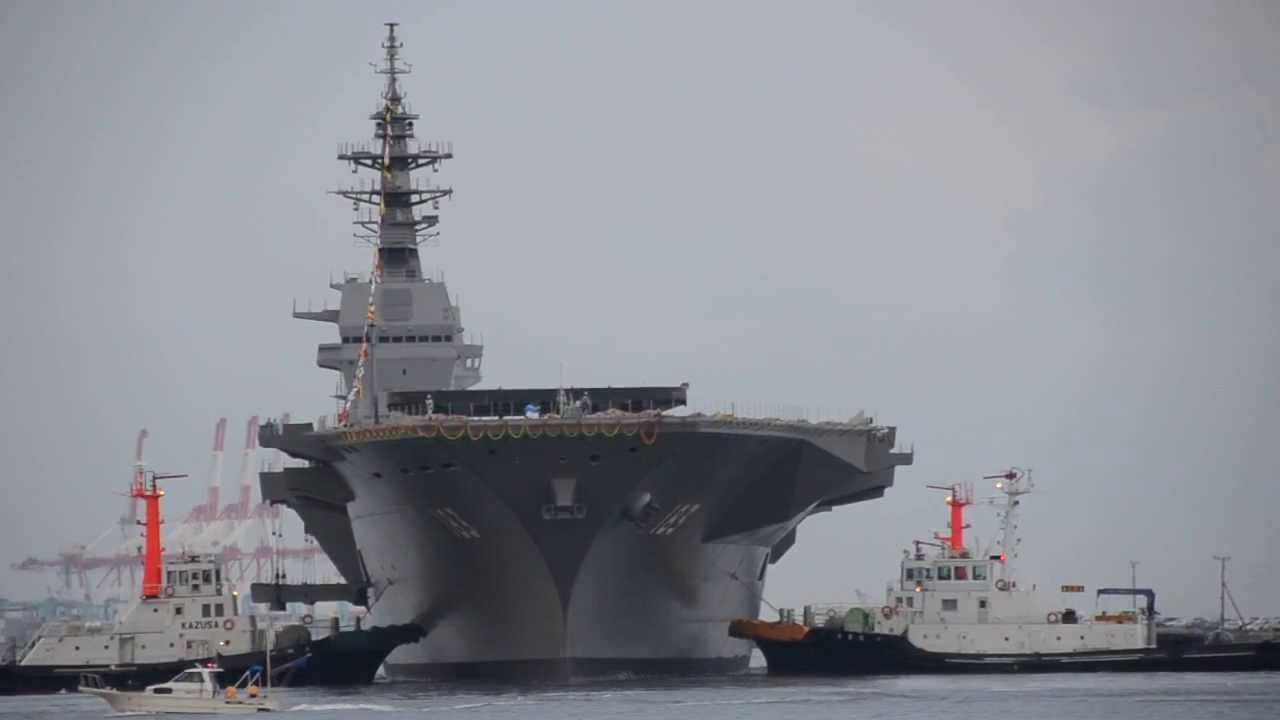
Japan Navy Commissions Izumo 'helicopter carrier' as largest ship in MSDF fleet

The Japan Maritime Self-Defense Force on March 25 officially commissioned the largest ship in its fleet.
The Izumo measures 248 meters in length, and she is described as a semi-aircraft carrier. It is 51 meters longer than the destroyer Hyuga, which was the largest ship in the MSDF fleet until now.
Jane's Fighting Ships,describes the Izumo as a helicopter carrier.
The Izumo has five landing spots on its flight deck for reconnaissance helicopters. It can carry up to nine helicopters at a time, five more than the Hyuga.
The Osprey transport aircraft that the Ground SDF will deploy in the fiscal year beginning in April can also land on the Izumo.
The Izumo joined the MSDF's Escort Flotilla 1, which is based in Yokosuka, Kanagawa Prefecture.
Construction on the ship began in fiscal 2010.
asahi

Mar 11, 2015

First Airborne Mine Counter Measures MCH-101 Deliverded To The Japan Maritime Self Defense Force

AgustaWestland and Kawasaki Heavy Industries (KHI) announced the delivery of the first Airborne Mine Counter Measures (AMCM) equipped MCH-101 helicopter to the Japan Maritime Self Defense Force. The KHI MCH-101, is equipped with the Northrop Grumman AN/AQS-24A airborne mine hunting system and the Northrop Grumman AN/AES-1 Airborne Laser Mine Detection System (ALMDS). Together these systems provide a complete surface-to-bottom mine detection capability. .
The development of the AMCM variant of the AW101/MCH-101 has been led by Kawasaki Heavy Industries, as prime contractor, with AgustaWestland providing technical support.
Following the handover ceremony at Kawasaki’s factory on 27th February, the Japan Maritime Self Defense Force aircraft was delivered to Iwakuni where it will perform evaluation trials with the 51st Experimental Squadron before entering operational service in 2016.
The first AMCM configured is the eighth of 13 AW101s that Kawasaki Heavy Industries is building under licence from AgustaWestland for the Japan Maritime Defense Force. The eight aircraft delivered to date comprise six MCH-101s and two CH-101s. The CH-101s are used to support Japan’s Antarctic research activities.
agustawestland

Sep 30, 2014

Japan puts helicopter carrier Izumo on sea trials

The Japan Maritime Self-Defence Force (JMSDF) has begun sea trials of its helicopter carrier JS Izumo (DDH 183).
The 248 m-long vessel, which displaces 24,000 tonnes at full load, is the largest Japanese military ship built since the Second World War and can carry up to 14 helicopters. Izumo and its yet unnamed sister ship (DDH 184) will replace the JMSDF's two Shirane-class destroyers, JS Shirane (DDH 143) and JS Kurama (DDH 144), inducted in March 1980 and 1981 respectively.
janes

Jul 24, 2014

Japan to build 2 more Aegis destroyers

Japan government will start building two Aegis-equipped destroyers with the latest missile defense systems starting next fiscal year, in light of the progress seen in missile development by North Korea.
The Defense Ministry will include related expenses in its budgetary requests, informed sources said. The government will start building one destroyer in the next fiscal year and the other in fiscal 2016.
The government had unveiled its policy of introducing two more Aegis-equipped destroyers within 10 years in the National Defense Program Guidelines, adopted by the Cabinet late last year.
Earlier this year, North Korea continually test-fired what were believed to be short- and mid-range missiles.
Four of the Maritime Self-Defense Force’s six Aegis-equipped destroyers are Kongo-type destroyers equipped with the missile defense system.
japan-news

Jul 12, 2014

Japan sets out plans to buy amphibious assault ships

Japanese Defence Minister has said that Tokyo is to consider the purchase of at least one amphibious assault ship.
"We are intending to acquire a transport ship capable of promptly sending out Self-Defense Force (SDF) units on missions to defend Japan's remote islands," Onodera told reporters after inspecting the Wasp-class assault ship USS Makin Island (LHD 8) at the US Navy's San Diego base on 7 July.
"It's a multifunctional transport ship capable of providing assistance in a timely manner when a major disaster breaks out," he said.
The Japanese Maritime Self-Defense Force (JMSDF) already operates three Osumi-class tank landing ships (LST), JS Osumi , JS Shimokita and JS Kunisaki , which all have a well deck embarking two Landing Craft Air Cushion (LCAC) hovercraft and a parking deck that can embark land vehicles.
Access is via lifts to the main deck or a ramp on the starboard side. The main deck is split between space for more land vehicles and a large helicopter landing pad aft the superstructure.
The Osumi class will be upgraded to allow them to embark BAE Systems AAV7A1 amphibious assault vehicles and Bell-Boeing MV-22 Osprey tiltrotor aircraft, both of which Japan intends to buy from the United States.
Asked about the difference with the existing Japanese ships, Onodera pointed to the fact that the Wasp class can carry many more LCACs below deck, and that the upper deck can carry many aircraft including MV-22s. He also said the ship is also fully compatible with operations using AAV7s.
defensenews

Apr 28, 2014

China may build 3 more carriers amid territorial disputes

The People's Liberation Army (PLA) Navy may build three Liaoning-class aircraft carriers to prepare for a potential conflict with Japan in the Asia-Pacific region.
Light aircraft carriers such as the Liaoning and Japan's Izumo have become vital for the PLA Navy and Japan Maritme Self-Defense Force amid territorial disputes between the two countries. It added that Japan may become an even greater threat to China if the country successfully introduces a Tarawa-class amphibious assault ship from the United States and deploys its F-35B fighters with vertical take-off and landing ability aboard the ship.
To face Japan in a potential combat situation, the PLA Navy needs to construct at least three aircraft carriers based on the Liaoning.
Meanwhile, if Japan is unable to purchase the Tarawa-class amphibious assault ship, the Izumo alone can carry at least 24 F-38B fighters after the vessel's fuel supply facility is removed, while Tokyo will likely choose to purchase cheaper but older AV-8 fighters.
Japan's F-35B fighter is designed mostly for surface attack missions and it is thus unable to compete against China's J-15 carrier-based fighters. But neither China nor Japan is likely to deploy aircraft carriers against each other over a narrow battlefield like the disputed East China Sea. If the local conflict escalated into a full scale war, it would be up to the United States to decide whether or not to fight for Japan.
wantchinatimes

Jan 14, 2014

Japan Navy looks to deploy drones on destroyers

The Japan Navy is considering deploying fixed-wing unmanned reconnaissance aircraft that can take off from and land on destroyers.
The Japan Navy also plans to conduct research on the equipment needed to conduct the drone operations.
The MSDF has no experience flying fixed-wing aircraft from destroyers because doing so might draw allegations that it is operating an offensive aircraft carrier, which is banned by the Constitution’s war-renouncing Article 9.
Depending on its research, Japan might someday build an aircraft carrier equipped with fighter jets.
With China increasing its presence in the East China Sea, the Self-Defense Forces are accelerating efforts to boost surveillance abilities.
Over the next five years, the MSDF is expected to buy up to 19 such aircraft, possibly the RQ-21 small tactical unmanned aircraft used by the U.S. Navy and Marine Corps.
In line with the constitutional constraints, the MSDF’s destroyers are not currently equipped with takeoff and landing equipment for aircraft. They can handle only helicopters and the U.S. Marine Corps’ MV-22 Osprey tilt-rotor transport aircraft.
japantimes

Dec 2, 2013

Japan could replace E-2C with 737 AEW&C


In response to China’s declaration of an air defense identification zone over the East China Sea that includes the Senkaku Islands in Okinawa Prefecture, the Japanese and U.S. governments have confirmed that the Self-Defense Forces and U.S. forces will cooperate to strengthen warning and surveillance activities over the sea.
To block China’s move to change the status quo by force, which Japan and the United States consider to be an unacceptable unilateral action, the SDF plans to set up a new permanent unit of the Air-Self Defense Force’s early-warning E-2C aircraft at Naha Base in the prefecture, and expand deployment of the Global Hawk high-altitude unmanned reconnaissance drone.
The SDF will launch “the second airborne warning and surveillance unit” at Naha Base in fiscal 2014, and will use some of the E-2C aircraft deployed at the ASDF’s Misawa Base.
With these plans in mind, the Defense Ministry plans to include its policy to introduce a successor aircraft to the E-2C in fiscal 2015.
The successor aircraft to the E-2C could be a Boeing E-737 AEW&C.
E-2C aircraft cannot be refueled in the air and can conduct warning and surveillance activities around the Senkaku Islands for only about four hours. The introduction of E-737s would make it possible for the SDF to conduct longer missions.
U.S. forces currently deploy the Global Hawk in Guam, which also conducts warning and surveillance activities around Japan. U.S.
The ASDF also intends to adopt the Global Hawk in fiscal 2015.
japan-news

Nov 27, 2013

U.S. sends B-52s over China-claimed waters


An American carrier battle group and a flotilla of Japanese warships will arrive Wednesday near a vast stretch of ocean claimed by China in what is shaping up as a test of how Prime Minister Shinzo Abe and the USA will stand up to the challenge.
The joint U.S.-Japan exercises in the sea are a direct challenge to China's claim. On Tuesday, the U.S. military said two Air Force B-52 bombers flew over the sea without notifying Beijing despite China's demand that it be told if anyone plans to fly military aircraft over its self-claimed "air defense zone."
The aircraft took off from Guam on Monday, part of a regular exercise.
China has been laying claim to nearly 1 million square miles of ocean known as the East China Sea, insisting that the sea's energy resources and fisheries belong to China. Much of the ocean territory it claims is hundreds of miles from its shore, including waters off the coasts of Japan, Taiwan and South Korea.
On Saturday China went further than ever, announcing it had designated much of the sea as an air defense zone it controls. The zone includes the Japan-held Senkaku Islands, a string of uninhabited islets that China calls the Diaoyus.
The challenge represents a test for Abe, a conservative party prime minister elected in 2012 who has vowed to shift Japan's deferential military posture to a more muscular stance that recognizes its right to defend itself.
On Tuesday, Abe directly confronted China, stating he would not recognize the Chinese air zone over the East China Sea or any of its claims to the Senkakus.
For the United States' part, Defense Secretary Chuck Hagel said the Chinese action represents a "destabilizing attempt to alter the status quo" and "will not in any way change how the United States conducts military operations in the region."
To that end, the U.S. Navy arrived in force Tuesday off the coast of Japan for a complex exercise in which Japanese naval ships and U.S. fighter jets, warships and submarines will practice scenarios for a possible attack on Japan.
China issued a protest with Japan and the U.S. government over the exercises and opposition to China's self-claimed right to an air defense zone over the sea.
Earlier this year, Japan scrambled fighter jets when Chinese planes flew near the Senkaku islands, a rich fishing ground annexed by Japan in 1895 and purchased by the legislature in 2012. Chinese interceptor aircraft conducted the first flights into the zone after it went into force at 10 a.m. on Saturday.
usatoday

Nov 6, 2013

Japan to build 2 more Aegis ships

With an eye on North Korea’s nuclear missile development and China’s maritime expansion, the Japanes government plans to build two more Aegis-equipped vessels armed with state-of-the-art interceptor missiles.
The MSDF has the second largest number of Aegis vessels after the United States.
The Aegis destroyers are a core part of Japan’s ballistic missile defense. Of the six MSDF vessels, four have sea-to-air Standard Missile-3 system and are capable of detecting, tracking and intercepting ballistic missiles in space in cooperation with ground radar.
The remaining two Aegis-equipped vessels will be equipped with SM-3 Block IIA, the next-generation interceptor missiles, which is currently being developed jointly with the United States.
The two Aegis destroyers to be built are expected to be deployed within 10 years.
The government decided to build the two additional Aegis vessels because it believes North Korea’s nuclear and missile development poses an imminent threat to the nation’s security.
japan-news

Oct 9, 2013

Japan Navy to resume use of P-1 patrol planes

The Maritime Self-Defense Force is expected to resume operations of its P-1 maritime patrol aircraft as early as this month, as the Defense Ministry has identified the cause of trouble with the plane’s engines that caused one of the aircraft to experience engine failure midflight in May.
The ministry announced Sept. 27 that the cause of patrol aircraft’s trouble was a problem in the fuel engine injection valves. The MSDF suspended flights of the P-1 planes following the incident.
The ministry will repair five P-1 planes deployed at its bases, including Atsugi Air Base in Kanagawa Prefecture.
According to the ministry, the incident occurred on May 13 over the Pacific Ocean during a test flight. At the time, the aircraft was trying to execute a nosedive from an altitude of about 10,000 meters to confirm the stability of warning systems. However, fuel combustion in the engines became unstable and all four briefly stopped working.
The MSDF and IHI Corp., which manufactured the engines, checked the plane and found that an irregularity in the fuel injection valves prevented a sufficient supply of fuel.
Following the incident, the makers improved programs responsible for controlling the valves to increase the flow of fuel.
Currently, the P-1 planes are in test operations. The ministry aims to start full-fledged operations in fiscal 2015 mainly for warning and surveillance in the East China Sea.
the-japan-news

Aug 6, 2013

Japan navy to unveil biggest warship since World War II


Japan is set to unveil its biggest warship since World War II on Tuesday amid tensions with China following maritime skirmishes between the two nations over disputed islands.
Tokyo's military is holding a ceremony in the port city of Yokohama to show off its new 248-metre (810-feet) helicopter carrier, which will be a centrepiece of its naval power.
channelnewsasia

Jul 8, 2013

Japan eyes two new Aegis destroyers to counter N. Korea missile threat

The Defense Ministry will likely purchase two new Aegis-equipped destroyers to raise Japan’s fleet of the vessels to eight in light of the mounting North Korean missile threat.
japantimes