Translate

Showing posts with label MQ-1. Show all posts

Oct 10, 2015

Russian jets 'intercept' US Predator drones over Syria

Russian fighter jets shadowed U.S. predator drones on at least three separate occasions high above Syria since the start of Russia’s air campaign last week.
Meanwhile, U.S. Navy Captain Jeff Davis told reporters a U.S. aircraft flying over Syria had to be rerouted to avoid a Russian fighter jet at least once.
“We have taken action to maintain safe separation,” Davis said, adding that the U.S. aircraft "changed path a little bit." He did not disclose which type of U.S. aircraft was involved.
The drone encounters took place over ISIS-controlled Syria, including its de facto headquarters in Raqqa, as well as along the Turkish-Syrian border near Korbani. Another occurred in the northwest, near the highly contested city of Aleppo.
“The first time it happened, we thought the Russians got lucky. Then it happened two more times,” said one official.
The U.S. military's MQ-1 Predator drone is not a stealth aircraft.
"It is easy to see a predator on radar," said one official.
The Russians have not attempted to shoot down any of the U.S. drones, but instead have flown "intercept tracks," a doctrinal term meaning the Russians flew close enough to make their presence felt, according to one official.
One other official said, “the Russians flew very close, but did not impede the drone flight.”
“The first time it happened, we thought the Russians got lucky. Then it happened two more times."
foxnews

Aug 17, 2015

USAF plans to end MQ-1 Predator operations in 2018

The remotely-piloted aircraft that ushered in the armed unmanned air vehicle revolution, the General Atomics Aeronautical Systems MQ-1, will be put out to pasture by 2018, after more than two decades of service, the US Air Force says.
The service has been planning to retire the MQ-1 ever since introducing the larger and more capable General Atomics MQ-9 Reaper in 2007, but the insatiable demand for intelligence surveillance and reconnaissance and target strikes in conflict zones around the world has kept the original Predator in service.
Now, the air force has set 2018 as the end date for the MQ-1 operations and says the aircraft will be moved to the boneyard, but the ground control stations and other items will be repurposed to support the MQ-9.
flightglobal

Mar 11, 2015

US Lawmakers Push White House to Sell MQ-1 Predator Drones to Jordan

Members of Congress are pushing the Obama administration to embrace a plan to lend older-model, surplus drones to Jordan for the fight against the Islamic State.
In a Republican-led letter to the White House, 23 House members said Monday that Jordan should be allowed to borrow U.S. Air Force-owned MQ-1 Predator drones.
The Air Force is currently replacing its MQ-1 fleet with the more advanced MQ-9 Reapers, which are more heavily armed. As a result, a portion of the fleet of older Predators is currently not in use, and those drones aren’t considered critical to U.S. missions.
Predators typically carry two Hellfire missiles. A congressional official said that under the plan, the U.S. would loan three or four Predators to Jordan. That would be enough drones to keep at least one aloft around the clock.
Jordan is an active member of the U.S.-led coalition against Islamic State, also known as ISIS, and has intensified its involvement after a Jordanian pilot captured by the extremist group was burned to death while locked in a cage.
In meetings with members of Congress, Jordan has requested clearance to purchase armed and unarmed drones from General Atomics.
The U.S. Air Force has a shortage of drone pilots, making it difficult for the U.S. to fly the surplus predators themselves. Jordanian pilots, trained to fly F-16 fighters, could be relatively easily retrained to fly the drones.
Jordanian fighter planes have mostly struck fixed targets in Syria, rather than moving vehicles or other so-called dynamic targets. Acquiring their own drones could expand the range of targets Jordanian forces could strike.
wsj

May 14, 2014

Predator to be retired by USAF in favour of Reaper

A symbol of America’s presence in Iraq and Afghanistan, would probably be a UAV stalking across the sky.
But with severe budget constraints, the US Air Force is looking to cut the number of UAV combat air patrols from 65 to 55. That number could drop further if sequestration funded levels are not raised in 2016, as is likely.
That doesn’t mean the service is abandoning its UAV program, but the future looks much more secure for the Reaper than the Predator.
The USAF need to double down efforts to develop unmanned aerial aircraft that can operate in contested environments. The Predators and the Reapers have been terrific, but they cannot operate well in a contested environment. In Afghanistan, no one was able to shoot them down or interfere with their operation.
The Air Force has purchased a total of 259 Predators, but crashes and retirements have left the service with a current fleet size of 154 platforms, which the service plans to retire between fiscal 2015 and 2017. Those plans are dependent on congressional decisions, but there has been no groundswell against divesting the MQ-1s, likely because they would be replaced with an all-Reaper fleet.
The MQ-9 Reapers offer better payload capabilities and range, particularly if they are equipped with a major re-winging program that extends the operational capability of the Reaper by about 10 hours. The standard Reaper is configured for 30 hours for the ISR model and roughly 23 hours if armed with Hellfire missiles. General Atomics, the developer of the MQ-1 and MQ-9, said the extended-range model would increase those times to 42 hours for ISR and 35 hours with the Hellfire.
In other words, the Predators are falling victim to their faster, stronger brothers. That leaves the Air Force to find a home for over 100 outdated, unwanted, but still functional surveillance drones.
defensenews

Mar 12, 2014

US Air Force to eliminate nearly 500 aircraft

The Air Force plans to cut nearly 500 planes from its inventory over the next five years if the Defense Department’s Fiscal 2015 budget request is approved by Congress.
The reductions would affect the active duty, Guard and Reserve in 25 states and the District of Columbia. Only 47 planes would be eliminated overseas at a time when officials are emphasizing the importance of maintaining a strong forward presence to deter adversaries and respond quickly to crises.
The cuts would entail the elimination of the entire A-10 and U-2 fleets, as well as significant reductions in the number of F-15s and MQ-1s.
To maintain capability at lower cost, some assets will be moved from the active duty force to the Reserve. The size of the Reserve fleet will only decrease by 17 aircraft.
The service also plans to slash personnel. The Air Force would reduce its end strength from 503,000 airmen to 483,000.
stripes

Sep 27, 2013

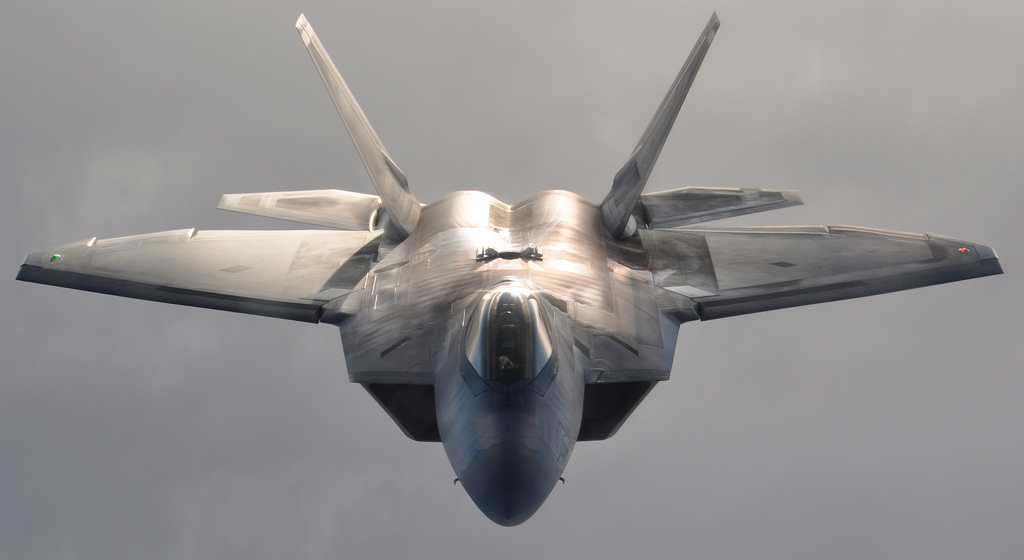
U.S. F-22 stealth fighter pilot taunted Iranian F-4 Phantom combat planes over the Persian Gulf

Earlier this year, Pentagon Press Secretary, said that an IRIAF F-4 Phantom attempted to intercept a U.S. MQ-1 drone flying in international airspace off Iran.
IRIAF F-4 Phantom jets came to about 16 miles from the UAV but broke off pursuit after they were broadcast a warning message by two American planes escorting the Predator.
The episode happened in March 2013, few months after a two Sukhoi Su-25 attack planes attempted to shoot down an American MQ-1 flying a routine surveillance flight in international airspace some 16 miles off Iran, the interception of the unmanned aircraft failed. After this attempted interception the Pentagon decided to escort the drones involved in ISR (intelligence surveillance reconnaissance) missions with fighter jets, either F-18 Hornets with the CVW 9 embarked on the USS John C. Stennis whose Carrier Strike Group is currently in the U.S. 5th Fleet area of responsibility or F-22 Raptors like those deployed to Al Dhafra in the UAE.
New details about the episode were recently disclosed by Chief of Staff Gen. Mark Welsh who on Sept. 17 not only confirmed that the fighter jets providing HVAAE (High Value Air Asset Escort) were F-22 stealth fighters but also said that:
“He [the Raptor pilot] flew under their aircraft [the F-4s] to check out their weapons load without them knowing that he was there, and then pulled up on their left wing and then called them and said ‘you really ought to go home’”
theaviationist

Sep 26, 2013

US relocates drones airfield after Djibouti crashes


The Pentagon is shifting its drone operations from a US base in Djibouti to a more remote airfield after local officials voiced concern about possible collisions with commercial aircraft.
"There was a concern over what would happen if a MQ-1 (Predator drone) obstructed a runway, and that it would have a significant impact on commercial air operations," said an official.
After the attacks of September 11 2001, Camp Lemonnier -- located next to the Djibouti international airport -- took on crucial strategic importance for Washington as a site for stationing special operations forces and drones for assaults on Al-Qaeda militants in Yemen and Islamist Shabab forces in Somalia.
afp

May 29, 2013

Predator passes 20,000-hour mark in Afghanistan


An MQ-1 Predator assigned Kandahar Airfield, Afghanistan, recently became the first Predator to pass 20,000 flying hours over Afghanistan, a feat equivalent to flying 15 hours every other day, for 2,667 days.

defencetalk

Mar 15, 2013

Iranian F-4 tried to intercept MQ-1 escorted by 2 American fighters


An Iranian military jet tried to intercept an unarmed American MQ-1 remotely piloted aircraft over international waters March 12 but it was discouraged from accomplishing that mission, Pentagon officials said today.
The MQ-1 aircraft was conducting a routine classified surveillance flight over international waters in the Arabian Gulf.
Iran sent an F-4 Phantom 2 jet to intercept the unmanned aircraft. “The closest point of approach between these aircraft was approximately 16 miles,” Pentagon Press Secretary George Little said in a written statement.
Two U.S. military aircraft were escorting the Predator, and the Iranian plane broke off pursuit after a verbal warning.
“All U.S. aircraft remained over international waters at all times,” Little said.
In November, Iranian aircraft fired on an American remotely piloted aircraft operating over the Arabian Sea. The Iranian aircraft fired two missiles at the drone and missed. After that incident, the U.S. government informed the Iranian government that its behavior was unacceptable. Army Gen. Martin E. Dempsey, the chairman of the Joint Chiefs of Staff, said at the time that the U.S. military will continue to fly these missions and will protect its aircraft.
defense.gov

Nov 29, 2010

El US Army empieza a utilizar en Iraq su nuevo UAV, el Gray Eagle/ Gray Eagle soars over Iraq


El US Army ha comenzado a utilizar su último sistema aéreo no tripulado, el MQ-1C Gray Eagle, en Iraq. Una unidad del ejército desplegada en Camp Taji, lo está probando antes de su despliegue con otras unidades.
Está basado en el General Atomics MQ-1 Predator, y su principal misión es el reconocimiento aunque tendrá una limitada capacidad de ataque.
Se prevé dotar a cada brigada de aviación del US Army con 12 Gray Eagle.
key.aero
_________________________________
The US Army has begun to use its latest unmanned aerial system (UAS), the MQ-1C Gray Eagle in Iraq. An Army unit deployed to Camp Taji known as ‘Quick Reaction Capability 1-Replacement 1’ is testing the UAS in a combat scenario before it is rolled out to other units.
Based on the General Atomics MQ-1 Predator, the Gray Eagle’s role is primarily reconnaissance with a limited strike capability.
The Army plans to provide 12 Gray Eagles to each of its 12 aviation brigades when the aircraft is fully developed.
key.aero