Translate

Showing posts with label SU-30MKI. Show all posts

Oct 17, 2022

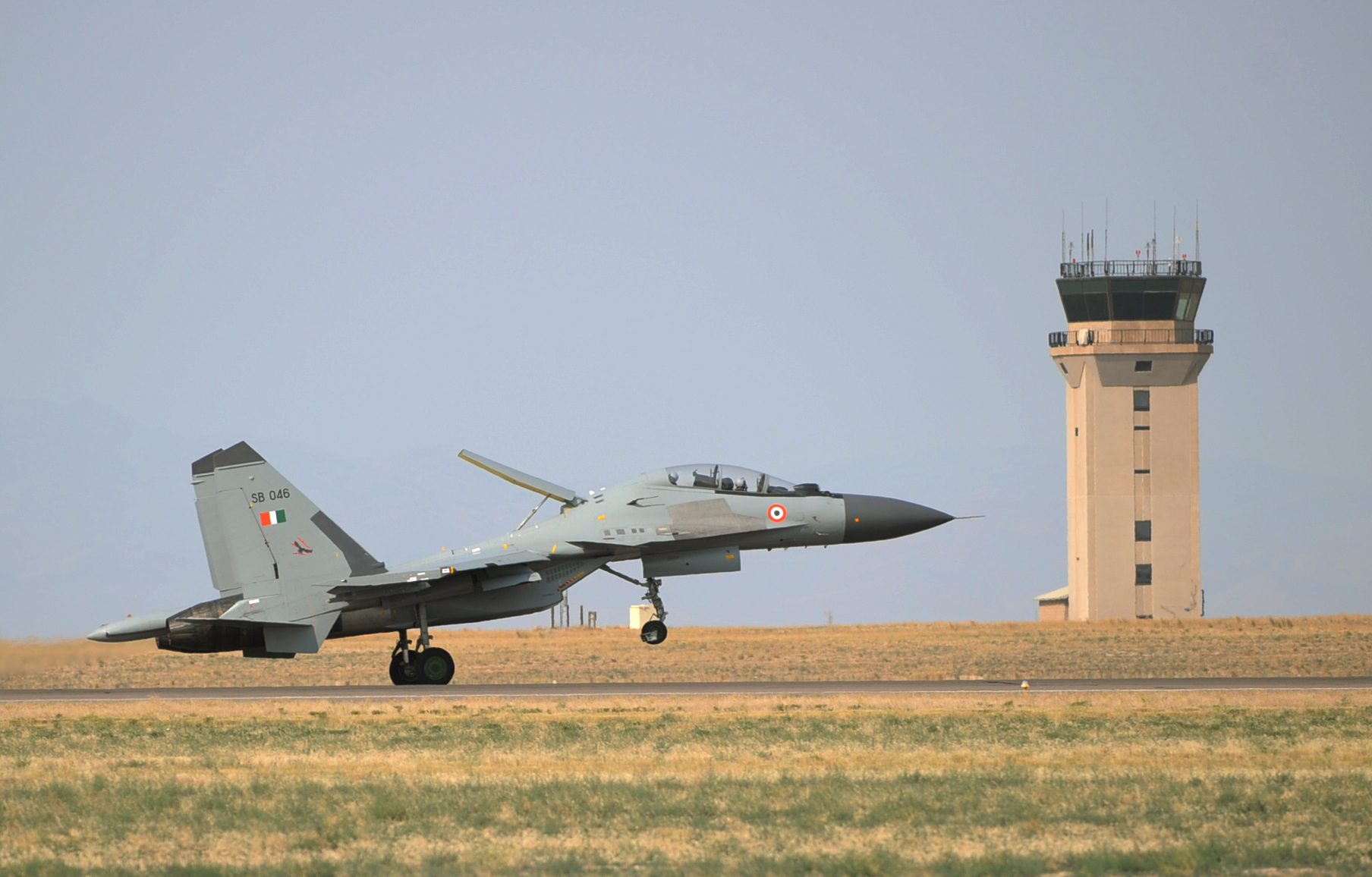
The Indian Air Force (IAF) will increase the number of Sukhoi Su-30MKI fighters that can carry the air-launched version of the BrahMos supersonic missile


T
he IAF had approved plans to modify 40 Su-30MKIs to enable them to operate the BrahMos Air-launched Cruise Missile (ALCM).

The Su-30MKI reportedly requires hardening in certain sections of its fuselage to carry the 2.5-ton BrahMos missile on its underside.

The modification is being performed by Hindustan Aeronautics Limited (HAL) locally in India. As per reports, 35 modified Su-30s have thus far been delivered to the IAF, with the service planning to approve the second batch of around 20 to 25 fighters.

The Brahmos missile increases the combat range of the Su-30MKI, enabling the IAF to strike targets at long distances. For example, as part of a test in 2020, a Su-30 armed with the air-launched version of the missile took off from a base in Punjab and struck a target in the Indian Ocean.

The target was struck deep in the Indian Ocean, approximately 4,000 kilometers away, which was considered ‘the longest’ mission of this kind.

eurasiantimes

Apr 23, 2016

India Air Force Jets Arrive In Alaska To Red Flag 'Aggressors'

Red Flag ALASKA 16-1 that begins April 28. The Indian Air Force's contingent (4 x Su-30MKI, 4 x Jaguar Darin II, 2 x Il-78M & 2 C-17 Globemaster III) arrived on April 16 amd have been on routine practice runs at the base with USAF jets.
The joint exercise will involve simulated interdiction, attack, air superiority, defence suppression, airlift, air refueling and reconnaissance aircraft -- all profiles the IAF has proven to be formidable at in past Red Flags/Cope India/Thunder exercises.
livefistdefence

Sep 12, 2015

Algeria to Purchase 14 SU-30

Russia and Algeria have signed a contract for the sale of 14 SU-30.
Algeria is one of Russia's biggest defense customers and already has 44 of Russia's heavy multi-role Su-30MKI fighter jets in service. A total of 28 of the planes were delivered under a 2006 contract, and 16 more were delivered under a 2010 contract.
The latest Algerian Su-30 contract was signed in the spring of 2015, but the deal has only been announced now.
The deal is the second contract announced this week for new Su-30 fighters.
On Tuesday, Russian Defense Minister announced that the Russian military had signed an agreement with Irkut for eight of the newer variants of the fighter jet, known as the Su-30SM.
Russian military is preparing to sign a 75-fighter contract by the end of the year. Irkut is expected to complete deliveries under a 2011 contract for 60 of the Su-30SM fighters.
themoscowtimes

May 27, 2015

India to review safety of Su-30MKI fighter fleet

India is to conduct a safety assessment of its fleet of S030MKI fighters following the loss of an aircraft on 19 May.
A high-level review of the more than 200 Su-30MKI aircraft fielded by the Indian Air Force is due to be held in the coming days.
The review follows the crash of an Su-30MKI during a training exercise in the far east of the country. Both crew members were reported to have ejected safely.
Since receiving the first of its Su-30MKIs in 2002, the IAF has lost six to accidents. Most recently, the fleet was grounded following a double uncommanded ejection that occurred in October 2014. The findings of an investigation into that incident have not been disclosed.
With the Su-30MKI making up nearly a third of the IAF's fast jet fleet, Indian Defence Minister was quoted by India's Zee News as saying, "We are not grounding the fleet (...) We can't ground the fleet after every accident."
India has received 205 of an expected 270 Su-30MKI aircraft, with deliveries set to run through to 2019. Of these 270, 222 are being assembled by HAL in India.
With many of the IAF's older types slated for retirement, the Su-30MKI will soon become the service's most numerous combat aircraft. In future, it will comprise the backbone of IAF's combat capability along with the Dassault Rafale and the indigenous Tejas Light Combat Aircraft.
janes

Apr 14, 2015

India could Scrap Rafale Deal

India is rethinking its long-delayed 126-aircraft Medium-Multi-Role Combat Aircraft (MMRCA) deal, and may opt to scrap the fighter purchase in favor of government-to-government sales, since negotiations under the existing request for proposals (RFP) had “gone into a loop with no solution in sight,” according to India’s defense minister.
Barely two days after India’s Prime Minister Narendra Modi, during his visit to Paris, negotiated with the French government to buy 36 Dassault Rafale fighter jets in flyaway condition under a separate deal, Indian Defense Minister Manohar Parrikar on April 13 categorically stated that “if India goes in for additional Rafale fighters, it will also be through government-to-government deals.”
The final negotiations for the MMRCA project with Dassault have been deadlocked for more than a year due to the company’s refusal to accept liability for the 108 jets to be made in India by state-owned Hindustan Aeronautics Limited (HAL).
India also maintains the French firm raised the price of the fighter. Under the original plan, 18 MMRCAs were to be bought off the shelf, with the remaining 108 manufactured by HAL in India. India has been insisting that it will not accept a hike in the L-1 (lowest bidder) price provided by Dassault since it had led Rafale to defeat the Eurofighter Typhoon in commercial evaluation in January 2012.
However, New Delhi’s insistence that Dassault back the quality of aircraft produced locally under the tender risks increasing the cost of manufacturing the combat jets in India, where a lack of technical know-how could increase the time needed to build a Rafale to the same standard as that of one coming off of Dassault’s Merignac production line.
Parrikar says the 36 Rafale fighter jets will be inducted into the Indian air force (IAF) in a span of two years. He did not specify how many additional Rafales would be acquired.
India is also trying to improve the serviceability of the 272 Su-30MKIs contracted from Russia.
India has not not purchased any new aircraft of the latest technology in the past 15 years and needs fourth-generation aircraft.
aviationweek

Mar 31, 2015

Angola to receive Su-30K fighters in 2015

Russia is to supply Angola with Sukhoi Su-30K fighter aircraft later in the year.
The 558th Aviation Repairing Plant located at Baranovichi in Belarus is upgrading 12 Su-30Ks that are to be supplied to Angola in accordance with a contract signed by Rosoboronexport and the African country's defence ministry in late 2013.
The first batch of fighters will be upgraded in 2015. The process is planned to be finished in late 2016 to early 2017.
The aircraft are from a batch of 18 Su-30Ks that India has returned to Russia.
janes

Mar 20, 2015

Indian Air Force admits Su-30 poor serviceability

The Indian Air Force's Su-30MKI is plagued by frequent engine failure-in-air and engine-related problems and poor operational serviceability.
Five twin-engine Su-30MKIs have crashed since the platform began to enter service in 1997.
The problems were related to faulty bearings and low-pressure oil.
Metal fatigue caused these bearings, which are incorporated to reduce friction between the fighter's moving parts, to chip or fragment and the resulting particles contaminated the oil flow.
Of 69 Su-30MKI engine failures investigated since 2012, 33 were due to finding [metal] chips in the oil, 11 due to vibration in the engine, and 8 because of low pressure of lubricating oil.
The IAF operates 200 Su-30MKIs, but of these only 110 or 55% were operationally available due to poor serviceability.
janes

Mar 10, 2015

Because of Stalemate on Rafale Deal India ready to spend $25bn on Russian 5G fighter jets

The stalemate over the 4th-gen Rafale fighter jets deal with France has forced the Indian military to accelerate an even larger project with Russia on the joint development and purchase of an equal quantity of 5th-gen fighters.
India is now ready to invest $25 billion in the development and purchase of 127 fifth-generation stealth fighter aircraft (FGFA). It will also make concessions to speed up the delivery of fighters and have the first ones available in 36 months instead of the previously envisaged 94 months.
The initial contract signed with Moscow implied a 50:50 design and production agreement to develop an Indian version of Russia’s Sukhoi T-50 (PAK-FA) 5G fighter jet. The $295-million preliminary design contract signed in December 2010 envisaged the creation of a two-seat version of the PAK-FA and preconditioned that all single-pilot fighters must be assembled in India. Now that the estimated number of Indian Air Force combat-ready squadrons has decreased sharply, New Delhi isn’t objecting to Moscow producing the first batch of perspective multi-role fighter FGFA at Russia.
The FGFA contract however will not replace the outgoing Rafale tender, as India is likely to replace it by buying a corresponding quantity of the Russian Sukhoi-30MKI fighters already being produced in India.
rt.com

Feb 16, 2015

Irkut aims to complete Su-30MKI deliveries to India in 2015

Irkut Corp. has stated that it will complete deliveries in 2015 of Su-0MKI multirole fighter kits to India's state-owned HAL as part of the Russian group's technology transfer obligations.
HAL has been licence building the Su-30MKI aircraft for the Indian Air Force (IAF) since 2000. At the conclusion of deliveries later this year, Irkut would have transferred a total of 222 kits for assembly at HAL's Nashik facility.
HAL is now manufacturing Su-30MKI parts from raw materials.
janes

Jan 23, 2015

BrahMos Testfire in March

The test of the air version of supersonic cruise missile BrahMos will be conducted in March this year.
On the visit of Russian Defence Minister to the BrahMos Aerospace Headquarters, CEO and Managing Director of BrahMos Aerospace Private Limited said the missile’s first test launch is expected in March If everything goes according to the plan, and will definitely be carried out from the Su-30MKI. Both the launcher and the missile are ready.
If test-fired successfully, BrahMos will be the first weapon system in the world to have such capability. As of now, there is no such weapon available in the world.
Jointly developed by India and Russia, the 8.4-metre BrahMos missile, the fastest in the world, has a flight range of 290 km and carries a conventional warhead up to 300 kg, thus delivering with high-precision, devastating power at supersonic speed of Mach 2.8.
BrahMos Aerospace has had to reduce the weight of the air version of the missile as it is to be launched from a moving platform unlike its land and navy versions.
newindianexpress

Jan 13, 2015

India Outlines SU-30MKI as an Alternative to Rafale

Indian Defence Minister has fired another warning shot across the bows of French fighter manufacturer, Dassault, which has been negotiating for three years with the ministry of defence to sell the Indian Air Force (IAF) 126 Rafale fighters.
A fortnight after declaring that the IAF could make do with additional Sukhoi-30MKI fighters - which HAL builds in Nashik - in case "complications" in the negotiations were not resolved, Minister has gone further in outlining how the IAF could function were it decided not to procure the Rafale.
Minister also voiced his concern at Dassault's reported reluctance to meet the terms of the IAF tender, which required the French company to guarantee the 108 fighters that HAL would build in India, after the first 18 were supplied fully-built in France. The defence minister said, "I have told (Dassault) to send a person to work out the (differences). You have to be clear that, irrespective of anything, the (tender's) terms have to be met. They cannot be diluted."
business-standard

Jan 12, 2015

HAL hands back first overhauled Su-30MKI to Indian Air Force

HAL delivered its first overhauled Su-30MKI to the Indian Air Force on 9 January.
The overhauled Su-30MKI is now capable of operating for another 14 years or 1,500 hours of flying time.
A second overhauled Su-30MKI was also ready for delivery to the IAF. The company also announced its intent of imminently increasing its capacity to overhaul 15 Su-30MKIs annually and of doubling this number by 2030.
Each Su-30MKI undergoes three overhauls during its 25-year operational life or 6,000 hours of flying time.
The IAF acquired 50 Su-30K variants in the late 1990s, and thereafter replaced them with the more advanced Su-30MKI export version through direct imports and licensed production by HAL. By around 2020 the IAF aims to operate 272 Su-30MKIs, making it India's single largest fighter type.
With the IAF reduced to just 34 fighter squadrons from its sanctioned strength of 42, the procurement of 126 Dassault Rafales in limbo, and older Russian platforms such as the MiG-21 retiring shortly, the number of Su-30MKIs in IAF service is likely to increase significantly.
However, the Su-30MKI's serviceability rate of around 50% - among the lowest of the IAF's fighters - poses serious operational problems, and for which the air force is entirely dependent on HAL to improve.
Official sources said of the 193 Su-30MKIs in service today, only around 106 were operationally available. The remaining 87 were in various stages of repair, overhaul or fitment by HAL - and to a limited degree by the IAF.
janes

Jan 5, 2015

Indian defence minister admits complications in Rafale talks

India's defence minister has said that negotiations with Dassault over the purchase of 126 Rafale fighters have suffered 'complications'
Minister also suggested that India could opt for more licence-built Su-30s instead
Minister did not specify these difficulties at a press conference in New Delhi, but tellingly stated that additional licence-built Sukhoi Su-30MKI multirole fighters would be "adequate" for the Indian Air Force (IAF) in the event of the Rafale deal being scrapped.
"The Su-30MKI is an adequate aircraft for meeting the air force's needs,", adding that at INR3.58 billion (USD59.66 million) each, the unit cost of the Su-30MKIs being licence-built by Hindustan Aeronautics Limited (HAL) was less than half that of a Rafale.
janes

Nov 19, 2014

India’s Su-30s to be back in use this week

The Indian Air Force’s Sukhoi Su-30MKI fleet, which was grounded last month over a crash near Pune, will be back in use this week, according Air Chief Arup Raha.
The Pune crash on October 14 was an accident which appeared to be automatic firing of the seats. Court of Inquiry (CoI) is about to be complete and the findings are being finalised.
The fleet of about 200 Su-30 jets currently grounded represents almost a third of the country’s fighter fleet. The IAF is due to purchase another 72 Su-30 jets from Russia.
Grounding the fleet of Sukhoi-30 aircraft for technical checks will not affect further contracts for the deliveries of these Russia-developed planes to India.
in.rbth.com

Nov 14, 2014

Indian Air Force Sukhoi-30s remain grounded

Nearly a month after a Sukhoi-30 fighter plane crashed near Pune, the entire fleet of front line combat aircraft continues to remain grounded pending a Court of Inquiry (CoI) that is in its final stages.
This is the longest period that the Russian-made aircraft has been grounded since 2009 when its flying was suspended for nearly three weeks following an accident.
Air Force sources said the CoI is in its last stages and will come out with a report soon.
A team of 10 experts is currently in Pune, the Sukhoi-30 base, probing the crash that took place on October 14 near there with both the pilot seats ejecting without any command during landing.
The pilots were safe but the aircraft crashed about 20 kms short of the runway.As standard operating procedure, the flying of the aircraft was suspended and a CoI ordered.
The aircraft will be back in operation only when the process is completed. The grounded fleet represents almost a third of the country's fighter plane fleet.
This was the fifth accident involving a SU-30 MKI since 2009 and the fleet has at least been grounded twice earlier.
indiatvnews

Oct 23, 2014

Indian Air Force Grounds Its Entire Sukhoi-30 Jet Fleet

The Indian Air Force (IAF) has grounded its entire fleet of Russia-developed Sukhoi-30 fighter aircraft to undergo safety checks, following the latest accident in Pune.
The fleet of about 200 Su-30 jets currently grounded represents almost a third of the country’s fighter fleet. The IAF is due to purchase another 72 of the aircraft from Russia.
An IAF Sukhoi-30 MKI crashed into a field in the Pune district on Tuesday. There were no casualties as both the pilot and the co-pilot had ejected to safety.
The Su-30 MKI is the IAF’s elite fighter-bomber. It was built under license by India's Hindustan Aeronautics.
ria.ru

Aug 4, 2014

Russia to modify engines of India Su-30MKI

India Air Force frontline fighter jet Sukhoi-30MKI will be modified under new specifications laid down by its Russian manufacturers to fix mid-air engine trouble in its fleet.
The move comes after the IAF faced an unusually high number of mid-air engine failures over the past two years (January 2102 onwards) and asked the Russians to rectify the problem in the fighter jet. The IAF has a fleet of 200 Sukhoi aircraft and another 72 are on their way from Moscow.
The modification will be carried out on 400 engines of the twin-engine aircraft, besides installation of some spares for emergencies. The Russians will install modified engines on the next lot of 72 jets, sources say.
The modified engines will first be tested on the aircraft, before being fitted to the entire fleet. The refit will be carried out in batches over the next 18-24 months.
The Russians have assured India that the modifications will eliminate the problem of mid-air engine failure.
Some of the engines — the AL-31FP — produced by NPO Saturn of Russia have been behaving inconsistently over the past two years. Since the engines powering the jet are still being produced, there is a scope for modification.
The IAF had flagged the Russians after studying each failure in detail between 2012 and 2013. The matter was taken up at a meeting between the two nations in February and later in June.
The instances of single-engine Su-30MKI landings were very high during the period. This was lowering the operational ability of the fleet, besides raising questions about war readiness.
While the aircraft is based at Bathinda, Halwara, Sirsa, Bareilly, Jodhpur and Bhuj in the North and West, its two squadrons are based at Tezpur and Chabua in the East.
Another squadron is based in South to augment the Indian Navy’s fleet of MiG29-K and Sea Harriers aboard aircraft carriers INS Vikramaditya and INS Viraat, respectively.
tribuneindia

Jul 21, 2014

Su-30MKI engine failures worry IAF; Russia told to fix snag

The Sukhoi-30MKI fleet of the Indian Air Force has been encountering mid-air engine failures for the past two years. India has officially flagged the matter to Russia seeking a correction.
Repeated engine failures and the newly introduced precautionary measures have affected the availability of planes for various operations. The IAF has a fleet of 200 Sukhois.
After a failure, the engine is replaced after testing before allowing the plane to fly again. The process of removing and replacing an engine usually takes four-five days, but can be extended depending upon the damage.
As a stopgap arrangement, the Russian side had suggested some measures.
The IAF has so far not arrived at a conclusion of its findings, but as a precautionary step, it has started servicing the engine after 700 hours instead of the mandated 1,000 hours of flying, adding to the non-availability of the aircraft.
Sources said the matter was taken up at the India-Russia meeting in June this year and also in February when a Russian delegation visited the Hindustan Aeronautics Limited's (HAL's) Sukhoi-30MKI plant at Nashik.
The IAF had told Russians after studying each failure in detail that Sukhoi's engines - AL-31FP produced by NPO Saturn of Russia - had been functioning inconsistently for the past two years (2012 and 2013). The number of single-engine landings by planes in two years is high and not healthy. It lowers the operational ability of the fleet, besides raising questions about war readiness.
A single-engine landing is necessitated after one of the power plants fails mid-air. The Sukhoi-30MKI is a twin-engine plane and a mid-air failure of one of its engines means the second engine allows it to land. Such a situation would be unacceptable during a conflict when the pilot would need an optimum speed to attack or to withdraw after an attack. The power of both engines is required to lift eight tonne of payload - missiles and rockets.
The IAF and the Ministry and Defence have always considered the Sukhoi as a "safe and reliable" warplane. So far, only four have crashed since phased- induction in 1997. A pilot had died in the first crash in 2009 and at least one of the crashes is attributed to engine trouble.
In northern and western India, the Sukhoi-30MKI is based at Bathinda, Halwara near Ludhiana, Sirsa, Bareilly, Jodhpur and Bhuj.
tribuneindia

Jun 7, 2014

French airforce contingent arrives in India for 'Garuda-5' exercise

Four French Rafale fighter aircraft and a contingent of about 70 French airforce personnel on Saturday landed at Jodhpur airbase to participate in the 10-day long joint air exercise "Garuda-5".
The air exercise, will kick start at the Jodhpur airbase on June 2.
The two air forces would be engaged in various missions ranging from close combat engagement of large forces, slow mover protection, and protecting and engaging high-value aerial assets in the exercise at the strategic airbase near Indo-Pak border.
The air exercise will include four Rafale multirole fighter aircraft and one air refueler that will participate with IAF's multirole Su-30MKI, four MiG-27 and four MiG-21 aircraft. The chiefs of both air forces will be flying the Rafale and Su-30 MKI.
The objective of the exercise is to acquaint the fighter pilots of the two countries with the fighter tactics of each other, air to air refuelling, cross-servicing of a common type between ground crews and understanding basic concepts of each countries fighter operations.
zeenews

Apr 3, 2014

Faulty Avionics Gear Grounds Some Indian Su-30s

Avionics failures have led to the grounding of more than 20 of India’s Sukhoi Su-30 fighter jets, with Indian and Russian officials each suggesting the problem subsystems could have been supplied by the other side.
The avionics faults have included the head-up display and the mission computer.
India has contracted to acquire 272 Russian-designed Su-30 aircraft, with 140 being license-produced by HAL.
The remainder is being provided by Russia in three phases; the first began in 1996. The grounded twin-engine planes were built in India.
No HAL official would publicly comment on the faulty avionics systems but a source in HAL said the firm has sent letters to Russian arms exporter Rosoboronexport complaining about faulty subsystems supplied by Irkut, the original equipment manufacturer.
A Russian diplomat said it is not clear whether the problems have been caused by subsystems supplied by Irkut or subsystems procured from Indian vendors by HAL. Aircraft built in India use subsystems from both countries.
India began licensed Su-30 production in various phases in 2004, and it expects to produce the last of the 140 aircraft by 2016.
In addition to technical problems with the subsystems, the cost of the India-built aircraft is as much as 30 percent higher than the aircraft provided by Russia.
The Indian Air Force has often complained about the shortage of spares and high-tech subsystems from Russia, hampering aircraft maintenance.
The Russian diplomat said a steady supply of spare parts cannot be ensured because of erratic orders from India, slowing deliveries. Moreover, HAL and the Indian Air Force do not make long-term inventory and requirements plans.
defensenews