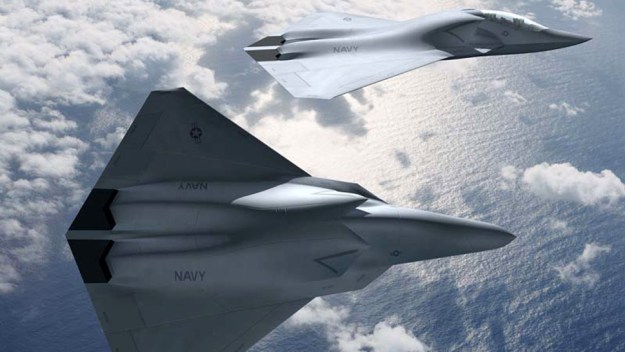
Northrop Grumman has stood a pair of teams dedicated to developing a "sixth-generation" fighter for both the Navy and Air Force, years before the US Navy or Air Force intends to issue requests for information on potential replacements for current aircraft.
Both the Air Force and Navy have begun preliminary planning for what is referred to as next-generation air dominance, or "sixth-generation" fighters. After working together on the F-35 joint strike fighter, the two services are looking at procuring their own respective jets.
The Navy's program is dubbed F/A-XX, while the Air Force's effort is known as F-X.
That program is expected to award a contract to either Northrop or its competitor, a team of Lockheed Martin and Boeing, in late spring or early summer.
defensenews
Translate
Showing posts with label F/A-XX. Show all posts
Jan 22, 2015
Northrop Developing 6th Gen Fighter Plans
Etiquetas:
F-X,
F/A-XX,
NORTHROP GRUMMAN,
UNITED STATES,
US NAVY,
USA,
USAF
Dec 1, 2014
China moves ahead to develop sixth-generation fighter
China is moving ahead to develop a sixth-generation stealth fighter after it finishes the fifth-generation J-20 and J-31.
The United States is the first nation to forge plans for the design of a sixth-generation fighter. In an official statement, the US Navy claimed that a sixth-generation fighter — called FAXX — will replace the F/A-18E/F Super Hornets and EA-18G Growler by 2030. A source from the US military said that the Department of Defense has already prepared a budget for the development of FAXX in 2015.
Russia has recently gotten on board with its own next generation fighter program. A research team was established in northeastern China's Shenyang much earlier than Russia for the country's 6th-gen program.
China is the only nation capable of designing two types of fifth-generation fighters in such a short period of time. With experience gained from the development of the J-20 and J-31, China has enough resources to carry out its next-gen program. China's next fighter is likely to be an unmanned aerial vehicle.
While the definition of "sixth-generation" is not clear yet, most believe such an aircraft must be equipped with a laser or railgun.
wantchinatimes
The United States is the first nation to forge plans for the design of a sixth-generation fighter. In an official statement, the US Navy claimed that a sixth-generation fighter — called FAXX — will replace the F/A-18E/F Super Hornets and EA-18G Growler by 2030. A source from the US military said that the Department of Defense has already prepared a budget for the development of FAXX in 2015.
Russia has recently gotten on board with its own next generation fighter program. A research team was established in northeastern China's Shenyang much earlier than Russia for the country's 6th-gen program.
China is the only nation capable of designing two types of fifth-generation fighters in such a short period of time. With experience gained from the development of the J-20 and J-31, China has enough resources to carry out its next-gen program. China's next fighter is likely to be an unmanned aerial vehicle.
While the definition of "sixth-generation" is not clear yet, most believe such an aircraft must be equipped with a laser or railgun.
wantchinatimes
Etiquetas:
China,
F/A-XX,
J-20,
J-31,
PLAAF,
RUSSIA,
SHENYANG,
SUPERHORNET,
UNITED STATES,
US NAVY,
USA
Sep 12, 2014
US Navy Asks formally industry for F/A-XX Development
The U.S. Navy has formally asked the defense industry to participate in a series of exchanges to provide technical insights into the next-generation replacement for the Boeing F/A-18E/F Super Hornet and the EA-18G Growler in the 2030s.
The exchanges, which have been dubbed Technical Interchange Meetings, are a precursor to a full-up analysis of alternatives (AOA) for the F/A-XX strike fighter aircraft replacement program that is expected to start in 2015.
The meetings are expected to focus on several areas including affordability and modifying current jets like the Super Hornet and Lockheed Martin F-35C to meet the F/A-XX requirement.
usni.org
The exchanges, which have been dubbed Technical Interchange Meetings, are a precursor to a full-up analysis of alternatives (AOA) for the F/A-XX strike fighter aircraft replacement program that is expected to start in 2015.
The meetings are expected to focus on several areas including affordability and modifying current jets like the Super Hornet and Lockheed Martin F-35C to meet the F/A-XX requirement.
usni.org
Sep 1, 2014
US Navy’s Next Fighter Likely to Feature Artificial Intelligence
Artificial intelligence will likely feature prominently onboard the Pentagon’s next-generation successors to the Boeing F/A-18E/F Super Hornet and the Lockheed Martin F-22 Raptor.
“AI is going to be huge,” said one U.S. Navy official familiar with the service’s F/A-XX effort to replace the Super Hornet starting around 2030.
Further, while there are significant differences between the U.S. Air Force’s vision for its F-X air superiority fighter and the Navy’s F/A-XX, the two services agree on some fundamental aspects about what characteristics the jet will need to share.
usni
“AI is going to be huge,” said one U.S. Navy official familiar with the service’s F/A-XX effort to replace the Super Hornet starting around 2030.
Further, while there are significant differences between the U.S. Air Force’s vision for its F-X air superiority fighter and the Navy’s F/A-XX, the two services agree on some fundamental aspects about what characteristics the jet will need to share.
usni
Aug 1, 2014
UCLASS Requirements Shifted To Preserve Navy’s Next Generation Fighter
The striking power and stealth of the U.S. Navy’s Unmanned Carrier Launched Airborne Surveillance and Strike (UCLASS) concept was reduced to protect the role of the service’s next-generation of manned fighters.
In particular, the change in UCLASS from a deep strike stealthy penetrator into the current lightly armed intelligence, surveillance and reconnaissance (ISR) focused aircraft was — in large part — to preserve a manned version of the F/A-XX replacement for the Boeing F/A-18E/F Super Hornet.
Industry, Pentagon and Navy sources outlined a, “bureaucratic and cultural resistance to the introduction of unmanned aircraft onto the carrier.”
Those sources outline a conflict inside the service between naval aviation traditionalists locked onto preserving manned strike aircraft against separate elements that want to shift more of the burden of strike to unmanned systems.
usni
In particular, the change in UCLASS from a deep strike stealthy penetrator into the current lightly armed intelligence, surveillance and reconnaissance (ISR) focused aircraft was — in large part — to preserve a manned version of the F/A-XX replacement for the Boeing F/A-18E/F Super Hornet.
Industry, Pentagon and Navy sources outlined a, “bureaucratic and cultural resistance to the introduction of unmanned aircraft onto the carrier.”
Those sources outline a conflict inside the service between naval aviation traditionalists locked onto preserving manned strike aircraft against separate elements that want to shift more of the burden of strike to unmanned systems.
usni
Etiquetas:
F/A-XX,
PENTAGON,
SUPERHORNET,
UCLASS,
UNITED STATES,
US NAVY
Apr 8, 2013
Boeing unveils updated F/A-XX sixth-gen fighter concept
Boeing is unveiling an updated version of its F/A-XX sixth-generation fighter concept at the Navy League's Sea-Air-Space Exposition in Washington DC this week.
The tail-less twin-engine stealth fighter design comes in "manned and unmanned options as possibilities per the US Navy," Boeing says. The design features diverterless supersonic inlets reminiscent of those found on the Lockheed Martin F-35 Joint Strike Fighter.
flightglobal
Subscribe to:
Posts (Atom)