Translate

Showing posts with label JUAN CARLOS I. Show all posts

Jan 25, 2026

Spain’s Forgotten Aircraft Carrier: The SAC-220 and the Return of Conventional Carrier Ambitions


As Spain quietly re-evaluates the possibility of building a future conventional aircraft carrier, a largely forgotten chapter of national naval history suddenly becomes highly relevant. In the mid-1990s, Spanish shipbuilder Bazán (later IZAR, today Navantia) developed a fully-fledged CATOBAR aircraft carrier design known as SAC-220, a project that was not only technologically mature but actively offered on the international export market.

Three decades later, as Spain once again considers returning to fixed-wing naval aviation beyond the Harrier era, SAC-220 stands as a striking reminder that Spain once seriously pursued indigenous aircraft carrier design — and nearly exported it worldwide.

The SAC-220: Spain’s Ambition to Enter the Carrier Market

The SAC-220 was conceived during the 1990s as a medium-sized conventional aircraft carrier, intended to fill the niche between light STOVL carriers and large fleet carriers. The concept targeted navies seeking affordable access to fixed-wing carrier aviation without the extreme financial and industrial burden of supercarriers.

Technically, SAC-220 represented a mature and coherent design. It featured a CATOBAR configuration, enabling the operation of conventional fixed-wing aircraft using catapults and arresting gear — a capability Spain itself never operated operationally.

Key Technical Characteristics:

  • Length: 241.8 m
  • Beam: 29.5 m
  • Full-load displacement: ~27,000 tons
  • Propulsion: CODAG/COGAG
  • Power output: 76,000–88,500 hp
  • Max speed: 25.5–26.5 knots
  • Range: 7,500 nautical miles at 15 knots
  • Air group: ~20 fixed-wing aircraft + 4 ASW helicopters
  • Sea state: Flight ops up to Sea State 5

Bazán also developed a smaller derivative version — SAC-200, displacing roughly 24,000 tons, aimed at even more cost-sensitive customers.

Designed for Export: Argentina, Brazil, India and China

Rather than serving Spanish requirements, SAC-220 was conceived primarily as an export product. Spain already operated the STOVL carrier Príncipe de Asturias, making a CATOBAR design unnecessary domestically. Instead, Bazán targeted countries seeking low-cost carrier capability.

Argentina

The original conceptual customer was the Argentine Navy, which sought a replacement for the aging ARA 25 de Mayo. SAC-220 would have restored Argentina’s fixed-wing naval aviation capability following the Falklands War. However, Argentina’s severe economic crisis during the 1990s rendered such a purchase impossible.

Brazil

Brazil also evaluated the design as a replacement for Minas Gerais, but ultimately opted for the ex-French carrier Foch (São Paulo) in 2000, acquiring it at a fraction of the cost despite its limited remaining service life.

India

India emerged as a potential industrial partner, with discussions linked to the modernization of Cochin Shipyard. While SAC-220 was examined, New Delhi eventually turned toward Russian carrier solutions and later indigenous designs.

China

Perhaps most intriguingly, China was offered SAC-220 during a period when the PLAN was intensively studying aircraft carrier operations. Despite China’s later massive carrier program, the design was reportedly declined — likely due to financial constraints, technical uncertainty, and Beijing’s preference for absorbing foreign technology through study rather than direct acquisition.

Technical Strengths and Design Limitations

SAC-220 aimed to provide credible conventional carrier aviation within a compact hull, but inevitably faced structural compromises.

Analysts and forum specialists highlighted:

  • A relatively narrow beam, limiting deck space
  • Single or dual catapult layouts with constrained recovery zones
  • Tight margins for high-performance fighters

Despite this, SAC-220 would have been fully capable of operating aircraft such as the F-18 Hornet, A-4 Skyhawk, Super Étendard, MiG-29K, and even E-2 Hawkeye-type AEW platforms, something far beyond the reach of STOVL carriers.

Operationally, it was intended for sea control, limited power projection, and regional deterrence, rather than global strike operations.

Pocket Carrier Logic: Strategic Sense in Small Fleets

SAC-220 belonged to the concept of “pocket carriers” — vessels below 30,000 tons designed to deliver strategic relevance at manageable cost.

Lifecycle cost estimates at the time placed SAC-220 in the $350–400 million range, dramatically lower than contemporary fleet carriers. Even adjusted for inflation, such platforms remain financially accessible compared to full-size carriers.

For medium naval powers, SAC-220 offered:

  • Fixed-wing strike capability
  • Organic air defence
  • ASW and maritime surveillance
  • Strategic autonomy

All without the budgetary shock of supercarriers.

Why SAC-220 Failed — And Why It Matters Today

Despite aggressive marketing, no contracts were secured. Economic crises in Argentina and Brazil, strategic hesitation in India, and long-term planning cycles in China sealed the project’s fate.

Spain itself focused instead on the Buque de Proyección Estratégica (BPE) concept, which later became Juan Carlos I, prioritizing amphibious assault and helicopter operations over fixed-wing aviation.


Yet today, Spain once again faces a strategic inflection point:

  • Harrier retirement approaching
  • F-35B acquisition abandoned
  • Increasing expeditionary commitments
  • NATO power projection demands
  • Rising Mediterranean and Atlantic security pressure

In this context, Spain’s historical experience designing SAC-220 suddenly gains new relevance.

SAC-220 and the Modern Spanish Carrier Debate

Spain is now actively studying the construction of a future conventional aircraft carrier, likely larger than Juan Carlos I and capable of operating fixed-wing aircraft.

Unlike the 1990s, today Spain benefits from:

  • A mature shipbuilding industry (Navantia)
  • Extensive LHD & carrier design experience
  • Deep NATO interoperability
  • Industrial partnerships, notably with Turkey and HÜRJET

The SAC-220 design philosophy — compact, efficient, affordable — fits remarkably well with modern Spanish strategic logic.

Rather than seeking a supercarrier, Spain appears more inclined toward a medium-sized conventional carrier, optimized for:

  • Mediterranean operations
  • NATO task groups
  • Maritime security
  • Limited expeditionary strike

The SAC-220 was far more than an unrealized drawing-board project. It represented a serious, credible attempt by Spain to enter the elite club of aircraft carrier designers.

Today, as Spain reopens the carrier debate, SAC-220 provides both technical legacy and strategic inspiration.

A future Spanish conventional carrier may not resemble SAC-220 in form, but its design philosophy — efficiency, affordability, and strategic autonomy — remains strikingly relevant.

In many ways, Spain’s future carrier may finally realize a vision first sketched more than 30 years ago.

Jun 25, 2025

🇪🇸 Spain Plans Its First Conventional Aircraft Carrier in Historic Naval Leap


Spain commissions a feasibility study for its first conventional aircraft carrier, shifting from STOVL-only platforms and signaling a major evolution in naval air power.

Spain Prepares for Its First Conventional Aircraft Carrier.

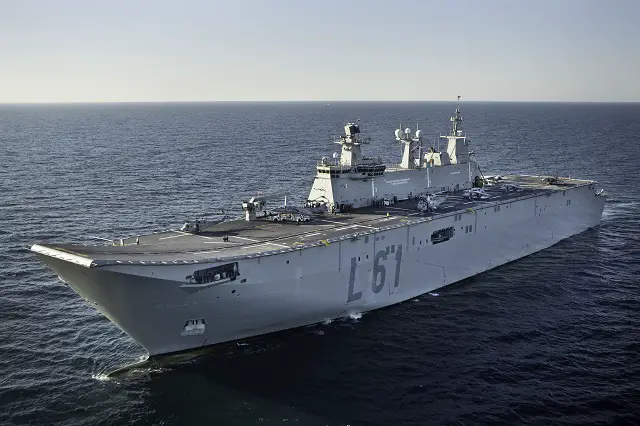
In a historic shift for its naval strategy, Spain is preparing to build its first conventional aircraft carrier, a development that would significantly upgrade its maritime airpower capabilities. The Spanish Navy (Armada Española) has formally commissioned state-owned shipbuilder Navantia to conduct a feasibility study for what could become the largest warship in Spain’s history—surpassing the current LHD Juan Carlos I.

This initiative marks a clear evolution from the Navy’s original plan to operate up to three STOVL-capable amphibious assault ships to now embracing a mixed fleet that includes one conventional fixed-wing aircraft carrier. The envisioned carrier could resemble the French Charles de Gaulle, weighing around 40,000 tons and measuring over 260 meters in length.

Currently, the Juan Carlos I supports STOVL (Short Take-Off and Vertical Landing) aircraft such as the AV-8B Harrier II, now reaching the end of their service life. The only modern replacement available for such aircraft is the F-35B by Lockheed Martin, which limits operational flexibility and market competition.

A conventional aircraft carrier, using catapults and arrestor wires, would expand Spain’s fighter options to include the F-35C, F/A-18F Super Hornet, and Rafale M, among others. These aircraft offer longer range, heavier payloads, and more advanced sensors compared to STOVL types.
The move also aligns Spain with NATO partners like France and the U.S., both operating advanced carrier-borne aircraft. Furthermore, it opens the door to future integration of sixth-generation jets from the Future Combat Air System (FCAS) project, being jointly developed by France, Germany, and Spain.
Navantia's study will explore key systems including:

- Catapult-assisted take-off and arrested recovery (CATOBAR) systems
- Aircraft support for 25–30 fixed-wing manned fighter jets
- Integration of Class 3 UAVs with capabilities for early warning

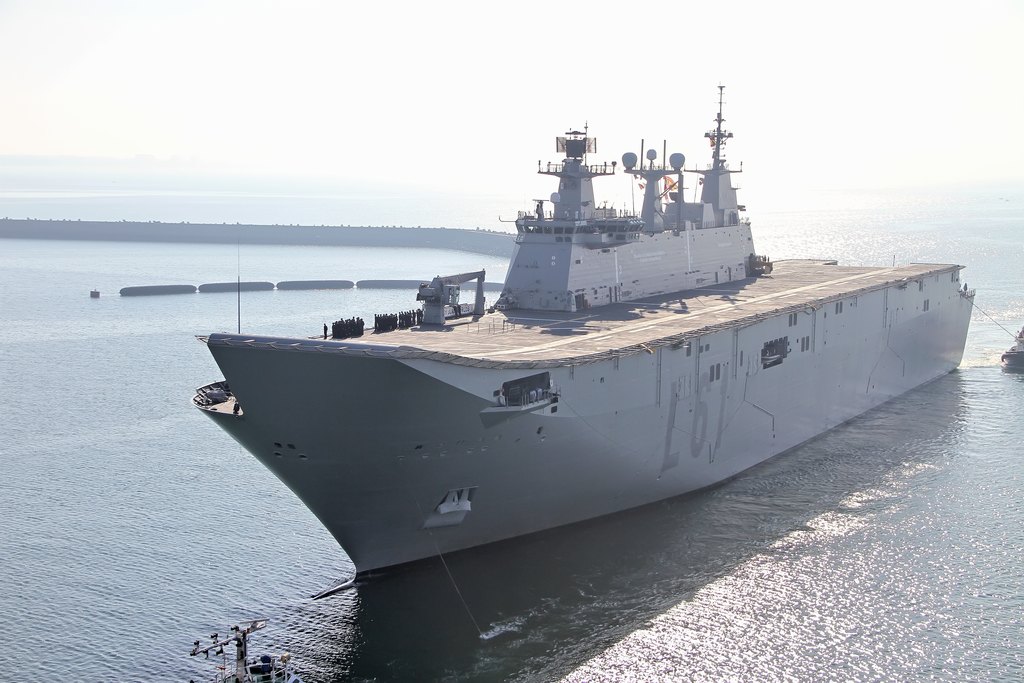
Pending government approval, the first steel cut could take place by 2035, with the ship entering service around 2040. When complete, the new carrier will be larger and more capable than the Juan Carlos I (26,000 tons, 231 meters), marking a leap forward in Spanish naval aviation.
Spain’s future carrier air wing may include a mix of:

- Carrier-capable fighter jets (F-35C, Rafale M, or F/A-18F)
- Unmanned aerial vehicles (UAVs) for surveillance and ASW
- Future FCAS naval variants (anticipated post-2040)

This development ensures that Spain will always have two naval aviation platforms operational, even when one is undergoing extended maintenance addressing a crucial limitation faced by navies operating a single carrier-type vessel.
It also reflects a broader trend across Europe: modernization of naval forces and an increased focus on blue-water capabilities. With rising geopolitical tensions and renewed interest in power projection, Spain is positioning itself as a stronger and more autonomous player within both NATO and the EU.
The construction of a conventional aircraft carrier not only reflects Spain’s technological ambition and industrial capacity, but it also enhances the country's strategic relevance in the Atlantic and Mediterranean theaters. This evolution is emblematic of a new chapter for the Spanish Navy and for European naval power as a whole.

Jan 7, 2024

Turkey confirms the construction of a second aircraft carrier based on Navantia's Juan Carlos I


In a meeting of the Turkish Defense Industry Executive Committee, chaired by President Recep Tayyip Erdoğan, held at the Presidential Complex, the committee assessed the current state of the Turkish defense industry, outlined future objectives, and deliberated on crucial projects.

Decisions were made during the meeting, including the initiation of the design phase for an Aircraft Carrier as part of military ship projects. 

According to the known plans before the plans were finally confirmed for the construction of a new Turkish aircraft carrier, which will be an upgraded version of the TCG Anadolu. This project is based on Navantia's previous work, the Spanish company that designed the Juan Carlos I. However, there is no mention of new submarines in these plans, despite a potential collaboration agreement between Turkey and Spain for a medium-term program based on the design of the Spanish Navy's S-80.

The disagreement between Ankara and Washington over Turkey's purchase of Russian S-400 missile systems led to Turkey's exclusion from the F-35 fighter jet program. As a result, for now, only unmanned fixed-wing aircraft can operate on the TCG Anadolu.

The TCG Anadolu, with a deck of over 200 meters in length and a displacement of 28,000 tons, is the world's first ship to carry armed drones. This vessel was designed to accommodate unmanned models like the TB3 Bayraktar and Kizilelma, and possibly the light combat aircraft Hurjet in the future. Additionally, it is equipped to operate helicopters.

Plans were also approved for constructing ships such as MİLGEM 9-10-11-12th ships (I-class frigates), offshore patrol vessels, new types of landing ships, new generation minehunters, and Turkish Type Fast Attack Crafts (FACs).

Additionally, the decisions covered a wide range of initiatives, including new missiles, radars, electronic warfare, communications, various weapons, ammunition and equipment, air defense systems, and satellite and space systems.

The defense industry has significant contribution to the Turkish economy, noting a record-breaking figure of $5.5 billion, indicating a 27% increase compared to the previous year, demonstrating the growing confidence in Turkish defense industry products, with export destinations increasing from 176 to more than 185 countries.

Turkey is fully commited to achieve a fully independent defense industry, utilizing domestic and national technologies. It confirms the expansion of the Turkish Navy, particularly mentioning the official confirmation of the Aircraft Carrier project, expected to be a larger and more capable version of the TCG Anadolu.

However, there was no mention regarding to the TF-2000 destroyer project, raising questions about the decision's coverage, but there are ongoing and upcoming projects in shipbuilding, including the construction of Hisar-class offshore patrol ships and the Turkish Type Fast Patrol Boat project.


Jun 22, 2019

Russian Su-24 buzzing Spanish carrier Juan Carlos I as it was about to launch AV-8Bs during NATO BALTOPS 2019

Flagship of the Spanish Navy Juan Carlos I was buzzed by a Russian Su-24 this week while the amphibious assault ship was preparing to launch its AV-8B fighters during Exercise Baltops.
okdiario

Apr 23, 2016

F-35B May Be In Spanish Navy's Future

The Spanish Navy has a midterm problem to tackle or maybe it would be more accurate to say it has a dilemma the country’s next defense minister must solve: Should the force continue with fixed-wing combat aviation and, if yes, is the F-35B the solution?
According to Admiral Chief of Naval Staff Jaime Muñoz-Delgado, "Our fleet of Harrier aircraft has a useful life until the period between 2025 and 2027. And there is only one short take-off and vertical landing (STOVL) option on the market: Lockheed Martin's F-35B. This is the reality."
The Spanish naval chief registered the concern Tuesday during a meeting with reporters. The problem with this solution is a limited defense budget.
Nowadays the "Armada Española" has a fleet of 12 AV-8B Harrier II Plus attack planes that formed the core of the 9th Aircraft Squadron more than 30 years ago.
The Spanish Navy Harriers can carry out missions ashore or from the landing helicopter dock Juan Carlos I.
In November 2014, the Ministry of Defense extended the agreement to support the Harrier program after approving an investment of €47.6 million (US $54.1 million) between 2014 and 2024.
"There isn't an official plan or proposal to pursue the acquisition of F-35Bs but the problem will be there in 10 years," Muñoz-Delgado stressed.
He mentioned the possibility of a joint strategy with the Spanish Air Force, which in the 2020s will need to start thinking about replacing its F-18s.
The US Marine Corps' F-35B reached initial operational capability last July 31. The variant is also being delivered to the UK, and the Italian Air Force will also operate it.
Esteban Villarejo defensenews

Nov 19, 2015

Spanish ship 'Juan Carlos I' embarks MV-22 Osprey squadron

Spanish Navy LHD 'Juan Carlos I', ship has embarked a USMC MV-22 Osprey squadron for the first time and is demonstrating a great level of interoperability between the two services
The Spanish Navy (Armada Española) has claimed to be the first non-US naval service to embark a squadron of the US Marine Corps' (USMC's) Bell Boeing MV-22 Osprey tiltrotor aircraft on board one of its ships. The embarkation took place during Exercise 'Trident Juncture 2015'.
The four Osprey transports, are stationed at the Morón de la Frontera Air Base in southern Spain.
For 'Trident Juncture 2015' the aircraft were embarked with six of the Armada's AV-8B Harrier and an AB-212 helicopter from the 27,000-tonne landing helicopter dock (LHD) Juan Carlos I .
The role of the Ospreys during the exercise was to ferry mixed companies of US Marines and their Portuguese and Spanish counterparts, the Fuzileiros and Infantería de Marina respectively.
The Ospreys were escorted during the insertion and extraction of the troops by the Spanish Navy's Harriers. In all 100 US Marines were embarked on the LHD, including support personnel, over a period of three days.
Apart from the tactical missions, some of the US pilots had the opportunity to complete their deck landing qualifications, performing landings and take-off from different spots of the flight deck.
janes

Jan 6, 2015

Turkey's Future LHD Could Be Modified as an "Aircraft Carrier" to Deploy F-35B Jets

Turkish-German media Deutsch Tuerkische Zeitung is reporting that during the last meeting of the Turkish National Security Council (in presence of the Turkish President) the decision was made to built the future LHD (Turkish designation: LPD Project) as an aircraft carrier capable to deploy the F-35B, the short takeoff and vertical landing (STOVL) variant of the Lockheed Martin built Joint Strike Fighter. The vessel should be delivered to the Turkish Navy by 2019.
Turkey's Undersecretariat for Defense Industries (SSM) announced in December 2013 that it selected Sedef shipyard as winner of its LPD tender and that final contract negotiations with this shipyard could begin. Sedef shipyard in Turkey offers a design based on Juan Carlos LHD under the collaboration with Spain's Navantia.
navyrecognition

Nov 29, 2014

RAN commissions first-of-class Canberra

The sealift capability of the Royal Australian Navy (RAN) has been dramatically increased by the commissioning of the 27,800-tonne landing helicopter dock (LHD) HMAS Canberra in Sydney on 28 November.
Based on the design of the Spanish Navy's aircraft carrier Juan Carlos , the 231 m Canberra can embark, transport, and deploy more than 1,000 troops and their equipment from alongside or by helicopter and landing craft.
Canberra , the RAN's largest-ever ship, will be joined in 2016 by sister ship Adelaide . The hulls of both ships were constructed by Navantia at its Ferrol facility in northwest Spain and subsequently transported by heavy-lift ship to BAE Systems in Melbourne for addition of the superstructure, fitting out, and systems integration.
Design changes for the RAN included upgrades to air conditioning, Australian explosives standards in the magazines, enhanced firefighting and medical facilities, and four Typhoon remote-controlled 25 mm weapons systems at each corner of the hull for close-in defence. The Australian-developed Nulka hovering anti-missile decoy will be fitted at a later date.
The flight deck is configured for simultaneous operation of four medium-sized helicopters, such as the NHIndustries NH90 (MRH90 in Australian service) or the Sikorsky S70A-9 Black Hawk, or four Boeing CH-47D/F Chinooks. Up to eight medium helicopters can be accommodated in the hangar, and up to 18 can be carried if the light vehicle deck is also utilised.
The four Navantia-built LCM-1E watercraft carried by each LHD can transport a maximum load of 54 tonnes via the ship's well deck.
The ship will then spend four weeks in the Coral Sea on hot weather trials, followed by four weeks off Tasmania for the cold weather equivalent. Amphibious development trials will subsequently take place off Townsville, Queensland.
These are expected to involve the so-called Amphibious Ready Element, a 350-strong infantry company with supporting elements and enablers that will be on 48 hours' notice to deploy.
An Amphibious Ready Group - a battalion-based combat team with enablers that will involve about 2,000 troops and require both LHDs to transport - is scheduled to be operational by 2017.
Initial operational capability (IOC) for Canberra is expected to be reached in 2016, enabling the ship to participate in that year's Rim of the Pacific (RIMPAC) exercise.
RAN Canberra retain the ski-jump ramp of the Juan Carlos design, and earlier this year Prime Minister ordered an assessment of the benefits of the F-35B short take-off and vertical landing (STOVL) variant of the Lightning II Joint Strike Fighter and modifying the LHDs to operate them.
Although the assessment is intended to help inform the Defence White Paper and Force Structure Review expected in mid-2015, the general reaction from senior defence sources has been that additional capability would not be justified by the time, cost, and risk involved.
janes

Oct 6, 2014

Australia has Formally Accepted HMAS Canberra ALHD

Australia has signed on October 3 acceptance of ALHD Canberra, first of two LHD ships Navantia has built for Australia based on the LHD Juan Carlos I designed for the Spanish Navy.
The contract, signed in 2007, includes the construction of 85% of the two ships in the shipyards of Navantia in Ferrol and completion in Australia by BAE Systems.
The ship was transferred to Australia in August 2012 and will be definitely delivered to the Australian Navy on 28 November.
defense-studies

Jun 24, 2014

Australia reveals interest in F-35B

Australian defence chiefs have told that Prime Minister coalition government is considering whether to acquire a number of short take-off and vertical landing Lockheed Martin F-35Bs.
Canberra confirmed in April it will acquire 58 F-35A Lightning IIs for the Royal Australian Air Force, adding to the 14 already on order to replace the RAAF's Boeing F/A-18A/B Hornet.
Australia has long-stated a requirement for 100 air combat aircraft. However, because it acquired 24 F/A-18F Super Hornets in 2009-2010 as a bridging capability between the retirement of the General Dynamics F-111C and the introduction of the F-35A, it has deferred a decision on Phase 2C of the project until the early- to mid-2020s.
The F-35B proposal is being pushed by Abbott’s office, and if acquired the aircraft would be fielded from the Royal Australian Navy’s two new LHD-class vessels – the first of which is to be commissioned as HMAS Canberra later this year.
The two 27,000t LHDs currently under construction in Melbourne, Victoria are based on Spain’s King Juan Carlos 1 (L-61) vessel, built by Navantia. When ordered, the LHDs were intended for amphibious and regional humanitarian assistance missions. They have capacity for a battalion of troops, up to 100 vehicles, four large amphibious watercraft and a dozen or more helicopters to be embarked for such missions.
There has long been an intention to conduct operational ‘cross-decking’ operations with US Marine Corps and UK Royal Navy fixed and rotary-wing aircraft.
HMAS Canberra will be followed by HMAS Adelaide in 2016.
flightglobal

Jun 21, 2014

US Marines MV-22 Osprey first take over on Spanish Navy 'Juan Carlos I' Carrier /Primera toma de un MV-22 Osprey a bordo del buque ‘Juan Carlos I’


On 18 June, in the Gulf of Cadiz, took place on historic milestone for the "Juan Carlos I" for the first take over of an MV-22 Osprey aircraft of the US Marines deployed in Air Base Morón de la Frontera.
During operations on board ,Osprey, lashing, stop, fold up trailer and a lift were performed.
After completion of the tests, rise of the aircraft by elevator and a filling was performed in hot, after which the aircraft takeoff made ​​for a total of take overs and take offs.
During operations interoperability ship was found with this type of aircraft

El pasado 18 de junio, en aguas del golfo de Cádiz, tuvo lugar el hito histórico para el “Juan Carlos I” de la primera toma de un avión Osprey de los Marines de los Estados Unidos de América desplegados en la Base Aérea de Morón de la Frontera.
Durante las operaciones a bordo con el Osprey, se realizaron el trincado, parada, pliegue y remolque hasta un ascensor.
Tras la finalización de las pruebas, se procedió a la subida de la aeronave por el mismo ascensor y se realizó un relleno en caliente, tras lo cual la aeronave efectuó el despegue completando un total de tres tomas con sus despegues correspondientes.
Durante las operaciones se comprobó la interoperabilidad del buque con este tipo de aeronaves
armada

May 29, 2014

Spain to extend AV-8B Harrier service life

The Spanish Navy has been promised EUR70.3 million for extending the lifespan of its Harrier EAV-8B carrier-borne strike aircraft beyond 2025.
The allocation was announced by the cabinet on 23 May, five months after the Chief of Navy Staff, warned that the Armada's fixed-wing capability could be coming to an end.
A government statement said the investment was necessary because funds were not available to buy replacement aircraft to operate from the service's sole flat top, the Juan Carlos I .
The opportunity to extend the programme of our EAV-8B Plus Harrier has opened up because the United States is also going to extend the useful life of its Harrier aircraft, in the face of development delays with the new vertical take-off F-35 JSF.
Spain has a joint programme with the United States for the Harrier, which was set up in 1990 with the signing of a memorandum of understanding (MoU) for development and support that also included Italy.
A 10-year agreement covering post-production and life-cycle support, in which those three countries were joined by the United Kingdom, was signed in 2004 and is due to run out on 9 December.
Speaking at a press briefing in January, spanish chief of Navy Staff said the only possible replacement for the Harrier was the F-35.
But as Spain had not been involved in the project from the start, trying to join at a late stage would make the aircraft "very expensive".
He warned then that the navy's Harriers would need to be retired between 2020 and 2025 and that "we have to start thinking, to see if we can come up with a replacement".
The AV-8B was acquired originally for the Armada's first modern aircraft carrier, Principe de Asturias , which was decommissioned in December 2013, following the commissioning of the much larger Juan Carlos I .
janes

May 14, 2014

Australia Is Getting Aircraft Carriers, Sort Of

Pretty soon, the Royal Australian Navy will take possession of HMAS Canberra, a 27,000-ton-displacement, flat-deck amphibious assault ship.
The RAN plans to use Canberra and her sister HMAS Adelaide to manage crises across the South Pacific. But could the Canberras also give Australia an offensive naval air capability that it has lacked since the early 1980s?
Could the assault ships, in other words, also be aircraft carriers?
In the early 2000s, Australia and a dozen other countries identified amphibious operations as a significant military shortcoming … and set out to acquire large assault ships to fill the gap.
Australia acquired the license to build two vessels based on Spain’s Juan Carlos, capable of launching both helicopters and landing craft. The Canberras should boost the Australian military’s ability to storm a beach … or help out after a natural disaster.
But they’re also, able to carry jet fighters. While officially an amphibious assault ship, Juan Carlos I also operates up to eight AV-8B Harrier jump jets.
Flying Harriers from the assault ship fulfilled Spain’s interest in maintaining naval light-attack and air-defense capabilities, which it had enjoyed since first acquiring the jump jet in 1987. Looking to the future, Juan Carlos I could also carry F-35B Joint Strike Fighters—if the financially troubled Madrid government ever commits to purchasing the pricey stealth jets.
The Australians don’t have Harriers, nor are they planning to acquire F-35Bs. All the same, they retained the Spanish deck layout for the Canberras—a configuration that makes the Australian ships compatible with fixed-wing fighters, should Australia ever acquire them.
Indeed, a 2004 parliamentary report on Australia’s maritime strategy explicitly argued for the government to buy a few F-35Bs along with the 100 or so land-based F-35As Australia already planned to acquire.
To be clear, effectively operating the high-tech JSF takes more than just a flat deck. The Canberras are amphibious warships first. They can support helicopters just fine, but they lack the munitions and aviation fuel storage to support intensive fixed-wing flight operations.
Training, deck organization and personnel for helicopters differ significantly compared to those for fighters. Moreover, flying JSFs from the Canberras would impair the vessels’ ability to carry out their primary mission by taking up deck space and storage and splitting training time.
So turning the Canberras into carriers is tough. But it’s possible. Flat-deck amphibs are flexible ships. In the 2011 Libya conflict, for example, British and French amphibs launched attack helicopters to strike enemy ground forces ashore—a mission no one envisioned just a few years ago.
There’s no question that the Canberras could launch and recover F-35Bs for short missions.
JSFs would also boost the RAN’s ability to carry out air strikes in lightly-defended airspace, although that would mean risking very expensive aircraft for modest effect on the ground.
Perhaps most importantly, Australian F-35s could plug into coalition operations alongside the U.S. and British navies, both of which are also acquiring F-35s for their full-size, purpose-built supercarriers.
If Australia were to commit to a limited carrier strike capacity in the form of modified amphibs and F-35Bs, it certainly wouldn’t be alone. The U.S. Marine Corps will soon operate JSF jump jets from the Navy’s assault ships. Italy, too, plans to purchase F-35Bs in addition to F-35As … and to deploy the vertical-takeoff fighters from the light carrier Cavour.
Japan and South Korea are getting new flat-deck assault ships. Neither government has formally expressed any interest in putting JSFs on the vessels. But as Russia, India and China both already have flattops and fixed-wing naval fighters—and want to build more—Tokyo and Seoul’s calculations could change.
Does Australia need flattops now? No. But the Canberras may serve in the Australian navy for 30 years or longer. It makes a lot of sense to at least preserve the option of converting them for fixed-wing ops. Time may come when Australia needs to defend its ships from air attack, bomb targets ashore or contribute to a wider coalition operation.
And it’s useful to think beyond the F-35B. It might not be long before ship-launched drones can perform many of the same missions as the manned JSF—and more easily. The Canberras might even make better drone-carriers than JSF-carriers.
Not every navy needs a supercarrier to deploy adequate naval air power. For Australia, the Canberras just might suffice.
medium

Mar 12, 2014

Navantia delivers first four landing crafts to Australia

The first four fast landing crafts (LLC) for the Royal Australian Navy departed on 8th. March on board a cargo from Navantia facilities in Puerto Real. It is scheduled that the cargo arrives destination around mid April.
The rest eight units are being built by Navantia in different steps of construction, and will be delivered in groups of four during the next months.
The main characteristics of the ships are:
Lenght overall: 23.30 m.
Floatation lenght: 21.27 m.
Width: 6.40 m.
Depth: 2.80 m.
Propulsion: two 809 kW diesel engines, two waterjets propellers
Speed: more than 20 knots
Autonomy: 190 miles at full load
Loading capacity flexibility: Abrams vehicle, several Army vehicles, fusiliers’ company or 20 feet container truck.
The contract for the construction of the series of 12 LLC was signed in September 2011. The landing crafts are destined to operate with the ALHD “Canberra” and ALHD “Adelaide”, strategic projection ships, similar to LHD ”Juan Carlos I”, also built by Navantia in cooperation with BAE Systems.
defense-studies

Feb 6, 2014

Helicóptero Superpuma del Ejercito del Aire por primera vez en el portaaeronaves Juan Carlos I

A finales del pasado mes de enero, en el marco del programa de pruebas de interoperabilidad de helicópteros de las Fuerzas Armadas con el portaaeronaves Juan Carlos I (LHD Juan Carlos I), se llevó a cabo la evaluación operativa con un helicóptero del Ejército del Aire HD-21 Superpuma del Ala 48. Con esta prueba se realizó la primera toma y despegue de una aeronave del Ejército del Aire en el buque.
Para conseguir la calificación de interoperabilidad se llevaron a cabo todas las pruebas requeridas por la Armada, en puerto ,y navegando la segunda. Se realizaron, entre otras tareas, plegado-desplegado de palas de rotor principal, rodaje en cubierta de vuelos, subida y bajada utilizando los distintos ascensores y compatibilidad de servicios (remolcado, lavado de turbinas, repostado, conexión alimentación externa, etc.). Tras la evaluación operativa las tripulaciones del Ala 48 recibieron durante tres días conferencias de ambientación marítima.
El Ejército del Aire da, de esta forma, un paso más para conseguir que sus helicópteros y tripulaciones puedan ser transportados y operar desde el Juan Carlos I, lo que beneficiará la capacidad expedicionaria del Ala 48 y la posibilidad de realizar misiones de recuperación de personal, operaciones aéreas especiales o aeroevacuaciones médicas.
ejercitodelaire

Dec 30, 2013

Navantia Cartagena se asegura varios meses de trabajo en la construcción del LHD para Turquía


El contrato para construir un buque de desembarco anfibio como el Juan Carlos I de la Armada Española, para Turquía, garantiza casi 78.000 horas de labor para los trabajadores de Navantia Cartagena, en sus factorías de Sistemas (50.000 h.) y Motores (28.000 h.).
La marina turca ha elegido a Navantia como socio para proporcionar “el diseño, la transferencia de tecnología, los equipos y la asistencia técnica al astillero otomano Sedef", para que lleve a cabo la construcción de este barco de la clase LHD, junto a cuatro lanchas de desembarco LCM en su propio país.
El contrato lo forman 878.000 horas y beneficiará principalmente a los astilleros de Fene Ferrol y San Fernando Puerto Real, donde recaerán 800.000 de ellas. Pero la factoría de Cartagena se beneficiará con las otras 78.000.
Navantia ha sido elegida por los turcos porque es la artífice de “un diseño ya construido y probado por la Armada Española en un buque del mismo tipo, el Juan Carlos I” y a que ha fabricado otros dos que fueron entregados a la marina australiana , el LHD Camberra y el LHD Adelaide.
Este encargo supone un balón de oxígeno que garantiza varios meses de actividad a Sistemas y Motores, tras varios años en los que la empresa cartagenera no conseguía ningún contrato externo, y a la espera de la reactivación de la construcción del los submarinos S-80 y de la entrada del Tramontana en su gran carena.
La Verdad de Murcia

Dec 29, 2013

Turkey selects Navantia's Juan Carlos LHD design as winner of its LPD tender


Turkey's Undersecretariat for Defense Industries (SSM) just announced via press release that it selected Sedef shipyard as winner of its LPD tender and that final contract negotiations with this shipyard can now begin. Sedef shipyard in Turkey offers a design based on Juan Carlos LHD under the collaboration with Spain's Navantia.
Landing Platform Dock Project According to SSM, the Landing Platform Dock Project (LPD)’s main purpose is the acqusition of one Landing Platform Dock in order to meet the operational requirements of Turkish Naval Forces. The scope of the procurement is for: - 1 LPD and - Four Landing Craft Mechanics (LCM) - Twenty seven Amphibious Assault Vehicles (AAV), - Two Landing Craft Personnel Vehicles (LCVP), - One Commander Boat - One RHIB (Rubber Hull Inflated Boat) will be acquired
Juan Carlos class LHD The multi-purpose Strategic Projection Ship "Juan Carlos I" is the largest naval unit ever built in Spain. Her NATO denomination is LHD (Landing Helicopter Dock). In June 2007, Australia announced it would purchase and build two ships of the same design to become the Canberra-class landing helicopter docks.
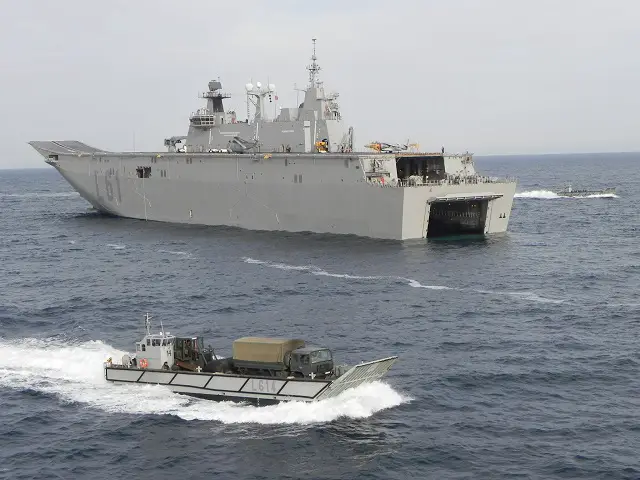
The ship has been designed for 4 mission profiles: - Amphibious ship transporting a Marine Corps Force for landings and land support operations. - Force projection ship transporting Army forces to any theatre of operations. - Aircraft-carrier - Non-combatant operations: humanitarian aid, evacuation from crisis zones and hospital-ship in catastrophe areas.
The crew consists of 261 people: 30 officers, 49 NCOs, 59 leading seamen and 123 ratings.
freerepublic

Oct 28, 2013

South Korea Envisions Light Aircraft Carrier similar to Spanish Navy 'Juan Carlos I', to buy retired S-3 'Viking'


The South Korean Navy believes it can deploy two light aircraft carriers by 2036 and expand its blue-water force to cope with the rapid naval buildups of China and Japan, according to a Navy source.
The service has been exploring ways of securing light aircraft carriers based on an interim feasibility study.
The South Korea Navy envisions three phases:

■The first is to equip the second ship of the Dokdo-class landing platform helicopter ship (LPH) with a ski ramp to operate short-range or vertical take-off and landing (VTOL) aircraft.
The flight surface of the landing ship is already sprayed with urethane, which can withstand the heat created by the aircraft during operations.
Dokdo, with the addition of a ski ramp, could be deployed before 2019, according to the report, which suggests the Navy procure used VTOL jets from the US, UK and Spain if needed.
■Second, the Navy could build an amphibious assault ship, similar to the Spanish Navy’s Juan Carlos, before 2019.
■Finally, the service aims to build two 30,000-ton light aircraft carriers between 2028 and 2036, the report said. The carrier is to have specifications similar to the Italian aircraft carrier Cavour, which can support about 30 aircraft.
China commissioned its first aircraft carrier last year, with three more carriers planned. Japan, whose Navy is classed as a self-defense force, has controversially unveiled a 20,000-ton helicopter destroyer akin to a small aircraft carrier.

More Aegis Ships and Jets
During the National Assembly last week, the Navy unveiled mid- to long-term procurement plans to further strengthen its naval power.
The service plans to commission three more 7,600-ton KDX-III Aegis destroyers by 2023 to develop a strategic mobile fleet. The service has three KDX-III destroyers fitted with Lockheed Martin-built SPY-1D radar capable of tracking incoming ballistic missiles and enemy aircraft.
The Navy also puts a priority on acquiring reconnaissance and surveillance aircraft. In particular, the service laid out plans to buy the Lockheed S-3 Vikings retired from front-fleet service aboard aircraft carriers by the US Navy in January 2009.
The service will purchase 18 S-3 jets and modify them into a new configuration meeting the Navy’s operational requirements. If adopted, it will be the first fixed-wing jet patrol aircraft operated by the South Korean Navy, which flies 16 P-3CK turboprop patrol aircraft.
In January, AgustaWestland won a $560 million contract to supply the South Korean Navy with six AW159 Lynx Wildcat helicopters equipped with an active dipping sonar for anti-submarine role.
defensenews

Jul 4, 2013

El ‘Juan Carlos I’ visitó Melilla

El ‘Juan Carlos I’ efectuó presencia naval por primera vez en los puertos de Málaga y Melilla entre los días 27 de junio y 2 de julio.
Estas escalas forman parte del programa de actividades contempladas en el crucero de instrucción que desarrollan a bordo alumnos de la Escuela Naval Militar.
El buque abrió sus abiertas todos los días que ha permanecido en puerto.
El buque permaneció atracado en Melilla entre los días 30 de junio y el 2 de julio recibiendo la visita de más de 3.000 melillenses.
El ‘Juan Carlos I’ navega ahora en demanda de Lisboa, última escala del crucero de instrucción de los alumnos de la Escuela Naval Militar.
armada

Feb 15, 2013

Morenés visitará hoy en Melbourne al buque 'Cantabria' y asistirá al bautizo del 'Canberra', construido por Navantia


El ministro de Defensa, Pedro Morenés, visitará este viernes en Melbourne (Australia) al buque 'Cantabria' de la Armada, que permanecerá todo el año en este país, y tendrá ocasión además de asistir al bautizo del buque 'Canberra' de la Royal Australian Navy, construido por Navantia con las mismas características del 'Juan Carlos I' de la Armada española.
europapress