Translate

Showing posts with label SAAB. Show all posts

Apr 23, 2026

Is NATO Moving Away from Boeing for Its Next AWACS?


NATO’s long-standing airborne early warning fleet, built around the aging Boeing E-3 Sentry, is approaching a critical replacement phase. After decades of service, the alliance is now exploring options for a next-generation system capable of operating in increasingly complex and contested environments.

Recent reports suggest that the Saab GlobalEye, developed by Saab in partnership with Bombardier, is gaining traction within discussions. The platform, already in service with operators such as the United Arab Emirates, combines airborne early warning with multi-domain surveillance capabilities, offering a more flexible and modern approach compared to legacy systems.


If confirmed, such a choice would mark a significant shift. NATO has traditionally relied on U.S.-built platforms for this mission, and selecting a European-led solution would signal a growing emphasis on industrial diversification and strategic autonomy within the alliance.

However, no official decision has been announced. The scale and strategic importance of the program mean that any final selection will involve extensive political, industrial, and operational considerations. Boeing is still expected to compete strongly, leveraging its long-standing role within NATO and its experience in airborne early warning systems.

For now, the reports should be seen as an indication of direction rather than a confirmed outcome. Even so, they highlight a broader trend: NATO is not only replacing an aircraft, but redefining how it conducts airborne surveillance and command in the decades ahead.

Mar 26, 2026

🇺🇦 Unconfirmed footage suggests Saab 340 AEW&C in Ukrainian service


Recent footage circulating on social media has raised the possibility that Ukraine may already be operating the Saab 340 AEW&C, a platform pledged by Sweden as part of a military aid package announced in 2024. The aircraft were committed as a donation by the Swedish government, although no official confirmation has been issued regarding their delivery or operational status. The appearance of the aircraft in what is believed to be Ukrainian airspace has drawn attention from analysts and observers.

The video, reportedly first shared on Telegram, shows an aircraft equipped with the distinctive Erieye radar mounted above the fuselage. The footage itself lacks clear indicators such as location or date, which initially led to some skepticism. However, its characteristics align with known configurations of the Saab 340 AEW&C, making it difficult to dismiss outright.

If the footage is indeed authentic, it would suggest that the platform has already entered operational use, potentially after a period of pilot training and infrastructure preparation that has been ongoing since the Swedish announcement. Earlier reports had already hinted at movements of similar aircraft toward Ukraine, including flight tracking data associated with callsigns such as “WELCOME”.

The introduction of an airborne early warning capability would represent a significant shift for the Ukrainian Air Force. Unlike ground-based radar systems, an aircraft like the Saab 340 AEW&C can detect and track targets over much greater distances and with fewer limitations imposed by terrain or low-altitude flight profiles. This becomes particularly relevant in a conflict environment where cruise missiles, drones and low-flying aircraft play a central role.

Another key factor is the potential integration with Western-supplied fighter aircraft. If connected through data links such as Link 16, the Saab 340 could act as a central node, sharing real-time targeting information with platforms like F-16s or even Dassault Mirage 2000. In that role, the aircraft would not just extend detection range, but also improve coordination and response times across the air defense network.

At the same time, the lack of official confirmation leaves several open questions. It remains unclear whether the aircraft shown is fully operational, whether Ukrainian crews have completed training, or whether the necessary integration with other systems has been finalized. 

What makes this development particularly noteworthy is its timing. The gradual arrival of Western aircraft and systems into Ukrainian service has been a phased process, often accompanied by limited visibility and delayed confirmation. The possible appearance of the Saab 340 AEW&C fits within that pattern, where operational capability may precede public acknowledgment.

For now, the Saab 340 remains a platform officially promised but not formally declared in service. However, the emergence of visual evidence—however inconclusive—suggests that its role in Ukraine’s air defense architecture may already be taking shape behind the scenes.


Feb 5, 2026

El bloqueo del FCAS abre la puerta a Saab y al KAAN turco en la carrera por el futuro caza español


El Futuro Sistema Aéreo de Combate (FCAS), el ambicioso programa europeo destinado a dotar a Francia, Alemania y España de un caza de sexta generación y un ecosistema de combate integrado, se encuentra en un punto crítico. A comienzos de 2026, tras más de una década de desarrollo y miles de millones de inversión, el proyecto está prácticamente paralizado debido a tensiones entre Francia y Alemania, que no logran ponerse de acuerdo sobre liderazgo industrial, reparto de competencias y prioridades tecnológicas. La decisión sobre la continuidad del programa se ha aplazado indefinidamente, dejando a España en una posición especialmente delicada: depende del FCAS para reemplazar al Eurofighter y al F-18, pero carece de un “plan B” industrial propio para asegurar la continuidad de su fuerza aérea.
Frente a este bloqueo, España comienza a explorar alternativas internacionales que le permitan garantizar su operatividad y el desarrollo industrial asociado al caza de nueva generación. Dos opciones principales emergen en el horizonte: Turquía, con sus programas HÜRJET y KAAN, y Suecia, a través de Saab, que mantiene abierta la puerta a colaboraciones en un caza de sexta generación o en plataformas complementarias. Ambas alternativas buscan ofrecer a Madrid un camino más estable frente a la incertidumbre del FCAS.

Turquía, el KAAN y el Hürjet como punto de partida 

El HÜRJET, cuya versión para el Ejército del Aire recibe el nombre de SAETA II, el entrenador avanzado turco, ha ganado relevancia internacional tras la firma de un contrato con España para reemplazar sus F-5 a partir de 2028. Más allá de ser un simple entrenador, el HÜRJET está diseñado para preparar pilotos para cazas de quinta generación, integrando fusión de sensores, capacidad de guerra en red y conceptos de colaboración hombre-máquina. Su diseño supersonico, arquitectura abierta y coste operativo relativamente bajo lo hacen atractivo para España, especialmente en el contexto de modernización rápida y con restricciones presupuestarias.
El caza KAAN, en desarrollo por Turkish Aerospace Industries (TAI), complementa la oferta turca como avión de combate de quinta generación. Aunque aún no en servicio, su propuesta incluye capacidades avanzadas de combate aéreo, sigilo limitado y compatibilidad con sistemas de entrenamiento como el HÜRJET, lo que permitiría a España mantener una cadena de formación y operativa coherente en caso de optar por esta vía.

Suecia y Saab


Por su parte, Saab ha expresado su disposición a colaborar con España en programas de caza de próxima generación, incluso ofreciendo opciones más flexibles que podrían adaptarse a las necesidades españolas. La empresa escandinava apuesta por la cooperación industrial abierta, con acceso a tecnologías críticas y participación real en el desarrollo de plataformas tripuladas y no tripuladas. Para España, Saab representa una alternativa confiable y modular, que no dependería de la resolución de conflictos internos entre socios del FCAS y permitiría mantener una industria nacional activa y competitiva.

La posición estratégica de España

España, consciente de que carece del músculo industrial de Francia o Alemania, ha adoptado una posición prudente pero estratégica: no busca liderar ni confrontar, sino asegurar certidumbre, retorno industrial y continuidad operativa. Para Madrid, la prioridad no es tener el FCAS perfecto, sino garantizar que exista un programa que funcione y en el que pueda participar realmente, evitando quedar atrapada en el conflicto franco-alemán o depender completamente de sistemas estadounidenses.
Entre sus prioridades destacan:
  • Certidumbre de calendario y continuidad: el Ejército del Aire necesita saber qué avión tendrá, cuándo y a qué coste. Los retrasos acumulados y la parálisis del FCAS representan un riesgo estratégico.
  • Retorno industrial tangible: España exige que Indra, Airbus España e ITP Aero tengan un papel significativo en sistemas, estructuras y mantenimiento, con acceso a tecnologías críticas y carga de trabajo estable.
  • Flexibilidad para alternativas: Madrid estudia cómo integrarse en programas como el HÜRJET/KAAN o en desarrollos suecos sin comprometer su posición en Europa.
Comparativa general de alternativas:


FCAS (Francia-Alemania-España)


  • Contras: Desarrollo paralizado , bloqueo político, retrasos, e incertidumbre industrial
  • Ventajas: Caza de sexta generación, integración total de combate

KAAN (Turquía)
  • Contras: Dependencia de Turquía, interoperabilidad con OTAN parcial
  • Ventajas: HÜRJET certificado, KAAN en desarrollo. Cadena de formación completa, bajo coste operativo, rápida disponibilidad

Programas Saab (Suecia)
  • Contras: plazos y alcance dependientes de acuerdos bilaterales, sin integración total
  • Ventajas: Estudios avanzados, flexibles, cooperación industrial abierta, acceso a tecnologías críticas.
España se encuentra, por tanto, en un momento decisivo: mantener vivo el FCAS con Francia y Alemania, asumiendo sus retrasos y riesgos, o explorar alternativas consolidadas con Turquía y Suecia que aseguren continuidad operativa, industrial y tecnológica. La flexibilidad, la certidumbre de calendario y la participación industrial real serán determinantes para decidir el futuro del combate aéreo español en la próxima década.
Mientras tanto, la industria española observa con atención. La participación activa en cualquier programa de caza del futuro será clave para mantener competencias estratégicas y empleo especializado, y para evitar que España quede relegada a un rol de mero cliente externo en tecnologías críticas de defensa europea.

Jan 11, 2026

Saab, FCAS, and the Question Spain May Soon Have to Answer


While there is no confirmed or official Saab proposal to Spain to replace FCAS, recent statements from Saab’s leadership suggest the Swedish aerospace company is actively positioning itself as a potential alternative partner should the Franco-German-Spanish programme continue to stall.
The backdrop is well known: FCAS remains plagued by industrial disputes, governance disagreements, and questions over leadership between Dassault and Airbus, creating uncertainty over timelines and technological ownership. For Spain, which has invested politically and industrially in FCAS under its national Proyecto Astra, any prolonged instability directly affects long-term air combat planning.
In this context, Saab’s public openness to joint development of a next-generation fighter with European partners is significant. Saab is not offering an “off-the-shelf” solution, nor pitching the Gripen as a replacement for FCAS. Instead, the message is more subtle — if Europe needs another path, Saab is ready to talk.

Why Saab Could Be Attractive to Spain

Saab brings several elements that resonate with Spanish strategic thinking:
Proven fighter design experience, from Gripen E/F development to systems integration
Flexible industrial cooperation models, often more politically balanced than large Franco-German frameworks
Full-spectrum combat aircraft know-how, including sensors, electronic warfare, data fusion, and networked operations
A reputation for cost control and pragmatic engineering, something increasingly relevant as defence budgets stretch
For Spain, Saab would not represent a rejection of European defence autonomy — on the contrary, it would still mean a European-designed, European-built fighter, but potentially with fewer political bottlenecks than FCAS currently faces.

Saab has not formally offered Spain a new fighter programme and Spain has not withdrawn from FCAS and no alternative programme has been approved or even formally discussed at government level.

However, defence programmes of this scale are shaped long before official announcements. Industrial signalling matters, and Saab’s positioning suggests that European air combat power may not remain limited to FCAS and the UK-led GCAP alone.

If FCAS continues to suffer delays or internal fractures, Spain may eventually face a strategic choice:
Double down on a troubled programme, or explore complementary — or alternative — European partnerships.
Saab’s message is clear: if that moment comes, Sweden does not intend to be absent from the conversation.
For now, this remains a strategic undercurrent rather than a policy shift — but in European fighter development, undercurrents often precede major realignments.

Apr 3, 2025

Colombia Chooses Saab Gripen to Modernize Its Air Force


Colombia has officially selected the Saab JAS 39 Gripen as the new fighter aircraft for its Air Force, replacing the aging Israeli-made Kfir jets. President Gustavo Petro announced this decision on April 3, 2025, highlighting the government's commitment to modernizing the nation's air defense capabilities.
The Colombian government evaluated multiple options before finalizing the Gripen. Competitors included the French Dassault Rafale and the American F-16 Fighting Falcon. The decision to opt for the Swedish-manufactured Gripen was influenced by factors such as technological capabilities, cost-effectiveness, and strategic partnerships.

Colombia plans to acquire between 16 and 24 Gripen fighters. While exact figures are pending final negotiations, previous estimates from 2023 indicated a budget of approximately 15 trillion Colombian pesos (around $3.6 billion USD) for 16 aircraft.

The deal includes significant offset agreements aimed at benefiting Colombian society. These encompass the establishment of a solar panel manufacturing facility in Córdoba, initiatives to provide potable water in La Guajira, and the modernization of the San Juan de Dios hospital in Bogotá.

This acquisition marks a pivotal shift in Colombia's defense strategy, emphasizing a move towards diversifying military partnerships. The selection of the Swedish Gripen over American and French alternatives reflects Colombia's intent to establish broader international collaborations. Notably, this decision comes amid strained diplomatic relations with Israel and ongoing internal security challenges.

The Colombian government and Saab are set to enter detailed contract negotiations to finalize the terms of the purchase.
These discussions will determine the final number of aircraft, delivery schedules, and the implementation of the agreed-upon offset programs.

This modernization effort is poised to significantly enhance Colombia's air defense capabilities, ensuring the protection of its sovereignty and aligning with contemporary defense standards.

Sep 27, 2020

The first Brazilian Gripen has flown in Brazil

September 24, the first Brazilian Gripen E, designated by Brazilian Air Force (FAB) as F-39 Gripen, concluded its first flight in Brazil. 
The aircraft flew from the airport in Navegantes to Embraer´s facility in Gavião Peixoto. 
The official presentation of the aircraft is scheduled to take place during the Aviator’s Day and the Brazilian Air Force Day ceremony in Brasilia, celebrated on the 23rd of October. 

Sep 22, 2020

First Brazilian Gripen arrives in-country

The first Saab Gripen E for Brazil arrived in-country on 20 September, having been shipped from Norrköping in Sweden. 
This first Gripen E is a flight test instrumentation (FTI) aircraft (serial number FAB4100) that has been flying in Sweden since August 2019. Now in Brazil, FAB4100 will undergo further testing at the Gripen Flight Test Center (GFTC) in Gavião Peixoto, São Paulo, before being officially presented to the country at the air force’s Aviator Day event in Brasília on 23 October. 
The Brazilian Air Force (Força Aérea Brasileira: FAB) has ordered an initial batch of 28 Gripen Es and eight twin-seat Gripen Fs to be delivered through to 2024. Saab is to build 13 aircraft at its facility in Linköping, Sweden, with the remaining 23 being built in Brazil. 

Oct 20, 2018

Philippines Air Air Force likely to buy JAS-39 Grippen

After a thorough study and research, the Department of National Defense (DND) is most likely to buy the Swedish-made Gripenmulti-role supersonic jet fighter for the Philippine Air Force (PAF).
Defense Secretary Delfin Lorenzana made this disclosure in an exclusive interview with the Philippine News Agency (PNA) on the sidelines of the book launching of former President Fidel V. Ramos at the Manila Hotel on Sunday.
Lorenzana said aside from being cheaper and less expensive in maintenance cost, the Gripen has been proven to be an excellent supersonic fighter aircraft.
The PAF has been scouting for over a decade of what jetfighter aircraft it would buy to replace the US-made F5A/B jet interceptors that retired in 2005 due to old age and lack of spare parts.
Since the F-5s were pulled from service, the Air Force tried to acquire advanced jetfighters such as the supersonic F-16 from the United States, but no progress was made.
Lorenzana said the United States government offered anew to sell F-16 fighter jets to the Philippines.
The offer, Lorenzana added, was made by US Defense Secretary James Mattis when the DND secretary visited Washington last month.
Lorenzana confirmed the US offer, but said the F-16 supersonic jetfighter interceptors are too expensive.
In comparison, the Gripen costs less and has the same capability with other multi-role jetfighters, including the F-16.
Since F-5s were put out of service, the PAF has no multi-role jetfighters in its arsenal, although it had bought from South Korea a dozen of F-50 jets but the planes’ capability is limited compared with the Gripen, F-16 and similar aircraft.
The acquisition of multi-role jetfighters, Lorenzana said, is badly needed to protect the country’s airspace.
pna.gov.ph

Jul 16, 2018

Saab readies to offer airborne early warning plane to UK

Saab is considering proposing an alternative to Boeing’s 737 Wedgetail for the United Kingdom’s future airborne early warning aircraft, but it isn’t ready to say which plane it will choose to host its radar if a program goes forward, the Swedish company’s top executive confirmed to Defense News on July 13.
“We are working with partners and others to try to find a solution,” Saab CEO Håkan Buskhe said during an interview at the Royal International Air Tattoo. “We are confident that we have a good system. … We are good in integration and could deliver according to time [constraints], probably much more affordably with better technology.”
Defense News was the first to report that Saab and Airbus specifically had discussed a partnership that would bring together Saab’s Erieye radar and an Airbus aircraft.
Buskhe declined to confirm whether the company was in talks with Airbus, instead saying more broadly that it was speaking to a number of platform providers.
“First of all our sensors and our system integration is fantastic. We can see stealth aircraft from hundreds and hundreds of kilometers and follow them and target them and the same mode for land, air, at the same time,” he said.
Its GlobalEye aircraft — a modified Bombardier Global 6000 business jet with a suite of integrated sensors including an extended-range version of the Erieye radar, and that’s one one option, but “we are also open if there would be other platforms," he added.
“We don’t compromise quality and efficiency,” he said. “From that, we are open to discussions to bring that technology for example into the U.K. and build them that.”
The United Kingdom is considering an order of new airborne early warning planes to replace its aging Boeing E-3D Sentry aircraft. In June, the Times newspaper reported that the U.K. government preferred to sole source the Wedgetail from Boeing.
One member of Parliament — Julian Lewis, who heads its Defence Committee — wrote an open letter to British Defence Procurement Minister Guto Bebb, urging the Ministry of Defence to open a wider competition, citing Boeing’s 2017 pursuit of tariffs against Bombardier that would have hurt a plant in Northern Ireland.
However, on July 12, Reuters reported that the MoD still leaned toward the sole-source plan and intended to award Boeing a contract for four to six Wedgetail aircraft in the coming weeks, valued at an estimated $1 billion.
If the United Kingdom does end up sole sourcing the Wedgetail, Buskhe said, Saab would “respect the government’s decision” and look for other potential business opportunities.
defensenews

Sep 16, 2017

Saab presents new Gripen Aggressor

Saab is pitching a dedicated ‘Aggressor’ variant of its Gripen C fighter aircraft for the upcoming UK and US pilot training requirements.
Speaking at the DSEI exhibition in London where the new variant of the multirole fighter was unveiled, the head of Gripen sales and marketing, Richard Smith, said that the Gripen Aggressor has been tailored for pilot training role, and that the UK Air Support to Defence Operational Training (ASDOT) and the US Adversarial Air (AdAir) requirements.
“There are two countries where we see market potential for the Gripen Aggressor; namely in the UK for ASDOT and in the US for AdAir. We have a product that matches the requirements, and we have the business case to make it work,” Smith said.
The Gripen Aggressor is essentially a newbuild Gripen C that has had its offensive weapons capability (including the internal cannon) removed. While it is currently modelled on the single-seat Gripen C, Smith noted that a twin-seat Gripen D version could be offered if a customer requested it.
janes

Jun 17, 2017

SAAB JAS-39 Gripen E makes maiden flight

The Saab Gripen E combat aircraft made its maiden flight from the company's Linköping production facility on 15 June.
The flight lasted for 40 minutes, during which the pilot "carried out a number of actions to demonstrate various test criteria including the retracting and extending of the landing gear," Saab said, adding that the aircraft performed as expected.
This milestone was slightly delayed from the original date of late 2016, as the company decided to finalise all of the software development ahead of commencing the flight trials process to reduce risk to the programme.
With 39-8 being used mainly for airframe and general flight control tests, a second prototype (39-9) will be used as a tactical systems testbed, while the third and final single-seat prototype (39-10) will fly as a production-standard airframe. The twin-seat Gripen NG demonstrator (39-7) that provided much of the risk mitigation for the Gripen E will continue to serve as a general test platform throughout the flight trials effort.
As previously highlighted by Saab, the Gripen E's enhancements over the earlier C/D models can be categorised in terms of survivability, sensors, general systems, payload, communications, performance, range, avionics, and human-machine interface/sensor fusion.
Sweden is due to receive the first of 60 Gripen Es (perhaps rising to 70, depending on a governmental decision that is to come) in 2019, with deliveries running through to 2026. In anticipation, the Swedish Air Force (SwAF) has already begun developing the tactics, techniques, and procedures (TTPs) that it will employ for the type.
Speaking to reporters at the home of the service's Operational Test and Evaluation (OT&E) squadron at Malmen Airbase in southern Sweden, Major Johan Jeppsson, director of operations for the unit, said in late May that, "We see what new tactics might be needed, and we then introduce those to the operational squadrons.
janes

Nov 15, 2015

UAE signs for two Saab 340-based early warning aircraft

Saab has announced receipt of a $218 million contract to supply to the United Arab Emirates Air Force and Air Defence with two Saab 340-based airborne early warning and control system aircraft.
The company's contract follows "several years" of discussions over the supply of airborne surveillance equipment. It also follows other good news for the manufacturer, which late last week performed the first flight of a Saab 340-based AEW aircraft for export buyer Thailand.
The Erieye radar has previously been integrated onto the Embraer EMB-145 regional airliner for customers including Brazil and Greece, and is undergoing final system testing aboard a Saab 2000 turboprop for launch customer the Pakistan air force.
flightglobal

Oct 31, 2015

KC-390 resumes flight tests

The flight on 26 October at Embraer’s test centre in Gaviao Pexioto, Brazil, ends an eight-month hiatus caused by a fiscal crisis in Brasilia. As the Real currency has devalued by 50% since the beginning of the year, the government had slowed payments to Embraer on a host of projects, but none bigger than the KC-390.
Last July, Embraer announced signing an agreement with the Brazilian air force that extended the KC-390 development schedule by a year, with entry into service beginning in 2018.
The timing of the Brazilian economic crisis posed a severe test for the KC-390 programme. Embraer completed a 1.5h first flight in Gaviao Peixoto on 3 February, but never flew again until 26 October. In the interim, Embraer’s team moved forward with ground vibration testing, Curado says.
Embraer also has kicked off development of the F-39 Gripen fighter for the Brazilian air force with prime contractor Saab.
flightglobal

Jun 13, 2015

Sweden Wants To Sell JAS-39 Gripen jets to India after France Rafale deal falters

Sweden is looking to export its Gripen fighter jets to India, seizing an opportunity after India Prime Minister effectively killed an $11 billion deal with France's Rafals two months ago.
Swedish Defense Minister said he would pitch Saab's Gripen in a meeting on Wednesday with Indian counterpart. He's also planning to meet with state-run Hindustan Aeronautics Ltd.
The single-engine Gripen lost out to Dassault's twin-engine Rafale jets in India's 2007 tender for 126 planes.
Saab is not the only manufacturer that has been given new hopes by the disintegration of Dassault's deal. Boeing's F/A-18 Super Hornet, Lockheed Martin's F-16 Fighting Falcon, United Aircraft's MiG-35 and the Eurofighter Typhoon were all part of the original tender process.
India's air force currently has 240 MiG's in its fleet of about 25 squadrons. It estimates that at least 45 squadrons are needed to repel a joint attack from Pakistan and China, according to an Indian parliament committee report released in December 2014.
chicagotribune

Jun 9, 2015

Vietnam eyes Western warplanes, patrol aircraft to counter China

Vietnam is in talks with European and U.S. contractors to buy fighter jets, maritime patrol planes and unarmed drones, as it looks to beef up its aerial defenses in the face of China's growing assertiveness in disputed waters.
The battle-hardened country has already taken possession of three Russian-built Kilo-attack submarines and has three more on order. Upgrading its air force would give Vietnam one of the most potent militaries in Southeast Asia.
The previously unreported aircraft discussions have involved Swedish defense contractor Saab, Eurofighter, and U.S. firms Lockheed Martin Corp and Boeing,.
Vietnam has ordered about a dozen more Russian Sukhoi Su-30 front-line fighters to supplement a fleet of older Su-27s and Su-30s.
Vietnam had held talks over the Typhoon warplane made by Eurofighter as well as the F/A-50 light fighter jointly developed by Korea Aerospace Industries and Lockheed.
Lockheed had discussed its Sea Hercules, the maritime patrol version of its C-130 transport plane.
Boeing wanted to sell its maritime surveillance aircraft P-8 Poseidon.
Vietnam has already started moving slowly away from Russia in recent years, buying Canadian Twin Otter amphibious planes and Airbus C-212 maritime patrol aircraft for its coastguard and Airbus C-295 transport planes.
Airbus Defence had been in talks to offer maritime patrol and airborne early warning systems on the C-295.
reuters

Apr 29, 2015

Saab not selling Gripens to Argentina

A proposed sale of 24 Saab Gripen E/F combat aircraft to Argentina is highly unlikely to happen, a senior company representative told reporters on 27 April.
"[A Gripen sale to Argentina] is not something that we are involved in, and isn't something that we would consider at present. Maybe in the future, if relations with the UK were to improve it could happen, or [if relations don't improve] then perhaps we could source some [UK-made] components from elsewhere, but right now no," representative said.
Nilsson referenced the United Kingdom as the British government has indicated that it would veto any Gripen E sale to Argentina, which disputes its sovereignty of the Falkland Islands (Malvinas). The United Kingdom will manufacturer many of the aircraft's flight and mission systems.
Prior to Saab's most recent statement on the issue, Brazilian government officials had said that they did not think that the United Kingdom would veto any such sale to Argentina (Brazil's interest in the sale lies in the fact that the Argentine aircraft would likely be sourced from its licenced production facility that is being set up to partially satisfy the Brazilian Air Force's order for 36 aircraft).
It is likely that Argentina will not be able to wait this long for a replacement fighter anyhow, and while this might make the country an attractive prospect for the Gripen C/D, which Saab is to continue marketing and developing in parallel to the E/F, the Swedish manufacturer is unlikely to want to upset such an important industrial partner as the United Kingdom in offering even this aircraft.
The Gripen E is one of a number of types that have been linked with a possible Argentine sale over recent months. Others include surplus Lockheed Martin F-16 Fighting Falcons from the United States, the Israel Aerospace Industries Kfir, CAC FC-1 (JF-17 Thunder), and J-10 fighters from China as well as Sukhoi Su-24 'Fencer' aircraft leased from Russia. While some commentators have dismissed the Su-24 proposal as a Latin American hoax, it surfaced again only a few days ago during a meeting between Russian president Vladimir Putin and Argentine president Cristina Fernández de Kirchner. Of all these options though, the Chinese FC-1 proposal appears to be the frontrunner at this stage.
janes

Mar 26, 2015

Swedish air force receives its last Gripen C

Saab has delivered its final Gripen C ordered for the Swedish air force.
Aircraft 39294 is now assigned to the air force’s F 17 wing at the base.
Sweden has an active fleet of 65 Gripen Cs and 20 D-model trainers prior to the delivery. The service's total fleet of the type stands at 74 and 24, respectively.
The next single-seat fighter to be delivered to the Swedish air force will be the first of at least 60 Gripens to be manufactured in the advanced E configuration. Saab is under contract to hand over its first example of the larger and more powerful model during 2019, with Brazil also having ordered 36 of the new-generation type.
flightglobal

Feb 26, 2015

Spain Submits Tender to Supply Eurofighter Typhoon To Indonesia

Spain has submitted a tender to supply Eurofighter Typhoon fighter jets to the Indonesian government, entering a bidding war with other producers of combat aircraft.
Indonesia has dedicated 7 percent of budgetary spending to defense over the past two years in an attempt to regenerate an aging military arsenal to both match regional powers and to secure the vast archipelago.
The Eurofighter, faces serious competition from Russia’s Sukhoi and Sweden’s Gripen aircraft.
Gripen maker, Saab, opened a representative office in Indonesia last year.
thejakartaglobe

Feb 13, 2015

USAF T-X Requirements Coming in 'Weeks'

The requirements for the US Air Force's next-generation trainer will be released within "weeks," the service's top training official said on Thursday.
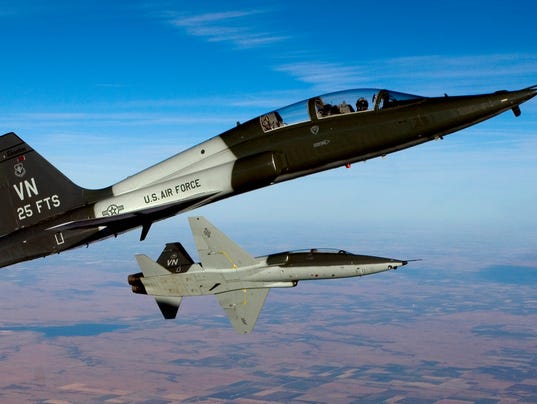
Official did not go into details on what is actually in those requirements, but emphasized that T-X is only to develop a replacement for the T-38.
In the president's budget request, there is a small amount of funding under T-X for using it as an aggressor training system.
There is no decision that's been made yet to use the T-X in any other capacity.
As an example, Rand pointed to the question of whether T-X will have a radar, something that would be required if T-X is eventually turned into an agressor Red Air jet.
"I don't expect the T-X will come with a radar unless they can do it really smart and don't drive the cost up".
The T-X program is intended to replace the Air Force's fleet of T-38 training aircraft with a more highly advanced jet capable of training pilots for use in fifth generation fighters like the F-22 and F-35. The service plans on issuing a request for proposals on the program in the fourth quarter of fiscal 2016, with a projected contract award in the fall of 2017.
The service signaled its intention to move ahead with T-X in its fiscal 2016 budget request.
There are two clean-sheet teams going head-to-head for the program in Northrop Grumman and a Boeing-Saab cooperative, while two legacy systems are being offered in the form of Lockheed Martin's offering of Korean Aerospace Industries' T-50, and the T-100, a collaboration between General Dynamics and Italy's Alenia Aermacchi based on the latter's M-346 design. Textron AirLand is also planning to enter a trainer variant of its new Scorpion jet in the competition.
defensenews

Jan 13, 2015

Belgium Seeks More Information For F-16 Replacement

The Belgian government has started a survey process to pave the way for a program to replace the country’s F-16 fighter fleet.
The Air Combat Capability Successor Program Preparation Survey document, published on Jan. 8, follows on from a survey last June sent to the government agencies requesting information from the five perceived successors: Lockheed Martin’s F-35, the Boeing F/A-18 Super Hornet, the Eurofighter Typhoon, Dassault’s Rafale and the Saab Gripen.
Over 25 pages, the new document outlines what Belgium wants to get out of its new fighter, assessing the operational capabilities, technical and logistical aspects as well as the costs and risks. With that information, the Belgian defense ministry will then be able to ask the government for approval to start the F-16 successor program.
Belgium believes its F-16s will reach the end of their operational lives in the mid- to late 2020s. So it wants to embark on a program that will start to deliver aircraft by the end of 2022, with full operational capability achieved by 2029.
The document places considerable emphasis on the need for a partner or partnership for the program to succeed, pointing to the success the country has had with its F-16 purchase along with other European NATO members.
Belgium wants to continue its track record of successful support of NATO and international operations with its future fighter fleet. Even now, Belgium has aircraft deployed in Jordan to support the U.S. led-coalition against Islamic State fighters in Iraq. Belgium wants to be able to deploy as many as 10 fighters for a sustained period of undetermined duration, or "execute a one-time participation in a multinational operation with a maximum engagement of 30 aircraft.
aviationweek