Translate

Showing posts with label U-2. Show all posts

Jul 29, 2017

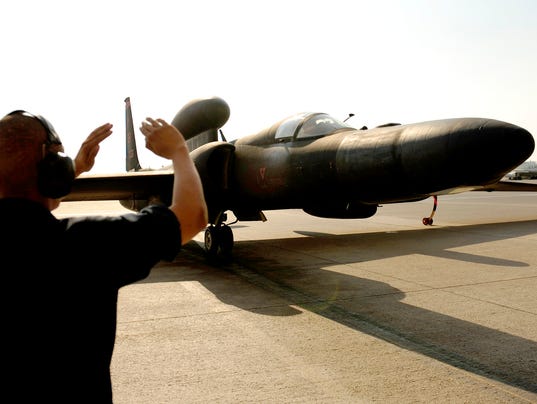
USAF using Tesla Model S as U-2 chase cars


The U.S. Air Force had previously used the Chevrolet Camaro Z/28 as chase cars for the U-2 spy plane. The flying branch has now switched to the Tesla Model S for the task.
The electric car was seen accompanying a U-2S taking off at RAF Fairford earlier this month.
alert5


Mar 9, 2015

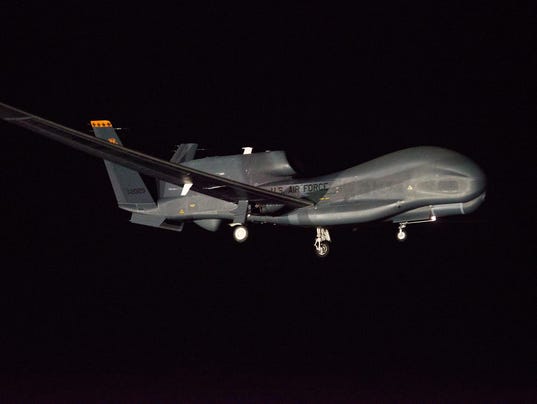
USAF Looks to Global Hawk Upgrades

After multiple attempts to end the Global Hawk Block 30, the US Air Force has now included the high-altitude, long-endurance unmanned system in two straight budget requests, giving a sense of stability to the program — and allowing operators to turn their eyes to future upgrades.
The service had wanted to retire the Global Hawk and funnel that money into keeping the manned U-2 flying. But intense pressure from congressional allies of manufacturer Northrop Grumman kept the Global Hawk alive. Now, it appears set to be the high-altitude option for the future.
In last year's budget, the Air Force sought to retire the U-2 immediately, but Congress again intervened. In this year's budget request, the service instead said it plans to retire the U-2 in 2019, providing a buffer zone during which the Global Hawk can be upgraded.
Northrop announced in February that it had driven flying-hour costs down to $14,876 in 2014. That number was $24,336 in 2013 and $33,598 in 2012. That cost drop occurred as the RQ-4 saw a 40 percent increase in flying hours between 2013 and 2014.
The upgrades needed are a weather radar, a universal payload adapter, which would allow Global Hawk to carry a wider range of electro-optical/infrared sensors, as well as legacy systems such as the U-2's wet film optical bar camera.
The Royal Australian Air Force announced last year it will procure the MQ-4C Triton to meet its maritime surveillance requirement. The Triton, a variation on the RQ-4 being developed for the US Navy, comes equipped with an active, electronically scanned array advanced radar and the ability to go below cloud cover.
Although details are still being finalized, the information released by Australia indicated it plans to purchase seven MQ-4Cs.
defensenews

Feb 20, 2015

USAF May be Forced to retire U-2 and Global Hawk In 2016 Due to sequestration

The USAF may be forced to retire its U-2 and RQ-4 Global Hawk Block 40 ISR aircraft if sequestration is not eliminated in Fiscal Year 2016 (FY16).
Though the Pentagon has wavered over which programme to retire in the prior two budget cycles, both the U-2 and the RQ-4 are fully funded in the department's FY16 budget request. The document states that the U-2 would be divested in 2019 after sensors for the Global Hawk are upgraded.
The U-2's sensors have a range of about 160 km, while the Global Hawk has a range of about 95 km.
The Global Hawk needs nearly USD2 billion in upgrades over approximately six years so that it can complete all the missions done by the manned U-2. The necessary work consists of upgrades to ground stations, communications and imagery capability, and the Global Hawk's weather radar.
janes

Feb 3, 2015

USAF will try to cut A-10 fleet again

The plan mirrors what the Air Force submitted last year. Under that plan, active-duty units would be cut at Moody Air Force Base, Georgia; Nellis Air Force Base, Nevada; and Eglin Air Force Base, Florida. Air National Guard and Air Force Reserve units in Idaho, Maryland, Michigan, Indiana, Missouri and Arizona would receive replacement aircraft, either F-15s or F-16s.
Several key lawmakers have already promised to block any plans to retire the Warthog, even before the Air Force submitted its budget plans.
The Air Force, in its fiscal 2016 budget proposal, is also looking at cutting other aircraft. The plan would reduce the service's F-15C/D fleet by 31 aircraft over five years, 10 in fiscal 2016. The fleet is more than 27 years old. The remaining aircraft would undergo radar and avionics upgrades, along with other service-life extension upgrades.
The service would retain the U-2 Dragon Lady. Last year, the Air Force tried to retire the aging aircraft, but was blocked by Congress. The plan also sustains RQ-4 Global Hawks, including the Block 30 variant the service tried to mothball in previous budget plans.
airforcetimes

Feb 2, 2015

USAF To Include U-2 In FY16 Budget But Will Again Ask To Retire A-10

The US Air Force will include both the U-2 spy plane and Global Hawk unmanned system in their FY16 budget request, but will once again ask to retire the A-10 Warthog, .
For several years the Air Force attempted to retire the Global Hawk in favor of the U-2, claiming the older platform was still cheaper and had greater capabilities than the Global Hawk.
While the U-2 may be saved, the A-10 Warthog remains on the cutting board.
The Air Force has spent a significant amount of its political capital on trying to retire the jet, which remains very popular in Congress. Speaking in January, service Secretary Deborah Lee James hinted that the service remains likely to retire fleets of planes.
defensenews

Dec 23, 2014

Iran: "Several USAF U-2 spyplanes shooed away by our missile systems”

A senior Iranian commander announced on Monday that the country's air defense units have alarmed several reconnaissance and surveillance planes, including some U-2 stealth aircraft, to stay away from Iran's borders.
The increase in the number of spy planes flying near the Iranian borders comes as the country is preparing for joint military exercises which are due to be held in the Southeastern parts of Iran by the Ground, Air and Naval Forces along with Khatam ol-Anbia Air Defense Base on December 25-31.
Earlier this month, Iran's top air defense commander announced that a U-2 stealth aircraft was alarmed to stay away from the country's borders.
english.farsnews

Nov 28, 2014

Lockheed Offers Unmanned U-2 Concept

U-2 advocates push optionally manned variant as a rival to Global Hawk.
Lockheed Martin has crafted a reduced-cost plan to “optionally man” its U-2, throwing a new possibility into the mix as Congress weighs whether to shift to an Global Hawk unmanned aircraft fleet for high-altitude reconnaissance. With an optionally manned U-2, advocates for the so-called Dragon Lady say the venerable aircraft finally can match the endurance offered by the RQ-4B Global Hawk.
Amy Butler-aviationweek

Sep 22, 2014

USAF Air Combat Command chief reluctantly accepts Global Hawk over U-2

While the plan to keep new, unmanned Global Hawks over the aging manned U-2 has support among top Defense Department officials, the top combat general in the Air Force says it is not the best military solution.
The Air Force, in its fiscal 2015 budget proposal calls for retiring the entire U-2 fleet and continuing to buy RQ-4 Global Hawks to handle high-altitude intelligence, surveillance and reconnaissance. The plan reverses previous Air Force attempts to retire the large drones. Officials have said the reversal is possible because Northrop Grumman and Global Hawk crews have been able to reduce the cost of flying the aircraft.
militarytimes

Jun 11, 2014

Global Hawk needs USD1.9 billion in upgrades before U-2 can retire

The RQ-4 Global Hawk unmanned surveillance aircraft still needs upgrades so that it can complete all the missions done by the manned Lockheed U-2, which the US Air Force (USAF) wants to retire to save money.
The necessary work consists of upgrades to ground stations, communications and imagery capability, and the Global Hawk's weather radar.
According to a USAF spokesman, the entire effort would cost USD1.9 billion over six years.
The service earlier this year reversed course on its 2012 plan to divest its new fleet of Global Hawk Block 30 and is now proposing to retire its U-2 fleet instead.
Just two years ago, the USAF said that the Global Hawk was too costly to fly. At the time, the air service's plan to mothball the UAVs was met with strong resistance in Congress.
This year, the Department of Defense said that it has been able to reduce the cost of flying RQ-4s and that it would prefer to retire the U-2 instead.
janes

Mar 31, 2014

Scrapping U-2 Won't Save As Much As Touted

Retiring all of its U-2 spy planes and replacing them with Global Hawk UAVs won’t save as much money as the US Air Force had said it would, since the unmanned systems will need upgrades to handle the mission, according to experts and service data.
To upgrade Northrop Grumman’s Block 30 Global Hawk, the Air Force intends to invest about $1.77 billion over the next 10 years. About $500 million of that is marked for a universal payload adapter that would allow U-2 sensors to be attached to the RQ-4 Global Hawk.
The Pentagon’s fiscal 2015 budget proposal submitted this month recommends retiring the U-2 fleet, which the Air Force has said will save about $2.2 billion. Subtract the $1.77 billion needed to upgrade the Global Hawk, and the savings drop to only $430 million.
The two aircraft perform a similar high-altitude ISR mission. But as recently as February, service leaders argued that the Global Hawk does not meet the full capabilities of the U-2 at a higher cost, and that politics was behind the push to keep the Global Hawk.
defensenews

Mar 12, 2014

US Air Force to eliminate nearly 500 aircraft

The Air Force plans to cut nearly 500 planes from its inventory over the next five years if the Defense Department’s Fiscal 2015 budget request is approved by Congress.
The reductions would affect the active duty, Guard and Reserve in 25 states and the District of Columbia. Only 47 planes would be eliminated overseas at a time when officials are emphasizing the importance of maintaining a strong forward presence to deter adversaries and respond quickly to crises.
The cuts would entail the elimination of the entire A-10 and U-2 fleets, as well as significant reductions in the number of F-15s and MQ-1s.
To maintain capability at lower cost, some assets will be moved from the active duty force to the Reserve. The size of the Reserve fleet will only decrease by 17 aircraft.
The service also plans to slash personnel. The Air Force would reduce its end strength from 503,000 airmen to 483,000.
stripes

Feb 28, 2014

Lockheed Martin starts campaign to save U-2S fleet


With the US Air Force's U-2S fleet facing a threatened early retirement in 2015, Lockheed Martin has finally gone on the defensive to save one of its landmark programmes from replacement by the Northrop Grumman RQ-4 Block 30 Global Hawk.
Lockheed’s U-2 programme director, says the U-2S is the only high-altitude intelligence, surveillance and reconnaissance (ISR) aircraft that can perform the mission based on the USAF’s requirements.
Although the fleet is often confused, the 32 active U-2S "Senior Year" aircraft and TU-2S trainers operated by the USAF today bear little resemblance to the original reconnaissance fleet delivered to the US Central Intelligence Agency in the late 1950s.
Current U-2 fleet was between 1982 and 1989, and were subsequently upgraded with a new engine. USAF has been upgrading U-2Ssince 1993. Up to 10 aircraft in the U-2S fleet were upgraded in 2013 with a new communications gateway payload.
flightglobal

Feb 25, 2014

Pentagon To Retire A-10, U-2s

US Defense Secretary made official Monday many of the expected cuts to legacy and modernization weapons programs across the military to include historic favorites like the A-10 and controversial platforms like the Littoral Combat Ship.
The Pentagon announced its plan to cut the entire A-10 and U-2 fleets as the Air Force transitions to the F-35 and Global Hawk respectively. Air Force leaders had said in the months leading up to the announcement that the service can no longer afford aircraft that fly niche missions.
The Navy’s variant of the Joint Strike Fighter, the F-35C, is similarly under pressure from sequestration cuts. The Pentagon would have to halt procurement of the carrier variant for two years if sequestration remains.
dodbuzz

Sep 16, 2013

US Air Force to buy additional RQ-4 Global Hawk Block 30s

The US Air Force has issued a pre-solicitation notice to purchase additional Northrop Grumman RQ-4 Global Hawk Block 30 unmanned air vehicles (UAV), despite the potential retirement of the existing fleet.
The Air Force released a pre-solicitation notice on 12 September, notifying the public of its intent to buy Lot 12 aircraft.
The Block 30, initially purchased to augment and eventually replace the Lockheed Martin U-2 as a high-altitude intelligence, surveillance and reconnaissance (ISR) aircraft, has come under fire for reliability and sensor problems. A low rate of mission readiness coupled with the high cost of operation has led the USAF to repeatedly attempt to cancel the programme, saying that the U-2 and a classified platform could fulfill Global Hawk's mission. The sensors Global Hawk carries, the Enhanced Imagery Sensor Suite (EISS) and Airborne Signals Intelligence Payload (ASIP), received mixed reviews.
flightglobal

Nov 23, 2012

USAF now using 2012 Chevrolet Camaro SS to chase U-2


The U.S. Air Force has chosen the 2012 Chevrolet Camaro SS to replace its fleet of Pontiac GTOs and Pontiac G8 GTs as chase cars for the U-2.

alert5

latimes

Mar 22, 2010

EL U-2 ESPIA, SIGUE OPERATIVO A PESAR DE SU LONGEVIDAD/U-2 spy planes, saved from scrap heap, find key role


El avión espía U-2, está viviendo una segunda juventud. Hace cuatro años el Pentágono iba a comenzar su retirada, pero fue bloqueada por el Congreso, al considerarlo todavía útil, debido a sus modernizaciones y al poder de sus sensores, lo que ha motivado que sea empleado frecuentemente en Afganistán. Ha pasado de buscar emplazamientos de misiles nucleares, para lo que fue diseñado, a detectar bombas en caminos, para combatir a los talibanes, así como a realizar misiones sobre Corea del Norte.
Actualmente, los pilotos de U-2 están en contacto directo con las tropas desplegadas en Afganistán, donde exploran los caminos por donde transitan las tropas y les proporcionan información cuando están bajo el fuego enemigo.
__________________________________________________
The U-2 spy plane, the high-flying aircraft that was often at the heart of Cold War suspense, is enjoying an encore. Four years ago, the Pentagon was ready to start retiring it. But Congress blocked that move, saying the plane was still useful. And so it is. Because of updates and changes in the use of its powerful sensors, it has become the most sought-after spy craft in a very different war in Afghanistan. As it shifts from hunting for nuclear missiles to detecting roadside bombs, it is outshining even the unmanned drones in gathering a rich array of intelligence used to fight the Taliban.
All this is a remarkable change from the U-2's early days as a player in U.S.-Soviet espionage. Designed to find Soviet missiles, it became famous in 1960 when Francis Gary Powers was shot down in one while flying across the Soviet Union and again in 1962 when another U-2 took the photographs that set off the Cuban missile crisis.
Newer versions of the plane have gathered intelligence in every war since then and still monitor countries like North Korea.
Now the U-2 and its pilots, once isolated in their spacesuits at 70,000 feet, are in direct radio contact with the troops in Afghanistan. And instead of following a rote path, they are now shifted frequently in midflight to scout roads for convoys and aid soldiers in firefights.

Jan 29, 2010

AVION U-2 PROPORCIONA IMAGENES DE LA SITUACIÓN EN HAITI/U-2 TO PROVIDE IMAGERY SUPPORT IN HAITI


Un avión de reconocimiento U-2 despegó desde la base aérea de Beale el 27 de Enero, para proporcionar imágenes en el esfuerzo humanitario necesario para Haiti. El avión será temporalmente utilzado, para proporcionar imágenes de alta calidad y eliminar otras que sean menos necesarias obtenidas por otros medios que están operando sobre Haiti. "Las capacidades del U-2, proporcionan imágenes que superan a las obtenidas por muchas de las plataformas utilizadas actualmente", dijo un oficial del 99th Reconnaissance Squadron. "Es como poner las piezas que no han sido encontradas antes." Las imágenes ayudarán a decidir donde es mas necesaria la ayuda.
"Las imágenes informarán sobre las áreas mas accesibles" dijo el oficial. "También darán prioridad a las áreas mas urgentes de atender en Haití."
En mi opinion personal, me agrada que un medio que ha sido utilizado para buscar los secretos mas ocultos del oponente, ahora sea utilizado para prestar ayuda humanitaria, algo que engrandece a Estados Unidos.
________________________________________________________________________________
A U-2 launched from Beale Air Force Base Jan. 27 to provide critical imagery support in the ongoing humanitarian relief mission in Haiti.The aircraft, temporarily flown out of Robins AFB, Ga., will be used to gather high-quality imagery, broad area shots, which will eliminate the need to patch together smaller images gathered by other intelligence, surveillance and reconnaissance assets currently operating in the Haiti. "The capabilities of the U-2, with the optical bar camera provide superior imagery that is unsurpassed in many of the reconnaissance platforms flying today", said official from the 99th Reconnaissance Squadron. "It's also going to fill in the pieces that were not found earlier by other platforms."
The images provided by the U-2 will give decision makers on the ground a broad picture when deciding on how to get help to those who need it the most.
"Some of the imagery we will be providing will be able to show them what roads will be usable so that they can find what areas are accessible on the ground via vehicles," official said. "Also, they will be able to prioritize to see what type of areas have been hit the hardest and hopefully this will expedite how quickly they can get in and out of the worst areas in Haiti."