Translate

Showing posts with label AV-8B. Show all posts

Jan 22, 2026

Spain May Turn to Ex-USMC Harriers to Sustain Naval Air Power Beyond 2030


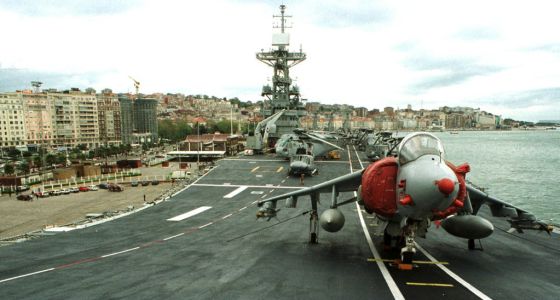
Spain’s naval aviation capability is approaching a critical transition phase, as the EAV-8B+ Harrier II Plus fleet of the Armada Española moves closer to the limits of its economical and technical service life. With no confirmed replacement programme in place and the F-35B procurement decision effectively frozen, attention is increasingly turning toward fleet sustainment strategies based on spare-parts acquisition and life extension.

According to well-connected Spanish naval aviation observers and specialist defence community reporting, Spain may seek to acquire a number of retired AV-8B+ aircraft from the United States Marine Corps, primarily as sources of spare parts, in order to extend the operational viability of its existing fleet into the early-to-mid 2030s.

One such report, shared by respected Spanish defence observer @mistercromer, suggests that up to 13 ex-USMC Harrier II Plus airframes, along with a substantial reserve of spare parts, could be made available to Spain. The same reporting indicates that an Italian option was explored but ultimately deemed unviable, though no official explanation has been provided.

While no formal confirmation exists, the scenario is widely considered operationally logical within naval aviation and defence logistics circles.

A Fleet Without a Clear Successor


The Armada Española currently operates around 11 EAV-8B+ Harrier II Plus aircraft, embarked aboard the amphibious assault ship Juan Carlos I, which functions as Spain’s sole fixed-wing carrier aviation platform.

However, the absence of a confirmed replacement — particularly the political decision to postpone or suspend procurement of the F-35B — has left Spanish naval planners with no viable near-term alternative.

With no European STOVL combat aircraft under development, Spain now faces a looming capability gap, in which Harrier retirement would result in the complete loss of fixed-wing embarked aviation.

Why Spare-Part Harvesting Makes Strategic Sense

Both the United States Marine Corps and the Italian Navy are in the process of retiring their Harrier fleets as they transition to the F-35B. Once this transition is complete, Spain would become the sole remaining frontline Harrier operator worldwide.

From a logistics standpoint, this presents severe challenges:

  • Collapse of the global Harrier spare parts ecosystem
  • Reduced access to overhaul facilities
  • Rising maintenance and sustainment costs
  • Increased fleet grounding risk

In this context, acquiring entire retired airframes as donor aircraft becomes the most efficient method of sustaining fleet operations. Cannibalisation of surplus jets allows operators to maintain availability when original manufacturing and supplier networks are no longer economically viable.

Defence analysts consistently note that ultra-small fast-jet fleets require disproportionate logistical investment, making stockpiling of critical components essential for survival beyond 2030.

Signals from the Specialist Community

Discussion within specialist military aviation forums and defence journalism circles has increasingly highlighted:

Quiet coordination between US and European naval aviation planners

Internal studies assessing Harrier sustainment pathways beyond 2030

The logistical fragility of single-operator combat aircraft fleets

These conversations, while informal, consistently point toward spare-parts harvesting as the only realistic bridge strategy available to Spain until a political decision on future naval aviation is reached.

Operational Reality: A Matter of Physics, Not Policy

From an operational perspective, Spain’s strategic dilemma is governed by physical constraints, not political preferences.

Without STOVL aircraft, Juan Carlos I cannot operate fixed-wing jets, reducing the vessel to a helicopter-only platform and sharply limiting strrike reach, deterrence value, coalition interoperability and power projection

As a result, extending Harrier operations becomes a strategic necessity, not simply a budgetary decision.

Spain’s apparent pursuit of retired USMC Harriers as spare-parts donors reflects a pragmatic response to strategic uncertainty. While not a substitute for a long-term fleet replacement plan, it offers a temporary stabilisation mechanism, preventing the abrupt collapse of naval air power.

It buys time, but it is not a solution, delays — but does not solve — the carrier aviation dilemma

Risks locking Spain into progressively diminishing operational relevance

Unless Madrid commits either to F-35B acquisition or to a fundamentally new carrier aviation architecture, Spain’s fixed-wing naval air capability will likely remain in strategic limbo throughout the next decade.

In that sense, Harrier life extension is best understood as a defensive strategic bridge — not a destination.

Jun 22, 2019

Russian Su-24 buzzing Spanish carrier Juan Carlos I as it was about to launch AV-8Bs during NATO BALTOPS 2019

Flagship of the Spanish Navy Juan Carlos I was buzzed by a Russian Su-24 this week while the amphibious assault ship was preparing to launch its AV-8B fighters during Exercise Baltops.
okdiario

Jan 23, 2016

Despite Pressures From China, Taiwan Might Procure Harriers

Taiwan will have the opportunity to procure refurbished AV-8 Harrier Jump Jets as the US Marine Corps (USMC) begins replacing the aircraft with F-35B stealth fighters, said US government sources.
The Harriers will be offered to Taiwan through the Pentagon’s Excess Defense Articles (EDA) program under the US Defense Security Cooperation Agency.
The AV-8 would fulfill Taiwan’s much-needed vertical and/or short takeoff and landing (V/STOL) requirement. China is expected to destroy Taiwan’s air bases within the first few hours of a war with its estimated 1,400 short-range ballistic missile arsenal and the Harrier’s V/STOL capability will allow the Taiwan air force to maintain air operations by hiding the aircraft in the mountainous interior.
A US defense industry analyst working in Taiwan said that it was a “great idea,” but the USMC’s AV-8s are “too worn to be of much sustainable service value, at least not without some, probably very costly, structural rehabilitation and avionics upgrade.”
The Taiwan Air Force is not crazy about the AV-8 and there is tremendous pressure to continue efforts to secure procurement of the F-35B short take-off and vertical landing aircraft (STOVL) aircraft.
defensenews

Nov 19, 2015

Spanish ship 'Juan Carlos I' embarks MV-22 Osprey squadron

Spanish Navy LHD 'Juan Carlos I', ship has embarked a USMC MV-22 Osprey squadron for the first time and is demonstrating a great level of interoperability between the two services
The Spanish Navy (Armada Española) has claimed to be the first non-US naval service to embark a squadron of the US Marine Corps' (USMC's) Bell Boeing MV-22 Osprey tiltrotor aircraft on board one of its ships. The embarkation took place during Exercise 'Trident Juncture 2015'.
The four Osprey transports, are stationed at the Morón de la Frontera Air Base in southern Spain.
For 'Trident Juncture 2015' the aircraft were embarked with six of the Armada's AV-8B Harrier and an AB-212 helicopter from the 27,000-tonne landing helicopter dock (LHD) Juan Carlos I .
The role of the Ospreys during the exercise was to ferry mixed companies of US Marines and their Portuguese and Spanish counterparts, the Fuzileiros and Infantería de Marina respectively.
The Ospreys were escorted during the insertion and extraction of the troops by the Spanish Navy's Harriers. In all 100 US Marines were embarked on the LHD, including support personnel, over a period of three days.
Apart from the tactical missions, some of the US pilots had the opportunity to complete their deck landing qualifications, performing landings and take-off from different spots of the flight deck.
janes

Mar 27, 2015

20 Percent of all US Marines Aircraft Are Grounded, F/A-18 Hornets The Most Affected

Nearly one of every five of the Corps' aircraft are unable to fly, making it difficult for Marines to train for deployments.
The shortfall spans across aircraft in the fleet, and it is largely caused by a backlog of aircraft stuck in depots for extensive work and overhauls. The problems date back to the 2013 defense budget cuts.
The problem is most prevalent with F/A-18 Hornets, but also impacts CH-53E, AV-8B Harriers, MV-22B Ospreys, and H-1 Hueys.
The strike-fighter shortfall could reach as high as 134 aircraft. The gap is caused by a service life extension program that has caused a backlog of Hornets in short-staffed maintenance depots.
Legacy Hornets were brought into depots to extend their service life from 6,000 flight hours to as long as 10,000 in order to keep them operational until the F-35B entered the fleet. The Hornets were only designed to last to 6,000 hours, and when engineers opened up the airframe to extend their service life, they found unexpected levels of corrosion that required extensive work.
Sequestration also made it tough to buy spare parts for aircraft, so even aircraft that are in the fleet sometimes can't fly.
marinecorpstimes

Dec 29, 2014

US Marine Corps receives first carrier variant F-35C

The US Marine Corps (USMC) has received its first carrier variant (CV) Lockheed Martin F-35C.
The USMC is acquiring a mixed fleet of short take-off and vertical landing (STOVL) F-35B and CV F-35C aircraft. The current plan is for the Corps' current AV-8B Harrier IIs to be replaced by 353 F-35Bs, and its Boeing F/A-18 Hornets to be replaced by 67 F-35Cs. Initial operating capability for the F-35B is slated to be achieving in the coming months, while that for the F-35C is expected in 2018.
CF-19 was the 36th and final F-35 to be delivered this year. Aircraft delivered in 2014 comprised 23 conventional take-off and landing (CTOL) F-35As to the US Air Force (USAF), two F-35As to the Royal Australian Air Force, four F-35Bs to the USMC, six F-35Cs to the USN, and one F-35C to the USMC.
With the programme still in low-rate initial production (LRIP), the final two lots (LRIP 10 and LRIP 11) are due to be contracted in the next couple of years. After 2016, Lockheed Martin intends to ramp-up to full-rate production of about one aircraft per day.
janes

Nov 4, 2014

U.S. Marines to Retire Harrier Fleet Earlier Than Planned, Extend Life of Hornets

The U.S. Marine Corps will phase out the AV-8B Harrier II by 2025 — about five years earlier than planned — and will instead extend the life of its fleet of aging Boeing F/A-18 Hornet strike fighters, according to the service’s recently released 2015 aviation plan.
In previous years, the service had said it would replace its increasingly older fleet of original model Boeing F/A-18A – D Hornet strike fighters before retiring the Harriers before replacing both fighters with the Lockheed Martin F-35 Lighting II Joint Strike Fighter (JSF).
Now, the Harrier will be retired in 2025 and the Hornets will hang on until 2029 for the active duty Marines.
The Marine short takeoff and vertical landing (STOVL) F-35B is planned to operational in the summer of 2015 will eventually replace the Harrier.
The Hornets will finally leave the Marine inventory in 2030 when the reserve component transitions to the F-35B.
The first Harrier squadron to transition to the F-35B will be VMA-211, which will make the switch in Fiscal Year 2016 (FY 2016). If all goes according to plan, the entire West Coast Harrier force will transition to the JSF by 2020.
The remaining East Coast Harriers will be retired 2025. In the meantime—since the AV-8B still has another 11 years to go in service—the Marines will focus on improving the fleet’s readiness.
The Marines will also continue to modernize the aging jet. The jet will receive new ALE-47 V2 countermeasures dispenser, ALR-67 radar warning receivers and ALQ-164 electronic countermeasures pods. The Harriers will also be modified with variable message format terminals, full Link-16 data-link capability and possibly the Tactical Targeting Network Technologies high-speed data-link.
With full integration of the fourth generation Litening pod, it will be able to self-designate the AGM-65E missiles and GBU-54 Laser Joint Direct Attack Munitions.
The Marines are also planning on integrating the AIM-120C/D AMRAAM and AIM-9X Block II air-to-air missiles onto the AV-8B. Flight testing of the AMRAAM onboard the Harrier is slated for 2016.
usni.org

Sep 12, 2014

US Marines Harrier strikes Islamic State for the first time

A Marine Corps AV-8B Harrier has struck an Islamic State target near the Haditha Dam in Iraq.
The strike occurred on Monday, and involved a Harrier from the 22nd Marine Expeditionary Unit operating from the amphibious ship Bataan.
It was the first time that a Marine unit dropped ordnance in the current fight against Islamic State.
marinecorpstimes

May 29, 2014

Spain to extend AV-8B Harrier service life

The Spanish Navy has been promised EUR70.3 million for extending the lifespan of its Harrier EAV-8B carrier-borne strike aircraft beyond 2025.
The allocation was announced by the cabinet on 23 May, five months after the Chief of Navy Staff, warned that the Armada's fixed-wing capability could be coming to an end.
A government statement said the investment was necessary because funds were not available to buy replacement aircraft to operate from the service's sole flat top, the Juan Carlos I .
The opportunity to extend the programme of our EAV-8B Plus Harrier has opened up because the United States is also going to extend the useful life of its Harrier aircraft, in the face of development delays with the new vertical take-off F-35 JSF.
Spain has a joint programme with the United States for the Harrier, which was set up in 1990 with the signing of a memorandum of understanding (MoU) for development and support that also included Italy.
A 10-year agreement covering post-production and life-cycle support, in which those three countries were joined by the United Kingdom, was signed in 2004 and is due to run out on 9 December.
Speaking at a press briefing in January, spanish chief of Navy Staff said the only possible replacement for the Harrier was the F-35.
But as Spain had not been involved in the project from the start, trying to join at a late stage would make the aircraft "very expensive".
He warned then that the navy's Harriers would need to be retired between 2020 and 2025 and that "we have to start thinking, to see if we can come up with a replacement".
The AV-8B was acquired originally for the Armada's first modern aircraft carrier, Principe de Asturias , which was decommissioned in December 2013, following the commissioning of the much larger Juan Carlos I .
janes

Jan 15, 2014

F-35 Weapons Tests in 2014 Focus On Amraam

With weapons testing becoming a more regular event for the F-35 program, developers are looking ahead to a fast pace of trials this year to prepare for the first operational use of the stealthy, single-engine fighter by the U.S. Marine Corps in 2015.
Delivering weapons is often described as the “business end” of a fighter's job, and the Marines are planning to declare initial operational capability (IOC) for the F-35B using the aircraft's 2B software release as early as July 2015, and no later than December 2015. Though limited to use of three weapons—the 1,000-lb. GBU-32 Joint Direct Attack Munition (JDAM), GBU-12 500-lb. Laser-Guided Bomb and Advanced Medium-Range Air-to-Air Missile (Amraam) AIM-120 series—the F-35B will surpass the current capability of the AV-8B Harrier jump jet and F/A-18C twin-engine Hornets.
aviationweek

Jan 6, 2014

Spanish Navy withdraws 25% of their Harrier by cuts and Only 10% of Army is combat Ready - La Armada da de baja el 25% de sus cazas Harrier por los recortes. Solo el 10% del Ejército está listo para combatir


Budget cuts have not only forced the Navy to terminate the Prince of Asturias, the only aircraft available to it (which will be supplied , in part, by the strategic projection ship Juan Carlos I, suitable for takeoff and decision aircraft ) , but a quarter of its fleet of Harrier aircraft.
Four of the 16 Harrier will be out of service due to the lack of funds for modernization and the high cost of maintenance. These older units , four AV- 8B Harrier that had not been transformed into the AV- 8B Harrier II Plus version includes a radar, among other improvements. The fleet will be thus reduced to 12 units (plus training ) whose operational life is expected to conclude in 2020. Thereafter , Spain should buy a replacement if you want to continue to have embarked aviation , which is not guaranteed , as the only candidate today is the U.S. F-35 with a prohibitive price .
The Air Force also runs the risk of losing one of its main capabilities : strategic refueling . One of two Boeing 707 that fulfilled this function and has been discharged and the other should be in two years. The Air Force has five KC -130 Hercules refueling , but its performance is not comparable to the B- 707. The solution is to buy two Airbus 330 tanker aircraft , but each one costs about 200 million and so far there is no budget . Meanwhile, Spain will not contribute, as the conflict in Libya ( 2011) , strategic refueling aircraft . Ejército del Aire is going to lost this ability.

Furthermore only 10% of the Spanish Armed Forces are ready to fight .
The Spanish Armed Forces in 2014 facing its most difficult year due to the continuing budget cuts in recent years . Restrictions continue in the medium term and the current structure is unsustainable.
The Spanish Armed Forces have launched a plan to ensure the operability of the core of the Armed Forces, called Joint Task Force , which will prevail in the allocation of scarce resources.
Since 2008 the defense budget was reduced by 32 %, from 8.494 million to 5.745 in 2014. The military got two outstanding loans that only served to settle debts with military industries. The money was not intended to pay maneuvers , fuel or ammunition to ensure operability.
Until now, the lack of resources has been supplied with funds for missions abroad , financed outside the regular budget starting with expandable in 2013 has touched 800 million . These missions have served to units participating in the same receive intense training , complete their templates and cover their deficiencies in equipment and supplies. The RG -31 armored mine or Lynx have bought with that extra money.
The Defense Ministry plan goes through concentrating resources on a force of "high quality" to give a " quick and effective" response when the government demands. Joint Action Force must be prepared to intervene in a maximum of one month from receiving the activation command Although some of their units , the rapid reaction , have a period of less deployment . in five , 15 or 20 days.
Joint Force will be part fighter and transport, frigates or armored units and special operations , but will not always be the same , when a ship is in dry dock for maintenance or fault will replace another of the same characteristics.
The joint force will total about 10,000 soldiers. Ie about 8 % of the 123,000 diponibles .

_________________________________________________________________________________

Los recortes presupuestarios no solo han obligado a la Armada a dar de baja prematuramente al Príncipe de Asturias, el único portaviones de que disponía (que será suplido, en parte, por el buque de proyección estratégica Juan Carlos I, apto para el despegue y toma de aeronaves), sino la cuarta parte de su flota de aviones Harrier.
Cuatro de los 16 Harrier quedarán fuera de servicio, ante la falta de fondos para modernizarlos y el alto coste de su mantenimiento. Se trata de los aparatos más antiguos, los cuatro Harrier AV-8B que no habían sido transformados a la versión AV-8B Harrier II Plus que incorpora un radar, entre otras mejoras. La flota quedará así reducida a 12 unidades (más una de entrenamiento) cuya vida operativa está previsto que concluya en 2020. A partir de entonces, España debería comprar un sustituto si quiere seguir contando con aviación embarcada, lo que no está garantizado, pues el único candidato hoy por hoy es el F-35 estadounidense, con un precio prohibitivo.
También el Ejército del Aire corre el riesgo de perder una de sus principales capacidades: el reabastecimiento estratégico en vuelo. Uno de los dos Boeing 707 que cumplía esta función ya ha sido dado de baja y el otro debería serlo en dos años. La Fuerza Aérea dispone de cinco Hércules KC-130 para reabastecimiento, pero sus prestaciones no son comparables a las del B-707. La solución es comprar dos aviones cisterna Airbus 330, pero cada uno cuesta unos 200 millones y hasta ahora no hay presupuesto. Mientras, España no podrá aportar, como en el conflicto de Libia (2011), un avión de reabastecimiento estratégico. Está a punto de perder esta capacidad.

Por otra parte solo el 10% del Ejército está listo para combatir.
Las Fuerzas Armadas españolas se enfrentan en 2014 a su año más difícil debido a los persistentes recortes presupuestarios de los últimos años. Las restricciones seguirán a medio plazo y la estructura actual es insostenible.
Las Fuerzas Armadas Españolas han puesto en marcha un plan destinado a garantizar la operatividad del núcleo de las Fuerzas Armadas, la llamada Fuerza Conjunta, a la que se primará en la asignación de recursos escasos.
Desde 2008 el presupuesto de Defensa se ha reducido un 32%, pasando de 8.494 millones a 5.745 en 2014. Las Fuerzas Armadas consiguieron dos créditos extraordinarios que solo sirvieron para saldar deudas con las industrias militares. El dinero no fue destinado a pagar maniobras, combustible o munición para garantizar la operatividad.
Hasta ahora, la falta de recursos se ha suplido con los fondos destinados a las misiones en el exterior, que se financian al margen del presupuesto ordinario con una partida ampliable que en 2013 ha rozado los 800 millones. Estas misiones han servido para que las unidades que participaban en las mismas recibieran un intenso entrenamiento, completasen sus plantillas y cubrieran sus carencias en equipos y pertrechos. Los blindados antiminas RG-31 o Lince se han comprado con ese dinero extra.
El plan del Ministerio de Defensa pasa por concentrar los recursos en una fuerza de “alta calidad" para dar una respuesta “rápida y efectiva” cuando el Gobierno lo demande. La Fuerza de Acción Conjunta deberá estar preparada para intervenir en un máximo de un mes desde que reciba la orden de activación. Aunque algunas de sus unidades, las de reacción rápida, dispondrán de un plazo de despliegue inferior: en cinco, 15 o 20 días.
De la Fuerza Conjunta formarán parte aviones de caza y transporte, fragatas o unidades blindadas y de operaciones especiales, pero no serán siempre las mismas; cuando un buque esté en dique seco por avería o mantenimiento lo sustituirá otro de las mismas características.
La Fuerza Conjunta contará en total con unos 10.000 militares. Es decir, en torno al 8% de los 123.000 disponibles.

El País-Spanish Navy withdraws 25% of their Harrier by cuts
El País-Only 10% of the Army is ready to fight


Jul 5, 2013

Spanish fighter jets fire up Gibraltar strife

Four Spanish air force Matador jets entered Gibraltar's airspace from the northwest on Wednesday while apparently on their way to an aircraft carrier that was about 12 nautical miles southeast of the territory, the government of Gibraltar said in a statement.
"At no time did the aircraft make contact with Gibraltar's air-traffic control and the Spanish air traffic authorities in Seville gave no warning of the aircrafts' approach," it said.
Air traffic controllers in Seville delayed the departure from Gibraltar of a British Airways flight to London for 12 minutes until it was safe for it to take off, the statement added.
The government of Gibraltar has called on Britain "to take up the matter of this military incursion into the airspace of Gibraltar at the highest diplomatic and military levels."
Last week British Prime Minister David Cameron protested to his Spanish counterpart Mariano Rajoy at a meeting of European Union leaders in Brussels over allegations that Spanish police fired shots at a jet ski in the contested waters around Gibraltar.
Madrid has flatly denied accusations that Spanish military-linked Guardia Civil police fired shots while chasing a jet ski on June 23 in waters off Gibraltar and it has criticized Britain for giving credence to rumours.
A Spanish foreign office spokesman said an incident involving a jet ski did take place but that no shots were fired.
In November, Spain and Britain summoned each other's ambassadors in a spat over a series of naval incidents around the small but strategically situated territory.
thelocal

Feb 16, 2013

El Ejército del Aire inicia el lunes sus maniobras más importantes del año


Participan cazas de combate, aviones de transporte y helicópteros. Incluye los cazas de la Armada y sistemas antiaéreos de Tierra.

Las capacidades aéreas españolas se ponen a prueba. El Ejército del Aire realizará sus maniobras más importantes del año, el conocido como ejercicio sirio, durante toda la próxima semana. En el mismo participarán la práctica totalidad de las unidades de combate que tiene este arma de las Fuerzas Armadas, así como otros medios aéreos del Ejército de Tierra y la Armada.

El objetivo de las mismas es adiestrar y evaluar a las unidades participantes en el espacio aéreo de responsabilidad nacional dentro del territorio peninsular para conseguir la superioridad aérea en una situación de crisis y de conflictos de baja intensidad.

Durante la pasada semana, se llevó a cabo una fase previa en la que se diseñó una crisis nacional ficticia y se planearon las misiones a realizar, al tiempo que se inició el proceso de activación de alerta con los centros de operaciones de las diferentes unidades. A partir de este lunes, y hasta el viernes 22 de febrero, se ejecutarán las misiones ofensivas y defensivas que se planearon en respuesta a la falsa crisis diseñada.

En este ejercicio militar se simulará la existencia de tres bandos enfrentados entre sí. El bando Blueland se extiende por el norte de la Península Ibérica y su capital estará situada en Madrid. Whiteland englobará zonas de Castilla La Mancha y la costa de Levante y tendrá su capital en Albacete; y Redland abarcará zonas de Andalucía y Murcia y tendrá su capital en Cánovas, próxima a la localidad murciana de Alcantarilla.

Participan aviones de combate F-18 de las Alas 12 (Torrejón de Ardoz), 15 (Zaragoza) y 46 (Gando); Eurofighter Typhoon de las Alas 11 (Morón de la Frontera) y 14 (Albacete); Mirage F-1 del Ala 14 (Albacete), F-5 del Ala 23 (Talavera la Real); aviones de transporte C-130 Hércules del Ala 31 (Zaragoza); C-295 del Ala 35 (Getafe); Boeing 707 del 47 Grupo Mixto (Torrejón de Ardoz); y helicópteros Súper Puma del Ala 48 (Getafe). A estos se unirán cazas AV88 Harrier de despegue vertical de la Armada y unidades antiaéreas del Ejército de Tierra.

Este ejercicio tendrá una tercera fase que se desarrollará entre el 25 y el 28 de febrero en el Polígono de Tiro de Bardenas Reales, en el sur de Navarra. En el mismo, los aviones de combate del Ejército de Tierra, que partirán desde la base aérea de Zaragoza, ejecutarán diversas misiones de ataque a objetivos terrestres.

libertaddigital

Feb 7, 2013

Despedida del Portaaviones ‘Príncipe de Asturias’ tras 25 años de servicio


Su Alteza Real el Príncipe de Asturias, acompañado por el ministro de Defensa, el jefe del Estado Mayor de la Armada y otras autoridades militares ha presidido hoy en la base naval de Rota la ceremonia oficial de despedida del portaaviones ‘Príncipe de Asturias’, tras 25 años de servicio.
A su llegada, después de ser recibido por las autoridades, S.A.R. Don Felipe de Borbón asistió a una conferencia sobre la historia del portaaviones.
Desde el Puente de Mando, el Príncipe de Asturias ha presenciado una demostración aeronaval, en la que cuatro aviones ‘Harrier AV8’ pertenecientes a la 9ª Escuadrilla de la Flotilla de Aeronaves de la Armada realizaron una pasada sobre el buque, finalizando con la toma y despegue en cubierta.
La parada naval finalizó con un desfile aéreo compuesto de tres helicópteros ‘AB 212’ de la 3ª Escuadrilla, tres helicópteros ‘Seaking SH3D’ de la 5ª Escuadrilla, tres helicópteros ‘HUGES 500’ de la 6ª Escuadrilla y tres aviones ‘Harrier’.
Una vez finalizada la demostración aeronaval, Don Felipe cerró con su firma el Libro de Honor del buque.
Su Alteza Real desembarcó pilotando un helicóptero SH-60 de la 10ª Escuadrilla de Aeronaves, en la que ha sido la última operación de vuelo del portaaviones.
El portaaviones ‘Príncipe de Asturias’ continúa su periplo hasta Ferrol, donde concluirá su vida operativa.

armada

Dec 14, 2012

FRC East delivers first Italian AV-8


Col. Mitchell A. Bauman, Fleet Readiness Center East Commanding Officer, stands with the first Italian Navy AV-8 to undergo planned maintenance and modification work at the facility. FRC East recently completed the extensive aircraft upgrades in 201 days—19 days earlier than projected and more than $275,000 under estimated costs. RADM Paolo Treu, Commander of Italian Naval Aviation, expressed his thanks to FRC East, writing, “Please convey my deepest admiration and appreciation to your ‘artisans’…they did a fantastic job.” The next Italian Harrier to be modified should arrive at FRC East by early January 2013.
navair.navy

Sep 16, 2012

Flight Operations on the USS Iwo Jima


USS Iwo Jima, US 5th Fleet Area of Responsibility (Sept. 10, 2012) -- MV -- 22B Ospreys, AV-8B Harriers, UH-1N Hueys and AH-1W Cobras with Marine Medium Tiltrotor Squadron 261 (Reinforced), 24th Marine Expeditionary Unit, conduct flight operations aboard the USS Iwo Jima, Sept. 10, 2012. The 24th MEU is deployed with the Iwo Jima Amphibious Ready Group as a theater reserve force for US Central Command and is providing support for maritime security operationss and theater support cooperative effects in the US Navy's 5th Fleet area of responsibility. (US Marine Corps video by Gunnery Sgt. Chad R. Kiehl) Available in high definition.