Translate

Showing posts with label B61 BOMB. Show all posts

Oct 30, 2023

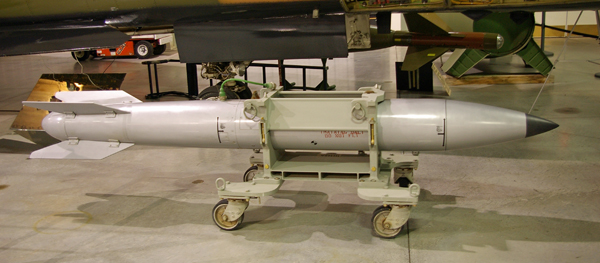
US Unveils Plans for the Development of an Enhanced B61 Nuclear Gravity Bomb


The U.S. Department of Defense made a significant announcement on Friday, revealing its commitment to develop an advanced iteration of the B61 nuclear gravity bomb.

This new bomb, designated as the B61-13, is poised to possess a yield similar to that of the B61-7, effectively phasing out some of the older gravity bombs within the military's arsenal. Notably, the B61-7 boasts a higher yield than its predecessor, the B61-12, which recently joined the military's arsenal.

The decision to embark on this project aligns with the evolving security landscape, consistent with the 2022 Nuclear Posture Review. The review underscored the necessity to modernize the nation's nuclear forces to serve as a formidable deterrent against its primary nuclear-armed rivals, China and Russia.

The B61-13 is designed to incorporate the same modern safety, security, and accuracy features that have been integrated into the B61-12. This upgrade is expected to expand the commander's options for targeting "harder and large-area military targets." Simultaneously, it will pave the way for the retirement of older bombs like the B61-7 and B83-1.

It is anticipated that this new bomb will leverage warheads from the B61-7 units of the 1980s and 1990s, transplanted into casings and tail kits akin to those of the B61-12.

The introduction of the B61-13 could potentially serve as a compromise, aimed at resolving a longstanding disagreement between Democrats and Republicans concerning the fate of the four-decade-old B83-1 bomb.

Former President Barack Obama wanted to terminate the 1.2-megaton B83-1, which is the sole remaining megaton bomb in the nation's nuclear arsenal, capable of exploding with 80 times the force of the 1945 Hiroshima bomb. However, his successor, former President Donald Trump, reversed this decision.

President Joe Biden has since renewed efforts to retire the B83-1, but key Republican lawmakers argue that this bomb is essential for targeting deeply buried and hardened targets.

The maximum yield of the B61-7 and, consequently, the new variant, is 360 kilotons, as opposed to the B61-12's maximum yield of 50 kilotons.

The B61-13 development is sawn as a concession to the congressional hardliners, offering them a limited number of high-yield bombs while also introducing a more precise tail kit.

Republican senators on the Senate Armed Services Committee, expressed their support for the new B61 variant. However, they emphasized that the B61-13 is only a modest step in the right direction, calling for a more comprehensive transformation of the nation's deterrent posture to address the evolving threat posed by the arms race between China and Russia.

The Department of Defense clarified that the creation of the B61-13 will not result in an overall increase in the size of the military's stockpile. The U.S. plans to offset the production of B61-12s by reducing their number to match the quantity of B61-13s manufactured.

Related:

Germany asking Washington if would let Eurofighter to carry nuclear weapons

B61-12 Nuclear Bomb Integration On NATO Aircraft To Start In 2015

USAF Ready To Put B-52 Bombers 24 Hour Ready Alert


Mar 16, 2014

B61-12 Nuclear Bomb Integration On NATO Aircraft To Start In 2015

The US Air Force budget request for Fiscal Year 2015 shows that integration of the B61-12 on NATO F-16 and Tornado aircraft will start in 2015 for completion in 2017 and 2018.
The integration marks the beginning of a significant enhancement of the military capability of NATO’s nuclear posture in Europe and comes only three years after NATO in 2012 said its current nuclear posture meets its security requirements.
The integration will take place on Belgian, Dutch, and Turkish F-16A/B and on German and Italian PA-200 Tornado fighter-bombers. It is unknown if US and NATO F-16s happen simultaneously or US aircraft are first, but the process will last four years between 2015 and 2018. Integration of German and Italian Tornados will take a little over two years.
The B61-12 will also be integrated on USAF F-15E, F-16C/D, and B-2A aircraft, and later on the F-35A Lightning II. The US Air Force plans to equip all F-35s in Europe with nuclear capability by 2024.
In addition to the US Air Force, the nuclear-capable F-35A will be supplied to the Dutch, Italian, Turkish, and possibly Belgian air forces.
From the mid-2020s, the B61-12 will also be integrated on the next-generation heavy bomber (LRS-B) planned by the US Air Force.
Integration of US nuclear weapons onto aircraft of non-nuclear weapon states that have signed the nuclear Non-Proliferation Treaty and promised “not to receive the transfer from any transferor whatsoever of nuclear weapons or other nuclear explosive devices or of control over such weapons or explosive devices directly, or indirectly,” is, to say the least, problematic.
The arrangement of equipping non-nuclear NATO allies with the capability and role to deliver US nuclear weapons was in place before the NPT entered into effect and was accepted by the NPT regime during the Cold War. But for NATO to continue this arrangement contradicts the non-proliferation standards that the member countries are trying to promote in the post-Cold War world.
How scattering enhanced nuclear bombs across Europe in five non-nuclear countries will enable “bold reductions” in US and Russian non-strategic nuclear weapons in Europe and help create the conditions for a world without nuclear weapons is another question.
fas.org

Jan 20, 2014

Sandia conducts first impact test in years of B61 nonnuclear components

A ground-penetrating bomb, minus its nuclear components, rammed through a target at the remote Coyote Canyon test range last month in Sandia National Laboratories’ first such rocket-driven impact test in seven years. Engineers said the Sandia components on the weapon performed as expected.
The Sandia team hoisted the test B61-11, an earth-penetrating weapon, high above the target on a device attached to a rocket sled capable of thousands of pounds of thrust. The motors were lit and the rocket pulled the B61 down into the target.
The nuclear package, removed prior to the tests, is studied separately by the design laboratory, either Los Alamos or Lawrence Livermore national laboratory.
As flight test preparations moved forward Nov. 20, a radio on a table in the room crackled with updates: the explosives were wired; the test team pulled back to a control facility 5,000 feet away to arm the firing system remotely; the final countdown of 5-4-3-2-1 began. A camera that had been focused on the weapon panned down to the target at T minus 30 seconds to capture the B61 slamming through the concrete.
An unimaginable amount of detail and work goes into getting as much information as possible out of the tests. This test involved a series of calibration tests and qualifying reviews beforehand, along with dozens of people from Sandia, as well as researchers from Los Alamos who fielded components on the weapon and personnel who helped set up and monitor the test.
After the test, the radio continued to snap out updates: no fires — a possibility from burning rocket fuel debris; no debris from the weapon around the target; levels of toxic gas from the burning rocket propellant at zero; in short, everything at the scene indicated the test was safe.
The area was declared safe about 15 minutes after the test, and technicians began moving cables and cleaning up the site. Later, two large cranes moved the target so technicians could excavate the B61 in preparation for disassembly at the Pantex Plant in Amarillo, Texas, where it was built. Data from the test will be used to update the annual assessment of the nation’s stockpile for President Barack Obama.
Sandia National Laboratories is a multi-program laboratory operated by Sandia Corporation, a wholly owned subsidiary of Lockheed Martin Corp., for the U.S. Department of Energy’s National Nuclear Security Administration. With main facilities in Albuquerque, N.M., and Livermore, Calif., Sandia has major R&D responsibilities in national security, energy and environmental technologies and economic competitiveness.
sandia.gov

Nov 7, 2013

US To Spend Billions 'Modernizing' Nuclear Arsenal

The United States plans to spend billions to upgrade a decades-old atomic bomb designed to stop a Soviet invasion of Europe, as part of a controversial project to modernize its nuclear arsenal.
Some lawmakers and experts dismiss the effort as a colossal waste of money that could derail arms control talks with Russia.
But top commanders and government officials argue the B61 nuclear gravity bomb needs to be maintained so other weapons can be scrapped and to ensure America retains a “credible” force.
Designed as a short-range “tactical” weapon to deter Soviet forces from overrunning Western Europe, the bomb has been in service for the US Air Force since the 1970s.
There are five versions of the bomb, which has an estimated yield of 0.3 to 360 kilotons, equivalent to 360,000 tons of TNT.
Washington removed thousands of tactical atomic weapons from Europe after the Cold War ended. But 180 of the B61 bombs remain in Europe, the only American nuclear weapon still deployed on the continent, at NATO bases in Germany, Belgium, Italy, the Netherlands and Turkey.
Under President Barack Obama’s planned upgrade, the various models of the bomb would be replaced by a modified version, the B61-12, which would have a smaller yield and more accuracy.
A tail kit would be outfitted for the bomb, which officials say would enable more precision and therefore reduce the quantity of fissile material needed to destroy a target.
The modernization also will allow the Obama administration to retire the most powerful atomic bomb, the B83, and reduce the overall amount of nuclear material in the arsenal.
defensenews

Nov 28, 2012

Boeing to Modernize U.S. Nuclear Bombs


In another demonstration about how the world of nuclear weapons and classification of information has changed it was announced that Boeing (BA) has received a contract from the U.S. Air Force to design a new tail kit for the standard B61 aerial nuclear weapon.

The contract is worth a little over $175 million and is part of a program to improve the weapon’s reliability and upgrade the design.

The B61 has been in existence for almost fifty years in various versions. Boeing will work with the Mod 12 of the bomb. The B61 is a key component of the current U.S. stockpile of weapons.

In the past even confirmation of the existence of this weapon would have been impossible and now contract awards are treated routinely.

defenseprocurementnews