The US military has flown a B-1B bomber over South Korea as part of a massive joint aerial drill, in a move seen as a warning to the North.
The B-1B Lancer plane simulated bombing a military field.
The drill is taking place a week after Pyongyang fired what it claimed was a new intercontinental ballistic missile which could hit mainland US.
The US has previously deployed bombers as a show of force after North Korean missile or nuclear tests.
South Korea's military said the US bomber took part in the simulation with US and South Korean fighter jets.
It took place at the Pilsung range in north-eastern Gangwon province, about 150km (93 miles) from the border with North Korea, reported Yonhap news agency citing the military.
More than 200 planes and thousands of troops are involved in the Vigilant Ace aerial exercise, which ends on Friday and had been planned before North Korea's latest missile launch.
Pyongyang, which routinely condemns US-South Korea's joint military exercises as rehearsals for war, called the latest drill "nuclear war provocation moves" in state media on Monday.
The drill is taking place as the UN's political chief Jeffrey Feltman visits Pyongyang for dialogue, in a rare visit by a senior UN official.
Tensions have been running high since the missile launch late last month, which triggered international condemnation and a warning from the US that the North Korean regime would be "utterly destroyed" if war broke out.
South Korea's military also plans to launch a combat unit of weaponised drones called "dronebots" next year, Yonhap reported quoting an unnamed official.
The "dronebots" would conduct reconnaissance on core North Korean targets such as nuclear and missile sites, and could also launch attacks, though the report did not give further details on how this could be done.
bbc
Translate
Showing posts with label North Korea. Show all posts
Dec 6, 2017
USAF B-1B bomber in attack drill show of force to North Korea
Etiquetas:
B-1,
North Korea,
SOUTH KOREA,
UNITED STATES,
USA,
USAF
Dec 3, 2017
Six US F-22 stealth fighter jets arrive in South Korea for joint Vigilant Ace air drills
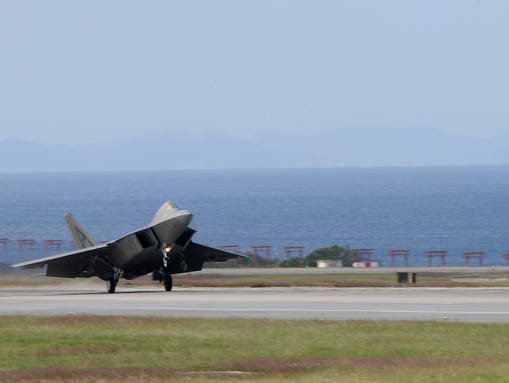
Six U.S. F-22 Raptor stealth fighter jets arrived in South Korea on Saturday for joint air drills between Seoul and Washington slated for next week in a show of force against North Korea.
The fighter planes will join the allies' annual airborne exercise named Vigilant Ace to be held from Dec. 4-8, according to the South Korean Air Force.
The U.S. also plans to send F-35A and F-35B stealth jets, F-16C fighter planes and others including an unspecified number of B-1B bombers.
The South Korean Air Force will dispatch F-15K, KF-16 and F-5 fighter jets and other planes for the exercises with about 230 aircraft at eight U.S. and South Korean military installations being mobilized.
koreaherald
The fighter planes will join the allies' annual airborne exercise named Vigilant Ace to be held from Dec. 4-8, according to the South Korean Air Force.
The U.S. also plans to send F-35A and F-35B stealth jets, F-16C fighter planes and others including an unspecified number of B-1B bombers.
The South Korean Air Force will dispatch F-15K, KF-16 and F-5 fighter jets and other planes for the exercises with about 230 aircraft at eight U.S. and South Korean military installations being mobilized.
koreaherald
Nov 25, 2017
United States to deploy 6 F-22 Raptor stealth fighters to Korea next month
The United States is planning to send six F-22 Raptor stealth fighter jets to a joint air force exercise in South Korea next month in what is believed to be U.S. action to put maximum pressure on North Korea, military officials here said on Thursday.
"Six F-22 fighters from the U.S. Air Force are scheduled to join the joint South Korea-U.S. air force exercise Vigilant Ace from Dec. 4-8," the officials said.
The fighters will fly to the Korean Peninsula from Kadena Air Base in Okinawa, Japan and stay at an air base in South Korea throughout the exercise, according to officials. Up to four F-35A Lightning stealth fighters are also likely to join the deployment, they said.
The U.S. fleet will reportedly engage in enemy infiltration and precision strike drills with South Korean Air Force fighter jets during the exercise.
It would mark the first time the U.S. has deployed six Raptors to Korea at once and is sure to put pressure on North Korea with the overwhelming military force by the allies.
The planned deployment comes as the U.S. steps up the deployment of strategic assets to South Korea in a show of force aimed at pressuring North Korea to the maximum level. Early this month, three U.S. nuclear-powered aircraft carriers were deployed to the East Sea after powerful American fighter jets flew near North Korea in the previous months.
The move is also sure to lead to an angry reaction from North Korea and threats to retaliate as similar operations have done in the past.
yonhapnews
"Six F-22 fighters from the U.S. Air Force are scheduled to join the joint South Korea-U.S. air force exercise Vigilant Ace from Dec. 4-8," the officials said.
The fighters will fly to the Korean Peninsula from Kadena Air Base in Okinawa, Japan and stay at an air base in South Korea throughout the exercise, according to officials. Up to four F-35A Lightning stealth fighters are also likely to join the deployment, they said.
The U.S. fleet will reportedly engage in enemy infiltration and precision strike drills with South Korean Air Force fighter jets during the exercise.
It would mark the first time the U.S. has deployed six Raptors to Korea at once and is sure to put pressure on North Korea with the overwhelming military force by the allies.
The planned deployment comes as the U.S. steps up the deployment of strategic assets to South Korea in a show of force aimed at pressuring North Korea to the maximum level. Early this month, three U.S. nuclear-powered aircraft carriers were deployed to the East Sea after powerful American fighter jets flew near North Korea in the previous months.
The move is also sure to lead to an angry reaction from North Korea and threats to retaliate as similar operations have done in the past.
yonhapnews
Etiquetas:
F-22,
Japan,
North Korea,
RAPTOR,
SOUTH KOREA,
UNITED STATES,
USAF
Nov 1, 2017
U.S. sends nuclear-capable B-2 stealth bomber on mission in Pacific ahead of Trump visit to Asia
The U.S. military sent a nuclear-capable B-2 stealth bomber from Whiteman Air Force Base in Missouri on a long-range mission to the Pacific area of operations over the weekend, it said Sunday, a day after Pentagon chief Jim Mattis highlighted rival North Korea’s “accelerating” atomic weapons program during a visit to South Korea.
The U.S. military’s Strategic Command said in a statement that the type of long-range mission conducted was to “familiarize aircrew with air bases and operations in different geographic combatant commands, enabling them to maintain a high state of readiness and proficiency.”
In a message likely intended to reassure Japan and South Korea ahead of U.S. President Donald Trump’s visit to Asia, which kicks off later this week, the statement also referred to the B-2 mission as “a visible demonstration of commitment to our allies and enhancing regional security.”
The flight path of the B-2 was unclear, and Strategic Command did not respond to a request for comment, but the last time one of the stealth bombers flew near the Koreas was during a rare show of force over the peninsula in 2013. Military experts say that any U.S. strike on North Korea would almost certainly involve the powerful bombers.
japantimes
The U.S. military’s Strategic Command said in a statement that the type of long-range mission conducted was to “familiarize aircrew with air bases and operations in different geographic combatant commands, enabling them to maintain a high state of readiness and proficiency.”
In a message likely intended to reassure Japan and South Korea ahead of U.S. President Donald Trump’s visit to Asia, which kicks off later this week, the statement also referred to the B-2 mission as “a visible demonstration of commitment to our allies and enhancing regional security.”
The flight path of the B-2 was unclear, and Strategic Command did not respond to a request for comment, but the last time one of the stealth bombers flew near the Koreas was during a rare show of force over the peninsula in 2013. Military experts say that any U.S. strike on North Korea would almost certainly involve the powerful bombers.
japantimes
Sep 16, 2017
South Korea responds to North Korea Firing a Taurus Missile
Korea's military fired two ballistic missiles in a swift response to North Korea's latest missile test on Friday, the Yonhap news agency in Seoul reported.
The action is unusual and shows a toughening response to North Korea's provocations, despite South Korean President Moon Jae-in on Thursday ruling out the return of nuclear weapons to South Korea because of fears it would spark an arms race.
Read More
The action is unusual and shows a toughening response to North Korea's provocations, despite South Korean President Moon Jae-in on Thursday ruling out the return of nuclear weapons to South Korea because of fears it would spark an arms race.
Read More
Sep 2, 2017
U.S. B-1B bombers, South Korea jets conduct flight operation after North Korea missile launch
Two U.S. nuclear-capable strategic bombers conducted a joint operation with South Korean air force fighter jets on Thursday, the Yonhap news agency reported, two days after North Korea launched a missile that flew over Japan sharply raising tension.
Four U.S. stealth F-35B jets also took part in the operation, Yonhap reported.
reuters
Four U.S. stealth F-35B jets also took part in the operation, Yonhap reported.
reuters
Etiquetas:
B-1,
North Korea,
SOUTH KOREA,
UNITED STATES,
USA,
USAF
Sep 3, 2016
South Korea mulls purchase of four Boeing P-8 Poseidon aircraft
The South Korean military may buy four Boeing P-8 Poseidon maritime surveillance aircraft in the wake of the successful test-firing of a submarine-launched ballistic missile (SLBM) by North Korea on 24 August, the Korea JoongAng Ilbo newspaper quoted a senior government official as saying on 1 September.
"North Korea is preparing a number of strategic ways to attack the South using its submarine fleet on top of the SLBM development," said the official.
"We are discussing whether to purchase the latest maritime patrol aircraft to detect North Korean submarines to prevent surprise attacks from under water," he added.
janes
"North Korea is preparing a number of strategic ways to attack the South using its submarine fleet on top of the SLBM development," said the official.
"We are discussing whether to purchase the latest maritime patrol aircraft to detect North Korean submarines to prevent surprise attacks from under water," he added.
janes
Etiquetas:
BOEING,
North Korea,
P-8,
POSEIDON,
SOUTH KOREA,
UNITED STATES,
USA
Jan 22, 2016
U.S. deploys F-22 Raptor stealth fighters to base in Japan
The U.S. Air Force flew eight F-22 stealth fighters to Yokota Air Base in western Tokyo on Wednesday, but U.S. officials said the move was a scheduled deployment.
The arrival of the Lockheed Martin aircraft, one of the most advanced fighter jets in operation, comes in the wake of North Korea's fourth nuclear test and Taiwan's elections.
The deployment comes after the nuclear aircraft carrier USS John C. Stennis departed the western coast of the United States last Friday. The vessel can sail anywhere from Japan to the southern Pacific and could dock in Yokosuka, Japan, to join the USS Ronald Reagan.
U.S. Forces Japan stated the F-22s, originating from Alaska, are to remain at the base until Jan. 22, as part of a scheduled drill. F-16 fighter jets are also due to arrive at the location.
Stars and Stripes reported the F-16s are from the 18th Aggressor Squadron, Eielson Air Force Base, Alaska.
upi.com
The arrival of the Lockheed Martin aircraft, one of the most advanced fighter jets in operation, comes in the wake of North Korea's fourth nuclear test and Taiwan's elections.
The deployment comes after the nuclear aircraft carrier USS John C. Stennis departed the western coast of the United States last Friday. The vessel can sail anywhere from Japan to the southern Pacific and could dock in Yokosuka, Japan, to join the USS Ronald Reagan.
U.S. Forces Japan stated the F-22s, originating from Alaska, are to remain at the base until Jan. 22, as part of a scheduled drill. F-16 fighter jets are also due to arrive at the location.
Stars and Stripes reported the F-16s are from the 18th Aggressor Squadron, Eielson Air Force Base, Alaska.
upi.com
Etiquetas:
F-16,
F-22,
Japan,
North Korea,
UNITED STATES,
US NAVY,
USAF
Jan 10, 2016
U.S. flies B-52 over South Korea after North's nuclear test
The United States deployed a B-52 bomber on a low-level flight over its ally South Korea on Sunday, a show of force following North Korea's nuclear test last week.
North Korean leader Kim Jong Un maintained that Wednesday's test was of a hydrogen bomb and said it was a self-defensive step against a U.S. threat of nuclear war.
North Korea's fourth nuclear test angered both China, its main ally, and the United States, although the U.S. government and weapons experts doubt the North's claim that the device was a hydrogen bomb.
The massive B-52, based in Guam and capable of carrying nuclear weapons, could be seen in a low flight over Osan Air Base at around noon (0300 GMT). It was flanked by two fighter planes, a U.S. F-16 and a South Korean F-15, before returning to Guam.
The United States is also considering sending a nuclear-powered aircraft carrier to waters off the Korean peninsula next month to join a naval exercise with Seoul.
reuters
North Korean leader Kim Jong Un maintained that Wednesday's test was of a hydrogen bomb and said it was a self-defensive step against a U.S. threat of nuclear war.
North Korea's fourth nuclear test angered both China, its main ally, and the United States, although the U.S. government and weapons experts doubt the North's claim that the device was a hydrogen bomb.
The massive B-52, based in Guam and capable of carrying nuclear weapons, could be seen in a low flight over Osan Air Base at around noon (0300 GMT). It was flanked by two fighter planes, a U.S. F-16 and a South Korean F-15, before returning to Guam.
The United States is also considering sending a nuclear-powered aircraft carrier to waters off the Korean peninsula next month to join a naval exercise with Seoul.
reuters
Etiquetas:
B-52,
GUAM,
North Korea,
SOUTH KOREA,
UNITED STATES,
USAF
Apr 16, 2015
USAF General: A-10 retirement will open gap in fighting North Korea tanks
The commander of U.S. forces in South Korea said Wednesday that the retirement of the A-10 aircraft will leave a gap in the ability to take out enemy tanks from the air.
The Air Force is pushing a controversial plan to retire the 1970’s-era close air support stalwart, which can shoot tank-busting depleted uranium rounds, and replace it with the F-35.
The testimony comes a day after the Pentagon told lawmakers that the first version of the F-35 will not be able to outdo the A-10 Warthog and its powerful nose cannon on the battlefield.
stripes
The Air Force is pushing a controversial plan to retire the 1970’s-era close air support stalwart, which can shoot tank-busting depleted uranium rounds, and replace it with the F-35.
The testimony comes a day after the Pentagon told lawmakers that the first version of the F-35 will not be able to outdo the A-10 Warthog and its powerful nose cannon on the battlefield.
stripes
Etiquetas:
A-10 THUNDERBOLT,
North Korea,
SOUTH KOREA,
UNITED STATES,
USA,
USAF
Apr 2, 2015
South Korea To Stamp Deal for PAC-3 Missile in coming months
Lockheed Martin Corp said on Tuesday it expected to complete a contract in coming months to supply an undisclosed number of PAC-3 missiles to South Korea.
It will likely take several months to complete a contract formalizing the deal, which also includes launcher modification kits and computers that tell the missile where to go and what to do.
South Korea's Defense Acquisition Program Administration on Monday announced an overall plan to buy the new missiles, and have Raytheon Co upgrade its Patriot missile defense system under a direct commercial sale.
The deal is part of an ongoing effort by South Korea to strengthen its arsenal amid growing concern about missile developments by North Korea.
reuters
It will likely take several months to complete a contract formalizing the deal, which also includes launcher modification kits and computers that tell the missile where to go and what to do.
South Korea's Defense Acquisition Program Administration on Monday announced an overall plan to buy the new missiles, and have Raytheon Co upgrade its Patriot missile defense system under a direct commercial sale.
The deal is part of an ongoing effort by South Korea to strengthen its arsenal amid growing concern about missile developments by North Korea.
reuters
Etiquetas:
North Korea,
PAC-3,
PATRIOT,
SOUTH KOREA,
UNITED STATES,
USA
Jan 9, 2015
North Korea asked for SU-35 Russian fighter jets
North Korea made an attempt to purchase advanced fighter jets from Russia by sending a special envoy, who visited Moscow as a special envoy of North Korean leader in November last year, and asked Russian President Vladimir Putin to provide Sukhoi Su-35 fighter jets,” a military source said.
Little has been disclosed about the discussions.
It is unknown how many jets the North attempted to acquire.
North Korea operates a fleet of aging and obsolete Soviet and Chinese aircraft. The North Korean air force is comprised of Soviet MiG fighters and some early versions of Sukhoi, hardly a match for the warplanes of the South and the U.S. 7th Air Force based in South Korea.
Little has been disclosed about the discussions.
It is unknown how many jets the North attempted to acquire.
North Korea operates a fleet of aging and obsolete Soviet and Chinese aircraft. The North Korean air force is comprised of Soviet MiG fighters and some early versions of Sukhoi, hardly a match for the warplanes of the South and the U.S. 7th Air Force based in South Korea.
Dec 17, 2014
South Korea signs Global Hawk deal for 2017-2019 delivery
South Korea has signed a USD657.4 million Foreign Military Sales contract for four Northrop Grumman RQ-4B Block 30 Global Hawk unmanned aerial vehicles (UAVs), two spare engines, and two ground control systems, the US Department of Defense announced on 16 December.
Deliveries are to begin by 2017 and will be complete by 2019. South Korea first expressed interest in the Global Hawk in 2005 and made a formal request for aircraft in 2009.
The Block 30 Global Hawk's synthetic aperture radar will be helpful in penetrating the mist that often obscures parts of the Korean peninsula, while the system's endurance of some 35 hours and ability to operate at altitudes of 50,000 to 65,000 ft (15,240 to 19,810 m) will provide Seoul with a persistent intelligence, surveillance, and reconnaissance (ISR) capability.
South Korea has always been heavily dependent on US ISR assets for its security. The Global Hawk purchase is the first step in giving it an independent ISR capability.
janes
Deliveries are to begin by 2017 and will be complete by 2019. South Korea first expressed interest in the Global Hawk in 2005 and made a formal request for aircraft in 2009.
The Block 30 Global Hawk's synthetic aperture radar will be helpful in penetrating the mist that often obscures parts of the Korean peninsula, while the system's endurance of some 35 hours and ability to operate at altitudes of 50,000 to 65,000 ft (15,240 to 19,810 m) will provide Seoul with a persistent intelligence, surveillance, and reconnaissance (ISR) capability.
South Korea has always been heavily dependent on US ISR assets for its security. The Global Hawk purchase is the first step in giving it an independent ISR capability.
janes
Etiquetas:
DRONE,
DSCA,
FMS,
GLOBAL HAWK,
North Korea,
ROKAF,
SOUTH KOREA,
UAV,
UNITED STATES,
USA,
USAF
Nov 21, 2014
USAF sends F-22s to Japan for deterrence exercise
The Air Force sent its most advanced stealth fighter to Japan this month to fly in a training exercise aimed at deterrence and maintaining security in the region.
F-22s flew from Kadena Air Base as part of exercise Keen Sword, underway from Nov. 8 through Nov. 19, as tensions in the area have risen over maritime disputes in the South China Sea. The F-22s are from the 525th Fighter Squadron at Joint Base Elmendorf-Richardson, Alaska.
Keen Sword is a bilateral exercise that has been held biennially since 1986.
Air Force F-22s have recently been active in training exercises in the region, serving as a deterrence to North Korea and as a show of force to China. Last spring, F-22s were sent to Osan Air Base, South Korea, to participate in exercise Foal Eagle, a large-scale drill alongside South Korean forces.
airforcetimes
F-22s flew from Kadena Air Base as part of exercise Keen Sword, underway from Nov. 8 through Nov. 19, as tensions in the area have risen over maritime disputes in the South China Sea. The F-22s are from the 525th Fighter Squadron at Joint Base Elmendorf-Richardson, Alaska.
Keen Sword is a bilateral exercise that has been held biennially since 1986.
Air Force F-22s have recently been active in training exercises in the region, serving as a deterrence to North Korea and as a show of force to China. Last spring, F-22s were sent to Osan Air Base, South Korea, to participate in exercise Foal Eagle, a large-scale drill alongside South Korean forces.
airforcetimes
Etiquetas:
F-22,
Japan,
North Korea,
RAPTOR,
SOUTH KOREA,
UNITED STATES,
USA,
USAF
Jul 24, 2014
Japan to build 2 more Aegis destroyers
Japan government will start building two Aegis-equipped destroyers with the latest missile defense systems starting next fiscal year, in light of the progress seen in missile development by North Korea.
The Defense Ministry will include related expenses in its budgetary requests, informed sources said. The government will start building one destroyer in the next fiscal year and the other in fiscal 2016.
The government had unveiled its policy of introducing two more Aegis-equipped destroyers within 10 years in the National Defense Program Guidelines, adopted by the Cabinet late last year.
Earlier this year, North Korea continually test-fired what were believed to be short- and mid-range missiles.
Four of the Maritime Self-Defense Force’s six Aegis-equipped destroyers are Kongo-type destroyers equipped with the missile defense system.
japan-news
The Defense Ministry will include related expenses in its budgetary requests, informed sources said. The government will start building one destroyer in the next fiscal year and the other in fiscal 2016.
The government had unveiled its policy of introducing two more Aegis-equipped destroyers within 10 years in the National Defense Program Guidelines, adopted by the Cabinet late last year.
Earlier this year, North Korea continually test-fired what were believed to be short- and mid-range missiles.
Four of the Maritime Self-Defense Force’s six Aegis-equipped destroyers are Kongo-type destroyers equipped with the missile defense system.
japan-news
Jul 13, 2014
North Korea Launches Missiles in Latest Test-Fire
North Korea launched two ballistic missiles into the sea on Sunday, South Korea said, the latest in a series of test-firings seen as expressions of anger over the North's failure to win talks on receiving outside aid, and over U.S.-South Korean military drills.
The missiles, believed to be of Scud variations, were fired from the North Korean city of Kaesong near the border with the South and had a range of about 500 kilometers (311 miles), said a South Korean military official who spoke on condition of anonymity because of department rules.
North Korea experts said it was highly unusual for Pyongyang to fire missiles from a city just 20 kilometers (12 miles) from the heavily fortified border separating the two Koreas. The North usually test-fires missiles launched from its eastern port city of Wonsan, about 130 kilometers (80 miles) from the border.
"It is remarkable that missiles were fired from Kaesong, a symbol of North-South cooperation".
abcnews
The missiles, believed to be of Scud variations, were fired from the North Korean city of Kaesong near the border with the South and had a range of about 500 kilometers (311 miles), said a South Korean military official who spoke on condition of anonymity because of department rules.
North Korea experts said it was highly unusual for Pyongyang to fire missiles from a city just 20 kilometers (12 miles) from the heavily fortified border separating the two Koreas. The North usually test-fires missiles launched from its eastern port city of Wonsan, about 130 kilometers (80 miles) from the border.
"It is remarkable that missiles were fired from Kaesong, a symbol of North-South cooperation".
abcnews
May 17, 2014
New North Korean Helicopter Frigates Spotted
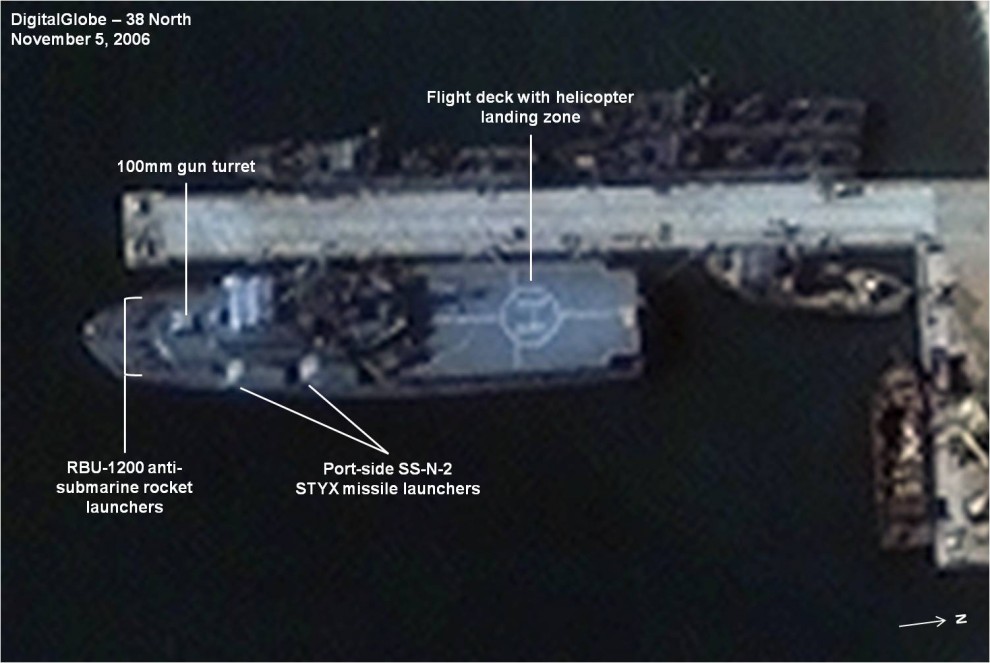
Recently, commercial satellite imagery has identified two new North Korean frigates carrying helicopters. These are the largest surface combatants constructed by the DPRK’s Korean People’s Navy (KPN) in 25 years and appear to be primarily designed to counter what Pyongyang sees as a growing threat from South Korea’s acquisition of submarines that began in the early 1990s. Moreover, these vessels may have an important secondary role: the protection of fisheries in the West and East Seas, which has obvious important security implications for the Republic of Korea, Japan and China. Their introduction into the North Korean fleet may also represent an evolutionary step in the development of naval strategy to include helicopter anti-submarine operations.
Construction began in 2006-07 and both ships were launched during 2011-12. However, it is unclear whether they have been commissioned and are ready for service. Nevertheless, should the KPN push aggressively to commission and operate these new vessels, it will still likely take several years to fully integrate their new capabilities into fleet operations.
38north
Construction began in 2006-07 and both ships were launched during 2011-12. However, it is unclear whether they have been commissioned and are ready for service. Nevertheless, should the KPN push aggressively to commission and operate these new vessels, it will still likely take several years to fully integrate their new capabilities into fleet operations.
38north
Apr 17, 2014
N. Korea's Drones Prompt Seoul To Seek Radars
In the wake of suspected infiltration by unmanned aircraft presumed to be made in North Korea, Seoul has laid out plans to buy low-altitude radars to help detect enemy drones.
In recent weeks, three crashed UAVs were discovered near the border areas, including on an island just south of the sea border between the two countries.
Painted sky-blue, the planes were less than 2 meters in length and width and were equipped with Japanese Nikon digital cameras to take pictures of key military installations, as well as the presidential office in central Seoul.
Receiving a barrage of criticism for its air security loophole, the South Korean military said it is considering buying Israel’s RPS-42 Tactical Air Surveillance Radar System.
The system is fitted with an active electronically scanned array radar built by RADA Electronic Industries, and it can detect aerial objects within a radius of 30 kilometers. The radar is also known to detect a 2-meter-long object within 10 kilometers.
The South Korean military operates TPS-840K missile control and ground surveillance radars, but these are not known for being able to detect a non-metal object less than 2 meters wide.
The military also is considering modifying UK-made multipurpose radars for UAV detection. Twenty-four Blighter electronic scanning radars, developed by Plextek, are being operated in South Korea.
Blighter is a long-range ground surveillance radar suited to detecting moving vehicles and people.
In the latest test, the radar detected a UAV 10 kilometers away and a helicopter-borne camera 1.5 kilometers away.
The military asked Plextek to modify the radar enough to spot a UAV that is less than 2 meters.
On top of the radar, the military is pushing to acquire more thermal observation devices and multipurpose telescopes.
A laser weapon system that can destroy an approaching UAV is being considered for integration with the low-altitude radar. A candidate is a system made by Germany’s Rheinmetall Defence.
In bids to bolster the air security in the South, Seoul and Washington plan to define threats of North Korean drones and come up with countermeasures as part of their joint military operational plans.
The military made locally built UAVs public on April 8 amid criticism for failing to counter North Korea’s UAV threats.
One of them is the Remoeye-006, developed by Uconsystem. It is 1.72 meters long, 2.72 meters wide and weighs 6.5 kilograms.
The Remoeye-006 can conduct missions at day and night with infrared cameras and relay data in real time. It can fly up to 12 hours at a maximum speed of 75 kilometers per hour.
South Korea also operates the RQ-101 Songgolmae UAV built by Korea Aerospace Industries. Its camera can swivel around to offer panoramic pictures covering up to 20 kilometers during the day and 10 kilometers at night. It is 5 meters long and 6.2 meters wide and can fly at a maximum speed of 150 kilometers per hour.
South Korea is introducing medium- and high-altitude UAVs in coming years. Last month, the Defense Ministry announced it would buy four Global Hawks from Northrop Grumman million with the first delivery by 2018.
North Korea is believed to have about 300 reconnaissance drones and about 10 Russian-made Shmel UAVs carrying bombs.
Drones called Banghyeon are said to have been remodeled Chinese-made D-4 UAVs. Each drone’s fuselage is estimated to be 3.6 meters long with a wingspan of 4.8 meters. The UAV is believed to fly at a maximum speed of 160 kilometers per hour.
The Shmel is a short-range UAV that the North is believed to have procured in the 1990s. With a range of 60 kilometers, it can fly at a maximum speed of 150 kilometers per hour.
defensenews
In recent weeks, three crashed UAVs were discovered near the border areas, including on an island just south of the sea border between the two countries.
Painted sky-blue, the planes were less than 2 meters in length and width and were equipped with Japanese Nikon digital cameras to take pictures of key military installations, as well as the presidential office in central Seoul.
Receiving a barrage of criticism for its air security loophole, the South Korean military said it is considering buying Israel’s RPS-42 Tactical Air Surveillance Radar System.
The system is fitted with an active electronically scanned array radar built by RADA Electronic Industries, and it can detect aerial objects within a radius of 30 kilometers. The radar is also known to detect a 2-meter-long object within 10 kilometers.
The South Korean military operates TPS-840K missile control and ground surveillance radars, but these are not known for being able to detect a non-metal object less than 2 meters wide.
The military also is considering modifying UK-made multipurpose radars for UAV detection. Twenty-four Blighter electronic scanning radars, developed by Plextek, are being operated in South Korea.
Blighter is a long-range ground surveillance radar suited to detecting moving vehicles and people.
In the latest test, the radar detected a UAV 10 kilometers away and a helicopter-borne camera 1.5 kilometers away.
The military asked Plextek to modify the radar enough to spot a UAV that is less than 2 meters.
On top of the radar, the military is pushing to acquire more thermal observation devices and multipurpose telescopes.
A laser weapon system that can destroy an approaching UAV is being considered for integration with the low-altitude radar. A candidate is a system made by Germany’s Rheinmetall Defence.
In bids to bolster the air security in the South, Seoul and Washington plan to define threats of North Korean drones and come up with countermeasures as part of their joint military operational plans.
The military made locally built UAVs public on April 8 amid criticism for failing to counter North Korea’s UAV threats.
One of them is the Remoeye-006, developed by Uconsystem. It is 1.72 meters long, 2.72 meters wide and weighs 6.5 kilograms.
The Remoeye-006 can conduct missions at day and night with infrared cameras and relay data in real time. It can fly up to 12 hours at a maximum speed of 75 kilometers per hour.
South Korea also operates the RQ-101 Songgolmae UAV built by Korea Aerospace Industries. Its camera can swivel around to offer panoramic pictures covering up to 20 kilometers during the day and 10 kilometers at night. It is 5 meters long and 6.2 meters wide and can fly at a maximum speed of 150 kilometers per hour.
South Korea is introducing medium- and high-altitude UAVs in coming years. Last month, the Defense Ministry announced it would buy four Global Hawks from Northrop Grumman million with the first delivery by 2018.
North Korea is believed to have about 300 reconnaissance drones and about 10 Russian-made Shmel UAVs carrying bombs.
Drones called Banghyeon are said to have been remodeled Chinese-made D-4 UAVs. Each drone’s fuselage is estimated to be 3.6 meters long with a wingspan of 4.8 meters. The UAV is believed to fly at a maximum speed of 160 kilometers per hour.
The Shmel is a short-range UAV that the North is believed to have procured in the 1990s. With a range of 60 kilometers, it can fly at a maximum speed of 150 kilometers per hour.
defensenews
Etiquetas:
DRONE,
ELBIT,
GLOBAL HAWK,
ISRAEL,
North Korea,
NORTHROP GRUMMAN,
SOUTH KOREA,
UAV
Apr 14, 2014
South Korea, US To Hold Largest-Ever Joint Air Drill
South Korea’s military said Thursday it would hold its largest-ever joint air drill with the United States as tensions mount over a series of threats from North Korea.
The twice-yearly Max Thunder exercise — to be held from Friday to April 25 — will be the largest-ever involving 103 aircraft and 1,400 troops.
Seoul’s F-15K jet fighters will take part along with US Air Force F-15 and F-16s and US Marines’ FA-18 and EA-18 aircraft.
The exercise will focus on “practical scenarios” involving precision attacks on enemies or supply drop missions for troops infiltrating enemy territory.
North Korea has slammed the drills as a rehearsal for invasion. In a pointed protest, Pyongyang has launched a series of rockets and missiles in recent weeks.
The two Koreas also traded fire across the tense Yellow Sea border on March 31, after the North dropped some 100 shells across the border during a live-fire drill, prompting the South to fire back.
The rare exchange of fire came a day after the North warned that it might carry out a “new” form of nuclear test — a possible reference to a uranium-based device or a miniaturized warhead small enough to fit on a ballistic missile.
South Korean President this week called for tighter vigilance against the North, days after its leader Kim Jong-Un warned of a “very grave situation” on the peninsula.
defensenews
The twice-yearly Max Thunder exercise — to be held from Friday to April 25 — will be the largest-ever involving 103 aircraft and 1,400 troops.
Seoul’s F-15K jet fighters will take part along with US Air Force F-15 and F-16s and US Marines’ FA-18 and EA-18 aircraft.
The exercise will focus on “practical scenarios” involving precision attacks on enemies or supply drop missions for troops infiltrating enemy territory.
North Korea has slammed the drills as a rehearsal for invasion. In a pointed protest, Pyongyang has launched a series of rockets and missiles in recent weeks.
The two Koreas also traded fire across the tense Yellow Sea border on March 31, after the North dropped some 100 shells across the border during a live-fire drill, prompting the South to fire back.
The rare exchange of fire came a day after the North warned that it might carry out a “new” form of nuclear test — a possible reference to a uranium-based device or a miniaturized warhead small enough to fit on a ballistic missile.
South Korean President this week called for tighter vigilance against the North, days after its leader Kim Jong-Un warned of a “very grave situation” on the peninsula.
defensenews
Etiquetas:
EA-18G,
F-15K,
F-16,
F-18 HORNET,
North Korea,
SOUTH KOREA,
UNITED STATES,
US MARINES,
USA,
USAF,
USMC
Apr 2, 2014
South Korea dispatchs F-15K as North Korea fires artillerey across border
When North Korea conducted live-fire drills in the Yellow Sea Monday, firing some 100 shells across the Northern Limit Line, Seoul quickly dispatched an F-15K fighter jet carrying cutting-edge, air-to-surface missiles.
The so-called SLAM-ER missiles, have a range of 278 kilometers and their margin of shooting error is only about 2 meters.
The secret of its precision is a state-of-the-art guidance system that connects the missile, the pilot of the jet and the operation headquarters.
When the 4.5-meter-long missile approaches within a few kilometers of a target, a camera in its nose transmits an image of the target to the pilot or the headquarters so that they can guide the missile exactly.
If the SLAM-ER is fired from the air near the inter-Korean border, its range covers the entire territory of North Korea.
Its name is an acronym for Standoff Land Attack Missile Expanded Response.
South Korea’s military did not strike North Korean artillery units immediately when shells reached Southern waters,because the shells from North Korea did not fall onto South Korean land.
Had the North’s shells landed on Baengnyeong Island, the forefront island of South Korea, the situation would have been totally different.
koreajoongangdaily
The so-called SLAM-ER missiles, have a range of 278 kilometers and their margin of shooting error is only about 2 meters.
The secret of its precision is a state-of-the-art guidance system that connects the missile, the pilot of the jet and the operation headquarters.
When the 4.5-meter-long missile approaches within a few kilometers of a target, a camera in its nose transmits an image of the target to the pilot or the headquarters so that they can guide the missile exactly.
If the SLAM-ER is fired from the air near the inter-Korean border, its range covers the entire territory of North Korea.
Its name is an acronym for Standoff Land Attack Missile Expanded Response.
South Korea’s military did not strike North Korean artillery units immediately when shells reached Southern waters,because the shells from North Korea did not fall onto South Korean land.
Had the North’s shells landed on Baengnyeong Island, the forefront island of South Korea, the situation would have been totally different.
koreajoongangdaily
Etiquetas:
F-15,
F-15K,
missile,
North Korea,
ROKAF,
SLAM-ER,
SOUTH KOREA
Subscribe to:
Posts (Atom)