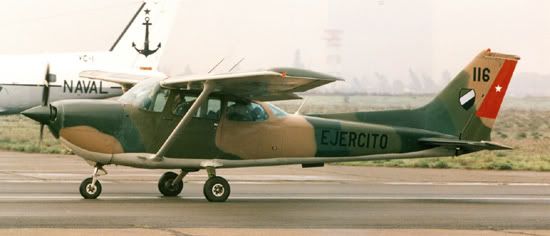
The Chilean Army Aviation Brigade (Brigada de Aviación del Ejército - BAVE) opened a tender to procure an unspecified number of basic training aircraft on 26 June and closed the tender on 1 July, but a winner has yet to be announced.
The new aircraft is meant to replace the Cessna R172K Hawk XP II basic trainers at the Army Aviation School (Escuela de Aviación del Ejercito - ESCAVE), which were retired from service in June 2013. The BAVE originally procured 18 Hawk XP IIs in 1977 and used them for training and liaison.
The tender indicates that ESCAVE will resume its own basic training programme after it had participated in the Chilean Air Force-run Joint Fixed-Wing Military Pilot Course (CCPMAF), a 6-month course with 100 hours of flight instruction performed mainly on ENAER T-35 Pillán piston-engine trainers.
janes
Translate
Showing posts with label CESSNA 172. Show all posts
Jul 17, 2014
Chilean Army launches training aircraft replacement programme
Nov 22, 2013
Turkey launches new bid for light trainer aircraft
Turkey has issued a Request for Proposals (RfP) for the contract that foresees the off-the-shelf purchase of a small fleet of trainers to replace the fleet of ageing SF 260s used in the Turkish Air Force for preliminary training.
Turkey still operates with nearly 40 SF 260s assembled by TAI in the early 1990s. For preliminary training purposes the Air Force operates Cessna 172s.
Potential bidders are the U.S. Beechcraft and Cirrus, Austria’s Diamond, Germany’s Grobe, Czech Zlin and Italy’s Aermacchi.
Meanwhile, Turkey has silently phased out a fleet of 48 F-5 lead-in trainer aircrafts, which Israel’s Elbit upgraded and delivered in the early 2000s.TAI is upgrading nearly 60 T-38 basic trainers to replace the F-5s and the older T-38s.
The Defense Industry Executive Committee, the ultimate decision-maker in defense procurement, decided Sept. 26 to make an order for the serial production of the Hürkuş, Turkey’s first indigenous basic trainer aircraft.
Turkey’s first indigenous basic trainer aircraft has been approved for flight testing, with the maiden flight planned within the next year.
The Hürkuş, also developed by TAI, has been undergoing tests for runway-holding, steering and braking time limits.
TAI is manufacturing four prototypes of the Hürkuş for a round of tests. The first prototype successfully went through engine tests in February, the second is being tested for static durability and cabin pressure, the third is being assembled, and the fourth will be tested for metal fatigue.
The two-seat Hürkuş will have a 35-year service life, or 10,500 flight hours. The turboprop aircraft has a 1,600-horsepower engine that can fly at an altitude of 10,577 meters at a maximum speed of 574 kilometers per hour.
The Hürkuş will come in four variants:
Hürkuş-A: A basic version that has been certified with EASA, according to CS-23 requirements and is intended for the civilian market.
Hürkuş-B: An advanced version with integrated avionics, including a mission computer and cockpit avionics layout similar to F-16 and F-35 fighters. The Turkish Army is considering an initial order of 15 aircrafts.
Hürkuş-C: An armed version for close-air support, which will have a maximum weapons load of 3,300 pounds. The Turkish Army has expressed interest in the Hürkuş-C to provide support for its attack helicopters.
The Coast Guard version: TAI plans to offer another version of the Hürkuş to support the Turkish Coast Guard’s maritime patrol activities. The aircraft’s back seat would be occupied by an operator for a forward-looking infrared sensor.
hurriyetdailynews
Turkey still operates with nearly 40 SF 260s assembled by TAI in the early 1990s. For preliminary training purposes the Air Force operates Cessna 172s.
Potential bidders are the U.S. Beechcraft and Cirrus, Austria’s Diamond, Germany’s Grobe, Czech Zlin and Italy’s Aermacchi.
Meanwhile, Turkey has silently phased out a fleet of 48 F-5 lead-in trainer aircrafts, which Israel’s Elbit upgraded and delivered in the early 2000s.TAI is upgrading nearly 60 T-38 basic trainers to replace the F-5s and the older T-38s.
The Defense Industry Executive Committee, the ultimate decision-maker in defense procurement, decided Sept. 26 to make an order for the serial production of the Hürkuş, Turkey’s first indigenous basic trainer aircraft.
Turkey’s first indigenous basic trainer aircraft has been approved for flight testing, with the maiden flight planned within the next year.
The Hürkuş, also developed by TAI, has been undergoing tests for runway-holding, steering and braking time limits.
TAI is manufacturing four prototypes of the Hürkuş for a round of tests. The first prototype successfully went through engine tests in February, the second is being tested for static durability and cabin pressure, the third is being assembled, and the fourth will be tested for metal fatigue.
The two-seat Hürkuş will have a 35-year service life, or 10,500 flight hours. The turboprop aircraft has a 1,600-horsepower engine that can fly at an altitude of 10,577 meters at a maximum speed of 574 kilometers per hour.
The Hürkuş will come in four variants:
Hürkuş-A: A basic version that has been certified with EASA, according to CS-23 requirements and is intended for the civilian market.
Hürkuş-B: An advanced version with integrated avionics, including a mission computer and cockpit avionics layout similar to F-16 and F-35 fighters. The Turkish Army is considering an initial order of 15 aircrafts.
Hürkuş-C: An armed version for close-air support, which will have a maximum weapons load of 3,300 pounds. The Turkish Army has expressed interest in the Hürkuş-C to provide support for its attack helicopters.
The Coast Guard version: TAI plans to offer another version of the Hürkuş to support the Turkish Coast Guard’s maritime patrol activities. The aircraft’s back seat would be occupied by an operator for a forward-looking infrared sensor.
hurriyetdailynews
Etiquetas:
AERMACHI,
AUSTRIA,
BEECHCRAFT,
CESSNA 172,
DIAMOND AIRCRAFT INDUSTRIES,
ELBIT,
F-5,
GERMANY,
GROB,
HURKUS,
ISRAEL,
ITALY,
SF-260,
T-38,
TAI,
TURKEY,
TURKISH AIR FORCE,
TURKISH NAVY,
UNITED STATES,
USA
Subscribe to:
Posts (Atom)