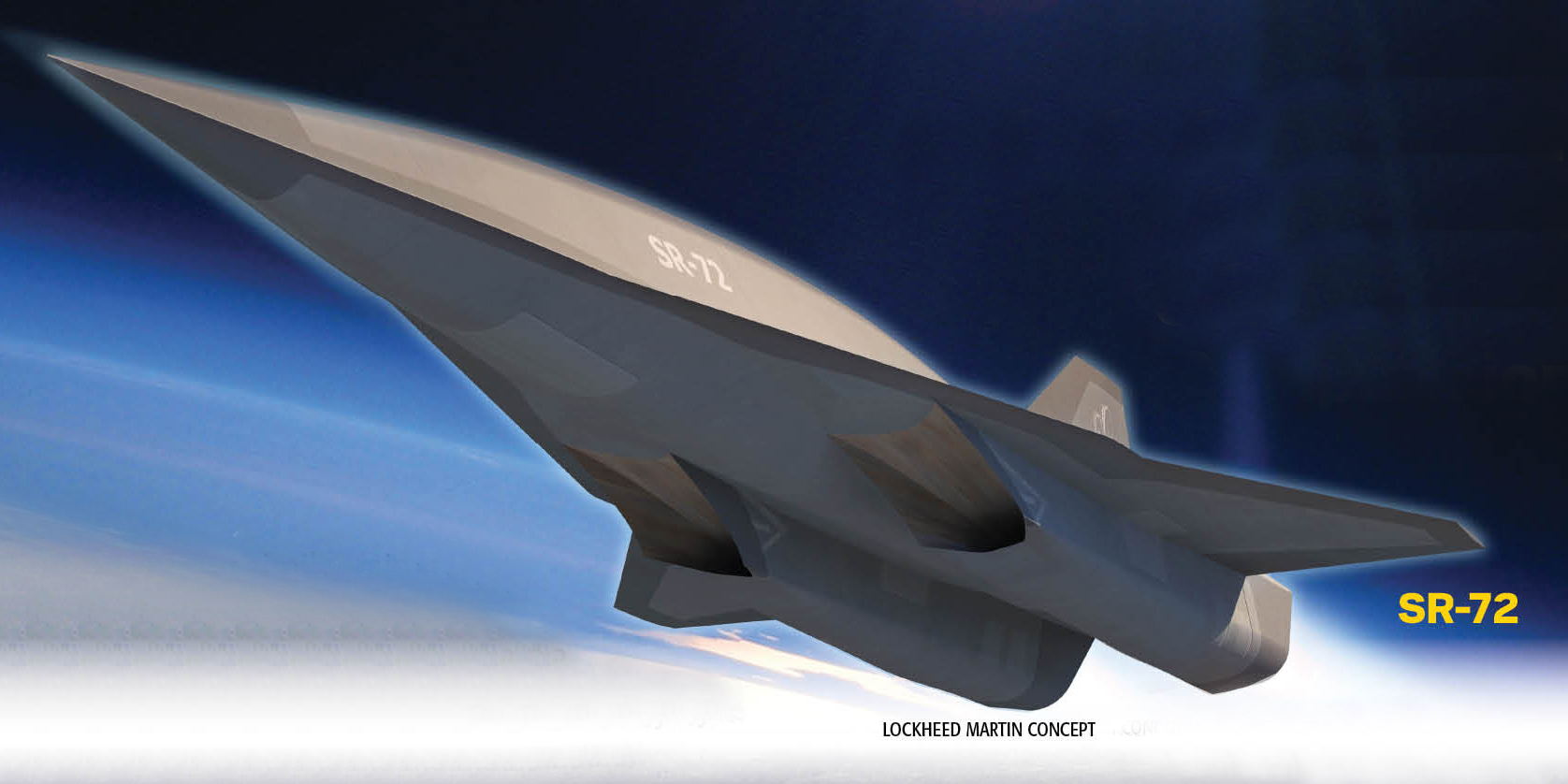
Lockheed Martin Skunk Works and Aerojet Rocketdyne have made a breakthrough in hypersonic propulsion technology, but the Mach 6.0-capable SR-72 remains more of aspiration than a real airplane.
The companies have found a way to pair a conventional turbine jet engine, such as those in existing fighter aircraft, with a supersonic combustion ramjet— an engine that can operate effectively only if an aircraft is traveling at very high speeds.
The pairing—first, makes a hypersonic plane a practical possibility, but Lockheed still faces scores of technological and funding challenges before the so-called Son of Blackbird becomes a reality.
Turbine engines would accelerate the notional SR-72 up to about Mach 3, before the jet transitions to scramjet propulsion. As the aircraft transitions into full scramjet propulsion, the turbines are deactivated. The scramjet would then accelerate the aircraft up to a maximum speed of about Mach 6.
Unlike the previous generation SR-71s’ Pratt & Whitney J58 engines, which were a partial ramjet design, the new engine concept burns fuel at supersonic speeds—allowing it fly a lot faster. But it is also more technologically challenging.
While the prospective government customers would be the U.S. Air Force and DARPA, Lockheed does not yet have a customer for the effort.
Lockheed hopes to launch the flight demonstrator program in 2018. While the 2018 flight demonstrator is not currently funded and is more of a notional project at this time.
The prospective demonstrator would be about the same size as the company’s F-22 Raptor stealth fighter. Unlike the operational SR-72 concept, it would be a single-scramjet engine design. The demonstrator would take off and land just like any normal aircraft, but would be able to cruise at Mach 6 for several minutes. Lockheed hopes to fly the demonstrator in 2023.
The operational SR-72 would be a twin-scramjet design, which Lockheed hopes would become operational in 2030.
It could hit any target on any continent in less than an hour, it could be a prompt theatre-strike weapon with more than 1,000 nautical miles of penetration into denied airspace (when the range of the missile is added to that of the SR-72).
Stealth would be of limited value in an aircraft like the SR-72, given that radar absorbent materials would not survive the extreme temperatures. Moreover, the jet would have a huge infrared signature, which would negate most signature reduction measures. The aircraft might also leave a wake that might be tracked on radar—much like the SR-71.
Survivability would be achieved through a combination of speed, altitude and some limited signature reduction.
Lockheed has a lot of experience with high-speed stores separation, which it gained on the 1960s-era YF-12 interceptor program.
The SR-72 would have range comparable to its SR-71 forbear—3,200 nautical miles.
usni
Translate
Showing posts with label SR-71. Show all posts
Nov 6, 2013
Lockheed Martin SR-72 is Only a Plane on Paper
Etiquetas:
BLACKBIRD,
LOCKHEED MARTIN,
SKUNK WORKS,
SR-71,
SR-72,
UNITED STATES,
USA
Nov 3, 2013
Lockheed Martin’s Skunk Works reveals a Mach 6 strike successor of SR-71 Blackbird dubbed SR-72
Lockheed Martin’s Skunk Works, the legendary division that designed airplanes which represented a giant leap for their times such as the F-104, the U-2, the Blackbird family or the F-117A stealth fighter jet, has eventually revelead the existence of a project for an Hypersonic strike aircraft dubbed SR-72.
The twin-engine aircraft is designed for a Mach 6 cruise, around twice the speed of its forebear, and will have the optional capability to strike targets and will be capable to hit or perform ISR of fast-moving targets, located in high-lethality areas at intercontinental ranges.
A Lockheed SR-72 has been released. The shape is coherent with the most recent hypersonic designs and it is quite similar to at least one of those published in April 2013 on LM’s Code One article about the configurations studied since the early ’60s for an SR-71 Blackbird replacement.
The shape and operational speed of the U.S. next generation strike bomber is much different from Russia’s next generation stealth strategic bomber PAK-DA concept.
theaviationist
The twin-engine aircraft is designed for a Mach 6 cruise, around twice the speed of its forebear, and will have the optional capability to strike targets and will be capable to hit or perform ISR of fast-moving targets, located in high-lethality areas at intercontinental ranges.
A Lockheed SR-72 has been released. The shape is coherent with the most recent hypersonic designs and it is quite similar to at least one of those published in April 2013 on LM’s Code One article about the configurations studied since the early ’60s for an SR-71 Blackbird replacement.
The shape and operational speed of the U.S. next generation strike bomber is much different from Russia’s next generation stealth strategic bomber PAK-DA concept.
theaviationist
Etiquetas:
HYPERSONIC,
LOCKHEED MARTIN,
SKUNK WORKS,
SR-71,
SR-72,
UNITED STATES,
USA
Aug 13, 2013
A return to the Air Force for the sleek Blackbird?
Nearly 50 years after its first flight — and 15 years after its last — the SR-71 Blackbird still looks like the spy plane of the future.
During its Cold War heyday, the sleek rocket-plane could skim along the atmosphere at Mach 3, twice as high and more than three times as fast as commercial jet aircraft.
It could shoot high-quality photographs of secret sites from an altitude that no Soviet fighter could reach.
omaha
Etiquetas:
BLACKBIRD,
LOCKHEED MARTIN,
SR-71,
UNITED STATES,
USA,
USAF
Subscribe to:
Posts (Atom)