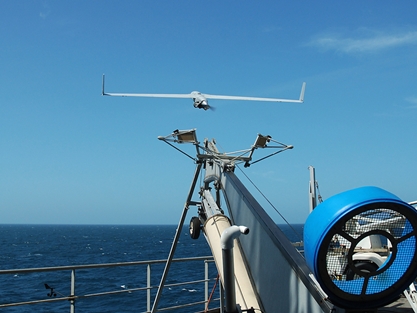
700X – X for ‘Xperimental’ – Naval Air Squadron will be at the vanguard of the Fleet Air Arm’s venture into the world of unmanned flight with ‘eyes in the sky’ pilotless aircraft.
The squadron has been established at RNAS Culdrose to oversee the deployment of Remotely Piloted Air Systems (RPAS) to pave the way for similar aircraft in the future.
For nearly a year, ScanEagle has been launched from the decks of HMS Somerset, Northumberland and Cardigan Bay, and is now being flown from HMS Kent, which has just arrived in the Arabian Sea to begin counter-piracy patrols.
Launched by a catapult on a 14ft ramp, ScanEagle can remain airborne for 12 hours operating at ranges of up to 40 miles from the mother ship, beaming live video of what it sees – by day or night, thanks to its electro-optical and infra-red camera – directly into the ship’s operations room.
Since being introduced to ships deployed east of Suez at the beginning of the year, ScanEagle has clocked up nearly 1,500 hours on missions.
It was brought in to provide eyes for the Royal Navy’s minehunting force in the Gulf, but has proved equally useful in counter-piracy and counter-smuggling operations thanks to its ability to constantly watch over a boarding operation – or monitor a suspicious vessel pretty much undetected.
royalnavy
Translate
Showing posts with label SCAN EAGLE. Show all posts
Nov 27, 2014
700X NAS, First Royal Navy Drone Squadron
May 17, 2014
Iran’s Drone War in Syria
Iran has been providing Syria’s regime with drones—some of them inspired by American technology—and they’re already playing a significant role in keeping Bashar Assad in power.Tehran announced it had replicated a top-of-the-line U.S. drone it claimed it captured in 2011, raising the possibility it will send still more sophisticated aerial robots into the skies over Damascus.
Iran’s drone program dates back to the early 1980s, and it first tried to weaponize the birds some 30 years ago, long before American Predators and Reapers first soared aloft.
The Middle East was the first great proving ground for unmanned aerial vehicles, or UAVs, as they’re called. During the 1980s, Israel flew drones over Lebanon’s Bekaa Valley to spot Syrian artillery and anti-aircraft positions, allowing the Israeli Air Force to knock out the Syrian air defenses with minimal risks to its pilots. At about the same time, Iran began using drones to spy on Iraqi positions in its war against Saddam Hussein. It was during that bitter conflict that Iranian engineers crudely mounted Soviet rocket-propelled grenades on their drones and fired them at Iraqi troops.
Over the last decade, even as American drones grew fearsome and infamous, killing alleged terrorists and many civilians in Afghanistan, Pakistan, and Yemen, the Iranians began expanding their own program dramatically.
In addition to the steady influx of Iranian military drones, civilian drones also have appeared on the Syrian battlefield. In November 2013 rebels released images of a DJI Phantom they claim to have brought down in the besieged city of Homs. These tiny quad-copters are available in hobby shops in the United States and are often seen filming sporting events or music videos when mounted with GoPro cameras.
The rebels claim the quad-copter was being used by government forces to spy on their positions. But given the fact that the Phantom was found intact and is far less capable than the military technology in the Syrian arsenal, it is possible that it was a rebel drone all along. Indeed it would make sense for rebels to invest in these miniature UAVs because a Phantom with a GoPro attached costs much less than the street value of an AK-47 assault rifle.
The first evidence of Iranian drones in Syria appeared in early 2012, when opposition activists released video showing a Pahpad AB-3. The drones became known locally by the Arabic slang term wizwazi, and their presence was usually a good indicator of imminent shelling or airstrikes. There have since been numerous sightings of various models -- in December 2013, the al Qaeda affiliate Jabhat al-Nusra shot down a small Yasir drone and displayed the wreckage on social media.
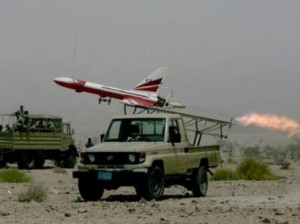
The Yasir drones are particularly interesting because Iran claims to have developed them by reverse engineering American technology captured in 2012. In this case, Iran says they developed their own model based on captured American ScanEagle mini UAVs, a claim Washington will not confirm, but which was widely reported in the media.
Over the last decade, even as American drones grew fearsome and infamous, the Iranians began expanding their own program dramatically.
The Yasir shoot-down provided solid evidence of advanced Iranian weaponry in Syria, as does recent footage of an Iranian Shahed-129 over Damascus. Iran has armed drones in its own arsenal, but so far only unarmed drones have appeared in Syria and their main purpose appears to be reconnaissance.
Iran now claims that it studied the American model to help create its first super-drone, the Fotros, and it seems quite eager for people to believe the new model is partially based on technology from the captured RQ-170. According to the Iranian ministry of defense, the new weapon is capable of delivering a 500-pound payload, can stay aloft for over 24 hours, and has a range of 2,000 miles.
Regardless of its true capacity and origin, the name “Fotros” appears to be a metaphor for the process of reverse engineering an American drone. In Shia mythology, Fotros was an angel who disobeyed God and was banished to Earth. After praying for forgiveness, Fotros was redeemed by the Imam Ali who gave him back his wings. On Sunday, Iranian state media reported that the Fotros would be flying soon. If so, it may only be a matter of time before we see those fallen angels in the skies over Syria.
thedailybeast
Iran’s drone program dates back to the early 1980s, and it first tried to weaponize the birds some 30 years ago, long before American Predators and Reapers first soared aloft.
The Middle East was the first great proving ground for unmanned aerial vehicles, or UAVs, as they’re called. During the 1980s, Israel flew drones over Lebanon’s Bekaa Valley to spot Syrian artillery and anti-aircraft positions, allowing the Israeli Air Force to knock out the Syrian air defenses with minimal risks to its pilots. At about the same time, Iran began using drones to spy on Iraqi positions in its war against Saddam Hussein. It was during that bitter conflict that Iranian engineers crudely mounted Soviet rocket-propelled grenades on their drones and fired them at Iraqi troops.
Over the last decade, even as American drones grew fearsome and infamous, killing alleged terrorists and many civilians in Afghanistan, Pakistan, and Yemen, the Iranians began expanding their own program dramatically.
In addition to the steady influx of Iranian military drones, civilian drones also have appeared on the Syrian battlefield. In November 2013 rebels released images of a DJI Phantom they claim to have brought down in the besieged city of Homs. These tiny quad-copters are available in hobby shops in the United States and are often seen filming sporting events or music videos when mounted with GoPro cameras.
The rebels claim the quad-copter was being used by government forces to spy on their positions. But given the fact that the Phantom was found intact and is far less capable than the military technology in the Syrian arsenal, it is possible that it was a rebel drone all along. Indeed it would make sense for rebels to invest in these miniature UAVs because a Phantom with a GoPro attached costs much less than the street value of an AK-47 assault rifle.
The first evidence of Iranian drones in Syria appeared in early 2012, when opposition activists released video showing a Pahpad AB-3. The drones became known locally by the Arabic slang term wizwazi, and their presence was usually a good indicator of imminent shelling or airstrikes. There have since been numerous sightings of various models -- in December 2013, the al Qaeda affiliate Jabhat al-Nusra shot down a small Yasir drone and displayed the wreckage on social media.
The Yasir drones are particularly interesting because Iran claims to have developed them by reverse engineering American technology captured in 2012. In this case, Iran says they developed their own model based on captured American ScanEagle mini UAVs, a claim Washington will not confirm, but which was widely reported in the media.
Over the last decade, even as American drones grew fearsome and infamous, the Iranians began expanding their own program dramatically.
The Yasir shoot-down provided solid evidence of advanced Iranian weaponry in Syria, as does recent footage of an Iranian Shahed-129 over Damascus. Iran has armed drones in its own arsenal, but so far only unarmed drones have appeared in Syria and their main purpose appears to be reconnaissance.
Iran now claims that it studied the American model to help create its first super-drone, the Fotros, and it seems quite eager for people to believe the new model is partially based on technology from the captured RQ-170. According to the Iranian ministry of defense, the new weapon is capable of delivering a 500-pound payload, can stay aloft for over 24 hours, and has a range of 2,000 miles.
Regardless of its true capacity and origin, the name “Fotros” appears to be a metaphor for the process of reverse engineering an American drone. In Shia mythology, Fotros was an angel who disobeyed God and was banished to Earth. After praying for forgiveness, Fotros was redeemed by the Imam Ali who gave him back his wings. On Sunday, Iranian state media reported that the Fotros would be flying soon. If so, it may only be a matter of time before we see those fallen angels in the skies over Syria.
thedailybeast
Etiquetas:
FOTROS,
IRAN,
ISRAEL,
SCAN EAGLE,
Syria,
UAV,
UNITED STATES,
USA
Jan 16, 2014
Royal Navy ready to launch ScanEagle operations
The UK Royal Navy is poised to conduct its first operational flights with the ScanEagle unmanned air system, as the service continues to evaluate its long-term requirements for such equipment.
The activity will involve the service’s Type 23 frigate HMS Somerset and the Royal Fleet Auxiliary landing ship Cardigan Bay, with the first embarked training flights having been conducted recently from the latter.
flightglobal
The activity will involve the service’s Type 23 frigate HMS Somerset and the Royal Fleet Auxiliary landing ship Cardigan Bay, with the first embarked training flights having been conducted recently from the latter.
flightglobal
Etiquetas:
DRONE,
ROYAL NAVY.,
SCAN EAGLE,
UAS,
UAV,
UK,
UNITED KINGDOM
Jan 10, 2014
US closer to sale, lease of Apache helicopters to Iraq
A resurgence of militants in Iraq and the chaos they are creating has gotten Washington’s attention.
Speaker of the House , urged the Obama administration Thursday to re-engage on the matter and emphasized the need to maintain a long-term commitment to securing U.S. interests in that nation.
On Wednesday, a powerful Senate Democrat has signaled that he might allow the transfer of AH-64 Apache helicopters to Iraq as the government in Baghdad struggles to recapture key territory seized by Islamic extremists.
Chairman of the Foreign Relations Committee, has blocked the lease and sale of the powerful attack helicopters for months seeking for assurances that Iraq would not use them to attack civilians, and that the government in Baghdad would take steps to stop Iran from using Iraqi airspace to ship arms to Syria.
The Obama administration has proposed selling up to 30 of the helicopters to the Iraqis, but, because building them could take years, it has also asked to lease up to 10 aircraft in the interim. Administration officials said the Apaches could be useful in targeting fighters affiliated with al Qaida like those who have taken over parts of Fallujah and Ramadi.
The US administration also is planning to ship more Hellfire missiles as early as this spring, 10 ScanEagle surveillance drones in coming weeks and 48 Raven surveillance drones later in the year. Those come on top of Aerostat surveillance balloons provided in September and three additional Bell IA-407 helicopters sent last month.
stripes
Etiquetas:
AH-64,
AL QAEDA,
APACHE,
BELL 407,
IRAQ,
SCAN EAGLE,
UAV,
UNITED STATES,
USA
Dec 27, 2013
U.S. expedites delivery of missiles, drones to Iraq amid violence
The United States has delivered dozens of Hellfire air-to-ground missiles to Iraq in recent weeks and plans shipments of Scan Eagle drones next year amid a surge in violence.
Al Qaeda-linked militants have stepped up attacks on government and anyone seen to be supporting it. The United Nations estimates that more than 8,000 people have been killed in attacks in Iraq this year.
About 75 Hellfire missiles were delivered to Iraq last week, and a shipment of 10 unmanned Scan Eagles surveillance drones is due next year.
The U.S. has already said the first of 18 F-16 fighter jets promised to Iraq will be delivered in the fall of 2014, with the entire order to be shipped over the course of two years.
reuters
Al Qaeda-linked militants have stepped up attacks on government and anyone seen to be supporting it. The United Nations estimates that more than 8,000 people have been killed in attacks in Iraq this year.
About 75 Hellfire missiles were delivered to Iraq last week, and a shipment of 10 unmanned Scan Eagles surveillance drones is due next year.
The U.S. has already said the first of 18 F-16 fighter jets promised to Iraq will be delivered in the fall of 2014, with the entire order to be shipped over the course of two years.
reuters
Etiquetas:
AL QAEDA,
HELLFIRE,
IRAQ,
SCAN EAGLE,
UNITED STATES,
USA
Jun 21, 2013
ROYAL NAVY GETS EAGLE SCANE EAGLE UAV
The Royal Navy is to get its first unmanned ‘eye in the sky’ in a £30m deal to buy the ScanEagle reconnaissance aircraft. The pilotless plane has been used by the US Navy over the past decade and has been trialled by the Royal Navy.
royalnavy
royalnavy
Etiquetas:
ROYAL NAVY.,
SCAN EAGLE,
UAV,
UK,
UNITED KINGDOM,
UNITED STATES,
USA
Feb 25, 2013
Another Drone Down in Iran?
Iran’s authorities announced today that Iran’s Revolutionary Guards Corps (IRGC) have intercepted and downed an ‘alien’ drone during the first day of the ‘Great Prophet 8′ exercise taking place in Southern Iran this week. It is not clear from the announcement whether the event is part of the training program or an actual intercept involving a foreign unmanned system has taken place.
In the past two years Iran intercepted several US drones, among them a CIA Lockheed Martin RQ-170 and Boeing/InSitu Scan-Eagle, supporting the US Navy, both were captured virtually intact.
defense-update
Etiquetas:
CIA,
DRONE,
IRAN,
RQ-170,
SCAN EAGLE,
UAV,
UNITED STATES,
US NAVY,
USA
Feb 11, 2013
Iran shows images of factory making copies of Scan Eagle
Iran on Friday released images of the production line that is making copies of the Scan Eagle UAV.
farsnews
Jan 15, 2013
Scan Eagle UAV conducts first flight on LPD class ship
A Scan Eagle Unmanned Air Vehicle prepares to launch from an amphibious transport dock class ship USS San Antonio (LPD 17) on Nov. 28 off the coast of North Carolina. The flight on the San Antonio LPD class ship was part of a post-installation and functional flight-check exercise. Scan Eagle’s first deployment aboard USS San Antonio is planned for summer 2013.
navair
Dec 9, 2012
Scan Eagle UAV conducts first flight on LPD class ship
A Scan Eagle Unmanned Air Vehicle prepares to launch from an amphibious transport dock class ship USS San Antonio (LPD 17) on Nov. 28 off the coast of North Carolina. The flight on the San Antonio LPD class ship was part of a post-installation and functional flight-check exercise. Scan Eagle’s first deployment aboard USS San Antonio is planned for summer 2013.
navair.navy.mil
Dec 6, 2012
Iranian TV shows captured Scan Eagle
Iran’s TV stations are showing a video of a Scan Eagle UAV captured by the Islamic Revolutionary Guard Corps Navy.
Subscribe to:
Posts (Atom)