Translate

Showing posts with label NORTHROP GRUMMAN. Show all posts

Feb 25, 2026

USAF accelerates B-21 Raider production, aims for operational fielding in 2027


The USAF and Northrop Grumman agreed to boost B‑21 production capacity by about 25% using roughly $4.5 billion in already-authorized U.S. funding. This expansion is intended to compress delivery timelines and speed up fielding without undermining cost or performance discipline. 

The bomber is currently in low-rate initial production, with final assembly underway at Northrop Grumman’s Palmdale, California facility. Multiple aircraft are undergoing production and test activity. 

According to recent official releases, the **first operational B‑21 Raider remains on track to arrive at Ellsworth Air Force Base in South Dakota in 2027, supporting the Air Force’s plan to begin fielding the next-generation stealth bomber that year.

Unlike legacy bomber programs, the B-21 was designed from the outset with digital engineering, modular sustainment, and production scalability in mind. 

The Air Force intends the B-21 to replace the B-1 Lancer and the B-2 Spirit by 2040, and potentially the B-52 Stratofortress thereafter.

Currently in flight testing, this long-range penetrating strike aircraft is designed to operate in the most contested environments and to hold any target at risk. The B-21 integrates advanced stealth, resilient networking, and a modern, data-driven command-and-control architecture, ensuring the Joint Force retains a decisive advantage on an increasingly complex battlefield.

Apr 7, 2018

Potential MQ-4C sale to Germany

Northrop Grumman’s long courtship with Germany’s requirement for a high-altitude unmanned air system took another step toward a contract on 5 February.
The US State Department approved a potential sale of four MQ-4C Tritons to Germany, the Defense Security Cooperation Agency announced on 5 April.
The approval allows Northrop to export the high-altitude surveillance aircraft, but doesn’t mean Germany has committed to sign a contract.
The DSCA notification says the full package, including a ground control station, spares and support, is worth $2.5 billion.
Germany would acquire a modified version of the MQ-4C configuration that Northrop has developed for the US Navy, but the notice doesn’t list the changes.
The USN’s version of the aircraft comes with several major sensors, including Northrop’s multi-function airborne system (MFAS) radar, a camera-based targeting system and electronic support measures.
In 2000, Germany launched a programme to acquire a high-altitude UAV for electronic surveillance. Northrop delivered one “Euro Hawk” aircraft to Germany, using an RQ-4B Global Hawk airframe and an Airbus sensor payload. But the Germany cancelled the Euro Hawk programme due to financing and airspace integration problems.
The Australian government also plans to buy the MQ-4C for the maritime surveillance mission in the Pacific and Indian oceans.
flightglobal

Jan 21, 2018

The Air Force may not get B-21 bombers on time

he Air Force’s B-21 Raider program could stagnate under a year-long continuing resolution, as the lower funding stream would slow development and possibly even delivery of the new bomber, the service’s number-two civilian warned Thursday.
Congress is rushing to avoid a government shutdown, which will occur unless lawmakers pass a short-term funding stopgap by Friday. But the Air Force is getting increasingly worried that even the best case scenario — another CR — could curb key modernization efforts like the B-21, its Undersecretary Matt Donovan said.
“A long-term CR will limit execution of the engineering, manufacturing and development phase, the EMD phase, of the B-21,” he said at an Air Force Association event. “We would be limited to the FY17 funding level, which is far below the FY18 budget request. This will have the effect of postponing delivery of the critical strategic capability to the joint warfighter.”
The Air Force allotted $2 billion in its unclassified FY18 budget request for continued EMD activities, up from $1.3 billion the previous year. While the B-21 program currently remains on track, Donovan stated the program will be negatively affected as early as April if the Defense Department remains entangled in a CR.
Northrop Grumman won the B-21 contract in 2015 after a protracted battle with a Boeing-Lockheed Martin team. The Air Force currently intends to buy at least 100 B-21s, with the fielding of the first bombers planned for the mid-2020s.
defensenews

Jan 22, 2016

Northrop Will Fly T-X Prototype This Year

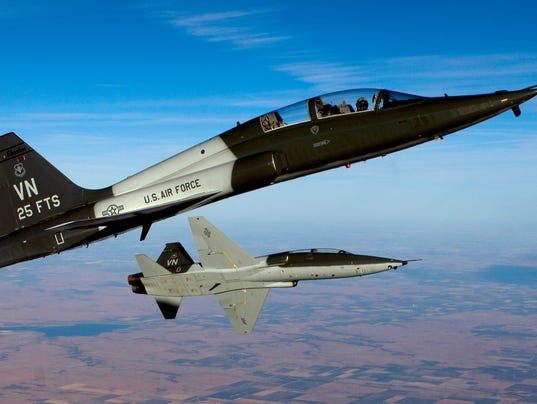
Northrop Grumman intends to fly a prototype of the company’s T-X concept early this year, in anticipation of an upcoming Air Force competition to replace the aging T-38 fleet used for advanced jet training.
Northrop is working with aerospace company Scaled Composites, which it acquired in 2007, on an internally funded T-X demonstrator aircraft, Tom Vice, president of the company’s aerospace sector, told reporters Jan. 14 during a media trip. Vice did not specify exactly when the prototype would fly, but said the event would take place in the first half of this year.
defensenews

Nov 13, 2015

Northrop's long-range U.S. bomber work paused after protest

Work on a recently awarded long-range strike bomber contract to Northrop Grumman Corp has been paused after rivals Boeing Co and Lockheed Martin protested against the selection process, the U.S. Air Force said. Air Force spokesman Major Robert Leese said the order to stop work was issued after a formal protest was filed on Nov. 6.
In October, the Air Force selected Northrop, maker of the stealth B-2 aircraft, to develop and build the new bomber over a bid by a Boeing and Lockheed Martin team.
Boeing and Lockheed Martin complained that the selection process was "fundamentally flawed."
news.yahoo

Oct 31, 2015

Northrop Grumman Wins USAF's Long Range Strike Bomber Contract

Northrop Grumman has won the contract to build the US Air Force’s next-generation Long Range Strike Bomber (LRS-B).
After US financial markets closed Tuesday evening, Defense Secretary Ash Carter and Air Force leadership announced that Northrop beat out the team of Boeing and Lockheed Martin for the contract, which is expected to top $55 billion over the life of the program. It's the largest military aircraft contract since Lockheed Martin won the Joint Strike Fighter (JSF) more than a decade ago.
Northrop now has the Pentagon's blessing to build a new fleet of aircraft to replace the Air Force’s aging B-52s and B-1s. As builder of the B-2 stealth bomber, Northrop beat out a joint Lockheed Martin-Boeing team in a closely watched competition that has lasted months longer than anticipated.
defensenews

Oct 24, 2015

USAF ‘Really, Really Close’ To Bomber Contract Award

The US Air Force is “really, really close” to announcing which industry team will build its next-generation bomber, according to top service officials.
Industry is still holding its breath for the contract announcement, which could come anytime in the next few weeks. The upcoming award pits three giants in the aerospace world against each other: Northrop Grumman, builder of the B-2 stealth bomber, is competing against a joint Boeing-Lockheed Martin team for the project.
Although the Air Force has repeatedly postponed the contract award, the program has not been delayed. Leadership is committed to making sure the source selection process is done right, he said.
The Air Force plans to buy 80 to 100 Long Range Strike Bombers to replace its aging B-52s and B-1s, which the service plans to retire in the mid-2040s. The target price is $550 million a copy in 2010 dollars. That unit cost is a key performance parameter for the program, meaning that a company can be disqualified if its price fails to reach that goal.
When the contract is awarded, it will come in two parts — a development contract that is cost-plus incentive fee, and an agreement on the first five low-rate initial production lots that is fixed-price incentive fee. Those first five lots will cover the production of 21 bombers.
LRSB is unusually mature for a program at this stage in its development, according to Lt. Gen. Arnie Bunch, the Air Force’s deputy assistant secretary for acquisition. The program has completed preliminary design review and manufacturing readiness review, and the platform designs are “at the subsystem level,” he said during the briefing.
The teams have already built component prototypes and scale models of the designs for testing
defensenews

Jun 2, 2015

Japan cleared to buy 4 E-2D Hawkeye

Japan has requested a possible sale of four E-2D Advanced Hawkeye AEW& C aircraft, ten (10) T56-A-427A engines (8 installed and 2 spares), eight (8) Multifunction Information Distribution System Low Volume Terminals (MIDS-LVT), four (4) APY-9 Radars, modifications, spare and repair parts. The estimated cost is $1.7 billion.
The principal contractor will be Northrop Grumman .
dsca

May 18, 2015

Canada Restarts Attempt to Buy Drones

Canada does not have a medium-altitude, long-endurance (MALE) UAV. It uses its CP-140 Aurora maritime patrol aircraft to fulfill the ISR mission against Islamic State extremists in Iraq.
Since 2006, Canada's military has been trying to purchase a fleet of UAVs, but it has faced an uphill battle due to lack of funding.
Air Force officers announced in 2006 that JUSTAS would see the purchase of MALE UAVs, but little has happened on that project.
The Air Force made a pitch to the Canadian government in 2007 for the sole-source purchase of Predator UAVs, built by General Atomics, but that was rejected.
Instead, in 2009 the Canadian military signed a lease arrangement which provided the Heron, made by Israel Aerospace Industries, for operations in Afghanistan. That lease ran from 2009 to 2011.
When the JUSTAS project was active, both MDA and General Atomics indicated they intended to bid.
Northrop Grumman also made an unsolicited offer in 2012 to provide Canada with a fleet of Global Hawks, specifically for Arctic operations, but the Canadian government did not act on that proposal. The Air Force determined that the cost of the Global Hawks was too expensive for the Arctic capability.
defensenews

May 14, 2015

New USAF bomber on track despite possible $460M cut

Two-star general in charge of the US Air Force’s nuclear mission says the Long-Range Strike Bomber (LRS-B) programme is “going exceedingly well” and meeting its major milestones despite a four-month delay to downselecting a prime contractor.
Maj Gen Garrett Harencak says he agrees with the $460 million funding reduction recently proposed by the house armed services committee for fiscal 2016, since the air force won’t be able to spend big on the programme until the contract is awarded anyway. Northrop Grumman and a Boeing-Lockheed Martin team are vying for the contract.
The air force wants to buy 80 to 100 stealthy, nuclear-capable bombers at a cost of about $550 million per copy to supplement and then eventually replace the aging B-1 Lancer and B-52 fleets. Air force acquisition spokesman says the service expects to award a contract this summer.
The new bomber will also support conventional operations.
flightglobal

Feb 19, 2015

Competition heats up for USAF next-gen Air Force bomber contract

Plans for the next-generation bomber, one of the top acquisition priorities for the Air Force, remain largely hidden from the public, but the major contractors vying for the program have been throwing punches at each other in their limited open discussions on the project.
Lockheed Martin and Boeing are combining forces to vie for the contract, which is expected to be announced this spring. The two giants of the defense industry are going against Northrop Grumman, the company that produced the Air Force's current stealth bomber, the B-2 Spirit.
Northrop, has repeatedly stated its experience in building the Air Force's B-2 will translate directly into building the next-generation version. The company's facilities in California produced the jet, and still sustain it.
The Air Force last summer released the requirements to industry, but has been quiet on what those requirements are. However, the bomber is expected to be stealthy and capable of carrying nuclear weapons. The ability of the jet to fly without a pilot on board has been discussed, but an unmanned capability would likely not be a requirement at the outset, but could be a possibility as the project advances.
The service is targeting a production line of 80 to 100 planes by 2040 to replace its fleet of B-52 and B-1 bombers, with some B-2s still flying.
The service has a target budget figure of about $500 million per aircraft.
airforcetimes

Feb 13, 2015

USAF T-X Requirements Coming in 'Weeks'

The requirements for the US Air Force's next-generation trainer will be released within "weeks," the service's top training official said on Thursday.
Official did not go into details on what is actually in those requirements, but emphasized that T-X is only to develop a replacement for the T-38.
In the president's budget request, there is a small amount of funding under T-X for using it as an aggressor training system.
There is no decision that's been made yet to use the T-X in any other capacity.
As an example, Rand pointed to the question of whether T-X will have a radar, something that would be required if T-X is eventually turned into an agressor Red Air jet.
"I don't expect the T-X will come with a radar unless they can do it really smart and don't drive the cost up".
The T-X program is intended to replace the Air Force's fleet of T-38 training aircraft with a more highly advanced jet capable of training pilots for use in fifth generation fighters like the F-22 and F-35. The service plans on issuing a request for proposals on the program in the fourth quarter of fiscal 2016, with a projected contract award in the fall of 2017.
The service signaled its intention to move ahead with T-X in its fiscal 2016 budget request.
There are two clean-sheet teams going head-to-head for the program in Northrop Grumman and a Boeing-Saab cooperative, while two legacy systems are being offered in the form of Lockheed Martin's offering of Korean Aerospace Industries' T-50, and the T-100, a collaboration between General Dynamics and Italy's Alenia Aermacchi based on the latter's M-346 design. Textron AirLand is also planning to enter a trainer variant of its new Scorpion jet in the competition.
defensenews

Feb 7, 2015

USAF T-X: Northrop-Bae Systems turns to a new prototype, abandoning a modified Hawk

A Northrop Grumman-led team is dashing its plan to propose a modified BAE Systems Hawk trainer for the U.S. Air Force’s T-38 replacement program, opting instead for a clean-sheet design for the.
The shift is more bold than it is surprising. The team is paying for a brand-new prototype despite a slump in defense spending. But it has become increasingly evident that the Hawk is unsuited for the mission due to shortfalls in the fast-jet trainer’s ability to sustain Gs, perform high angle-of-attack maneuvering and execute tight turn rate and radius.
BAE’s Hawk would struggle to meet sustained G, high angle of attack and tight turn radius requirements sought in the U.S. Air Force’s T-38 replacement program.
The Air Force intends to buy as many as 350 of the trainers as part of a larger T-X system, including advanced training aids such as a sophisticated ground-based training platform and aids.

Feb 3, 2015

Northrop Grumman to Start Production on Republic of Korea Global Hawks

Northrop Grumman will begin production of four RQ-4 Global Hawk for the Republic of Korea's Air Force.
The contract announcement follows procurement decisions made by the Japanese and Australian governments to purchase the Global Hawk and the MQ-4C Triton.
globenewswire

Jan 22, 2015

Northrop Developing 6th Gen Fighter Plans

Northrop Grumman has stood a pair of teams dedicated to developing a "sixth-generation" fighter for both the Navy and Air Force, years before the US Navy or Air Force intends to issue requests for information on potential replacements for current aircraft.
Both the Air Force and Navy have begun preliminary planning for what is referred to as next-generation air dominance, or "sixth-generation" fighters. After working together on the F-35 joint strike fighter, the two services are looking at procuring their own respective jets.
The Navy's program is dubbed F/A-XX, while the Air Force's effort is known as F-X.
That program is expected to award a contract to either Northrop or its competitor, a team of Lockheed Martin and Boeing, in late spring or early summer.
defensenews

Dec 14, 2014

Germany eyes Euro Hawk revival

The German Air Force is to consider alternative manned and unmanned options should it elect to revive its infamous EUR1.2 billion Northrop Grumman/Airbus RQ-4E Euro Hawk programme, which was cancelled in 2013.
Defence sources within the German Air Force said they were "90%" confident that the Euro Hawk's signals intelligence (SIGINT) payload will fly no later than 2016 on board an alternative platform that has yet to be selected. The air force is understood to be concerned about a lack of SIGINT capability after it ceased operation of the Breguet Br 1150 Atlantic 'Peace Peek' in 2010.
janes

Dec 11, 2014

Center Fuselage for First Norwegian F-35 Completed

Northrop Grumman Corporation has completed – on budget and on schedule – the center fuselage for the first F-35 to be ordered by Norway, a conventional takeoff and landing (CTOL) variant designated AM-1.
The company celebrated the production milestone with a brief ceremony Dec. 4 at its Palmdale Aircraft Integration Center of Excellence, the site of its F-35 Integrated Assembly Line (IAL). Royal Norwegian Air officials attended the ceremony on behalf of the Norwegian government.
The AM-1 center fuselage is the first of 52 center fuselages that Northrop Grumman will produce for Norway. It is the 166th center fuselage that the company has produced at its Palmdale site, and the 34th such unit delivered to Lockheed Martin this year.
Lockheed Martin Aeronautics will perform final assembly and checkout of the Norwegian F-35s in Fort Worth, Texas. The process includes mating the center fuselage to the forward fuselage/cockpit and wings produced by Lockheed Martin, and the aft fuselage and empennage produced by BAE Systems.
globenewswire

Dec 9, 2014

X-47B May Begin Automated Aerial Refueling Demonstrations Next Year

The Navy’s carrier-based unmanned aircraft demonstrator is undergoing preparations for automated aerial refueling testing next year, including a possible flight demonstration using the aircraft itself, said officials from the service and X-47B manufacturer Northrop Grumman.
Thusfar, the Navy had used a surrogate aircraft for AAR testing.
The service in June 2014 awarded a contract modification to Northrop Grumman for aerial refueling research, development, test and evaluation efforts at Naval Air Station Patuxent River in Maryland
The X-47B is the Navy’s first carrier-based drone, capable of almost completely autonomous operations even as the ship moves throughout the seas. The stealthy, tailless aircraft can take off, conduct surveillance and land back on the carrier using a combination of algorithms and sensors that allow it to land on the runway with precision. It first showcased that ability in May 2013 during sea trials on the USS George H.W. Bush when it successfully completed its first touch-and-go and arrested landings.
In August 2014, it returned to the carrier deck once again for its first cooperative flight with a manned aircraft. This time, it flew in pattern with an F-18 Hornet over the USS Theodore Roosevelt.

nationaldefensemagazine

Dec 6, 2014

First Operational MQ-8C Fire Scout Delivered to US Navy

Northrop Grumman has delivered the first of a possible 70 MQ-8C Fire Scout unmanned helicopters to the US Navy (USN).Based on the Bell 407 helicopter, the aircraft is a larger and more capable version of the MQ-8B Fire Scout. The MQ-8C has double the endurance and three times the payload capacity of the B-model. The C-model has a range of about 150 n miles and a payload capacity over 317 kg. It is outfitted to conduct ship-based intelligence, surveillance, and reconnaissance (ISR) missions.
The company is under contract to build 19 MQ-8Cs, including two test aircraft. The navy's total planned inventory for MQ-8 Fire Scout is 70 air vehicles. In addition to the 30 MQ-8Bs and 19 MQ-8Cs that have been procured to date, the programme will buy an additional 21 MQ-8C air vehicles. The MQ-8Cs first deployment is currently scheduled for 2016.
The USN conducted land-based MQ-8C flight tests in August to prepare for sea-trials. The first ship-board flight tests aboard USS Jason Dunham (DDG 109) are scheduled to begin in the coming weeks. The trials will provide the navy with data to assess the system for operational use.
janes

Oct 20, 2014

ROKAF F-16 Upgrade: Problems With S. Korea-BAE Deal Could Open Door to Lockheed

South Korea is threatening to break an agreement with BAE Systems to upgrade its fleet of KF-16s, opening a window of opportunity for competitor Lockheed Martin to reclaim its dominance in theF-16 upgrade market.
The Defense Acquisition Program Administration (DAPA) selected BAE Systems’ North American subsidiary in December 2012 as prime integrator to take charge of software and hardware upgrades for 134 KF-16 aircraft. It represented the first time any company had beat Lockheed, the original producer of the F-16, for upgrades to the jet.
defensenews