Translate

Showing posts with label HYPERSONIC. Show all posts

Jan 2, 2024

US Navy's USS Zumwalt Scheduled to Conduct Naval Hypersonic Missile System Test in 2024


The USS Zumwalt is set to undertake pivotal flight tests in 2024 for its naval hypersonic missile system, marking a significant leap in its weaponry capabilities. Lockheed Martin confirmed the commencement of these trials, which will feature a ship-based hypersonic missile launcher designed to bolster the destroyer's armament.

Preparations for these crucial tests align with the Navy's objective to integrate hypersonic weaponry onto the Zumwalt by 2025. Currently undergoing modernization in Pascagoula, Mississippi, the destroyer is being equipped with the Navy's Conventional Prompt Strike hypersonic missile system, courtesy of American Shipbuilder HII.

Cmdr. Arlo Abrahamson, a Naval Surface Force spokesperson, emphasized that these upgrades will uphold the USS Zumwalt's status as one of the most technologically advanced and formidable ships in the U.S. Navy's fleet.

Lockheed Martin, spearheading the development of the launcher, weapon control system, and components of the missile, announced their intent to conduct flight tests in 2024. This signifies a pivotal step forward in implementing the hypersonic missile system aboard the Zumwalt, reinforcing its position as a cutting-edge naval asset.

Despite the vessel's brief return to San Diego due to an undisclosed maintenance issue, the USS Zumwalt has now settled in its new home port in Pascagoula, where it is undergoing modernization, including the critical installation of the hypersonic missile system.

The forthcoming flight tests in 2024 will be a crucial milestone, showcasing the technological advancements and firepower enhancements that the USS Zumwalt is poised to achieve through its naval hypersonic missile system


Jan 14, 2014

China tests high-speed missile to beat U.S. defenses

China's military last week conducted the first flight test of a new ultra-high speed missile vehicle aimed at delivering warheads through U.S. missile defenses, Pentagon officials said.
The test of the new hypersonic glide vehicle was carried out Jan. 9 and the experimental weapon is being dubbed the WU-14 by the Pentagon.
The hypersonic vehicle represents a major step forward in China’s secretive strategic nuclear and conventional military and missile programs.
The new hypersonic vehicle was detected traveling at extremely high speeds during the flight test over China.
The hypersonic craft appears designed to be launched atop one of China’s intercontinental ballistic missiles, and then glides and maneuvers at speeds of up to 10 times the speed of sound from near space en route to its target.
A Pentagon spokesman confirmed the test but declined to provide details.
United States, Russia, and China are all engaged in a hypersonic arms race. All three nations are developing high-speed aerospace vehicles. India is also developing a hypersonic variant of its BrahMos cruise missile.
The military advantages of hypersonic craft include precise targeting, very rapid delivery of weapons, and greater survivability against missile and space defenses.
Hypersonic speed is between Mach 5 to Mach 10.
China is also developing a hypersonic, scramjet-powered vehicle that can take off independently or be launched from a bomber.
washingtontimes

Nov 3, 2013

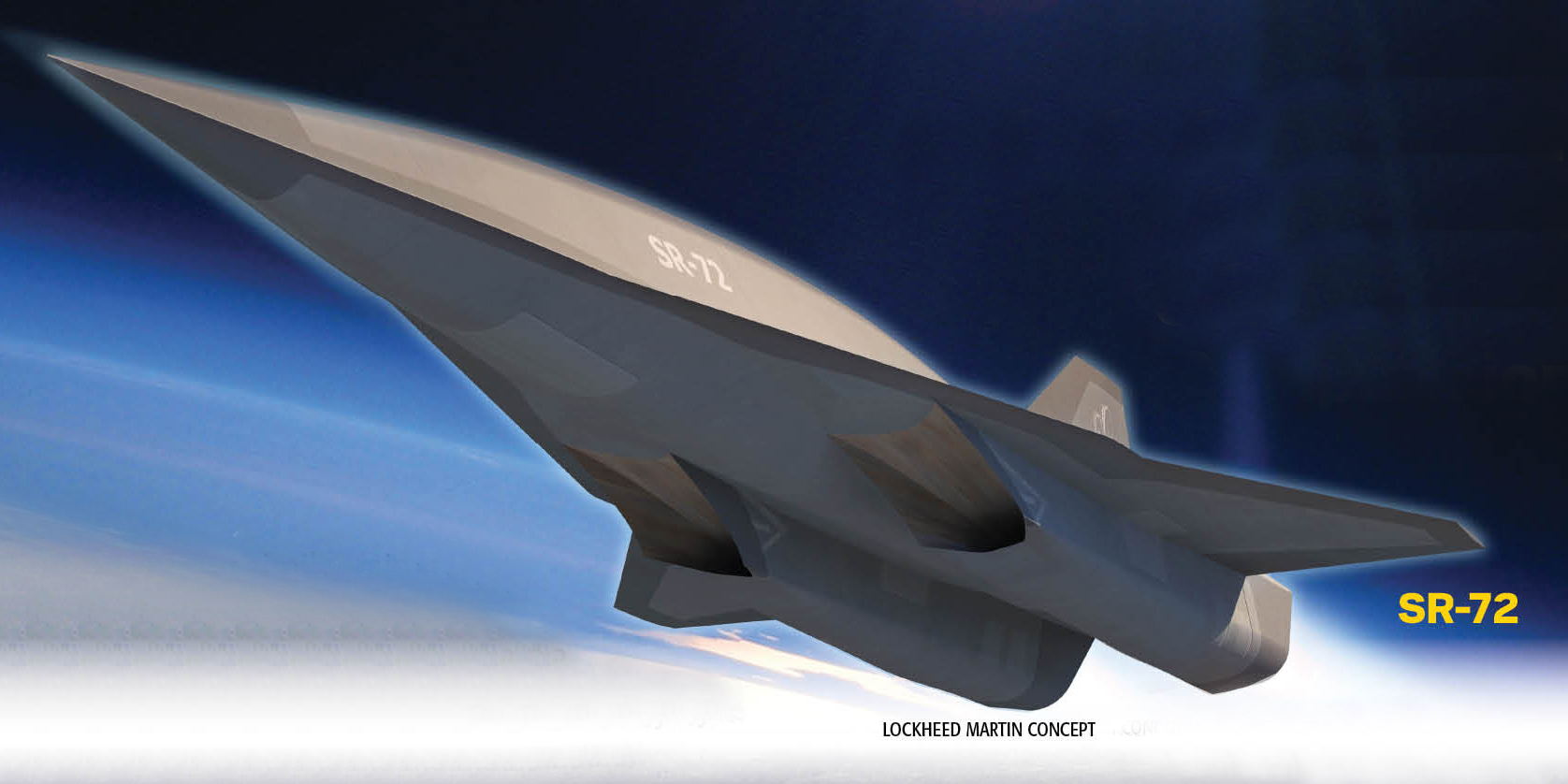
Lockheed Martin’s Skunk Works reveals a Mach 6 strike successor of SR-71 Blackbird dubbed SR-72

Lockheed Martin’s Skunk Works, the legendary division that designed airplanes which represented a giant leap for their times such as the F-104, the U-2, the Blackbird family or the F-117A stealth fighter jet, has eventually revelead the existence of a project for an Hypersonic strike aircraft dubbed SR-72.
The twin-engine aircraft is designed for a Mach 6 cruise, around twice the speed of its forebear, and will have the optional capability to strike targets and will be capable to hit or perform ISR of fast-moving targets, located in high-lethality areas at intercontinental ranges.
A Lockheed SR-72 has been released. The shape is coherent with the most recent hypersonic designs and it is quite similar to at least one of those published in April 2013 on LM’s Code One article about the configurations studied since the early ’60s for an SR-71 Blackbird replacement.
The shape and operational speed of the U.S. next generation strike bomber is much different from Russia’s next generation stealth strategic bomber PAK-DA concept.
theaviationist

Nov 15, 2012

New Russian Bomber ‘Will Not be Hypersonic’


Russia’s future PAK-DA manned bomber project will not have hypersonic speed capability, Russia’s bomber force commander said on Wednesday, in an apparent contradiction of claims by Deputy Prime Minister Dmitry Rogozin earlier this year.

defencetalk

Oct 28, 2012

Fourth Hypersonic X-51A To Fly In Mid-2013


The U.S. Air Force Research Laboratory (AFRL) plans to fly the fourth and final Boeing X-51A WaveRider hypersonic engine demonstrator in mid-2013.

aviationweek

Aug 17, 2012

X-51A Waverider test flight ends in failure


The US Air Force Research Laboratory's (AFRL) third test flight of the Boeing/Pratt & Whitney Rocketdyne X-51A Waverider hypersonic test vehicle on 14 August has ended in failure.

Though the test article was successfully launched from a Boeing B-52 bomber near Point Mugu, California, the vehicle developed a fault after only 16s of flight-- before the X-51A separated from its rocket booster. When the X51A did separate from the booster rocket 15s later, the USAF says it could not maintain control of the vehicle due to a faulty control fin.

The X-51A subsequently crashed.

read more

May 21, 2010

Primer vuelo hipersónico del X-51/X-51A will make its first hypersonic flight test


Si las condiciones meteorológicas no lo impiden, el demostrador de vuelos hipersónicos X-51A Waverider realizará su primer vuelo el proximo 25 de mayo de 2010, lanzado desde un B-52 desde las costas del Sureste de California.
Se prevee que su vuelo dure cinco minutos y que acelere hasta Mach 6, transmitiendo gran cantidad de datos a estaciones en tierra, antes de caer en el Pacífico. No hay planes de recuperar el vehículo. En esos cinco minutos se espera obtener mas información que en todos las pruebas anteriores. El vuelo hipersónico mas largo realizado anteriormente con un motor de propulsión a chorro, fue realizado por la NASA, con el vehículo X-43, fué mas rápido pero solo duró 10 segundos.
El X-51A es fruto de la colaboración entre la USAF, Boeing Company, Pratt & Whitney, y otros organismos gubernamentales. Un P-3 Orion de la US Navy ayudará en la transmisión de datos. Este será el tercer vuelo del X-51 que ya lo ha hecho anteriormente fijado en los pilones alares de sujección de un B-52.
(read more)
__________________________________________
Weather permitting, Air Force officials said the X-51A Waverider will make its first hypersonic flight test attempt May 25 after it is released from a B-52 Stratofortress off the southern coast of California.
The unmanned X-51A is expected to fly autonomously for five minutes, powered by a supersonic combustion scramjet engine, accelerating to about Mach 6 and transmitting vast amounts of data to ground stations before breaking up after splashing down into the Pacific, as planned. There are no plans to recover the flight test vehicle, one of four built. In those 300 seconds, it is hoped to learn more about hypersonic flight with a practical scramjet engine than all previous flight tests combined.
The longest previous hypersonic scramjet flight test performed by a NASA X-43 in 2004was faster, but lasted only about 10 seconds.
The X-51A program is a collaborative effort by representatives from the Air Force Research Laboratory and the Defense Advanced Research Projects Agency, with industry partners The Boeing Company and Pratt & Whitney Rocketdyne.
A U.S. Navy P-3 Orion will aid in transmitting telemetry data.
The May 25 hypersonic test will actually be the third time the X-51 has flown, but in each previous instance it has remained attached to the B-52's wing.
(leer más)