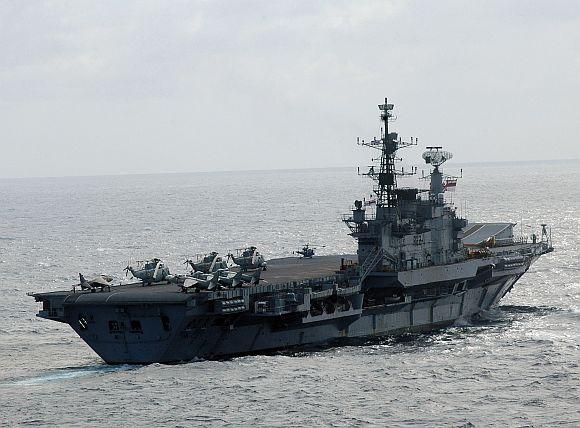
The Indian Navy (IN) has retired its fleet of Sea Harriers. A flight of six single-seat Sea Harrier FRS Mk 51s was officially 'disembarked' from INS Viraat , the IN's 57-year-old, 23,900-tonne Centaur-class aircraft carrier, on 6 March, prior to the Sea Harriers being officially retired from service on 22 March.
The most recent figures available put the IN's Sea Harrier strength at 10 or 11, with two of these two-seat.
IN officials told IHS Jane's that keeping the Sea Harriers operational for an air-defence role and/or training purposes would have been "logistically problematic and hugely expensive".
"Even readying ... six Harriers to participate in the IN's International fleet Review [IFR] in February in Visakhapatnam by cannibalising five other platforms was a major feat," said a senior naval officer. He added that keeping them functioning for longer would be impossible.
The surviving aircraft will probably be mothballed at INS Hansa, the navy's shore-based facility at Dabolim in Goa, before being dispatched to various naval stations around the country to serve as exhibits.
The IN originally acquired a total of 30 Harriers as the air arm of Viraat (ex-HMS Hermes ). But over the years 15 of them crashed, killing eight pilots. The last Harrier fatality occurred in August 2009 in the Arabian Sea off the Goa coast.
In 2008-09 India's state-owned Hindustan Aeronautics Ltd (HAL) partially upgraded the Harriers by replacing their Sea Fox radars with Israeli ELTA EL/M-2032 multimode fire control radars and arming them with Rafael Derby beyond-visual-range air-to-air missiles.
janes
Translate
Showing posts with label INS VIRAAT. Show all posts
Mar 27, 2016
Indian Navy prepares to retire its Sea Harriers
Mar 15, 2015
Indian Navy Submitted an RFI to Dassault about the Rafale M Carrier Capable Variant
Dassault Aviation announced the French company has replied to a request for information from the Indian Navy on the naval Rafale M carrier-capable variant of its fighter.
India and France are in final negotiation for the procurement of 126 Rafale fighters for the Indian Air Force.
Indian Navy's current (INS Vikramaditya, INS Viraat) and near term (INS Vikrant) aircraft carriers are all fitted with a ramp for STOBAR type operations (Short Take-Off But Arrested Recovery). While likely capable of STOBAR operations, the Rafale M capabilities would be maximized with a CATOBAR type aircraft carrier (Catapult Assisted Take-Off But Arrested Recovery) like the French Navy aircraft carrier.
Indian Navy's future INS Vishal might be nuclear-powered carrier with CATOBAR system.
navyrecognition
India and France are in final negotiation for the procurement of 126 Rafale fighters for the Indian Air Force.
Indian Navy's current (INS Vikramaditya, INS Viraat) and near term (INS Vikrant) aircraft carriers are all fitted with a ramp for STOBAR type operations (Short Take-Off But Arrested Recovery). While likely capable of STOBAR operations, the Rafale M capabilities would be maximized with a CATOBAR type aircraft carrier (Catapult Assisted Take-Off But Arrested Recovery) like the French Navy aircraft carrier.
Indian Navy's future INS Vishal might be nuclear-powered carrier with CATOBAR system.
navyrecognition
Etiquetas:
INDIA,
INDIAN NAVY,
INS VIKRAMADITYA,
INS VIKRANT,
INS VIRAAT,
INS VISHAL,
RAFALE
Feb 24, 2015
Indian Navy Set to Accelerate Second Indigenous Carrier as INS Viraat is Set to Decommission Next Year
The Indian Navy is accelerating the design and construction of its second domestic carrier as its oldest carrier leaves service next year.
The work to develop the carrier — thought to be called INS Vishnal — has been given a top priority to shore up capability gaps in the service following the planned retirement of INS Viraat — the former U.K. Royal Navy carrier Hermes next year.
Vishnal — the indigenous aircraft carrier-II (IAC-II) program — would take 10 to 12 years of construction and is seen as a hedge against China’s People’s Liberation Army Navy (PLAN) own domestic carrier program.
The PLAN has started to patrol more in the Indian Ocean in the last several years, which has prompted concern in Indian leadership.
The Indians are reportedly leaning toward a nuclear powered carrier and have determined it will feature a catapult-assisted take-off but arrested recovery (CATOBAR) — in line with the current generation of U.S. Nimitz-class carriers (CVN-68).
India’s other carriers — the Soviet-built Vikramaditya and the domestically built Vikrant (IAC-I) — currently are built around a short-take off but arrested recovery (STOBAR) system which require a sloped “ski-jump” ramp to allow aircraft to take off.
A CATOBAR system would allow Vishnal to not only launch heavier fighters than its current crop of Mikoyan MiG-29Ks but also heavier airborne surveillance aircraft.
The Indians have inquired about the inclusion of the General Atomics Electromagnetic Aircraft Launch System (EMALS) that will launch aircraft off the new U.S. Gerald R. Ford-class of nuclear carrier.
A 65,000-ton nuclear powered CATOBAR Vishnal would be an exceedingly more complicated shipbuilding program.
Under the accelerated timeline, Vishnal could commission as early as 2033.
usni
The work to develop the carrier — thought to be called INS Vishnal — has been given a top priority to shore up capability gaps in the service following the planned retirement of INS Viraat — the former U.K. Royal Navy carrier Hermes next year.
Vishnal — the indigenous aircraft carrier-II (IAC-II) program — would take 10 to 12 years of construction and is seen as a hedge against China’s People’s Liberation Army Navy (PLAN) own domestic carrier program.
The PLAN has started to patrol more in the Indian Ocean in the last several years, which has prompted concern in Indian leadership.
The Indians are reportedly leaning toward a nuclear powered carrier and have determined it will feature a catapult-assisted take-off but arrested recovery (CATOBAR) — in line with the current generation of U.S. Nimitz-class carriers (CVN-68).
India’s other carriers — the Soviet-built Vikramaditya and the domestically built Vikrant (IAC-I) — currently are built around a short-take off but arrested recovery (STOBAR) system which require a sloped “ski-jump” ramp to allow aircraft to take off.
A CATOBAR system would allow Vishnal to not only launch heavier fighters than its current crop of Mikoyan MiG-29Ks but also heavier airborne surveillance aircraft.
The Indians have inquired about the inclusion of the General Atomics Electromagnetic Aircraft Launch System (EMALS) that will launch aircraft off the new U.S. Gerald R. Ford-class of nuclear carrier.
A 65,000-ton nuclear powered CATOBAR Vishnal would be an exceedingly more complicated shipbuilding program.
Under the accelerated timeline, Vishnal could commission as early as 2033.
usni
Etiquetas:
China,
CHINA NAVY,
INDIA,
INDIAN NAVY,
INS VIKRANT,
INS VIRAAT,
INS VISHAL,
MIG-29K,
PLAN
Aug 4, 2014
Russia to modify engines of India Su-30MKI
India Air Force frontline fighter jet Sukhoi-30MKI will be modified under new specifications laid down by its Russian manufacturers to fix mid-air engine trouble in its fleet.
The move comes after the IAF faced an unusually high number of mid-air engine failures over the past two years (January 2102 onwards) and asked the Russians to rectify the problem in the fighter jet. The IAF has a fleet of 200 Sukhoi aircraft and another 72 are on their way from Moscow.
The modification will be carried out on 400 engines of the twin-engine aircraft, besides installation of some spares for emergencies. The Russians will install modified engines on the next lot of 72 jets, sources say.
The modified engines will first be tested on the aircraft, before being fitted to the entire fleet. The refit will be carried out in batches over the next 18-24 months.
The Russians have assured India that the modifications will eliminate the problem of mid-air engine failure.
Some of the engines — the AL-31FP — produced by NPO Saturn of Russia have been behaving inconsistently over the past two years. Since the engines powering the jet are still being produced, there is a scope for modification.
The IAF had flagged the Russians after studying each failure in detail between 2012 and 2013. The matter was taken up at a meeting between the two nations in February and later in June.
The instances of single-engine Su-30MKI landings were very high during the period. This was lowering the operational ability of the fleet, besides raising questions about war readiness.
While the aircraft is based at Bathinda, Halwara, Sirsa, Bareilly, Jodhpur and Bhuj in the North and West, its two squadrons are based at Tezpur and Chabua in the East.
Another squadron is based in South to augment the Indian Navy’s fleet of MiG29-K and Sea Harriers aboard aircraft carriers INS Vikramaditya and INS Viraat, respectively.
tribuneindia
The move comes after the IAF faced an unusually high number of mid-air engine failures over the past two years (January 2102 onwards) and asked the Russians to rectify the problem in the fighter jet. The IAF has a fleet of 200 Sukhoi aircraft and another 72 are on their way from Moscow.
The modification will be carried out on 400 engines of the twin-engine aircraft, besides installation of some spares for emergencies. The Russians will install modified engines on the next lot of 72 jets, sources say.
The modified engines will first be tested on the aircraft, before being fitted to the entire fleet. The refit will be carried out in batches over the next 18-24 months.
The Russians have assured India that the modifications will eliminate the problem of mid-air engine failure.
Some of the engines — the AL-31FP — produced by NPO Saturn of Russia have been behaving inconsistently over the past two years. Since the engines powering the jet are still being produced, there is a scope for modification.
The IAF had flagged the Russians after studying each failure in detail between 2012 and 2013. The matter was taken up at a meeting between the two nations in February and later in June.
The instances of single-engine Su-30MKI landings were very high during the period. This was lowering the operational ability of the fleet, besides raising questions about war readiness.
While the aircraft is based at Bathinda, Halwara, Sirsa, Bareilly, Jodhpur and Bhuj in the North and West, its two squadrons are based at Tezpur and Chabua in the East.
Another squadron is based in South to augment the Indian Navy’s fleet of MiG29-K and Sea Harriers aboard aircraft carriers INS Vikramaditya and INS Viraat, respectively.
tribuneindia
Etiquetas:
INDIA,
INDIAN AIR FORCE,
INDIAN NAVY,
INS VIKRAMADITYA,
INS VIRAAT,
RUSSIA,
SU-30,
SU-30MKI,
SUKHOI
May 8, 2014
India’s New Carrier is ‘Operational’
India’s newest aircraft carrier — INS Vikramaditya — is underway on an operational deployment embarking MiG— 29K and being flown by Indian naval pilots.
The carrier has taken part in wargames with India’s fleet.
The ship fields 34 aircraft, including 21 MiG-29Ks.
Vikramaditya is India’s second carrier joining the 50 year-old carrier INS Viraat.
usni
The carrier has taken part in wargames with India’s fleet.
The ship fields 34 aircraft, including 21 MiG-29Ks.
Vikramaditya is India’s second carrier joining the 50 year-old carrier INS Viraat.
usni
Etiquetas:
INDIA,
INDIAN NAVY,
INS VIKRAMADITYA,
INS VIRAAT,
MIG-29
Apr 25, 2013
INS Viraat can continue for another 3 years
The navy’s sole aircraft carrier INS Viraat can continue its service for another three years, the Lok Sabha was informed on Monday.
In a written reply, Defence Minister A K Antony said adequate safeguards are in place to ensure that navy’s operational capabilities are not compromised during the time a ship is under refit and repairs. He was asked whether the country does not have an aircraft carrier prowling the high seas.
thehindubusinessline
Oct 4, 2012
India's carrier INS Viraat aheads for 5-month long refit, setback for Navy
The Indian Navy will be without an operational aircraft carrier for over four months between November and March 2013 as the lone and ageing INS Viraat heads for a longer refit to Cochin very soon.
learn more
Subscribe to:
Posts (Atom)