Translate

Showing posts with label BAE HAWK. Show all posts

Feb 4, 2026

The Indonesian Ministry of Defense signs a Letter of Intent for the M-346 Block 20.

In a strategic move to modernize its air force, the Indonesian Ministry of Defense took a decisive step by signing a Letter of Intent (LoI) on February 4, 2026, with the Italian firm Leonardo. This agreement, sealed during the Singapore Airshow 2026, positions the M-346F Block 20 as the cornerstone for the generational transition of its training and light combat fleet.

Farewell to the Hawk Era


The arrival of the M-346F will mark the end of service for the veteran BAE Systems Hawk (models 109 and 209), which have been the backbone of advanced training in Indonesia for decades. The M-346 will not only take over the training role but, in its "F" (Fighter) variant, will provide multi-mission light combat capabilities, allowing the Indonesian Air Force (TNI-AU) to operate with greater flexibility in air-to-air and air-to-ground missions.

Technological Leap: The Block 20 Standard

The Block 20 configuration chosen by Jakarta represents the technological pinnacle of this model. Its most notable features include:

• AESA Radar: A cutting-edge sensor for high-precision detection and tracking of multiple targets.

• Digital Cockpit with LAD: Two Large Area Displays (LAD) that optimize the human-machine interface.

• Advanced Connectivity: Equipped with Link 16 data link and state-of-the-art electronic countermeasure systems.

• Refueling Capability: Includes an in-flight refueling probe, significantly extending its operational range.

Cooperation and Regional Impact

The agreement covers more than just the purchase of aircraft; it boosts the local industry through a partnership with the Indonesian company PT ESystem Solutions. This collaboration will focus on localizing Maintenance, Repair, and Overhaul (MRO) services, as well as developing specialized human capital within the country.

This announcement comes just one day after Boeing confirmed the end of its campaign to sell the F-15EX to Indonesia, highlighting a shift in priorities toward platforms that balance operational costs with high technological capability.

Feb 20, 2016

Saudi Arabia orders more Hawk jet trainer aircraft

Saudi Arabia has doubled the number of Hawk Advanced Jet Trainer (AJT) aircraft it has bought from BAE Systems, with an order for a further 22.
The RSAF already operates 24 of the earlier-generation Hawk Mk 65 aircraft that it began receiving in 1987 and 16 Hawk Mk 65A aircraft from 1997. In 2012 it signed a contract for 22 of the latest-generation Hawks AJTs, plus 55 Pilatus PC-21s, and 25 Cirrus SR22 primary training aircraft.
janes

Feb 25, 2015

Pilatus delivers additional PC-21 trainer to Royal Saudi Air Force

Pilatus has shipped another PC-21 expanded envelope trainer aircraft off its final assembly line for the Royal Saudi Air Force (RSAF).
The aircraft represents the 100th turboprop trainer PC-21 to be rolled off the company's final assembly line in Switzerland.
Saudi Arabia ordered 55 PC-21 aircraft in May 2012.
The deal also covered the delivery of 22 Hawk 165 advanced jet trainers.
The PC-21 will also replace RSAF's existing PC-9 trainer fleet, which comprises 47 aircraft that were delivered by BAE as part of a package deal with Hawks to Saudi Arabia in the mid-1980s.
The RSAF took delivery of the initial six aircraft in June 2014. The remaining aircraft are currently in production, while the instructors are preparing for their first student courses.
The PC-21 is currently operated by the air forces of Singapore, Switzerland and the UAE, and has also been ordered by Qatar.
airforce-technology

Feb 24, 2015

BAE Systems in talks to weaponise India's Hawks

The Indian Air Force is in negotiations with BAE Systems to weaponise its fleet of Hawk Mk 132 advanced jet trainers so they could be deployed on strike co-ordinated armed reconnaissance and close air support missions.
The IAF is evaluating the feasibility of integrating its largely licence-built Hawk Mk 132s with a range of weapon systems that are fitted onto its SEPECAT Jaguar fighters.
This includes MBDA's Advanced Short Range Air-to-Air Missiles, Rafael Litening targeting pods, and a range of smart weapons.
By 2016-17 the IAF will operate 106 Hawks and the Indian Navy another 17, making India the largest operator of the type. The IAF plans to acquire another 20 Hawks for its aerobatics team, disbanded in February 2011 after its HAL-built Surya Kiran HJT-16 Mk I and Mk II aircraft were diverted to train fighter pilots.
IAF fighter pilots begin their instruction on Pilatus PC-7 Mk II tandem-seat basic turboprop trainers for 55 hours before moving onto the Kiran HJT-16 Mk I and Mk II intermediate jet trainers for another 70 hours. Thereafter, they graduate to Hawk Mk 132s for two 'semesters' of 135 hours before going on to operate fighters.
janes

Feb 7, 2015

USAF T-X: Northrop-Bae Systems turns to a new prototype, abandoning a modified Hawk

A Northrop Grumman-led team is dashing its plan to propose a modified BAE Systems Hawk trainer for the U.S. Air Force’s T-38 replacement program, opting instead for a clean-sheet design for the.
The shift is more bold than it is surprising. The team is paying for a brand-new prototype despite a slump in defense spending. But it has become increasingly evident that the Hawk is unsuited for the mission due to shortfalls in the fast-jet trainer’s ability to sustain Gs, perform high angle-of-attack maneuvering and execute tight turn rate and radius.
BAE’s Hawk would struggle to meet sustained G, high angle of attack and tight turn radius requirements sought in the U.S. Air Force’s T-38 replacement program.
The Air Force intends to buy as many as 350 of the trainers as part of a larger T-X system, including advanced training aids such as a sophisticated ground-based training platform and aids.

Dec 3, 2014

Boeing says its T-X Design Won't Be Unveiled Soon

Boeing continues to develop a custom-designed solution for the US Air Force’s T-X trainer replacement program with an eye on contract award in 2017 — but a company official indicated Monday that a preview of what that may look like is still a ways away.
It's not defined the timeframe that we will roll out the family of systems, including the new aircraft.
Indeed, Boeing’s plans for T-X are a closely guarded secret. Almost nothing about the design itself has leaked.
What is known is that Boeing is teamed up with Sweden-based Saab to develop the aircraft for an off-the-shelf custom design geared to meet the Air Force’s requirements. However, Boeing officials, including defense head Chris Chadwick, have insisted the plane will not be a modified version of Saab’s Gripen fighter.
The winner of the T-X competition will replace the service’s T-38 trainers with 350 new aircraft.
Boeing is facing off against the Hawk Advanced Jet Training System, a joint program led by BAE Systems and Northrop Grumman; Lockheed Martin’s offering of Korean Aerospace Industries’ T-50; and the T-100, a collaboration between General Dynamics and Italy’s Alenia Aermacchi based on the latter’s M-346 design. Textron AirLand is also offering a trainer variant of its new Scorpion jet.
defensenews

Oct 8, 2014

Indonesia’s Air Force Adds More Flankers

Indonesian Military Commander tells that they’re leaning toward the Su-35 as their F-5 replacement, with the JAS-39 in 2nd place and the F-16 a distant 3rd.
Indonesia’s turn toward Russian fighters stemmed partly from necessity. Its 12 remaining F-16A/Bs and 16 remaining F-5E/F fighters experienced severe maintenance problems external link in the wake of a US embargo, triggered by the Indonesian military’s widespread human rights abuses in East Timor. Its 30+ single-seat Hawk 209 sub-sonic light combat aircraft, derived from the trainer jets the TNI-AU also operates, were the country’s only fighter alternative.
A $192 million contract began to address that in 2003, by buying 2 SU-27SK single-seat and 2 SU-30MK twin-seat multi-role fighters from Russia. Indonesia submitted a formal request to buy 24 used F-16s in 2011, but it isn’t backing away from its high-end Flanker fleet. In fact, the TNI-AU has steadily added more. Now, they’re reaching out to their neighbors for training and support.
defenseindustrydaily

Sep 4, 2014

Indian deal for 20 more Hawks faces more delays

A contract for 20 more BAE Systems Hawk Mk 132 Advanced Jet Trainers (AJTs) for the Indian Air Force's (IAF's) aerobatics display team, approved three years ago by the Indian Ministry of Defence (MoD), is unlikely to be signed before 2016.
The MoD was "processing" the request for proposals (RfP) for the 20 Hawks. The kits would be sent to Hindustan Aeronautics Limited (HAL) for licence-building sometime over the next 12-16 months.
BAE Systems said commercial discussions with HAL for the aircraft were continuing, but did not elaborate.
HAL, however, said it would be unable to begin work on the 20 Hawks until mid-2016, when it completed delivery of the 36 AJTs it is currently building for the IAF and the Indian Navy (IN).
These are part of a second batch of 57 Hawks acquired by India in July 2011, 40 of which are for the IAF and 17 for the Indian Navy. In 2003 the IAF procured 66 Hawks: 24 were bought off the shelf and the remaining 42 were licence-built by HAL.
Since 2005-06 HAL claims to have built and delivered 63 Hawks.
Before the RfP for the 20 supplementary Hawks is cleared, the MoD needs to clarify its position on Rolls-Royce, whose Adour Mk 861 turbofan engines power the AJT.
The MoD suspended all dealings with Rolls-Royce in early March after the then Congress Party-led government began a federal inquiry against it for employing proscribed agents to secure Indian contracts.
The new BJP government reversed this order in July, permitting Rolls-Royce to continue its participation in numerous ongoing Indian military programmes and service contracts, including the Hawk. However, under an advisory released in late August, all new MoD tenders involving foreign materiel vendors facing such partial bans are to be stayed until investigations into their alleged wrongdoing is completed.
The Hawks will replace the HAL-built Surya Kiran Mk II aircraft that the IAF's Surya Kiran Aerobatics Team (SKAT) operated for 15 years until it was disbanded in February 2011 and its assets diverted to train fighter pilots following a shortage of such platforms.
janes

Jul 9, 2014

Northrop Takes The Lead From BAE On $11B USAF T-X Trainer

While Northrop Grumman isn’t doing much at the upcoming Farnborough Air Show — at least publicly — they certainly shook things up today with their announcement that they are swapping places with BAE Systems to take the lead role in the competition for the $11 billion, 350-plane T-X trainer program.
While the BAE-Northrop team is still offering BAE’s Hawk jet, being the lead or prime contractor on a program is where the real money lies, so this move highlights Northrop’s political and manufacturing power:
“The decision to realign was reached mutually by all team members to better leverage Northrop Grumman’s domestic development and production capabilities, which were realized through the company’s establishment and investment in its Centers of Excellence last year. The Northrop Grumman, BAE Systems, L-3 and Rolls-Royce team is committed to providing the Hawk as the most capable and affordable training solution for the Air Force.”
breakingdefense

May 28, 2014

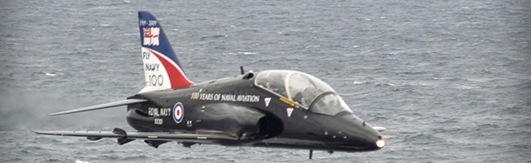
Royal Navy takes over Hawk T1 jets

Fast jets operating out of the Royal Naval Air Station at Culdrose in Cornwall have been returned to full military control.
The 14 Hawk T1 jets now make up 736 Naval Air Squadron and are flown by military and civilian pilots.
Until recently the aircraft were operated by private contractor SERCO which still provides three of the civilian pilots.
Their role includes acting as target aircraft to train ship crews.
Lt Cdr Tim Flatman, the squadron's commanding officer, says they will also help train pilots for the new Queen Elizabeth aircraft carrier, pretending to be enemy aircraft and missiles.
bbc.com

May 6, 2014

Royal Navy recommissions training squadron

Britain's Royal Navy has quietly recommissioned a fighter squadron to train the next generation of aviators who will eventually fly from the decks of its new Queen Elizabeth class aircraft carriers.
736 Naval Air Squadron has been back in business for almost a year. It was formed from a civilian-run operation used to help train navy ships how to defend themselves from air attacks and flies Hawk T1 aircraft.
The history of the unit dates froem 1943 when it was established as an air combat training squadron for pilots of the Fleet Air Arm. It has operated classic navy jets including the Sea Vampire, Sea Hawk, Scimitar and Buccaneer.
Naval jet flying in Britain ceased with the 2010 Ministry of Defence decision to retire the Harrier.
dailymail

Apr 6, 2014

SAAF Hawk fleet grounded

The South African Air Force has ground their Hawk trainer fleet following the crash of a jet whilst landing last Thursday.
The BAE Systems Hawk Mk 120 jet trainer, operated by 85 Combat Flying School, was performing a ‘touch and go’ at AFB Makhado when it experienced a control problem.
Unconfirmed reports indicate that the control stick ‘locked’ shortly before touch-down, resulting in the aircraft slamming the front wheel onto the runway, bouncing and then hitting the runway again with the front wheel. This resulted in the front wheel breaking off and the Hawk sliding down the runway before coming to a halt.
Neither of the two crew aboard, who deploying the drag chute after the nose-wheel broke off in order to slow the aircraft, were injured.
As the damaged aircraft blocked the runway, other aircraft that were still in the air were forced to land on the taxiway. This was safely accomplished as when the airbase was built in the 1980’s, the taxiway was designed to operate as a secondary runway in the event of the main runway being blocked or damaged.
AFB Makhado is situated near the town of Louis Trichardt in the Limpopo Province. 85 Combat Flying School is equipped with the remaining 23 Lead-In Fighter Trainer (LIFT) Hawk jets of the 24 delivered as part of the 1999 Strategic Defence Package (SDP).
The other flying squadron operating from the base is 2 Squadron, equipped with the SAAB Gripen advanced fighter.
saairforce

Feb 23, 2014

New Tailfin design for the RAF Red Arrows to mark the Team's 50th display season in 2014

Feb 19, 2014

Poland confirms M-346 selection after tests

Poland's has confirmed its selection of the Alenia Aermacchi M-346 for its air force's advanced jet trainer requirement, after the completion of verification flights with the type from Deblin air base.
Performed between 3 and 5 February, the activity comprised two test flights, during each of which a Polish air force pilot joined an Alenia Aermacchi test pilot in the cockpit. A final agreement between the defence ministry and the Italian company is expected to be signed later this month, or in March. The order for eight aircraft includes training services, flight simulators and technical and logistics support. Warsaw will also have an option to acquire a further four of the aircraft at a later date.
First announced last December, Warsaw's selection of the M-346 for the requirement followed a competition also involving the BAE Systems Hawk and Korea Aerospace Industries/Lockheed Martin T-50, offered by latter's UK business unit. Alenia Aermacchi's proposal was selected on the grounds of it having submitted a compliant solution at the lowest price.
The proposals from BAE and Lockheed were rejected due to their non-compliance with air force requirements. The defeated bidders had the right to appeal against the decision before 2 January 2014, but neither exercised this option.
flightglobal

Dec 18, 2013

T-X Requirements Under Review

The newly appointed head of US Air Force Air Education and Training Command (AETC) acknowledged last week that funds for a replacement trainer won’t be coming in the near future, but said the T-X program remains a priority for his staff.
Timetable confirms there won’t be much movement on the T-X program in the next two years, despite heavy interest from industry. In 2014 and 2015 there are no plans for T-X.
Three competitors have offered off-the-shelf designs: the Hawk Advanced Jet Training System, a joint program of BAE Systems, Northrop Grumman, L-3 Link Simulation & Training and Rolls-Royce; Lockheed Martin’s offering of the Korean Aerospace Industries T-50; and the T-100, a collaboration between General Dynamics and Italy’s Alenia Aermacchi.
This month, Boeing and Saab announced they would be teaming on a clean-sheet design for the program.
The Air Force is eyeing an initial operating capability date of 2023 or 2024 for the winner of the T-X competition, which will replace the service’s T-38 trainers with 350 new models.
There could be life for the T-38 after T-X, perhaps as an opposition plane during training missions.
defensenews

Dec 12, 2013

Korea exports 24 FA-50 light attack aircraft to Iraq


Korea Aerospace Industries (KAI) signed a contract to sell 24 FA-50 light attack aircraft to Iraq.
South Korea defense contractor is set to deliver the jets between October 2015 and October 2016.
Kai has sold 16 T-50 supersonic trainers to Indonesia, 40 KT-1 basic trainers to Turkey and 20 KT-1s to Peru.
In the competition, the KAI product beat BAE Systems’ Hawk-128, Russian Yakovlev’s Yak-130 and Czech aircraft producer Aero Vodochody’s L-159.
With Iraq being scheduled to import 36 F-16s from next year, the Korean light attack plane was seen as the best option to bridge the air power vacuum, while nurturing pilots.
The FA-50 was developed in Korea as a possible replacement for the Air Force’s F-5E/F when the aging fighters are retired.
KAI is set to try to continue the winning vibe in its sales pitch for other countries including the Philippines, Botswana and eventually, the United States.
In the U.S. Air Force’s trainer competition, aimed at replacing its fleet of T-38s.
The FA-50, which was first unveiled in January 2006, is a light combat version of the T-50 supersonic trainer that was co-developed with Lockheed Martin.
koreatimes

Nov 26, 2013

Poland reveals bid values for AJT acquisition

Alenia Aermacchi, BAE Systems and Lockheed Martin UK have submitted offers for the Polish air force's advanced jet trainer (AJT) requirement, but only one of the rivals has come in below Warsaw's revised price estimate for a purchase.
The Polish defence ministry's inspectorate of armament on 20 November opened bids submitted by the three companies, respectively for the M-346, Hawk and T-50.
An earlier programme estimate of zlotych (Zl) 1.5 billion ($484 million) had been set, but defence ministry representatives now say that a sum of only Zl1.2 billion has been allocated for the purchase of an AJT system.
According to the defence ministry, the prices of the individual offers submitted are almost Zl1.17 billion from Alenia Aermacchi (M-346 pictured), just over Zl1.75 billion from BAE Systems and slightly more than Zl1.8 billion from Lockheed Martin UK.
With pricing offers now in, the last step in the acquisition process will be for the air force to assess whether they meet the criteria stated in its tender documentation. Evaluation elements include price, life cycle cost and so called “bonus parameters”. Warsaw – which has previously outlined a requirement for eight new aircraft, plus related ground-based training systems – plans to sign an agreement with the winning contender in the first quarter of 2014.
flightglobal

Oct 19, 2013

Poland Invites Lockheed, BAE, Alenia To Bid For Jet Trainers

Poland has invited Lockheed Martin, BAE Systems and Alenia Aermacchi to bid in an upcoming Polish Air Force advanced jet trainer (AJT) aircraft competition.
Under the plan, the Polish ministry will place an order for eight jet trainers and related infrastructure and equipment with an option for an additional four aircraft. The new jet trainers are intended to replace Poland’s TS-11 Iskra aircraft built by Sikorsky’s local subsidiary PZL Mielec.
In 2011, the ministry canceled its first tender for the aircraft after BAE Systems withdrew its Hawk advanced jet trainer from the contest. Four bidders were left competing for the Polish contract: Alenia Aermacchi, Korea Aerospace Industries and Lockheed Martin, Czech Republic’s Aero Vodochody, and Finland’s Patria.
defensenews

Sep 24, 2013

INDIAN NAVY RECEIVES FIRST HAWK TRAINER JET

The Indian Navy has received the first of 17 Hawk Advanced Jet Trainers, becoming the third naval operator of the Hawk along with the US Navy and the Royal Navy.
baesystems

Jul 8, 2013

BAE Systems UK Awarded Contract for RAAF BAE Hawk Upgrade

Minister for Defence Materiel announced that BAE Systems UK has been awarded a contract to upgrade the Lead-In Fighter Hawk fleet.
defense-studies