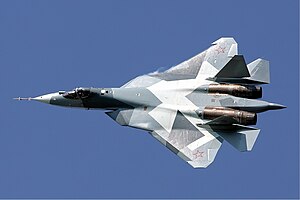
Bahrain has expressed interest in Russia’s multipurpose fighter of the fifth generation ‘Sukhoi’ T-50 (PAK FA). The start of serial production of an export version is scheduled for 2020.
Mass production of Russia’s Sukhoi T-50 fifth-generation fighter jets will begin in 2017.
sputniknews
Translate
Showing posts with label PAK FA. Show all posts
Jan 24, 2016
Bahrain express interest in PAK FA 5th Gen. Fighter
Etiquetas:
BAHRAIN,
BAHRAIN AIR FORCE,
PAK FA,
RUSSIA,
RUSSIAN AIR FORCE,
T-50
Dec 8, 2015
Flight tests of Russia’s PAK FA 5th-generation fighter jet "practically completed"
The tests confirming the flight characteristics of Russia’s fifth-generation PAK FA (Prospective Airborne Complex of Frontline Aviation) fighter jet have been actually completed, Deputy Defense Minister Yuri Borisov said in an interview with Rossiya 24 TV Channel on Monday.
"Several planes are now primarily testing airborne avionics. The tests proving the aircraft’s flight characteristics have practically been completed," the deputy defense minister said.
Deputy Defense Minister Borisov earlier told the media the Russian military would purchase only a squadron of PAK FA fighter jets, compensating this with a larger order for Sukhoi Su-35.
tass.ru
"Several planes are now primarily testing airborne avionics. The tests proving the aircraft’s flight characteristics have practically been completed," the deputy defense minister said.
Deputy Defense Minister Borisov earlier told the media the Russian military would purchase only a squadron of PAK FA fighter jets, compensating this with a larger order for Sukhoi Su-35.
tass.ru
Aug 16, 2015
India halves its demand for Russian fighter jets
Looking to cut costs and prune military imports, the Indian Air Force (IAF) has halved its demand for Russian-built fifth generation fighter aircraft (FGFA).
It now wants just three squadrons of the fighter jets which are to be inducted into the Russian Air Force in 2016.
Sources say the IAF has scaled down its needs and now indicated that just three squadrons (around 18 planes in each), besides a few more for training of the pilots, will be enough for now. This works out to be 65 planes, almost half from the earlier projection of 127 FGFAs to be jointly designed and produced by India and Russia.
The T-50 has been built for the Russians under the PAK-FA (Prospective Airborne Complex of Frontline Aviation) programme for the fifth generation fighter aircraft.
tribuneindia
It now wants just three squadrons of the fighter jets which are to be inducted into the Russian Air Force in 2016.
Sources say the IAF has scaled down its needs and now indicated that just three squadrons (around 18 planes in each), besides a few more for training of the pilots, will be enough for now. This works out to be 65 planes, almost half from the earlier projection of 127 FGFAs to be jointly designed and produced by India and Russia.
The T-50 has been built for the Russians under the PAK-FA (Prospective Airborne Complex of Frontline Aviation) programme for the fifth generation fighter aircraft.
tribuneindia
Etiquetas:
FGFA,
INDIA,
INDIAN AIR FORCE,
PAK FA,
PAK FA T-50,
RUSSIA,
RUSSIAN AIR FORCE
Mar 25, 2015
Russia to Begin Serial Production of PAK T-50 Fighters in 2016
Russia plans to start production of fifth-generation T-50 fighter jets in 2016.
Four more prototypes will be available for tests this year, after manufacturers said last month that five fighters were carrying out test flights.
Sukhoi, the Russian company behind the T-50 project, also plans to produce an export version of the fighter for India.
sputniknews
Four more prototypes will be available for tests this year, after manufacturers said last month that five fighters were carrying out test flights.
Sukhoi, the Russian company behind the T-50 project, also plans to produce an export version of the fighter for India.
sputniknews
Mar 10, 2015
Because of Stalemate on Rafale Deal India ready to spend $25bn on Russian 5G fighter jets
The stalemate over the 4th-gen Rafale fighter jets deal with France has forced the Indian military to accelerate an even larger project with Russia on the joint development and purchase of an equal quantity of 5th-gen fighters.
India is now ready to invest $25 billion in the development and purchase of 127 fifth-generation stealth fighter aircraft (FGFA). It will also make concessions to speed up the delivery of fighters and have the first ones available in 36 months instead of the previously envisaged 94 months.
The initial contract signed with Moscow implied a 50:50 design and production agreement to develop an Indian version of Russia’s Sukhoi T-50 (PAK-FA) 5G fighter jet. The $295-million preliminary design contract signed in December 2010 envisaged the creation of a two-seat version of the PAK-FA and preconditioned that all single-pilot fighters must be assembled in India. Now that the estimated number of Indian Air Force combat-ready squadrons has decreased sharply, New Delhi isn’t objecting to Moscow producing the first batch of perspective multi-role fighter FGFA at Russia.
The FGFA contract however will not replace the outgoing Rafale tender, as India is likely to replace it by buying a corresponding quantity of the Russian Sukhoi-30MKI fighters already being produced in India.
rt.com
India is now ready to invest $25 billion in the development and purchase of 127 fifth-generation stealth fighter aircraft (FGFA). It will also make concessions to speed up the delivery of fighters and have the first ones available in 36 months instead of the previously envisaged 94 months.
The initial contract signed with Moscow implied a 50:50 design and production agreement to develop an Indian version of Russia’s Sukhoi T-50 (PAK-FA) 5G fighter jet. The $295-million preliminary design contract signed in December 2010 envisaged the creation of a two-seat version of the PAK-FA and preconditioned that all single-pilot fighters must be assembled in India. Now that the estimated number of Indian Air Force combat-ready squadrons has decreased sharply, New Delhi isn’t objecting to Moscow producing the first batch of perspective multi-role fighter FGFA at Russia.
The FGFA contract however will not replace the outgoing Rafale tender, as India is likely to replace it by buying a corresponding quantity of the Russian Sukhoi-30MKI fighters already being produced in India.
rt.com
Etiquetas:
FGFA,
INDIA,
INDIAN AIR FORCE,
PAK FA,
RAFALE,
RUSSIA,
RUSSIAN AIR FORCE,
SU-30,
SU-30MKI,
T-50
Jan 12, 2015
Russia, India Complete Draft Project for FGFA
Russia and India have completed the preliminary design for the Sukhoi/HAL Fifth Generation Fighter Aircraft (FGFA).
While the Russian version of the fifth generation fighter jet is operated by a single pilot, the Indian Air Force prefers aircraft that are operated by two pilots.
The Sukhoi PAK FA (T-50) is the Russian Air Force’s first stealth fighter, intended to succeed the Sukhoi Su-27, as well as the Mikoyan MiG-29 fighter jets. The aircraft conducted its first test flight in 2010 and deliveries are set to begin in 2016. The FGFA, developed jointly by Russia’s Sukhoi and India’s Hindustan Aeronautics Limited, is a derivative from the PAK FA.
sputniknews
While the Russian version of the fifth generation fighter jet is operated by a single pilot, the Indian Air Force prefers aircraft that are operated by two pilots.
The Sukhoi PAK FA (T-50) is the Russian Air Force’s first stealth fighter, intended to succeed the Sukhoi Su-27, as well as the Mikoyan MiG-29 fighter jets. The aircraft conducted its first test flight in 2010 and deliveries are set to begin in 2016. The FGFA, developed jointly by Russia’s Sukhoi and India’s Hindustan Aeronautics Limited, is a derivative from the PAK FA.
sputniknews
Etiquetas:
FGFA,
HAL,
INDIA,
INDIAN AIR FORCE,
PAK FA,
PAK FA T-50,
RUSSIA,
RUSSIAN AIR FORCE,
SUKHOI
Dec 19, 2014
Russia plans to receive 55 PAK-FAs by 2020
The Russian Air Force (VVS) will have received 55 Sukhoi PAK-FA (T-50) fighter aircraft by 2020, according the deputy director of the United Aircraft Corporation's (UAC's) combat aircraft department.
The first PAK-FA deliveries are scheduled for 2016.
Five PAK-FAs have been produced and three more are now being constructed at the Sukhoi Aviation Holding Company.
janes
The first PAK-FA deliveries are scheduled for 2016.
Five PAK-FAs have been produced and three more are now being constructed at the Sukhoi Aviation Holding Company.
janes
Etiquetas:
PAK FA,
PAK FA T-50,
RUSSIA,
RUSSIAN AIR FORCE,
SUKHOI
Sep 7, 2014
Indian Air Force unhappy at progress of PAK-FA fifth-gen fighter
The Indian Air Force (IAF) has expressed concerns to Russia over technical problems and delays plaguing the Fifth Generation Fighter Aircraft (FGFA) programme, which is based on the Russian Air Force's Sukhoi T-50 PAK-FA platform.
The IAF's primary objections to fighter's preliminary design features included the inadequacy of its AL-41F1 engines, its stealth features and its weapons carriage system.
Differences also emerged over the operational capability of the Byelka active electronically scanned array (AESA) radar. Additional IAF concerns include the overall development cost of the aircraft, its maintainability and safety features, the sources said.
As a result, in recent months the IAF has significantly reduced the number of FGFA aircraft it plans to acquire from around 220 to 130-145. It has also dropped its requirement for 45-50 twin-seat FGFA trainers as Russia had demanded an additional USD1 billion and extended deadlines for their development.
The IAF is also annoyed over Russian reluctance to share design information on the T-50 PAK-FA -officially designated the Perspective Multi-Role Fighter (PMF) by India - despite New Delhi being an equal financial partner in its development costs.
India has so far paid USD295 million towards the preliminary design and considers the programme vital to helping the state-run Aeronautical Development Agency kick-start its indigenous fifth-generation single-seat, twin-engine Advanced Medium Combat Aircraft (AMCA) programme.
Officials claim Russia is unwilling even to share details of a fire that erupted aboard a prototype PAK-FA as it landed at the Zhukovsky test centre near Moscow in June. An IAF technical evaluation team at the site was reportedly not permitted access to the fire-affected platform.
Russian officials, however, have reportedly told the IAF that many of its concerns will be resolved soon. They maintain that the prototype PAK-FA's NPO Saturn AL-41FI engine is a temporary solution, meant only for the duration of flight-testing, and that a replacement power pack is under development. Similarly, the AESA radar's proficiency is being improved alongside other systems.
janes
The IAF's primary objections to fighter's preliminary design features included the inadequacy of its AL-41F1 engines, its stealth features and its weapons carriage system.
Differences also emerged over the operational capability of the Byelka active electronically scanned array (AESA) radar. Additional IAF concerns include the overall development cost of the aircraft, its maintainability and safety features, the sources said.
As a result, in recent months the IAF has significantly reduced the number of FGFA aircraft it plans to acquire from around 220 to 130-145. It has also dropped its requirement for 45-50 twin-seat FGFA trainers as Russia had demanded an additional USD1 billion and extended deadlines for their development.
The IAF is also annoyed over Russian reluctance to share design information on the T-50 PAK-FA -officially designated the Perspective Multi-Role Fighter (PMF) by India - despite New Delhi being an equal financial partner in its development costs.
India has so far paid USD295 million towards the preliminary design and considers the programme vital to helping the state-run Aeronautical Development Agency kick-start its indigenous fifth-generation single-seat, twin-engine Advanced Medium Combat Aircraft (AMCA) programme.
Officials claim Russia is unwilling even to share details of a fire that erupted aboard a prototype PAK-FA as it landed at the Zhukovsky test centre near Moscow in June. An IAF technical evaluation team at the site was reportedly not permitted access to the fire-affected platform.
Russian officials, however, have reportedly told the IAF that many of its concerns will be resolved soon. They maintain that the prototype PAK-FA's NPO Saturn AL-41FI engine is a temporary solution, meant only for the duration of flight-testing, and that a replacement power pack is under development. Similarly, the AESA radar's proficiency is being improved alongside other systems.
janes
Etiquetas:
FGFA,
INDIA,
INDIAN AIR FORCE,
PAK FA,
PAK FA T-50,
RUSSIA
Feb 24, 2014
Russian Air Force Receives 2nd T-50 Stealth Fighter Prototype
The second T-50 prototype was delivered to the Russian Air Force for flight testing.
The first T-50had been delivered to a military airfield in Russia’s southern Astrakhan region for test flights.
Russian Air Force combat squadrons could expect deliveries of the production version of PAK-FA in 2016 at the latest.
Sukhoi has been conducting its own test flights of several of the aircraft since 2010, including in-flight refueling and high-agility maneuvers. The company said in October that these had produced favorable results.
ria.ru
The first T-50had been delivered to a military airfield in Russia’s southern Astrakhan region for test flights.
Russian Air Force combat squadrons could expect deliveries of the production version of PAK-FA in 2016 at the latest.
Sukhoi has been conducting its own test flights of several of the aircraft since 2010, including in-flight refueling and high-agility maneuvers. The company said in October that these had produced favorable results.
ria.ru
Etiquetas:
PAK FA,
PAK FA T-50,
RUSSIA,
RUSSIAN AIR FORCE,
SUKHOI
Dec 21, 2013
India’s Home-Grown Supersonic Fighter Jet
India’s air force is set to receive the country’s first locally-designed and developed supersonic fighter jet, the Tejas, in a significant milestone for its aerospace industry as it tries to phase out the aging and accident-prone MiG-21 jet fleet.
State-run Hindustan Aeronautics Ltd. plans initially to produce eight of the single-engine multi-role fighter jets a year from 2014, and to double production rate at a later stage.
Conceived in 1983 as the Light Combat Aircraft program, the project to develop the Tejas was delayed for several years because of difficulties related to developing the jet from scratch, which resulted in an escalation in the cost. The aircraft has been designed and developed by the Aeronautical Development Agency among other government agencies with Hindustan Aeronautics as the principal partner. It has a digital fly-by-wire flight control system and composites were used extensively to develop its airframe to provide strength and offer lower radar visibility.
The aircraft is powered by a General Electric Co. engine– received the first so-called initial operational clearance from the Indian government in Jan. 2011. The second initial operational clearance –which means the fighter is ready to operate in all conditions–was awarded on Friday, paving the way for its series production by Hindustan Aeronautics and induction into the fleet of the air force, according to the company. The Tejas will not be combat-ready until 2015 when it receives its final operational clearance
The Soviet-era MiG-21 has been the combat backbone of India’s air force for 50 years with nearly 1,000 planes in the fleet. However, a spate of accidents in which some of which killed several young air force pilots, and the armed forces push to upgrade its weaponry, led the government to initiate steps to retire the MiG-21.
The induction of advanced supersonic jets such as the Tejas forms part of a modernization drive of the Indian armed forces–including its army and navy, as neighbors China and Pakistan also upgrade their military capabilities. India’s military comprises mainly aging Soviet-era equipment, including helicopters and infantry combat vehicles.
One of India’s key defense projects is the potential acquisition of 126 Rafale fighter jets from Dassault Aviation S.A. of France. Commercial talks are continuing with Dassault.
India is also jointly developing a fifth-generation fighter jet with Russia, and is also upgrading its fleet of other fighter jets including the Mirage-2000 and MiG-29.
A total of 254 MiG-21 planes are currently in service with India’s air force. The air force plans to phase out the MiG-21 in a staged manner, and replace it with the Tejas.
wsj
State-run Hindustan Aeronautics Ltd. plans initially to produce eight of the single-engine multi-role fighter jets a year from 2014, and to double production rate at a later stage.
Conceived in 1983 as the Light Combat Aircraft program, the project to develop the Tejas was delayed for several years because of difficulties related to developing the jet from scratch, which resulted in an escalation in the cost. The aircraft has been designed and developed by the Aeronautical Development Agency among other government agencies with Hindustan Aeronautics as the principal partner. It has a digital fly-by-wire flight control system and composites were used extensively to develop its airframe to provide strength and offer lower radar visibility.
The aircraft is powered by a General Electric Co. engine– received the first so-called initial operational clearance from the Indian government in Jan. 2011. The second initial operational clearance –which means the fighter is ready to operate in all conditions–was awarded on Friday, paving the way for its series production by Hindustan Aeronautics and induction into the fleet of the air force, according to the company. The Tejas will not be combat-ready until 2015 when it receives its final operational clearance
The Soviet-era MiG-21 has been the combat backbone of India’s air force for 50 years with nearly 1,000 planes in the fleet. However, a spate of accidents in which some of which killed several young air force pilots, and the armed forces push to upgrade its weaponry, led the government to initiate steps to retire the MiG-21.
The induction of advanced supersonic jets such as the Tejas forms part of a modernization drive of the Indian armed forces–including its army and navy, as neighbors China and Pakistan also upgrade their military capabilities. India’s military comprises mainly aging Soviet-era equipment, including helicopters and infantry combat vehicles.
One of India’s key defense projects is the potential acquisition of 126 Rafale fighter jets from Dassault Aviation S.A. of France. Commercial talks are continuing with Dassault.
India is also jointly developing a fifth-generation fighter jet with Russia, and is also upgrading its fleet of other fighter jets including the Mirage-2000 and MiG-29.
A total of 254 MiG-21 planes are currently in service with India’s air force. The air force plans to phase out the MiG-21 in a staged manner, and replace it with the Tejas.
wsj
Etiquetas:
DASSAULT,
FRANCE,
HAL,
INDIA,
INDIAN AIR FORCE,
LCA TEJAS,
MiG-21,
PAK FA,
PAK FA T-50,
RAFALE,
RUSSIA
Oct 29, 2013
Fifth PAK FA fighter aircraft made its first flight
The fifth prototype of the prospective 5th — generation aviation complex (PAK FA, T-50) made its maiden flight in Komsomolsk-on-Amur at the Y.A.Gagarin KnAAZ aircraft plant of the Sukhoi Company.
The fighter aircraft spent 50 minutes in the air and landed safely on the factory airfield runway. The test flight was a success and in full accordance with the flight plan. The stability of the aircraft and the propulsion system were tested during the flight. The aircraft performed well in all phases of the planned flight program. The pilot confirmed reliability of all systems and equipment.
Upon completing the test flights program in Komsomolsk the aircraft will join the flight tests in the city of Zhukovsky near Moscow. Four 5th — generation fighter aircraft have already joined these tests. Two more planes are involved in ground tests — one as a complex ground stand and the other undergoes static tests.
The first flight of the PAK FA took place on January 29, 2010 in Komsomolsk-on-Amur. Currently work is underway on the full range of ground and flight tests. To date, more than 450 flights were carried out under the flight test program.
sukhoi
The fighter aircraft spent 50 minutes in the air and landed safely on the factory airfield runway. The test flight was a success and in full accordance with the flight plan. The stability of the aircraft and the propulsion system were tested during the flight. The aircraft performed well in all phases of the planned flight program. The pilot confirmed reliability of all systems and equipment.
Upon completing the test flights program in Komsomolsk the aircraft will join the flight tests in the city of Zhukovsky near Moscow. Four 5th — generation fighter aircraft have already joined these tests. Two more planes are involved in ground tests — one as a complex ground stand and the other undergoes static tests.
The first flight of the PAK FA took place on January 29, 2010 in Komsomolsk-on-Amur. Currently work is underway on the full range of ground and flight tests. To date, more than 450 flights were carried out under the flight test program.
sukhoi
Etiquetas:
PAK FA,
PAK FA T-50,
RUSSIA,
RUSSIAN AIR FORCE,
SUKHOI
Oct 4, 2013
Russia to See 20-Ton Combat Drone by 2018
The prototype of Russia’s first 20-ton combat drone will be unveiled in 2018.
The 20-ton unmanned combat aerial vehicle is being developed by the Sukhoi company, and will be based on the fifth-generation T-50 fighter.
rian
The 20-ton unmanned combat aerial vehicle is being developed by the Sukhoi company, and will be based on the fifth-generation T-50 fighter.
rian
Sep 23, 2013
Various Obstacles Confront Russia’s T-50 Project
There is no shortage of uncertainty about the future of Sukhoi PAK-FA T-50 fifth-generation fighter project. These doubts are driven by problems with major subsystems, delays with the aircraft’s introduction into service, and plans to defray some of the R&D cost by making India a developmental partner on the aircraft.
Russia’s NIIP radar design bureau, the traditional supplier for Sukhoi-design aircraft, has developed prototype models of the N050 active electronically scanning array (AESA) radar set with impressive results. However, the N050 is a hand-assembled product and currently the industrial base capacity to series produce the N050 does not exist. Furthermore, the PPMs [transmit/receive modules] are produced at the Istok military electronics enterprise on a limited scale, which has made the radar’s cost prohibitive.
In the same vein, the T-50’s composite panels are also handmade using the same basic technology as the well known Sukhoi range of all-composite aerobatic sports aircraft.
The fifth-generation engine that is to power later versions of the T-50 is still mostly on paper. The flight-test aircraft are powered by the same Saturn 117S engine that is installed in the Su-35, and this will also be the engine for the initial production batches of the T-50.
Above all, without changes to the aircraft it is questionable whether or not the T-50 will actually be a low-observable design. Several aspects of the aircraft as currently configured will produce unacceptably high RCS, as well as IR, signatures, according to U.S. industry experts.
Another factor is that the T-50 program was considered to be economically viable only if India stepped up to purchase at least 250 of the aircraft, and also would share in the R&D effort. But India is planning to procure only around half that number of fifth-generation fighter aircraft. Sources in the Indian MoD state they cannot afford both the T-50 and the Dassault Rafale that was selected as the winner in the MRCA competition. If the situation becomes an “either or” proposition the T-50 may be jettisoned in favor of the French fighter.
ainonline
Russia’s NIIP radar design bureau, the traditional supplier for Sukhoi-design aircraft, has developed prototype models of the N050 active electronically scanning array (AESA) radar set with impressive results. However, the N050 is a hand-assembled product and currently the industrial base capacity to series produce the N050 does not exist. Furthermore, the PPMs [transmit/receive modules] are produced at the Istok military electronics enterprise on a limited scale, which has made the radar’s cost prohibitive.
In the same vein, the T-50’s composite panels are also handmade using the same basic technology as the well known Sukhoi range of all-composite aerobatic sports aircraft.
The fifth-generation engine that is to power later versions of the T-50 is still mostly on paper. The flight-test aircraft are powered by the same Saturn 117S engine that is installed in the Su-35, and this will also be the engine for the initial production batches of the T-50.
Above all, without changes to the aircraft it is questionable whether or not the T-50 will actually be a low-observable design. Several aspects of the aircraft as currently configured will produce unacceptably high RCS, as well as IR, signatures, according to U.S. industry experts.
Another factor is that the T-50 program was considered to be economically viable only if India stepped up to purchase at least 250 of the aircraft, and also would share in the R&D effort. But India is planning to procure only around half that number of fifth-generation fighter aircraft. Sources in the Indian MoD state they cannot afford both the T-50 and the Dassault Rafale that was selected as the winner in the MRCA competition. If the situation becomes an “either or” proposition the T-50 may be jettisoned in favor of the French fighter.
ainonline
Etiquetas:
INDIA,
INDIAN AIR FORCE,
PAK FA,
PAK FA T-50,
RAFALE,
RUSSIA,
RUSSIAN AIR FORCE,
SUKHOI
Aug 7, 2013
Russian Air Force to Get First T-50 Fighter Jet This Year
The Russian Air Force will take delivery of its first fifth-generation T-50 fighter jet in the third quarter of this year for final state test flights starting in the fourth quarter.
In late April, President Vladimir Putin said the T-50 would enter service in 2016, and not 2015 as had been previously announced.
ria
In late April, President Vladimir Putin said the T-50 would enter service in 2016, and not 2015 as had been previously announced.
ria
Etiquetas:
PAK FA,
PAK FA T-50,
RUSSIA,
RUSSIAN AIR FORCE,
SUKHOI
Apr 13, 2013
India, Russia Agree On Technical Specs of New PAK FA Fighter
The contract to develop a sketch and technical project of the Russian-Indian perspective multi-functional 5th-generation fighter (PMI/FGFA) was completed. The fighter design was fully developed.
Both parties have agreed upon on the amount and division of work during the research and development (R&D) stage. A contract for the R&D is being prepared. It is to be signed this year.
defencetalk
Feb 6, 2013
O primeiro protótipo do caça russo-indiano estará finalizado entre 2015 e 2016
T-50 O primeiro protótipo do caça russo-indiano de 5ª geração, o Sukhoi/HAL Fifth Generation Fighter Aircraft (FGFA), estará finalizado entre 2015 e 2016, informou hoje o diretor do Serviço Federal de Cooperação Ténico-Militar da Rússia, Alexandr Fomin, quem encabeçará a delegação russo no Salão Internacional Aeroespacial “Aero India-2013”, que acontecerá entre os dias 6 a 10 de fevereiro em uma base aérea próximo a Bangalore, Karnataka, Índia.
O Informante
Dec 15, 2012
4th Sukhoi PAK FA Prototype Joins Flight Tests Program
The first flight of the 4th prototype of the fifth-generation aviation complex (PAK FA) took place in Sukhoi’s KnAAPO aircraft plant in Komsomolsk-on-Amur.
defencetalk
Etiquetas:
PAK FA,
PAK FA T-50,
RUSSIA,
RUSSIAN AIR FORCE,
SUKHOI
Oct 18, 2012
India to Cut Stealth Fighter Order by Third
India is cutting its order for a fifth-generation stealth fighter being developed jointly with Russia by a third, India’s Air Chief Marshal N A K Browne told India Strategic
defencetalk
Nov 24, 2010
Primer vuelo del segundo prototipo del PAK FA se realizará en 2010/ Second prototype fifth-generation fighter to fly before yearend

Los vuelos del segundo prototipo del caza Sukhoi de quinta generación comenzarán antes de fin de 2010. El primer prototipo realizó su primer vuelo a inicios de 2010.
(leer más)
________________________________
Flight trials of the second prototype of Sukhoi's fifth-generation T-50 fighter aircraft are due before the end of the year, Sukhoi holding CEO Mikhail Pogosyan said on Monday.
The first prototype of the aircraft made its maiden flight in late January ad has conducted 40 in total, Pogosyan said
(read more)
Etiquetas:
Fuerza Aérea Rusa,
PAK FA,
RUSIA,
RUSSIA,
RUSSIAN AIR FORCE,
T-50
Oct 27, 2010
Rusia e India comenzarán en Diciembre diseño conjunto de caza de quinta generación/ Russia, India to begin design of 5G-fighter in December

Rusia e India firmarán en Diciembre el acuerdo para empezar la fase preliminar de diseño de un caza de quinta generación.
La rusa Sukhoi y la hindú Indian Hindustan Aeronautics Limited (HAL) acordaron a principios de 2010, denominado inicialmente PAK FA.
Las partes acordaron desarrollar una versión monoplaza y biplaza para 2016.
El nuevo avión estará basado en el prototipo ruso de avión de quinta generación T-50, que se espera entre en servicio en 2015.
(leer más)
___________________________________
Russia is planning to sign in December an agreement with India on the preliminary design of a joint fifth-generation fighter aircraft.
Russian Sukhoi holding and Indian Hindustan Aeronautics Limited (HAL) agreed in early 2010 to jointly develop a fifth-generation fighter jet, tentatively dubbed PAK FA.
The sides agreed to develop both a single-seat and a two-seat version of the aircraft by 2016, focusing on the single-seat version in the initial stages of development.
The new aircraft will most likely be based on Russia's T-50 prototype fifth-generation fighter, which has already made several test flights and is expected to join the Russian Air Force in 2015.
(read more)
Etiquetas:
Fuerza Aérea Rusa,
INDIA,
INDIAN AIR FORCE,
PAK FA,
RUSIA,
RUSSIA,
RUSSIAN AIR FORCE
Subscribe to:
Posts (Atom)