Translate

Showing posts with label US ARMY. Show all posts

Jan 14, 2024

Albania Receives First Batch of Black Hawk Helicopters with $50 Million U.S. Support


A United States C-17 arrived in Tirana today to deliver Albania’s first order of Black Hawk helicopters with the support of over $50 million in U.S. funding assistance. The new helicopters will help bolster Albania’s rotary wing capabilities and the ability to conduct medical evacuation, personnel recovery, search and rescue missions, and support logistics movements for operations and exercises.


The helicopters are part of a U.S. aid package to one of NATO's smallest allies, which has been phasing out its entire fleet of military aircraft of Chinese and Soviet origin inherited from the communist dictatorship era. Since then, Albania has only managed to rebuild a small fleet of veteran helicopters donated by Germany and Italy, to which four AS532AL Cougars and two H145Ms were added in recent years.

NATO is investing over 50 million euros to renovate and operationalize the Kuçova air base, which will be the first Albanian air base enabled for NATO use. Through a contract, the U.S. Army is expected to train Albanian pilots and maintain the helicopters. Additionally, the U.S. has provided Albania with several 4x4 Humvees and MRAPs.


Dec 23, 2023

U.S. Army to Reduce Black Hawk Fleet by 8% in Preparation for Future Assault Aircraft


The U.S. Army is set to reduce its UH-60 Black Hawk fleet by about 8%, cutting approximately 157 helicopters from its active-duty component. This reduction is part of the preparation for introducing the Future Long-Range Assault Aircraft (FLRAA) in the early 2030s as a replacement.

Last year, Textron-Bell’s V-280 Valor tiltrotor aircraft was chosen to replace the 40-year-old Sikorsky-made UH-60. The Army plans to replace the Boeing-made AH-64 Apache attack helicopter with the Future Attack Reconnaissance Aircraft and is currently evaluating competitive demonstrator aircraft from two companies.

McCurry emphasized the importance of balancing current readiness with future procurement and fielding. The Black Hawk fleet grew to over 300 aircraft from the early 2000s to support higher end strength during deployments in Iraq and Afghanistan. With a smaller force today, the Army no longer requires the entire fleet, reducing it from 2,135 to 1,978 aircraft.

The removal of the oldest Alpha and Lima models from the active component aims to reduce the fleet's age, lower long-term maintenance needs, and address critical parts challenges. The Army plans to sell these Black Hawks through Foreign Military Sales transactions or exchange and sales programs, each estimated at around $2 million per aircraft.

The timeline for removing these helicopters from the fleet is yet to be determined, pending fleet health assessments by Program Executive Office Aviation and Army Aviation and Missile Command. Additionally, the Army intends to upgrade its Mike-model Black Hawks and provide Victor models, identical to the Mike model, to the Army National Guard.

However, efforts to equip Black Hawks with new engines through the Improved Turbine Engine Program have been delayed due to technical and supply chain issues. The Army also plans to assess the size of the Boeing-manufactured CH-47 Chinook cargo fleet to align with the service’s force structure and end strength.

While the CH-47 Chinook fleet is under review, the AH-64 Apache attack helicopters will not undergo a similar examination at this time due to existing shortages resulting from recent losses.

Oct 25, 2023

"U.S. Approves Shipment of Two Iron Dome Batteries to Israel"

The U.S. Defense Department has announced that two Iron Dome missile defense systems will be provided to Israel by the Pentagon, as Israel continues to combat the militant group Hamas.

"The deadliest day for Israel in 50 years occurred on October 7 when Hamas launched a massive, coordinated attack. As a response to this situation, the U.S. has committed to sending additional Iron Dome support to Israel, aiming to bolster its air defense. The U.S. Army previously procured two Iron Dome systems several years ago, as requested by Congress, to address cruise missile defense gaps while developing long-term countermeasures for air and missile threats. However, the Army does not plan to acquire more Iron Domes or integrate the system into its existing air defense framework, as disclosed by Army officials to Defense News.

The two Iron Dome batteries have seen limited use, with Army personnel conducting training exercises at Fort Bliss, Texas. One of the systems was deployed to Guam at the end of 2021 for a two-week exercise, while the others remained at Joint Base Lewis-McChord in Washington state.

Although the U.S. Defense Department official did not specify the terms of the battery transfer, it represents a significant show of support for Israel's air defense. The official did not indicate whether the batteries would be returned to the U.S. after potential combat use. Additionally, the U.S. has announced the deployment of a Terminal High Altitude Area Defense battery and Patriot air defense battalions to the region, further enhancing Israel's defense capabilities.

The U.S. continues to expand its security assistance to Israel, including the delivery of air defense supplies, munitions, artillery rounds, armored vehicles, and precision-guided munitions. This support is part of a broader American effort to provide assistance in response to the ongoing conflict.

As a sign of this commitment, the U.S. has deployed carrier strike groups to the Eastern Mediterranean and the Persian Gulf, with additional troops and a Marine expeditionary unit prepared for immediate deployment if required. Senior U.S. officials, including Defense Secretary Lloyd Austin, Secretary of State Antony Blinken, and President Joe Biden, have visited Israel and pledged continued U.S. support.

In a recent address from the Oval Office, President Biden requested over $100 billion in supplemental security aid from Congress, with $14.3 billion allocated for Israel. Notably, this aid has not been tied to conditions requiring Israel to limit civilian casualties.

However, U.S. officials have publicly called on Israel to adhere to the laws of war during its retaliatory actions. As the conflict continues, reports indicate that more than 5,000 people in Gaza have lost their lives, according to the Gaza Health Ministry, which is administered by Hamas.

The Iron Dome missile defense system is among the most effective air defense systems globally, with a successful track record in intercepting more than 2,000 rockets. Each Iron Dome battery comprises three key components: radar, command-and-control systems, and launchers for interceptors. These components play a critical role in enhancing Israel's defense capabilities, with extra radars improving threat detection, and more launchers and command-and-control technology expanding the system's capacity to protect Israeli territory from rocket attacks.

Should the conflict extend beyond the Gaza Strip, the Lebanese militant group Hezbollah possesses tens of thousands of rockets, potentially posing a significant threat. Recent reports have indicated that Israel's military targeted two Hezbollah cells that were allegedly preparing to launch rockets across the border."

Related:

Bahrain and other Gulf States Set To Buy Iron Dome System

US to Raise Finance of Israeli "Iron Dome" Defense System

US Army Buys Its First Iron Dome from Israel


Mar 11, 2022

NEWS 2022 March, 11

US Army Sends Two Army Patriot missile batteries to Poland Amid Ukraine War


The Pentagon is sending two Patriot surface-to-air missile batteries to Poland to counter potential threats to U.S. and NATO forces in the alliance’s territory.

Roughly 4,700 soldiers from the 82nd Airborne Division were dispatched to Poland last month to bolster NATO’s deterrence posture as Russian forces invaded Ukraine. Poland’s border has been a conduit through which man-portable anti-tank and anti-aircraft weapons have traveled to Ukrainians fending off the Russian military.

The Patriot systems will come from the Rhine Ordnance Barracks in Germany. Russia has fired more than 600 missiles into Ukraine, and the Patriot system could also guard against a stray shot if the war creeps closer to Polish borders.

armytimes 

Philippines receives 2 T129 helos from Turkey


The first T129B attack helicopters arrived in the Philippines , six months later than originally expected.

Two Airbus A400M airlifters of the Turkish Air Force touched down at Clark Air Base outside the Philippine capital Manila , carrying two T129Bs along with logistics support equipment.

The Philippines has six helicopters on order under a $269 million government-to-government contract with Turkey that was signed in July 2020. 

The helicopters are manufactured by Turkish Aerospace Industries and is based on the AgustaWestland A129 Mangusta design. The new helos will be assigned to the Philippine Air Force’s 15th Strike Wing. 

The T129Bs will complement a pair of used Bell AH-1S HueyCobra attack helicopters acquired from Jordan, along with armed light observation and transport helicopters in the Philippine Air Force’s inventory.

The Philippines has also been recapitalizing its transport helicopter fleet with S-70i Black Hawks built under license by Poland’s PZL Mielec to  complement the Air Force’s fleet of Bell UH-1 Huey utility/transport helicopters.

defensenews

US National Guard gets funds to  get 20 more C-130J transport aircraft


Sixteen of the added C-130Js would go to the Air National Guard to modernize two operational wings. The remaining four would go to the Reserve.

The Air National Guard is now in the midst of a multiyear effort to upgrade its mobility fleet and replace its three-decade-old C-130H Hercules planes with modern C-130Js.

In November 2020, the Air Force announced it had selected Air National Guard bases in Kentucky, West Virginia, Texas and Georgia to receive 24 C-130Js to replace their aging “H” models. 

The budget deal also would considerably increase spending on C-130 modifications including upgrading older C-130s with eight-blade propellers and engine enhancements to make C-130Hs more efficient as well as to provide more thrust during takeoff and while climbing.

defensenews

Turkey revives insterest in developing developing domestic new generation combat aircraft


War between Russia and Ukraine, two Turkey’s partners, has given an unexpected jolt to the country’s quest for new fighter jets and its domestic program to make new-generation aircraft.

The war has practically killed all potential Turkish-Russian deals in strategic weapons systems.

Since the start of the Russian invasion of Ukraine, Turkey has maintained a delicate balance with Russia and Ukraine.

Turkey faced suspension from the U.S.-led multinational program that builds the F-35 Joint Strike Fighter, as it insisted on becoming the first NATO ally to deploy on its soil the Russian-made S-400 air defense system. Meanwhile, Turkey supplies armed drones to Ukraine.

The U.S. suspension of Turkey’s partnership in the F-35 program has left the country with limited options, given its fleet of F-16s will be phased out in the early 2030s. A Turkish request to acquire a new fleet of F-16 Block 70 aircraft will likely face opposition from U.S. lawmakers. In the past, Turkish President Recep Tayyip Erdoğan indicated his government’s interest in Russian aircraft in place of the F-35.

One stopgap option for Turkey is to buy scores of the Eurofighter Typhoon and, in return, bargain for European know-how for its own fighter program, the TF-X.

defensenews


Jan 6, 2018

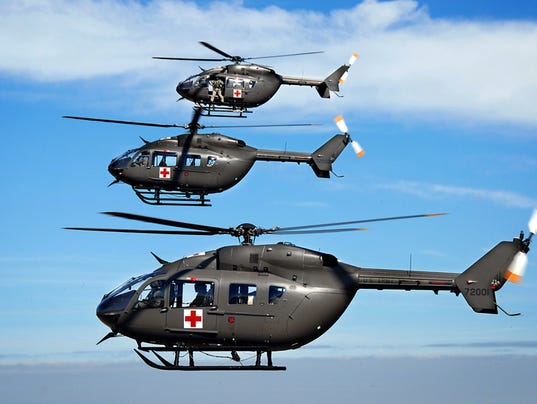
US Army begins process to buy 35 more UH-72s

The US Army on 4 January took the first step in the process to award a contract to Airbus for up to 35 more UH-72 Lakota helicopters.
The notice notes that only Airbus owns the technical data on the UH-72, which means any potential competitor would have to acquire the data from the OEM to build the twin-engined aircraft.
Airbus has delivered more than 400 UH-72s to the army since 2006. The re-designated H145 aircraft lack a military airworthiness certificate by design, rendering the fleet limited to peacetime support roles. In 2014, the army also selected the UH-72A to replace the Bell Helicopter TH-67 as a primary trainer.
The army’s approved budget in Fiscal 2017 contains funds to buy 23 UH-72As, so up to another 12 could be purchased later.
Airbus assembles the UH-72 from a factory in Columbus, Mississippi, although major components are built in Europe.
The new order from the army is necessary to keep the facility open.
flightglobal

Dec 8, 2015

Army Lifts US Helicopter Fleet Grounding Triggered by Fatal Crashes

The U.S. Army on Monday night ended a weeklong grounding of its stateside rotary fleet of more than 1,100 aircraft after a five-day shutdown to review safety procedures, the service said.
The grounding came after three helicopters in as many locations crashed within 10 days, killing a total of eight soldiers.
The training accidents brought the total of Class A mishaps -- accidents in which there is a fatality or more than $2 million damage -- to four in fiscal 2016, which began on Oct. 1, according to the Army’s Combat Readiness Center.
By comparison, a total of 13 such accidents occurred in all of fiscal 2015, resulting in 15 fatalities, according to the center.
military

Apr 21, 2015

Poland Selects Patriot, Caracal Helos

Poland has selected the US Patriot system and the Airbus Caracal helicopter as the European nation faces an increasingly aggressive Russia.
A spokesman at the Polish Embassy in Washington confirmed that the nation has chosen the Patriot over the Aster 30, a system offered by a European consortium of MBDA and the Thales Group.
Developed by Raytheon, the Patriot is used by the US Army along with fifteen partner nations. That includes Poland's NATO partners Spain, the Netherlands, Greece and Germany.
That NATO relationship appears to have given Patriot as boost in the competition.
Poland also has chosen the Caracal from Airbus Helicopters, beating competition from the Sikorsky S-70 Black Hawk and AgustaWestland AW149, the Airbus unit said on Tuesday.
The pre-selection of the Caracal is for 60 military multirole helicopters under.
Poland also has a requirement for some 30 combat helicopters, for which Airbus will pitch its Tiger.
defensenews

Apr 20, 2015

US Army Plans Removing 24 Apaches from Europe To Alaska

The US Army plans to transfer 24 attack helicopters from Germany to Alaska over the next two years as part of a larger cost-saving aviation plan, by 2017.
Only one US Army combat aviation brigade is permanently stationed in Europe.
The Apaches are part of the Army's overarching aviation restructure, billed by the service as means to save $12 billion. The active component would divest itself of the OH-58D Kiowa Warrior fleet and pull Apaches from the National Guard to fill the gap, providing UH-60 Black Hawk helicopters in turn. The Army would also close three of its 13 combat aviation brigades.
The 24 Apaches planned for Alaska will come from "reset facilities," and go to Fort Wainwright, in Fairbanks, to convert the 6th Squadron, 17 Cavalry Regiment, into an armed reconnaissance squadron.
The 12 Gray Eagles would be stationed in Alaska, though the exact location is under negotiations with the Air Force. The Army is seeking to station them at Eielson Air Force Base in Fairbanks, though the Air Force also operates at Joint Base Elmendorf-Richardson in Anchorage, where the Federal Aviation Administration has approved the use of unmanned aviation.
defensenews

Apr 9, 2015

US Army To Acquire Six DHC-8 For Special Missions

The US Army is procuring six de Havilland Canada DHC-8-315 (Dash 8) special mission aircraft in the 'Saturn Arch' and 'Desert Owl' configurations, the Department of Defense (DoD) disclosed on 7 April.
Six aircraft will be delivered to the army by 17 July. The announcement did not specify how many of the six aircraft would be Saturn Arch and how many Desert Owl.
The DHC-8 is one of several platform types the US Army uses to conduct its Airborne Reconnaissance Low (ARL) mission.
In this ARL-E configuration the aircraft is kitted out with high-resolution electro-optical-infrared (EO/IR) imaging, digital mapping, and full motion video (FMV), as well as signals intelligence (SIGINT), communications intelligence (COMINT), foliage penetrating (FOPEN) radar, ground moving target indication/synthetic aperture radar (GMTI/SAR), dismount moving target indicator (DMTI), and ground penetrating (GPEN) radar equipment. Its six operator work stations will be Distributed Common Ground System - Army (DCGS-A) compliant.
Within this ARL-E mission, the Saturn Arch configuration is geared towards neutralising improvised explosive devices (IEDs).
Also first fielded in 2010, Desert Owl is an ISR capability to simultaneously conduct measurement and signature intelligence (MASINT) and imagery intelligence (IMINT) missions in near all-weather conditions.
While the DoD contract notification does not state where these Saturn Arch and Desert Owl platforms might be operated, likely theatres include Afghanistan , East Africa (Djibouti), and South Korea.
janes

Mar 12, 2015

Italian Typhoons Jets Scramble to Intercept Russian IL-78 Fuel Tanker Over Baltic Sea

Italian Eurofighter Typhoon jets protecting airspace over the Baltic states were deployed to intercept a Russian refueling aircraft over the Baltic Sea, Latvian National Armed Forces said via Twitter.
The IL-78 is an air-to-air refueling tanker and is part of a regiment based in western Russia's Ryazan Region nearly 200 kilometers southeast of Moscow.
Over the past few months, several NATO members have expressed concern over Russia's alleged violations of their airspace. The Russian Ministry of Defense retorted, however, that the Russian Air Force's routine flights are in compliance with international agreements and do not violate foreign airspace.
Moreover, the air force command criticized these allegations as distractions from NATO's military buildup in the Baltic region along Russia's western borders.
On Monday, over 120 armored units, including Abrams tanks and Bradley armored vehicles, arrived in Latvia from the United States. Similar equipment, including two groups of US paratroopers, is expected to arrive this week in neighboring Estonia to take part in joint military drills involving 13,000 soldiers.
The nearly year-long conflict in southeast Ukraine has served as justification for NATO's expansion in Eastern Europe.
sputniknews

Feb 26, 2015

US Army Not Interested in Taking A-10 from USAF

The U.S. Army has no interest in taking over the Air Force’s fleet of A-10 attack planes, even if it would save the venerable Cold War-era aircraft from the bone yard.
The service’s top civilian, Army Secretary John McHugh, rejected the idea of accepting hand-me-down A-10 Warthogs from the Air Force.
Meanwhile, on Capitol Hill, Air Force Secretary Deborah Lee James defended the service’s renewed budget proposal to begin retiring its fleet of almost 300 Warthogs — even as pilots fly the gunship in the Middle East to attack militants affiliated with the Islamic State in Iraq and Syria.
Over the past decade-plus of war in Iraq and Afghanistan, James said, “the A-10 has done a magnificent job, but so has the F-16 and the F-15E, and the B-1 bomber has been a contributor and there have been a number of aircraft that have contributed to the totality of close-air support. So to me, close-air support is not a plane, it’s a mission.”
If lawmakers approve the Air Force’s budget request for fiscal 2016, which begins Oct. 1, the service would divest the A-10 over a period of five years and save an estimated $4 billion during that period.
Congress blocked the service’s previous budget request to retire the aircraft, but allowed it to move as many 36 of the planes to back-up status. The shift will free up more maintainers to work on the F-35 Joint Strike Fighter.
dodbuzz

Feb 17, 2015

US Army Orders 41 UH-72 Lakota Helicopters

Airbus has been awarded a contract modification to build 41 more UH-72A Lakota light utility helicopters for the US Army, planned as flight trainers.
The contract brings the total number of Lakota helicopters ordered to 411 — 400 for the Army or National Guard, five for the US Naval Test Pilot School and six that will go to Thailand through the foreign military sales program. Airbus has delivered 331 of the aircraft.
The 41 aircraft are all to be built at the Airbus facility in Columbus, Mississippi. The Army had used the Lakota, a militarized version of the commercial EC145, for non-combat purposes: homeland security, drug interdiction, general support, logistics and medical evacuation.
defensenews

Nov 18, 2014

US looking to replace re-manufactured MH-47Gs with newbuild helos

The US Army is looking at options for replacing its remanufactured Boeing MH-47G special-mission Chinook helicopters with newbuild platforms.
According to a request for information (RfI) released on 14 November, the Technology Applications Program Office is conducting market research in support of the acquisition for the production of replacement airframes for the currently fielded 61 legacy MH-47G aircraft.
The disclosure that the US Army is looking to replace its rebuilt MH-47G helicopters comes just weeks after the service took delivery of the first of eight newbuild platforms. With the final re-manufactured aircraft having been delivered to the US Army in 2011, these aircraft have seen an extremely high tempo of operations in the harsh environment of Afghanistan.
Used by special forces, such as the 160th Special Operations Aviation Regiment, the MH-47G differs from regular-model Chinooks in that it is equipped with double-capacity fuel tanks, an in-flight aerial refuelling probe, a digital advanced flight control system, and sensors and electronic warfare kit specified by the Special Operations Command.
janes

Nov 5, 2014

US Army Buys Its First Iron Dome from Israel

Israel had been struggling to sell the Iron Dome anti-missile defense system abroad, but the Israel Defense website revealed on Sunday that a major purchaser has been found: the United States.
Apparently the US Army will acquire one Iron Dome battery, and based on tests it will conduct on the system decide whether or not to purchase more units of the Israeli defense system that reportedly boasted a 90% hit rate in Operation Protective Edge.
Israel Defense notes that at the beginning of Iron Dome's development the US Army didn't have much confidence in the system, which is why it was funded with a special budget and not the ordinary annual US defense budget that is allocated for other anti-missile systems such as the Arrow.
Having seen the system proven in war, the US now apparently is considering deploying it to defend military establishments and US soldiers around the world.
By doing so, Iron Dome may be included in the "normal" defense budget for Israel, which requires roughly 75% of Israel's defense spending to be of American-made military hardware. It also will allow Israel and the US to offer the system for sale to several other countries, such as Poland, Ukraine and South Korea.
India has also reportedly been interested in buying the Israeli-made system.
israelnationalnews

Oct 15, 2014

Sikorsky, Boeing Expect To Fly JMR Demonstrator in '17

The SB-1 Defiant, being developed by Boeing and Sikorsky for the Army’s Joint Multi-Role (JMR) program, is on track for first flight in fiscal 2017.
The JMR program is the opening stage of the Army’s future vertical lift program that aims to replace its Apache and Black Hawk fleets. A downselect in August left the SB-1 team competing with Bell Helicopter and its V-280 Valor tiltrotor design.
The Defiant is a coaxial design, featuring counter-rotating rigid main rotor blades for vertical and forward flight. The program heads said the design gives greater maneuverability, including the ability to hover and tilt the nose 20 degrees up or 20 degrees down with minimal downwash.
defensenews

Oct 14, 2014

US Army Configures Apaches for Sea Duty

The U.S. Army is engineering its Apache AH-64 attack helicopters with additional avionics, radar and sensor technology to perform better in maritime environments.
The Army plans to test these and other upgrades in 2017 in order to keep the attack helicopter platform current into the 2050s.
The upgrades will also give the Apache the ability to better communicate with assets from other services through a connection with LINK 16, a digital data link used widely by the Air Force and Navy.
The first AH-64E Block III Apaches are now returning from combat service in Afghanistan, after deploying this past September.
dodbuzz

Oct 6, 2014

Army Apache helos used in strikes against Islamic State

US Army pilots for the first time used an Apache attack helicopter to strike Islamist militant targets in Iraq over the weekend, according to a statement by CENTCOM.
On Oct. 4, “U.S. military forces used attack bomber, fighter and helicopter aircraft to conduct six airstrikes against ISIL in Iraq”.
On July 1, the Pentagon announced that it was sending an unspecified number of Apaches to Baghdad to help protect embassy personnel in an increasingly uncertain situation as Islamist extremists allied with Sunni tribes continued to take swaths of territory in the north and west of the country. The U.S. military also sent a number of RQ-7 Shadow drones to Baghdad at the same time.
The Saturday strikes near Fallujah struck two mortar teams and what CENTCOM characterized as “a large ISIL unit and two small ISIL units.”
navytimes

Oct 4, 2014

S-97 Raider Helicopter Unveiled

Sikorsky unveiled its first S-97 Raider prototype Thursday, kicking off the test flight phase of the experimental helicopter program.
The Raider is Sikorsky’s planned entry to replace the US Army’s OH-58D Kiowa Warrior fleet.
The Raider prototype is based on the X-2 technology that Sikorsky developed in the late 2000s, with some key differences. Where the X-2 demonstrator was a one-person, 5,000-pound platform, the Raider is roughly 11,000 pounds with room for six troops for combat assault missions; if those troops aren’t needed, that space can be used to hold extra equipment or ammunition.
Sikorsky has expressed confidence it will go hand in hand with unmatched speed. The company has claimed speeds of 220 knots (253 mph), which would be significantly faster than conventional military rotorcraft.
defensenews

Jun 29, 2014

Boeing proposes high-speed Apache, heavier Chinook

As the US Department of Defense pursues a family of high-speed rotorcraft, Boeing officials say two stalwarts of the current fleet – the AH-64 Apache and CH-47 Chinook – must be kept viable for decades to come.
The AH-64E entered service last year, but an F-model is already on the drawing boards. Some upgrades – the 3,000shp turboshaft in development under the army’s improved turbine engine programme (ITEP).
Boeing officials also believe high-speed capabilities can be added to the 40-year-old Apache design. Possibilities include adding a retractable landing gear, wingstubs to offload lift from a single main rotor in high-speed cruise and a tail rotor that articulates 90° to provide forward thrust.
Boeing is scheduled to deliver the last CH-47F in Fiscal 2019, ending a production run that began in 1961. Boeing now is proposing to remanufacture F-models with a higher gross weight.
In the past, Boeing has proposed a 31,800kg (70,000lb) class variant with a 30cm (1in) wider fuselage to accommodate up-armoured HMMWV (Humvee) trucks. Budget realities have forced the company to propose a more modest solution now. The “H-model” CH-47, as proposed, strengthens the airframe and the propulsion system to lift 24,500kg, or about 1,810kg more than the existing helicopter.
The proposals seem to clash with the company’s interests in the Future Vertical Lift (FVL) programme. Boeing has teamed with Sikorsky to develop the high-speed SB-1 Defiant for the joint multi-role technology demonstrator (JMR-TD), which is a intended to be a scaled down version of the FVL-Medium concept to replace the Sikorsky UH-60 Black Hawk after 2030.
flightglobal

Jun 24, 2014

US Army moves Apache helicopters to Hawaii

Eight U.S. Army’s Apache Helicopters arrived in Hawaii on Friday for this summer’s Rim of the Pacific joint exercises, after which half of those Apache Guardians will be sent deeper into Asia as part of the Army’s Pacific Pathways initiative.
Under Pacific Pathways, the Army is developing small units that will be forward-deployed for quick response to humanitarian emergencies or regional threats. Between actual crises, the units will train with various partner countries.
This is the first time the new Echo version of the Apache helicopter has been brought to Hawaii. Two dozen of them were deployed to Afghanistan this spring for the first time.
The eight Apaches, along with about 40 soldiers, will be in Hawaii for about two months. The aircraft will be stationed at Wheeler Army Airfield, 15 miles north of Honolulu.
Following the two-month RIMPAC exercise, two of the Apaches will join the Tiger Balm exercise held in Hawaii with Singapore.
stripes