Translate

Showing posts with label TYPE 45. Show all posts

Mar 6, 2026

HMS Dragon Delayed in Support of Defence Against Iran Threat in the Mediterranean: Nine‑to‑Five Dockyards or the Real Limits of Today’s Royal Navy?


Recent reports claiming that the deployment of HMS Dragon was delayed because a dockyard “only works nine-to-five” have circulated widely online. The phrase makes for an eye-catching headline and fits neatly into the familiar narrative of bureaucratic inefficiency. However, focusing on working hours risks missing the larger and more structural issue affecting the Royal Navy today: operational availability.

The reality is that the delay of a single destroyer rarely comes down to something as simplistic as shift patterns in a dockyard. Modern warships are extraordinarily complex systems requiring constant maintenance, specialist parts, and highly trained personnel. When a navy operates with a very limited number of hulls, any technical issue, refit delay, or crew shortfall can quickly ripple through the entire fleet schedule.

This is particularly relevant in the case of the Royal Navy’s Type 45 destroyers. The class has faced well-documented propulsion reliability issues in the past, leading to the Power Improvement Project (PIP) upgrades currently being installed across the fleet. While those upgrades will significantly improve long-term performance, they also mean that at any given moment part of the already small destroyer force is in refit or modification.

The deeper challenge therefore lies in numbers and availability. The Royal Navy currently operates six Type 45 destroyers, and maintaining continuous deployments while ships rotate through maintenance cycles inevitably stretches the force. In such circumstances, even relatively minor delays in dockyard work can appear magnified because there is little spare capacity elsewhere in the fleet.

It is worth remembering just how different the Royal Navy once looked. In 1964, the year the Admiralty was abolished and absorbed into the Ministry of Defence, Britain still maintained three major fleets — in home waters, the Mediterranean, and Singapore — each centered on an aircraft carrier, alongside standing task forces in the Gulf, the Red Sea, and Hong Kong. The scale of global presence was dramatically larger than today’s force structure.

Against that historical backdrop, the issue surrounding HMS Dragon should not really be framed as a question of dockyard working hours. The more relevant question is how a navy with global commitments manages operational readiness with a comparatively small number of frontline ships.

Headlines about “nine-to-five dockyards” may generate attention, but they obscure the more fundamental reality: the Royal Navy’s challenge today is not a lack of dedication from dockyard workers, but the constraints imposed by a reduced fleet that must still meet worldwide obligations.

May 9, 2014

Royal Navy spots russian Admiral Kuznetsov carrier

HMS Dragon,was able to monitor the movement of the seven-strong group led by Russian aircraft carrier Admiral Kuznetsov as it approached the UK.
As well as the Kuznetsov, the task group included the Kirov Class nuclear powered battle cruiser Pyotr Velikiy; three tankers; one Ocean-going Tug Altay and the Landing Support Ship Minsk.
HMS Dragon is the fourth of six Type 45 Destroyers which have entered service over the past five years.
royalnavy

Apr 27, 2014

Royal Navy warship 'monitoring' Russian naval vessel

A Royal Navy warship is monitoring the activity of a Russian destroyer as it transits past United Kingdom territorial waters.
HMS Dragon, Type 45 destroyer moved into position last week north of Scotland to be able to respond to the activity of the Russian vessel, Vice Admiral Kulakov.
In what the MoD are calling a "well-established and standard" response, HMS Dragon will track the Russian vessel as she transits south.
itv.com

Apr 21, 2014

Wildcat helicopter replacing Royal Navy's Westland Lynx passes first major test

The newest helicopter in the Royal Navy's arsenal came through its toughest test, spending a fortnight taking part in Europe's biggest naval war games.
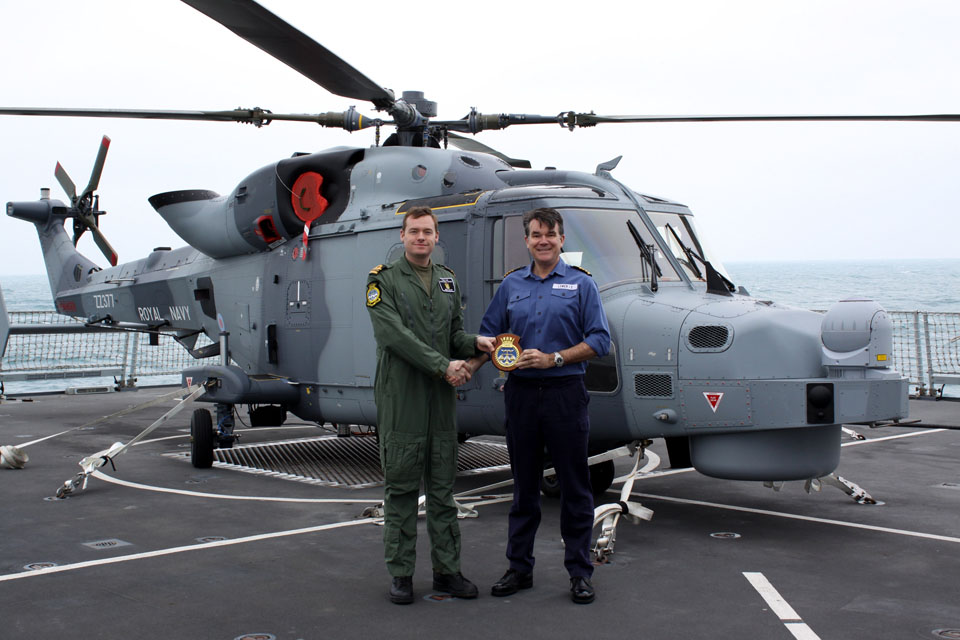
Wildcat joined HMS Dragon on Exercise Joint Warrior. It is the first time the helicopter – normally based at RNAS Yeovilton in Somerset with 700W Naval Air Squadron – has spent such a concerted time at sea, and the first time it has taken part in the exercise aboard a ship.
From next year, Wildcat will start to replace the Lynx as the mainstay of aerial operations by the Royal Navy's Type 23 frigates and Type 45 destroyers.
Although it looks similar to its predecessor, Wildcat is a different aircraft, from the way it handles, to the equipment aboard – which is a generation ahead of that on the Lynx.
Later this year Wildcat will go through two months of intensive Operational Sea Training with a Type 23 frigate to prepare ship and helicopter for deployment.
Wildcat is due to be declared operational in early 2015 and is due to deploy for the first time with a Royal Navy warship on the North Atlantic patrol next May.
westerndailypress

Mar 18, 2014

New Wildcat aircraft drops in on Type 45 Destroyer HMS Dragon for the first time

The Royal Navy’s Wildcat, the maritime attack variant of the Lynx helicopter, is currently undergoing extensive trials with 700W Naval Air Squadron.
From next year, Wildcat will begin to replace the Lynx Mark 8 as the helicopter which supports Royal Navy destroyer and frigate operations.
Wildcat will be a more permanent presence on board Dragon later this month as, for the first time, the helicopter is embarking on the ship for the latest Exercise Joint Warrior; a biannual exercise in which British and foreign armed forces hone their skills off the coast of Scotland.
The Wildcat roll-out programme continues apace, and plans are in motion for the current flight to be the first to complete operational sea training with a Type 23 frigate in the autumn.
gov.uk

Jan 31, 2014

ROYAL NAVY STRENGTHENS PRESENCE IN GIBRALTAR


The Royal Navy has sent additional personnel to Gibraltar to strengthen its Gibraltar Squadron in response to Spanish maritime incursions into British territorial waters.
The Gibraltar Squadron has increased from two to three crews – around 25 sailors in total – to enable 24-hour coverage, although the number of vessels they operate remains the same.
The decision to increase personnel was revealed in a response to a question in the House of Lords and came as Headquarters British Forces Gibraltar announced that the Royal Navy destroyer HMS Diamond was scheduled to arrive in Gibraltar on Sunday for a week-long visit as she sets out on a six month operational deployment to the Gulf.
The British Government has so far ruled out deploying larger naval vessels permanently in Gibraltar but has said repeatedly that Royal Navy warships will continue to call regularly at the Rock.
The Gibraltar Squadron’s third crew was sent to Gibraltar late last year following a rise in the number of incursions by Spanish state vessels into British Gibraltar territorial waters.
HMS Diamond is the third of six Type 45 air defence destroyers and is one of the most sophisticated warships in the world.
chronicle

Jan 1, 2014

Final Type 45 Destroyer Enters UK Royal Navy Service

The Royal Navy’s sixth and final Type 45 destroyer has entered service four months ahead of schedule.
HMS Duncan’s entry into service marks the end of a 13-year build program to provide Britain with a fleet of anti-air destroyers to replace the old Type 42 vessels, the last of which, HMS Edinburgh, was decommissioned in the summer of 2013.
The 7,500-ton warship was commissioned in September and will be based at Portsmouth along with the other vessels of its class. All of the warships were built by BAE Systems.
The first of class, HMS Daring, entered service in mid-2009. Originally, the British intended to purchase 12 destroyers but whittled the number down as costs rose and requirements changed.
The entry into service of HMS Duncan brings the Royal Navy’s surface combat fleet up to its full strength of 19 warships — Six Type 45s and 13 Type 23 frigates.
The Type 23s will be gradually replaced by the Type 26 frigate. Design work on that warship is already well advanced and a decision on building the first of the new warships is scheduled for 2016.
The government said it will place a first order with BAE covering eight Type 26s. The MoD remains committed to a fleet of 13 frigates for the time being but the actual number has been clouded slightly by a recent order of three offshore patrol boats capable of operating a Merlin helicopter.
defensenews

Nov 12, 2013

UK to send ship to help Philippines

The UK will send HMS Daring Royal Navy warship to help deal with the storm disaster.
An RAF C-17 transporter plane will be sent as well.
Up to 10,000 people are feared to have been killed.
Britain is contributing £10m and HMS Daring, currently deployed near Singapore, will shortly be heading at full speed towards the disaster zone with further support from an RAF C-17 which will be a powerful help to the relief operation.
The additional support announced by the prime minister will provide aid flights to Cebu in the eastern Philippines, the delivery of temporary shelters, blankets and water purification tablets to 300,000 people, and household goods for water treatment and storage.
Launched in 2006, HMS Daring was the first of the Navy's six £1bn Type 45 destroyers.
It has a Lynx helicopter on board and has equipment to make drinking water from seawater.

bbc.co.uk

Dec 7, 2012

Final Type 45 Destroyer Completes Trials On The Clyde


It was a programme that arguably saved the Clyde shipyards, albeit with half the number of ships first mooted, but HMS DUNCAN is the final vessel of the Type 45 programme to near handover to the Royal Navy

She returned after her second and final sea trials to the Scotstoun shipyard where she has been fitting out since her launch at Govan shipyard on the South Bank of the river on 11 October 2010.

nosint

shippingtimes

Nov 18, 2012

Royal Navy Sea King Mk7 Airborne Surveillance meets Type 45 for first time


TheSea King from 854 Naval Air Squadron worked with HMS Diamond while deployed in the Gulf.
They are two of the Royal Navy Fleet's most recognisable assets, but although Type 45 destroyers have been around for a good four years and the Baggers have been flying since the mid-80s in various forms, never the twain have met, until now.
mod.uk

Oct 6, 2012

HMS Diamond foils F-15 'attack'


Type 45 destroyer HMS Diamond tested her mettle against two of the fastest jet fighters in the world when she played cat and mouse with US Air Force F-15 Strike Eagles.
learn more

Sep 10, 2012

Final Type 45 destroyer begins trials

The last of the Royal Navy's Type 45 air defence destroyers has put to sea to begin an extensive period of sea trials, it has been announced.
The future HMS Duncan left BAE's Scotstoun shipyard on 31 August and will be put through her paces by personnel from the Royal Navy, Ministry of Defence and BAE Systems before eventually being commissioned into the fleet.
Duncan is set to spend the next four weeks trialling power and propulsion systems, while combat systems and sensors will be tested during a second set of sea trials later this year.
Sister ships HMS Daring, HMS Dauntless, HMS Diamond and HMS Dragon have already been commissioned into the Royal Navy fleet, while Duncan and Defender are expected to be commissioned in 2013.

learn more