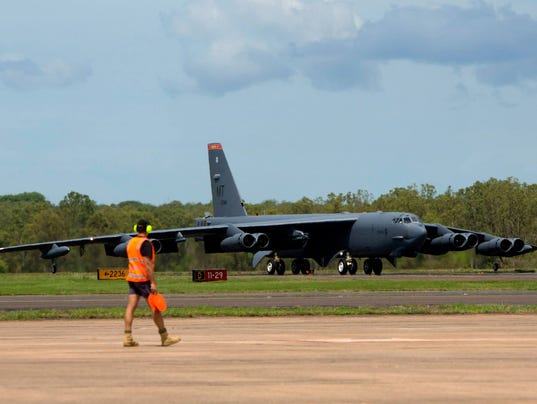
USAF announced April 17 it will no longer base strategic bombers outside of the continental United States, marking an end to the service’s 16-year continuous bomber presence at Andersen Air Force Base, Guam.
But before the last bomber left the island, USAF reminded the world of its combat power with an impressive “elephant walk” that included five B-52 strategic bombers, six KC-135 tankers, an MH-60S Knighthawk helicopter, an RQ-4 Global Hawk, and a U.S. Navy MQ-4C Triton.
airforcemag
Translate
Showing posts with label GUAM. Show all posts
Apr 22, 2020
Apr 2, 2020
USS Theodore Roosevelt Sailors will be quarantined in Guam hotels
The governor of Guam announced Wednesday the territory will provide vacant hotel rooms to house crew from the USS Theodore Roosevelt who do not have coronavirus.
Nearly 100 sailors have tested positive for COVID-19 since the San Diego-based aircraft carrier docked at Guam last week, and the ship’s captain appealed to the Navy to provide shore housing for his crew to prevent further cases.
Gov. Lou Leon Guerrero and Rear Adm. John Menoni, commander of the Navy’s Joint Region Marianas, announced the quarantine plan at news conference in Hagatna, the island’s capital.
timesofsandiego
Nearly 100 sailors have tested positive for COVID-19 since the San Diego-based aircraft carrier docked at Guam last week, and the ship’s captain appealed to the Navy to provide shore housing for his crew to prevent further cases.
Gov. Lou Leon Guerrero and Rear Adm. John Menoni, commander of the Navy’s Joint Region Marianas, announced the quarantine plan at news conference in Hagatna, the island’s capital.
timesofsandiego
Etiquetas:
GUAM,
UNITED STATES,
US NAVY,
USA,
USS THEODORE ROOSVELT
May 5, 2018
US Air Force B-52s patrol South China Sea
The Air Force on April 24 flew B-52H Stratofortress bombers to the South China Sea as part of a training mission.
Pacific Air Forces spokeswoman Lt. Col. Megan Schafer said the B-52s took off from Andersen Air Force Base in Guam, where they conducted a training mission in the vicinity of the South China Sea. The bombers then flew to the Okinawa, Japan, area to train with American F-15C Strike Eagles before returning to Guam.
The bombers were among six B-52s the Air Force deployed to Guam from Barksdale Air Force Base in Louisiana in January.
airforcetimes
Pacific Air Forces spokeswoman Lt. Col. Megan Schafer said the B-52s took off from Andersen Air Force Base in Guam, where they conducted a training mission in the vicinity of the South China Sea. The bombers then flew to the Okinawa, Japan, area to train with American F-15C Strike Eagles before returning to Guam.
The bombers were among six B-52s the Air Force deployed to Guam from Barksdale Air Force Base in Louisiana in January.
airforcetimes
Jan 20, 2018
B-52 bombers join B-2s, B-1s in Guam for second time in history
About a week after the Air Force deployed three B-2 Spirit stealth bombers to Guam, six B-52H Stratofortress bombers joined them on the island Tuesday.
The B-52s from Barksdale Air Force Base, Louisiana deployed to Andersen Air Force Base along with about 300 airmen. The aircraft and personnel will support the U.S. Pacific Command’s continuous bomber presence mission, replacing six B-1B Lancer bombers, which are scheduled to return home to Ellsworth Air Force Base, South Dakota, at the end of this month.
But for a few days at least, all three types of bombers — the nuclear-capable B-2s and B-52s and the conventional B-1Bs — will be flying together out of the U.S. territory in the Pacific, just the second time that has happened, according to a Pacific Air Forces news release. The first time was in August 2016 as part of an historic integrated bomber operation.
The B-2 Spirits and about 200 airmen, assigned to the 509th Bomb Wing at Whiteman Air Force Base in Missouri, arrived Jan. 8 in support of U.S. Pacific Command’s bomber assurance and deterrence mission.
airforcetimes
The B-52s from Barksdale Air Force Base, Louisiana deployed to Andersen Air Force Base along with about 300 airmen. The aircraft and personnel will support the U.S. Pacific Command’s continuous bomber presence mission, replacing six B-1B Lancer bombers, which are scheduled to return home to Ellsworth Air Force Base, South Dakota, at the end of this month.
But for a few days at least, all three types of bombers — the nuclear-capable B-2s and B-52s and the conventional B-1Bs — will be flying together out of the U.S. territory in the Pacific, just the second time that has happened, according to a Pacific Air Forces news release. The first time was in August 2016 as part of an historic integrated bomber operation.
The B-2 Spirits and about 200 airmen, assigned to the 509th Bomb Wing at Whiteman Air Force Base in Missouri, arrived Jan. 8 in support of U.S. Pacific Command’s bomber assurance and deterrence mission.
airforcetimes
Jan 13, 2018
B-2 Spirit stealth bombers, 200 airmen deploy to Guam
Three B-2 Spirit stealth bombers and approximately 200 airmen arrived at Andersen Air Force Base on Guam Monday.
The aircraft and airmen, assigned to the 509th Bomb Wing at Whiteman Air Force Base in Missouri, deployed to Guam in support of U.S. Pacific Command’s bomber assurance and deterrence mission, according to Pacific Air Forces.
During this “short-term deployment,” the B-2s will conduct local and regional training sorties. They will also work with “key regional partners, ensuring bomber crews maintain a high state of readiness and crew proficiency.”
The nuclear-capable stealth bombers join several B-1B Lancer conventional bombers at Andersen Air Force Base. PACOM has said the Lancers are “ready to fulfill [U.S. Forces Korea’s] Fight Tonight mission if called upon to do so.”
airforcetimes
The aircraft and airmen, assigned to the 509th Bomb Wing at Whiteman Air Force Base in Missouri, deployed to Guam in support of U.S. Pacific Command’s bomber assurance and deterrence mission, according to Pacific Air Forces.
During this “short-term deployment,” the B-2s will conduct local and regional training sorties. They will also work with “key regional partners, ensuring bomber crews maintain a high state of readiness and crew proficiency.”
The nuclear-capable stealth bombers join several B-1B Lancer conventional bombers at Andersen Air Force Base. PACOM has said the Lancers are “ready to fulfill [U.S. Forces Korea’s] Fight Tonight mission if called upon to do so.”
airforcetimes
Feb 12, 2016
U.S. Pacific Air Forces chooses Tinian Island as divert airfield
The famous World War II island where a B-29 named Enola Gay and its pilot, Col. Paul Tibbets Jr., came together Aug. 6, 1945, to lead a mission that would deploy a uranium bomb known as "Little Boy" over Hiroshima, Japan, is soon to be back in use.
Tinian Island, just north of Guam, has been selected as a preferred alternative divert and exercise training island.
The plan will also improve and support the Tinian airport, which would be able to take up to 12 tanker aircraft and support personnel.
airforcetimes
Tinian Island, just north of Guam, has been selected as a preferred alternative divert and exercise training island.
The plan will also improve and support the Tinian airport, which would be able to take up to 12 tanker aircraft and support personnel.
airforcetimes
Jan 10, 2016
U.S. flies B-52 over South Korea after North's nuclear test
The United States deployed a B-52 bomber on a low-level flight over its ally South Korea on Sunday, a show of force following North Korea's nuclear test last week.
North Korean leader Kim Jong Un maintained that Wednesday's test was of a hydrogen bomb and said it was a self-defensive step against a U.S. threat of nuclear war.
North Korea's fourth nuclear test angered both China, its main ally, and the United States, although the U.S. government and weapons experts doubt the North's claim that the device was a hydrogen bomb.
The massive B-52, based in Guam and capable of carrying nuclear weapons, could be seen in a low flight over Osan Air Base at around noon (0300 GMT). It was flanked by two fighter planes, a U.S. F-16 and a South Korean F-15, before returning to Guam.
The United States is also considering sending a nuclear-powered aircraft carrier to waters off the Korean peninsula next month to join a naval exercise with Seoul.
reuters
North Korean leader Kim Jong Un maintained that Wednesday's test was of a hydrogen bomb and said it was a self-defensive step against a U.S. threat of nuclear war.
North Korea's fourth nuclear test angered both China, its main ally, and the United States, although the U.S. government and weapons experts doubt the North's claim that the device was a hydrogen bomb.
The massive B-52, based in Guam and capable of carrying nuclear weapons, could be seen in a low flight over Osan Air Base at around noon (0300 GMT). It was flanked by two fighter planes, a U.S. F-16 and a South Korean F-15, before returning to Guam.
The United States is also considering sending a nuclear-powered aircraft carrier to waters off the Korean peninsula next month to join a naval exercise with Seoul.
reuters
Etiquetas:
B-52,
GUAM,
North Korea,
SOUTH KOREA,
UNITED STATES,
USAF
Dec 6, 2015
Russian Bombers Circle Guam
Russian bombers circled the U.S. military hub on the Pacific island of Guam last week in the latest case of Moscow’s nuclear saber rattling.
“On Nov. 25th, two Russian bomber aircraft circumvented Guam, transiting international airspace,” said Army Maj. Dave Eastburn, a Pacific Command spokesman.
The latest bomber flights around the island were the fourth time in the past three years that Russian bombers circumnavigated Guam.
Earlier incursions took place on Dec. 13 and Nov. 12, 2014, and Feb. 12, 2013. During the 2013 incident, U.S. F-15 jets were scrambled to intercept the bombers.
Eastburn declined to specify the exact type of bombers involved in the circumnavigation and sought to play down the incident, noting that the flights “in no way” violated U.S. airspace around the island.
Other officials said the bombers were Tu-95 Bear H nuclear-capable bombers.
One defense official said Japanese jet fighters intercepted the bombers during an earlier stage of the Guam overflight.
Tu-95s are known to carry Russia’s new long-range Kh-55SM cruise missiles, which can be armed with either nuclear or conventional warheads and have a range of up to 1,800 miles.
The command said in a statement no U.S. jets were dispatched to intercept the Russian bombers since the aircraft were flying in international airspace.
freebeacon
“On Nov. 25th, two Russian bomber aircraft circumvented Guam, transiting international airspace,” said Army Maj. Dave Eastburn, a Pacific Command spokesman.
The latest bomber flights around the island were the fourth time in the past three years that Russian bombers circumnavigated Guam.
Earlier incursions took place on Dec. 13 and Nov. 12, 2014, and Feb. 12, 2013. During the 2013 incident, U.S. F-15 jets were scrambled to intercept the bombers.
Eastburn declined to specify the exact type of bombers involved in the circumnavigation and sought to play down the incident, noting that the flights “in no way” violated U.S. airspace around the island.
Other officials said the bombers were Tu-95 Bear H nuclear-capable bombers.
One defense official said Japanese jet fighters intercepted the bombers during an earlier stage of the Guam overflight.
Tu-95s are known to carry Russia’s new long-range Kh-55SM cruise missiles, which can be armed with either nuclear or conventional warheads and have a range of up to 1,800 miles.
The command said in a statement no U.S. jets were dispatched to intercept the Russian bombers since the aircraft were flying in international airspace.
freebeacon
Etiquetas:
F-15,
GUAM,
RUSSIA,
RUSSIAN AIR FORCE,
TU-95,
UNITED STATES,
USA,
USAF
Mar 12, 2015
U.S. asks Vietnam to stop helping Russian bomber flights
The United States has asked Vietnam to stop letting Russia use a former U.S. base to refuel nuclear-capable bombers engaged in shows of strength over the Asia-Pacific region, exposing strains in Washington's steadily warming relations with Hanoi.
The request, comes as U.S. officials say Russian bombers have stepped up flights in a region already rife with tensions between China, U.S.-ally Japan and Southeast Asian nations.
The planes had conducted "provocative" flights, including around the U.S. Pacific Ocean territory of Guam, home to a major American air base.
It is the first time that U.S. officials have confirmed the role of Cam Ranh Bay, a natural deep-water harbor, in Russian bomber plane activity that has increased globally.
The planes that circled Guam were refueled by Russian tankers flying from the strategic bay, which was transformed by the Americans during the Vietnam War into a massive air and naval base.
Vietnam's willingness to allow Russia to use Cam Ranh Bay reflects Hanoi's complex position in a geopolitical tug-of-war that frequently pits China and Russia on one side and the United States, Japan and much of Southeast Asia on the other.
The Vietnamese government did not immediately respond to a request for comment on the U.S. request.
Russia's Defense Ministry said on Jan. 4 that Russian Il-78 tanker aircraft had used Cam Ranh Bay in 2014, enabling the refueling of nuclear-capable TU-95 "Bear" strategic bombers, a statement also reported in Vietnam's state-controlled media.
Last year, NATO conducted more than 100 intercepts of Russian aircraft, about three times as many as in 2013.
Russian bomber patrol flights, a Cold War-era practice, were cut back after the fall of the Soviet Union but President Vladimir Putin revived them in 2007.
Russia said in November it planned to send long-range bombers on patrols over North American waters but the Pentagon played this down at the time as routine training in international airspace.
reuters
The request, comes as U.S. officials say Russian bombers have stepped up flights in a region already rife with tensions between China, U.S.-ally Japan and Southeast Asian nations.
The planes had conducted "provocative" flights, including around the U.S. Pacific Ocean territory of Guam, home to a major American air base.
It is the first time that U.S. officials have confirmed the role of Cam Ranh Bay, a natural deep-water harbor, in Russian bomber plane activity that has increased globally.
The planes that circled Guam were refueled by Russian tankers flying from the strategic bay, which was transformed by the Americans during the Vietnam War into a massive air and naval base.
Vietnam's willingness to allow Russia to use Cam Ranh Bay reflects Hanoi's complex position in a geopolitical tug-of-war that frequently pits China and Russia on one side and the United States, Japan and much of Southeast Asia on the other.
The Vietnamese government did not immediately respond to a request for comment on the U.S. request.
Russia's Defense Ministry said on Jan. 4 that Russian Il-78 tanker aircraft had used Cam Ranh Bay in 2014, enabling the refueling of nuclear-capable TU-95 "Bear" strategic bombers, a statement also reported in Vietnam's state-controlled media.
Last year, NATO conducted more than 100 intercepts of Russian aircraft, about three times as many as in 2013.
Russian bomber patrol flights, a Cold War-era practice, were cut back after the fall of the Soviet Union but President Vladimir Putin revived them in 2007.
Russia said in November it planned to send long-range bombers on patrols over North American waters but the Pentagon played this down at the time as routine training in international airspace.
reuters
Etiquetas:
GUAM,
RUSSIA,
RUSSIAN AIR FORCE,
TU-95,
UNITED STATES,
USA,
VIETNAM
Dec 22, 2014
Russian Nuclear Bombers Again Buzz Guam
Russian strategic bombers conducted a third circumnavigation of the U.S. Pacific island of Guam last week as other bombers flew close to Alaska and Europe, defense officials said.
Two Tu-95 Bear H bombers made the flight around Guam, , on Dec. 13. No U.S. interceptor jets were dispatched to shadow the bombers.
Separately, two Canadian F-18s intercepted two Bear bombers that intruded into the Alaska air defense identification zone on Dec. 8.
Around the same time in Europe, NATO jets intercepted Russian Tu-95 and Tu-22 Backfire bombers also conducting provocative flights.
Russian warplanes, including four Bear Hs and two Tu-22M Backfire bombers were shadowed as they flew simulated bombing runs from bases in Russia to the Baltic Sea enclave of Kaliningrad for four days beginning on Dec. 7.
Regarding the Guam air defense zone incursions, “U.S. Pacific Command can confirm that two aircraft entered Guam’s outer air defense identification zone on Dec. 13”.
The aircraft were flying safely in international airspace and in accordance with international norms; as such, the decision was made to not intercept them.
It was the second time in a month that nuclear-capable Russian bombers buzzed the island.
Earlier Russian bomber flights around the 36-mile-long island took place in November and on Feb. 12, 2013. During the 2013 incursion, F-15 jets were scrambled to intercept the part of bombers.
Both earlier flights were timed to political events, including President Obama’s meeting with Putin in Australia and the president’s state of the union message in 2013.
The latest bomber flights near Guam appear timed to the Obama administration’s plan for imposing additional economic sanctions on Russia for its military annexation of Ukraine’s Crimea and continuing destabilization operations in eastern Ukraine.
freebeacon
Two Tu-95 Bear H bombers made the flight around Guam, , on Dec. 13. No U.S. interceptor jets were dispatched to shadow the bombers.
Separately, two Canadian F-18s intercepted two Bear bombers that intruded into the Alaska air defense identification zone on Dec. 8.
Around the same time in Europe, NATO jets intercepted Russian Tu-95 and Tu-22 Backfire bombers also conducting provocative flights.
Russian warplanes, including four Bear Hs and two Tu-22M Backfire bombers were shadowed as they flew simulated bombing runs from bases in Russia to the Baltic Sea enclave of Kaliningrad for four days beginning on Dec. 7.
Regarding the Guam air defense zone incursions, “U.S. Pacific Command can confirm that two aircraft entered Guam’s outer air defense identification zone on Dec. 13”.
The aircraft were flying safely in international airspace and in accordance with international norms; as such, the decision was made to not intercept them.
It was the second time in a month that nuclear-capable Russian bombers buzzed the island.
Earlier Russian bomber flights around the 36-mile-long island took place in November and on Feb. 12, 2013. During the 2013 incursion, F-15 jets were scrambled to intercept the part of bombers.
Both earlier flights were timed to political events, including President Obama’s meeting with Putin in Australia and the president’s state of the union message in 2013.
The latest bomber flights near Guam appear timed to the Obama administration’s plan for imposing additional economic sanctions on Russia for its military annexation of Ukraine’s Crimea and continuing destabilization operations in eastern Ukraine.
freebeacon
Etiquetas:
ALASKA,
BALTIC,
CANADA,
GUAM,
ROYAL CANADIAN AIR FORCE,
RUSSIA,
RUSSIAN AIR FORCE,
TU-22M3,
TU-95,
UNITED STATES,
USA,
USAF
Dec 13, 2014
USAF B-52 lands in Australia for training
An Air Force B-52, along with a KC-135 refueling tanker, landed in Australia on Monday to train with the Royal Australian Air Force, marking the fourth time a Superfortress has landed down under since 2012.
The U.S. and Australia in 2011 agreed on a joint Force Posture Initiative to train together to face threats in the Pacific.
The B-52, assigned to Andersen Air Force Base, Guam, and deployed from Minot Air Force Base, North Dakota, touched down at RAAF. The Air Force has bombers deployed to Guam on a constant rotational basis.
The training mission will include simulated ordnance drops at the Delamere Training Range and a fighter intercept exercise, according to Pacific Air Forces.
airforcetimes
The U.S. and Australia in 2011 agreed on a joint Force Posture Initiative to train together to face threats in the Pacific.
The B-52, assigned to Andersen Air Force Base, Guam, and deployed from Minot Air Force Base, North Dakota, touched down at RAAF. The Air Force has bombers deployed to Guam on a constant rotational basis.
The training mission will include simulated ordnance drops at the Delamere Training Range and a fighter intercept exercise, according to Pacific Air Forces.
airforcetimes
Jun 13, 2014
Russian Bombers Fly 50 Miles off California. F-22s and F-15s intercept them
Four Russian Tu-95 strategic bombers triggered U.S. air defense systems while conducting practice bombing runs near Alaska this week, with two of the Tu-95 Bear H aircraft coming within 50 miles of the California coast, the North American Aerospace Defense Command (Norad) confirmed Wednesday.
The last time it was saw anything similar was two years ago on the Fourth of July.
The latest Bear H incursions began Monday around 4:30 p.m. Pacific time when radar detected the four turbo-prop powered bombers approaching the U.S. air defense zone near the far western Aleutian Islands.
Two U.S. Air Force F-22 jets were scrambled and intercepted the bombers over the Aleutians.
After tracking the bombers as they flew eastward, two of the four Bears turned around and headed west toward the Russian Far East.
The remaining two nuclear-capable bombers then flew southeast and around 9:30 pm entered the U.S. northern air defense zone off the coast of Northern California.
Two U.S. F-15 jets were deployed and intercepted the bombers as they eventually flew within 50 miles of the coast before turning around and heading west.
The four bombers also were supported by two IL-78 aerial refueling tankers that were used for mid-air refueling during the operation.
The aircraft acted professionally. The bombers appeared to be conducting a training mission.
They typically do long range aviation training in the summer and it is not unusual for them to be more active during this time, and they did not enter territorial airspace.
The bomber incursion is the latest Russian nuclear saber-rattling amid stepped up tensions over Moscow’s military annexation of Ukraine’s Crimea.
A member of the House Armed Services Committee, called the Russian flights “intentional provocations.”
The Alaska-California bombers flight also came a month after a Russian Su-27 interceptor jet flew dangerously close to a U.S. RC-135 reconnaissance aircraft flying over the Sea of Okhotsk, north of Japan.
In that incident on April 23, the Su-27 jet flew close to the RC-135, turned to reveal its air-to-air missiles to the crew, and then flew dangerously close to within 100 feet of the cockpit in a maneuver military officials called reckless.
In the past 10 years, 50 Bear H bombers were intercepted near U.S. air defense zone, although he Monday’s flight near California was unusual.
In February 2013, two of the bombers were intercepted as they circled the U.S. Pacific island of Guam, in a rare long-range incursion.
Two Bear Hs also were intercepted near Alaska on April 28, 2013.
A Russian Bear H incursion in Asia took place in in July 2013 when two Tu-95s were intercepted by Japanese and South Korean jets near the Korean peninsula and Japan’s northern Hokkaido Island.
The July 4, 2012 bomber flights near the West Coast were the first time since the Cold War that Russian jets has traveled so close to the U.S. coastline.
That action followed an earlier intrusion by Tu-95s near Alaska that were part of large-scale strategic nuclear exercises by the Russians aimed at practicing strikes on enemy air defenses.
Russia has stepped up provocative nuclear war games in recent years as part of propaganda efforts to display Moscow’s dislike of U.S. missile defenses in Europe.
freebeacon
The last time it was saw anything similar was two years ago on the Fourth of July.
The latest Bear H incursions began Monday around 4:30 p.m. Pacific time when radar detected the four turbo-prop powered bombers approaching the U.S. air defense zone near the far western Aleutian Islands.
Two U.S. Air Force F-22 jets were scrambled and intercepted the bombers over the Aleutians.
After tracking the bombers as they flew eastward, two of the four Bears turned around and headed west toward the Russian Far East.
The remaining two nuclear-capable bombers then flew southeast and around 9:30 pm entered the U.S. northern air defense zone off the coast of Northern California.
Two U.S. F-15 jets were deployed and intercepted the bombers as they eventually flew within 50 miles of the coast before turning around and heading west.
The four bombers also were supported by two IL-78 aerial refueling tankers that were used for mid-air refueling during the operation.
The aircraft acted professionally. The bombers appeared to be conducting a training mission.
They typically do long range aviation training in the summer and it is not unusual for them to be more active during this time, and they did not enter territorial airspace.
The bomber incursion is the latest Russian nuclear saber-rattling amid stepped up tensions over Moscow’s military annexation of Ukraine’s Crimea.
A member of the House Armed Services Committee, called the Russian flights “intentional provocations.”
The Alaska-California bombers flight also came a month after a Russian Su-27 interceptor jet flew dangerously close to a U.S. RC-135 reconnaissance aircraft flying over the Sea of Okhotsk, north of Japan.
In that incident on April 23, the Su-27 jet flew close to the RC-135, turned to reveal its air-to-air missiles to the crew, and then flew dangerously close to within 100 feet of the cockpit in a maneuver military officials called reckless.
In the past 10 years, 50 Bear H bombers were intercepted near U.S. air defense zone, although he Monday’s flight near California was unusual.
In February 2013, two of the bombers were intercepted as they circled the U.S. Pacific island of Guam, in a rare long-range incursion.
Two Bear Hs also were intercepted near Alaska on April 28, 2013.
A Russian Bear H incursion in Asia took place in in July 2013 when two Tu-95s were intercepted by Japanese and South Korean jets near the Korean peninsula and Japan’s northern Hokkaido Island.
The July 4, 2012 bomber flights near the West Coast were the first time since the Cold War that Russian jets has traveled so close to the U.S. coastline.
That action followed an earlier intrusion by Tu-95s near Alaska that were part of large-scale strategic nuclear exercises by the Russians aimed at practicing strikes on enemy air defenses.
Russia has stepped up provocative nuclear war games in recent years as part of propaganda efforts to display Moscow’s dislike of U.S. missile defenses in Europe.
freebeacon
Etiquetas:
ALASKA,
F-15,
F-22,
GUAM,
IL-78MD,
Japan,
NORAD,
RUSSIA,
RUSSIAN AIR FORCE,
SOUTH KOREA,
UNITED STATES,
USA,
USAF
May 6, 2014
Russian bombers fly off California and around U.S. Pacific base at Guam
As U.S. and NATO planes gather around Ukraine, long range air activity by Russian bombers in the Pacific is increasing and concerning.
Russian activity in Crimea has been accompanied by an increased presence in the Asia-Pacific region by Moscow’s long-range bombers.
Commander of the U.S. Pacific Air Forces, said that Russian patrols included air activity off the coast of California, and around the U.S. Pacific base at Guam.
At Washington’s Center for Strategic and International Studies think tank, Carlisle showed also a slide of a U.S. F-15 fighter jet intercepting a Russian Tu-95 “Bear” aircraft that was circumnavigating Guam, a base where U.S. strategic bombers are usually deployed.
Along with missions flown as far as the U.S. West Coast, Russian patrols around the Japanese islands and Korea have increased “drastically.”
Few days ago, Tu-95s were intercepted by RAF Typhoons off UK islands.
theaviationist
Russian activity in Crimea has been accompanied by an increased presence in the Asia-Pacific region by Moscow’s long-range bombers.
Commander of the U.S. Pacific Air Forces, said that Russian patrols included air activity off the coast of California, and around the U.S. Pacific base at Guam.
At Washington’s Center for Strategic and International Studies think tank, Carlisle showed also a slide of a U.S. F-15 fighter jet intercepting a Russian Tu-95 “Bear” aircraft that was circumnavigating Guam, a base where U.S. strategic bombers are usually deployed.
Along with missions flown as far as the U.S. West Coast, Russian patrols around the Japanese islands and Korea have increased “drastically.”
Few days ago, Tu-95s were intercepted by RAF Typhoons off UK islands.
theaviationist
Etiquetas:
F-15,
GUAM,
RUSSIA,
RUSSIAN AIR FORCE,
TU-95,
UNITED STATES,
USA
Dec 11, 2013
US plans for Guam missile base seen as countering strength of China
The US is planning to station anti-ballistic-missile systems on the Pacific island of Guam, a move ostensibly to defend against unpredictable North Korea and to counter China.
Within Washington's defence plans for next year are provisions for siting terminal high-altitude area defence (Thaad) systems on the island territory, combined with the broader realignment of US forces in the Asia-Pacific region.
Under those movements, United States troop numbers on the Japanese island of Okinawa are due to be cut, with troops from the Futenma air station relocated to an enlarged base in the northeast of the prefecture, while others will be reassigned to Guam, South Korea and Australia.
Thaad systems and Patriot interceptor missiles have been stationed on Guam in the past, supplementing warships.
scmp.com
Within Washington's defence plans for next year are provisions for siting terminal high-altitude area defence (Thaad) systems on the island territory, combined with the broader realignment of US forces in the Asia-Pacific region.
Under those movements, United States troop numbers on the Japanese island of Okinawa are due to be cut, with troops from the Futenma air station relocated to an enlarged base in the northeast of the prefecture, while others will be reassigned to Guam, South Korea and Australia.
Thaad systems and Patriot interceptor missiles have been stationed on Guam in the past, supplementing warships.
scmp.com
Dec 2, 2013
Japan could replace E-2C with 737 AEW&C
In response to China’s declaration of an air defense identification zone over the East China Sea that includes the Senkaku Islands in Okinawa Prefecture, the Japanese and U.S. governments have confirmed that the Self-Defense Forces and U.S. forces will cooperate to strengthen warning and surveillance activities over the sea.
To block China’s move to change the status quo by force, which Japan and the United States consider to be an unacceptable unilateral action, the SDF plans to set up a new permanent unit of the Air-Self Defense Force’s early-warning E-2C aircraft at Naha Base in the prefecture, and expand deployment of the Global Hawk high-altitude unmanned reconnaissance drone.
The SDF will launch “the second airborne warning and surveillance unit” at Naha Base in fiscal 2014, and will use some of the E-2C aircraft deployed at the ASDF’s Misawa Base.
With these plans in mind, the Defense Ministry plans to include its policy to introduce a successor aircraft to the E-2C in fiscal 2015.
The successor aircraft to the E-2C could be a Boeing E-737 AEW&C.
E-2C aircraft cannot be refueled in the air and can conduct warning and surveillance activities around the Senkaku Islands for only about four hours. The introduction of E-737s would make it possible for the SDF to conduct longer missions.
U.S. forces currently deploy the Global Hawk in Guam, which also conducts warning and surveillance activities around Japan. U.S.
The ASDF also intends to adopt the Global Hawk in fiscal 2015.
japan-news
Etiquetas:
B-737 AEW,
China,
E-2C HAWKEYE,
GUAM,
Japan,
JAPAN NAVY,
SENKAKU ISLANDS,
UNITED STATES,
USA,
USAF
Nov 27, 2013
U.S. sends B-52s over China-claimed waters
An American carrier battle group and a flotilla of Japanese warships will arrive Wednesday near a vast stretch of ocean claimed by China in what is shaping up as a test of how Prime Minister Shinzo Abe and the USA will stand up to the challenge.
The joint U.S.-Japan exercises in the sea are a direct challenge to China's claim. On Tuesday, the U.S. military said two Air Force B-52 bombers flew over the sea without notifying Beijing despite China's demand that it be told if anyone plans to fly military aircraft over its self-claimed "air defense zone."
The aircraft took off from Guam on Monday, part of a regular exercise.
China has been laying claim to nearly 1 million square miles of ocean known as the East China Sea, insisting that the sea's energy resources and fisheries belong to China. Much of the ocean territory it claims is hundreds of miles from its shore, including waters off the coasts of Japan, Taiwan and South Korea.
On Saturday China went further than ever, announcing it had designated much of the sea as an air defense zone it controls. The zone includes the Japan-held Senkaku Islands, a string of uninhabited islets that China calls the Diaoyus.
The challenge represents a test for Abe, a conservative party prime minister elected in 2012 who has vowed to shift Japan's deferential military posture to a more muscular stance that recognizes its right to defend itself.
On Tuesday, Abe directly confronted China, stating he would not recognize the Chinese air zone over the East China Sea or any of its claims to the Senkakus.
For the United States' part, Defense Secretary Chuck Hagel said the Chinese action represents a "destabilizing attempt to alter the status quo" and "will not in any way change how the United States conducts military operations in the region."
To that end, the U.S. Navy arrived in force Tuesday off the coast of Japan for a complex exercise in which Japanese naval ships and U.S. fighter jets, warships and submarines will practice scenarios for a possible attack on Japan.
China issued a protest with Japan and the U.S. government over the exercises and opposition to China's self-claimed right to an air defense zone over the sea.
Earlier this year, Japan scrambled fighter jets when Chinese planes flew near the Senkaku islands, a rich fishing ground annexed by Japan in 1895 and purchased by the legislature in 2012. Chinese interceptor aircraft conducted the first flights into the zone after it went into force at 10 a.m. on Saturday.
usatoday
Etiquetas:
B-52,
China,
GUAM,
Japan,
JAPAN NAVY,
JASDF,
UNITED STATES,
US NAVY,
USA,
USAF,
USS GEORGE WASHINGTON
Nov 12, 2013
US Report: 1st Sub-launched Nuke Missile Among China's Recent Strides
For the first time in the country’s history, China’s sea-based nuclear deterrent nears initial operational capability (IOC).
China’s JL-2 submarine-launched ballistic missile could reach IOC later this year.
With a range of 4,000 nautical miles, the People’s Liberation Army Navy (PLAN) will have its first credible sea-based nuclear deterrent against the US mainland, mated with the Type 094 Jin-class nuclear ballistic missile submarine (SSBN). China has deployed three Jin-class SSBN and probably will field two additional units by 2020.
The report also states that China is pursuing two new classes of nuclear submarines — the Type 095 guided-missile attack submarine (SSGN) and the Type 096 SSBN. The Type 096 will likely improve the range, mobility, stealth, and lethality of the PLAN’s nuclear deterrent.
US military facilities on Guam are coming into conventional missile range for China, according to the report.
Though China does not have the ability to strike land targets with sea-based cruise missiles, the report states China’s navy is developing a land-attack cruise missile capability, most likely with the Type-095 SSGN and Luyang-III (Type 052D) guided-missile destroyer. This will enhance China’s flexibility for attacking land targets throughout the Western Pacific, including US facilities in Guam.
In June, the People’s Liberation Army Air Force accepted 15 new H-6K bomber aircraft. An improved variant of the H-6, the K variant has extended range and can carry China’s new long-range, land-attack cruise missile (LACM). The bomber/LACM weapon system provides the PLA Air Force with the ability to conduct conventional strikes against regional targets throughout the Western Pacific, including Guam.
China is working on extending the range of the DF-21D anti-ship ballistic missile. With its current range of 810 nautical miles, it can already threaten US naval vessels throughout the Western Pacific. At 1,600 nautical miles from China, Guam falls outside the DF-21D’s range.
Other developments include progress on China’s first aircraft carrier, the Liaoning, which conducted its first successful carrier-based takeoff and landing with the J-15 Flying Shark fighter jet in November 2012, certified its first group of aircraft carrier pilots and landing signal officers during the ship’s first operational deployment in June, and verified its flight-deck operations process in September.
defensenews
China’s JL-2 submarine-launched ballistic missile could reach IOC later this year.
With a range of 4,000 nautical miles, the People’s Liberation Army Navy (PLAN) will have its first credible sea-based nuclear deterrent against the US mainland, mated with the Type 094 Jin-class nuclear ballistic missile submarine (SSBN). China has deployed three Jin-class SSBN and probably will field two additional units by 2020.
The report also states that China is pursuing two new classes of nuclear submarines — the Type 095 guided-missile attack submarine (SSGN) and the Type 096 SSBN. The Type 096 will likely improve the range, mobility, stealth, and lethality of the PLAN’s nuclear deterrent.
US military facilities on Guam are coming into conventional missile range for China, according to the report.
Though China does not have the ability to strike land targets with sea-based cruise missiles, the report states China’s navy is developing a land-attack cruise missile capability, most likely with the Type-095 SSGN and Luyang-III (Type 052D) guided-missile destroyer. This will enhance China’s flexibility for attacking land targets throughout the Western Pacific, including US facilities in Guam.
In June, the People’s Liberation Army Air Force accepted 15 new H-6K bomber aircraft. An improved variant of the H-6, the K variant has extended range and can carry China’s new long-range, land-attack cruise missile (LACM). The bomber/LACM weapon system provides the PLA Air Force with the ability to conduct conventional strikes against regional targets throughout the Western Pacific, including Guam.
China is working on extending the range of the DF-21D anti-ship ballistic missile. With its current range of 810 nautical miles, it can already threaten US naval vessels throughout the Western Pacific. At 1,600 nautical miles from China, Guam falls outside the DF-21D’s range.
Other developments include progress on China’s first aircraft carrier, the Liaoning, which conducted its first successful carrier-based takeoff and landing with the J-15 Flying Shark fighter jet in November 2012, certified its first group of aircraft carrier pilots and landing signal officers during the ship’s first operational deployment in June, and verified its flight-deck operations process in September.
defensenews
Jun 26, 2013
Will Congress Let USAF Abandon the Global Hawk?
June is the start of the rainy season in the South Pacific, six months of storms that come in fast and unpredictable. And when the wind starts blowing, that takes its toll on U.S. intelligence-gathering far off in North Korea.
A substantial amount of the intel of the North Korea comes from the three massive Global Hawk unmanned surveillance planes based at Andersen Air Force Base in Guam. Because of special flight restrictions, the Global Hawks can’t fly over thunderstorms, nor, without a way to see the clouds ahead, can they go around them. So whenever a hint of bad weather arose on the route Global Hawk was assigned last year from Guam, the missions were canceled. Last year, the UAVs were grounded for an entire month.
This susceptibility to South Pacific cyclones is adding new energy to the political hurricane raging in Washington over the future of the expensive UAVs.
Aran Roston-defensenews
A substantial amount of the intel of the North Korea comes from the three massive Global Hawk unmanned surveillance planes based at Andersen Air Force Base in Guam. Because of special flight restrictions, the Global Hawks can’t fly over thunderstorms, nor, without a way to see the clouds ahead, can they go around them. So whenever a hint of bad weather arose on the route Global Hawk was assigned last year from Guam, the missions were canceled. Last year, the UAVs were grounded for an entire month.
This susceptibility to South Pacific cyclones is adding new energy to the political hurricane raging in Washington over the future of the expensive UAVs.
Aran Roston-defensenews
Etiquetas:
GLOBAL HAWK,
GUAM,
ISR,
UAV,
UNITED STATES,
USA,
USAF
Apr 7, 2013
South Korea Expects Missile Launch by North
The South Korean government warned on Sunday that the North might launch a missile later this week, while a top military leader postponed a scheduled trip to Washington, citing escalating tensions on the peninsula.
The warning by Kim Jang-soo, director of national security for President Park Geun-hye, came three days after the South Korea’s defense minister said that the North had moved to its east coast a missile with a “considerable range” but not capable of reaching the mainland United States.
The missile was widely believed to be the Musudan, which the South Korean military says can travel “more than” 3,000 kilometers or 1,864 miles. But South Korean media and analysts say the missile can extend its range to 4,000 kilometers or 2,490 miles, which would put American bases in Guam within its reach.
nytimes
Etiquetas:
GUAM,
missile,
MUSUDAN,
North Korea,
NUCLEAR,
NUCLEAR WEAPON,
SOUTH KOREA,
UNITED STATES,
USA
U.S. Air Force says B-1s were not deployed to Guam. So, where did five big bombers go last night?
It looks like the B-1Bs strategic bombers heard last week by milair monitoring expert Steve Douglass did not deploy to Andersen Air Force Base, Guam.
A couple of nights ago, from his monitoring station in Amarillo, Douglass heard a flight of seven Dyess Air Force Base’s 7th Bomb Wing “Bones” asking for weather report for Guam, where they were seemingly going alongside some supporting KC-135s aerial refuelers.
However, the B-1s never landed in the strategic airbase in the Pacific.
theaviationist
Subscribe to:
Posts (Atom)