Translate

Showing posts with label AIM-9X. Show all posts

Jan 23, 2016

F-35 fires first AIM-9X missile

An F-35 fighter jet from the 461st Flight Test Squadron launched an AIM-9X missile for the first time over the Pacific Sea Test Range Jan. 12.
The flight sciences aircraft, AF-1, of the Joint Strike Fighter Integrated Test Force, was piloted by David Nelson, the Lockheed Martin chief F-35 test pilot at Edwards Air Force Base.
The AIM-9X is an advanced infrared missile and the newest of the Sidewinder family of short-range air-to-air missiles carried on a wide range of fighter jets.
The missile was launched at 6,000 feet.
af.mil

May 14, 2015

Norway Cleared To Buy 200 AIM-9X

The US State Department has made a determination approving a possible Foreign Military Sale to Norway for 200 AIM 9X Block II Sidewinder Missiles and associated equipment.
Norway requires these capabilities for mutual defense, regional security, force modernization, and U.S. and NATO interoperability.
The principal contractor will be Raytheon Missile Systems Company.
dsca

May 13, 2015

F-22 Fires First Guided AIM-9X Sidewinder

The USAF F-22 has fired a guided Raytheon AIM-9X Sidewinder air-to-air missile for the first time.
USAF test pilots fired two guided AIM-9X missiles earlier this year, but the event was not revealed until now. The first shot was taken on 26 February and the missile successfully shot down a BQM-34 drone.
The second guided firing was conducted on 29 April and targeted a BQM-74 drone. The second shot was done in a much more stressing flight regime.
Lockheed Martin was awarded a USD33.4 million contract in October 2014 to modify the Raptor to carry the AIM-9X. The contract provided for the upgrade of 220 AIM-9 Configurable Rail Launchers (CRLs) to be compatible with the AIM-9X.
The AIM-9X has the same rocket motor and warhead as previous versions of the missile, but its guidance section features an imaging infrared seeker. Unlike older variants of the missile, it includes fixed forward canards and smaller fins. Operational F-22s currently carry the AIM-9M.
The AIM-9X is already in service with several of the USAF's combat aircraft, including the F-15C Eagle, F-15E Strike Eagle, F/A-18A+ Hornet, F/A-18C/D Hornet, F/A-18E/F Super Hornet, and F-16. Integration work on the Lockheed Martin F-35 Lightning II Joint Strike Fighter is also in progress.
janes

Apr 13, 2015

Turkey Receives Last Upgraded F-16

The Turkish Air Force received the last of a batch of F-16 fighter jets which underwent a comprehensive upgrade program.
The upgrade program substantially boosts Turkey's air combat power.
In 2011, the Turkish and US governments signed a letter of offer and acceptance (LOA) for the modernization of 117 Turkish Air Force F-16s to a common avionics configuration.
The upgrade created a common avionics configuration for the service's fleet of F-16 Block 40 and 50 aircraft. Systems integrated on Turkey's upgraded F-16s include:

  • The AN/APG-69(V)9 radar installed on new F-16 Advanced Block 50/52 aircraft
  • Color cockpit displays
  • The Modular Mission Computer and new avionics processors
  • The Joint Helmet-Mounted Cueing System (JHMCS)
  • The Link 16 datalink
  • New identification-friend-or-foe (IFF) transponders
  • AN/AVS-9 night-vision goggles
  • Upgraded navigation systems; and BAE Systems' AN/ALQ-178(V)5+ electronic-warfare (EW) system, mounted internally, with radar-warning and jamming capabilities for aircraft self-protection

The aircraft were also modified to accept new missile systems of unspecified types; some potential candidates include the AIM-9X Sidewinder, AIM-120 AMRAAM, and MBDA Meteor.
The deal was conducted under the US Foreign Military Sales (FMS) program, with Lockheed Martin as principle contractor, although the actual modification of the aircraft was performed by TAI.
defensenews

Jan 19, 2014

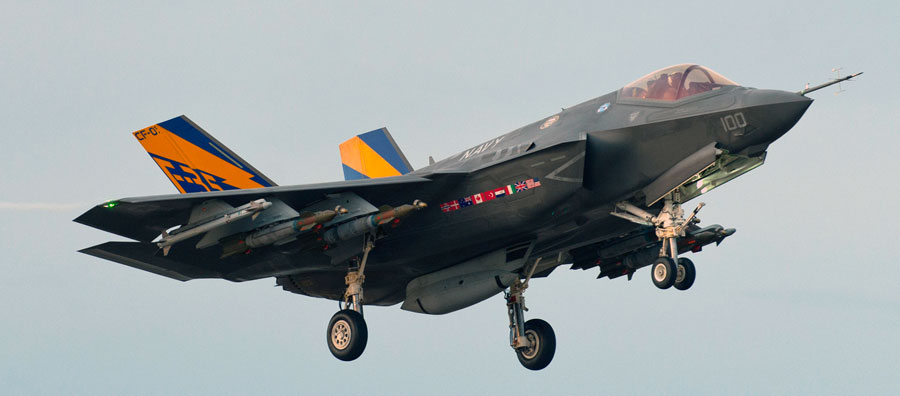
First image of F-35C carrying full load of weapons (externally)

"On Jan. 13, RAF Squadron Ldr. Andy Edgell flew first F-35C, the U.S. Navy’s carrier variant of the Joint Strike Fighter, with external GBU-12s, AIM-9Xs air-to-air missiles and the centerline gun pod.
Obviously, a radar-evading plane loses some of its stealthiness with such an external payload…
Image credit: Andy Wolfe via Lockheed Martin"
theaviationist

Jul 25, 2013

US Navy hopes to increase AIM-9X range by 60%

The US Navy is hoping to increase the range of the new Raytheon AIM-9X Block III by some 60% over current Sidewinder variants due to the unique needs of the Lockheed Martin F-35 Joint Strike Fighter, the Naval Air Systems Command (NAVAIR) says. The new weapon is scheduled to become operational in 2022.
flightglobal

Jul 16, 2013

U.S. Navy following U.K on IRST for fighters

The U.S. Navy expects to award contracts soon for a longer-range version of the AIM-9X Sidewinder, known as Block III. Not only will it be a major change to the AIM-9X—retaining only the seeker, optical target detector and data link of the Block II weapon—but its development is starting before the Block II has finished operational tests.
The Block III is associated with the Navy's effort to fit the F/A-18E/F Super Hornet with a Lockheed Martin infra-red search and track (IRST) system. The two systems are complementary, improving the ability of Navy fighters to operate in what a Boeing engineer calls an “RF (radio frequency)-denied environment” that will challenge X-band systems such as fighter radars and the seeker of the AIM-120 Advanced Medium Range Air-to-Air Missile (Amraam).
With these developments, the U.S. Navy is following the lead of other air arms—notably, the Royal Air Force—in investing in non-RF sensors and weapons that work far outside the within-visual-range envelope. One key technology is better processing that has greatly improved the performance of IRST.
aviationweek

Feb 2, 2013

Lack of HMCS and AIM-9X on F-22 make its vulnerable in WVR arena


The lack of a HMCS and the AIM-9X on the F-22 makes the stealth fighter vulnerable against fighters with similar weapons in WVR (within visual range) combat.

Even after the US Air Force's fleet of Lockheed Martin F-22 Raptor air superiority fighters starts receiving full Raytheon AIM-9X Sidewinder high off-boresight missle capability in 2017, the aircraft needs a helmet-mounted cueing system (HMCS) to use the weapon to its full potential. That is even taking into account the AIM-9X Block I and Block II's helmetless high off-boresight (HHOBS) capability.

"Without a helmet, that means the missile will need a very tight cue from somewhere," one F-22 pilot says. "[That's] something that is not always available in a dynamic, turning environment."

To be clear, the AIM-9X is a huge improvement over the AIM-9M version even without a HMCS . "Don't get me wrong, it will still be better than having a 9M, but it won't be anything close to what a fighter with a helmet and an externally carried missile has," the pilot says. "Hence, probably not the savior we've all been waiting on."

flightglobal