Translate

Showing posts with label E-2D ADVANCED HAWKEYE. Show all posts

Mar 17, 2026

Iranian drones leaking through air defenses may be forcing the U.S. to deploy Northrop Grumman E-2D Hawkeye to the Middle East


Recent open-source flight tracking suggests the United States may be reinforcing its airborne early warning capabilities in the Middle East by deploying additional Northrop Grumman E-2D Hawkeye aircraft to the region.

According to OSINT monitoring of transatlantic military flights, at least five U.S. Navy E-2D Hawkeyes crossed the Atlantic overnight, likely staging through Lajes Air Base, a key transatlantic logistics hub frequently used by U.S. forces moving between North America and Europe.


The aircraft reportedly flew in formation and were supported by aerial refueling tankers during the crossing, suggesting a long-range deployment that could ultimately bring them to the Middle East.

Iranian drones stressing regional air defenses

The possible deployment comes as Iranian drone activity continues to challenge regional air defense networks. Systems such as the Shahed-136 have demonstrated the ability to penetrate air defenses in multiple conflicts, thanks to their relatively small radar cross-section and low-altitude flight profiles.

Even advanced integrated air defense systems can struggle when confronted with large numbers of small, inexpensive drones launched simultaneously.

Aging AWACS aircraft under heavy operational demand


For years, the primary airborne surveillance platform in the region has been the Boeing E-3 Sentry, operated by the United States Air Force.

However, the platform is increasingly strained. The aircraft is based on the aging Boeing 707 airframe and many of the remaining E-3s have accumulated decades of heavy operational use.

While still capable, the radar architecture of the E-3 was originally designed to track large aircraft rather than swarms of low-flying drones.

Why the E-2D may be better suited for the mission

The Northrop Grumman E-2D Hawkeye, operated by the United States Navy, was specifically designed to counter modern threats such as cruise missiles and low-observable aerial targets.

Its AN/APY-9 AESA radar provides improved detection of small and low-altitude objects, allowing the aircraft to track large numbers of targets simultaneously across a wide battlespace.

This capability could prove particularly valuable in environments where drones represent an increasing share of the threat landscape.

A larger debate over the future of airborne early warning

The situation also highlights an ongoing debate within the United States Air Force, which has proposed retiring its aging AWACS fleet in favor of a future architecture based largely on space-based sensors.

The proposal has faced skepticism from analysts and members of the United States Congress, who argue that satellites alone cannot fully replace the real-time command-and-control capabilities provided by airborne early warning aircraft.

A sign of changing air warfare

If confirmed, the arrival of E-2D Hawkeyes in the region would underscore how modern air defense challenges are evolving. Small drones and low-cost aerial systems are increasingly capable of testing even advanced defense networks.

In that environment, platforms optimized for detecting low-observable threats—like the Hawkeye—may become more important than ever.

Nov 21, 2015

Japan orders first E-2D Advanced Hawkeye AEW aircraft

Japan has ordered its first Northrop Grumman E-2D Advanced Hawkeye airborne early warning and control (AEW&C) system aircraft.
The order for Japan will fit into the US Navy’s 25-aircraft, $3.6 billion multi-year contract for the E-2D that was signed in June 2014.
The Japan Air Self-Defence Force has 13 E-2Cs in service, which range between 22 and 34 years in age.
flightglobal

Jun 2, 2015

Japan cleared to buy 4 E-2D Hawkeye

Japan has requested a possible sale of four E-2D Advanced Hawkeye AEW& C aircraft, ten (10) T56-A-427A engines (8 installed and 2 spares), eight (8) Multifunction Information Distribution System Low Volume Terminals (MIDS-LVT), four (4) APY-9 Radars, modifications, spare and repair parts. The estimated cost is $1.7 billion.
The principal contractor will be Northrop Grumman .
dsca

Oct 17, 2014

New US Navy E-2D Aircraft Goes Operational

The E-2D Advanced Hawkeye has been declared to be operational, meaning that deployment training for the US Navy’s newest airborne warning and control aircraft can begin in earnest.
Initial Operational Capability (IOC) for the Advanced Hawkeye was achieved Oct. 10 when Carrier Airborne Early Warning Squadron 125 (VAW-125) was certified to have five operational aircraft, five trained air crews and a fully-certified maintenance team.
With IOC declared, the VAW-125 Tigertails now will train with Carrier Air Wing 1, scheduled to deploy next year aboard the carrier Theodore Roosevelt.
The E-2D is a greatly modified version of the E-2C Hawkeye.
defensenews

Mar 28, 2014

E-2D Become fully operational

The E-2D Advanced Hawkeye officially became ready for tasking with VAW-125.
The "Tigertails" of VAW-125 are the first Navy squadron to become fully operational with the Advanced Hawkeye, the newest, most technologically capable variant of the E-2 AEW&C platform.
navy.mil

Dec 10, 2013

USS Theodore Roosevelt Launches E-2D Hawkeye for the first time

The carrier USS Theodore Roosevelt (CVN 71) launched and recovered E-2D Hawkeyes, from the Tiger Tails of Carrier Airborne Early Warning Squadron (VAW) 125, for the first time, Dec. 3.
With notable improvements and new features, the E-2D is a major advancement from the E-2C Hawkeye.
Improvements include a fully integrated-all-glass-tactical cockpit, advanced identification friend-or-foe system, a new radar with both mechanical and electronic scanning capabilities, electronic support measures enhancements, new mission computers and tactical workstations.
After hundreds of practice landings on shore, the launch and recovery of the E-2D onboard Theodore Roosevelt begins VAW-125's final
military.com

Oct 17, 2013

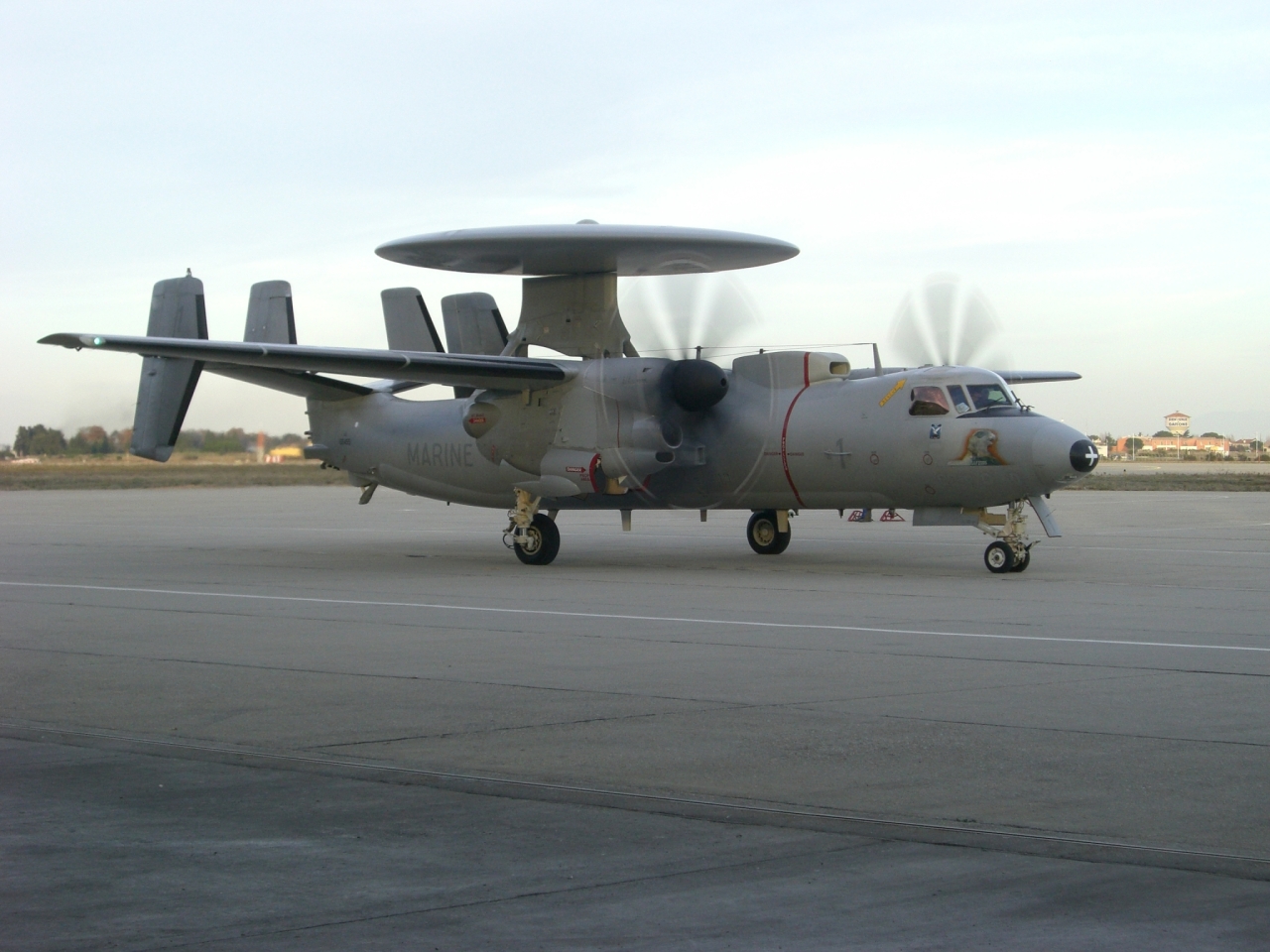
Northrop Grumman to Upgrade French Navy E-2C Hawkeye Fleet

Northrop Grumman will modify the French Navy's fleet of three E-2C Hawkeyes with an upgraded Identification Friend or Foe (IFF) system, further increasing commonality and interoperability with U.S. Navy E-2D Advanced Hawkeye aircraft.
IFF systems enable warfighters to distinguish between friendly forces and enemies.
The French Navy has been operating the E-2C Hawkeye since 2000 when it stood up the first French E-2 Hawkeye squadron, the Flotille 4F, in Lorient. France is the only country other than the United States to operate its E-2 Hawkeyes from an aircraft carrier. This unique bond has led to multiple interoperability exercises where the two navies have operated Hawkeyes from each other's carrier flight decks. The first of these took place in May 2001 when a U.S. Navy E-2 Hawkeye flew from the deck of the USS Enterprise to the deck of the French carrier Charles de Gaulle.
irconnect

Aug 13, 2013

Boeing, US Navy Demo New Targeting and Data Systems on EA-18G

The U.S. Navy recently flew Boeing EA-18G Growler aircraft with sensor system upgrades and its newest data network, demonstrating how the enhanced technologies would allow aircrews to locate threats more quickly and accurately.
Ultimately, the secure, high-speed network will allow aircrews to share targeting data in real time. The technology will be incorporated into deployed Growler electronic attack aircraft in 2018, sooner than all Navy aircraft other than the E-2D Hawkeye surveillance airplane.
boeing

Northrop Grumman Awarded $617 Million for Full-Rate Production E-2D Advanced Hawkeyes

The U.S. Navy has awarded Northrop Grumman Corporation a $617 million contract for five full-rate production Lot 1 E-2D Advanced Hawkeye aircraft. Moving from low-rate production into full-rate production is a significant milestone for the E-2D Advanced Hawkeye program.
northropgrumman

Jul 9, 2013

Northrop Grumman prepares to build five E-2D Advanced Hawkeye carrier-based aircraft

Aircraft designers at the Northrop Grumman Corp. Aerospace Systems sector in Bethpage, N.Y., are preparing to build an additional five E-2D Hawkeye carrier-based surveillance and early warning aircraft for the U.S. Navy.
militaryaerospace

Feb 9, 2013

Initial Operational Test and Evaluation reports E-2D Advanced Hawkeye ready for full-rate production


Air Test and Evaluation Squadron (VX) 1 declared the E-2D Advanced Hawkeye “suitable and effective” in an Initial Operational Test and Evaluation (IOT&E) report, aiding the Defense Acquisition Board in approving the aircraft for full-rate production in January.

“This milestone is the culmination of years of hard work,” said Capt. John S. Lemmon, E-2/C-2 Airborne Tactical Data System Program Office (PMA-231) program manager. “The E-2D team came together with one vision and goal, and the IOT&E report confirms that we are delivering a solid product to the fleet.”

During IOT&E, VX-1 tested the E-2D to determine how well the aircraft could perform required missions and evaluated the aircraft’s readiness for fleet introduction scheduled for 2015. IOT&E was conducted according to current program System Design Development (SDD) requirements.

During testing, VX-1 deployed to several locations to collect flight test data. Tests were held at Naval Air Station Fallon, Nev. VX-1 participated in aerial combat training exercises at Nellis Air Force Base during Red Flag, as well as the Black Dart exercise at Naval Air Station Point Mugu. Black Dart is designed to test the military’s ability to counter enemy unmanned aircraft systems (UAS).

navair.navy