Translate

Showing posts with label PLA. Show all posts

Feb 10, 2018

China PLA scrambles Su-35s, J-20s to S China Sea as US Navy sails in

Beijing has responded to the US Navy’s ramped-up presence in the South China Sea – an aircraft carrier strike group led by the USS Carl Vinson has been scheduled to call at Vietnamese ports next month – with squadrons of advanced fighters including Su-35s and J-20s that will soon start patrolling the 3.5-million-square-kilometer sea.
Further incidents involving US and Chinese forces appear inevitable after the China News Service revealed that the US guided-missile destroyer Hopper came within 12 nautical miles of Scarborough Shoal (Huangyan Island) last month, and was intercepted by the Chinese missile destroyer Huangshan. CNS said the US warship steered away from the area after a brief standoff.
Similar encounters in the air are set to become frequent as well, as the People’s Liberation Army has dispatched an unconfirmed number of Su-35 multirole fighters to the sea for joint combat cruise missions.
This is “a pragmatic action for the air force to fulfill its mission in the new era and conduct combat training exercises” above the South China Sea, said a statement by the PLA Air Force on its Weibo social media account.
It is also rumored that several J-20s already in service with the PLAAF will fly south to join Russian-made counterparts to test the 4.5th generation fighter’s operational reliability.
atimes

Mar 10, 2015

China Navy PLA Official Confirms 2nd Aircraft Carrier Under Construction

Satellite images on Google Maps indicate that Beijing has constructed a model aircraft carrier in Wuhan Province.
A People's Liberation Army Navy official has confirmed for the first time that China is building its second aircraft carrier.
China's second aircraft carrier is currently under construction and will be more advanced than the country's first carrier, the Liaoning, which was retrofitted from the Soviet-era carrier Varyag and commissioned in September 2012.
It is uncertain just how many aircraft carriers the country intends to build. Some have claimed as many as six carriers are needed to safeguard China's territorial sovereignty and interests abroad
defense-studies

Feb 26, 2015

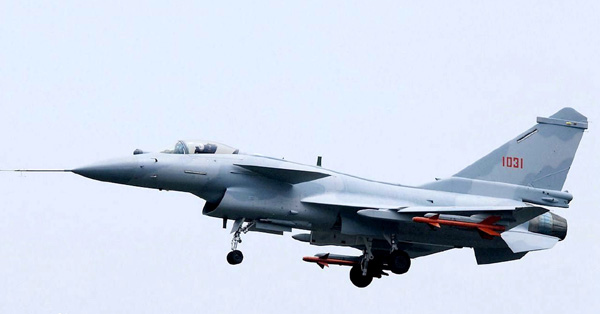
J-10B Will Be Soon Inducted to China's Air Force

China's air force will soon commission the J-10B fighter jet, the most advanced military aircraft the country has ever developed on its own.
Several pictures showing 14 of the planes lined up outside an unidentified aircraft factory have been circulating on military websites. Experts said their gray paint scheme indicates that they will soon be delivered to the People's Liberation Army air force.
It is also possible and feasible that the J-10B's upgraded version will be chosen by the navy to serve on an aircraft carrier.
The J-10B is an improved variant of the J-10A, which is manufactured by the Chengdu, a subsidiary of the State-owned giant Aviation Industry Corp of China.
Western military sources said the jet had its first flight in December 2008, and mass production started in 2013.
The new fighter has an increase of at least 30 percent in overall capability compared with its predecessor.
The aircraft has a maximum takeoff weight of 19 metric tons and can carry a payload of up to 8 tons. Its combat radius can reach to about 1,000 kilometers.
ecns.cn

Jan 12, 2015

China J-10B fighter may be close to entering service

A photo posted on the internet indicates that the J-10B, the upgraded version of China's's J-10 fighter is almost ready for service.
The photo shows more than 10 J-10B fighters parked on an unidentified airfield in China. After the J-10A went out of production last year, the first J-10B is likely to be commissioned in 2015.
The plane was originally designed for use with the domestically developed WS-10 Taihang turbofan engine but will use the Russian AL31FN engine as the Taihang engine is not yet ready. Due to its reliance on the engines provided by Russia, China is still unable to produce the J-10B in large numbers.
The first J-10B to enter service will be with the PLA Air Force units that currently deploy the J-10A. After that, it is likely to serve the PLA Navy's East Sea Fleet as an ground attack aircraft. The Russian-built Su-30MKK was originally earmarked for this role, but PLA Navy believes the fighter is better suited to taking on Taiwan's F-16 fighters in aerial combat.
wantchinatimes

Dec 3, 2014

PLA's YJ-18 anti-ship missile useful against US carrier group


Footage of what appeared to be China's YJ-18 anti-ship missile, rumored to be in development, was shown recently in a news report on state broadcaster China Central Television.
If reports about the missile are accurate, it will be China's first combination subsonic and supersonic anti-ship missile.
According to an unnamed source cited by a military affairs column on Chinese news web portal Sina, the YJ-18 will be the basis for a series of models that will be adapted for launch from warships, submarines and from the coast and will likely replace current anti-ship missiles, given its versatility.
The People's Liberation Army Navy currently employs several different models of anti-ship missile, which requires a great deal of logistics and maintenance planning.
The six series of anti-ship missiles the PLA Navy uses include the HY series developed from the Soviet-era P-15, the YJ-8/YJ-83 series developed from the YJ-8, the YJ-62 series developed from the YJ-6 and the most recent YJ-12 supersonic anti-ship missile. Imports include the 3M80E/BE and the 3M-54E series. Each of these missile series requires its own launcher and guidance system, which places logistical pressure on the navy, making the simplification of anti-ship models a major priority.
wantchinatimes

Jun 1, 2014

China PLA Could Commission Four Carrier Battle Groups

The People's Liberation Army Navy will commission between three and four carrier battle groups over the next 15 years.
Photos on the internet revealed new facilities and vehicles on the Liaoning, China's first aircraft carrier which is now undergoing maintenance at Dalian Shipyard. PLA Navy has gained more experience in operating an aircraft carrier in the 18 months since the Liaoning was commissioned.
China already has plans to build two domestic aircraft carriers after the Liaoning. Over the next 15 years, the PLA Navy may be able to maintain four carrier battle groups. For the US Navy, meanwhile, there is currently debate over whether it is necessary to keep 11 aircraft carriers in active service.
Through gaining more diesel-electric submarines from Russia or producing them domestically, the PLA Navy possesses enough underwater threat to take on the United States Navy in any potential conflict. All of the diesel-electric submarines are equipped with air-independent propulsion systems, which allow a non-nuclear submarine to operate without the need to access atmospheric oxygen and to stay underwater for a longer period of time.
The nuclear strike capability of the PLA has increased dramatically with the DF-41 nuclear solid-fueled road-mobile intercontinental ballistic missile and the JL-2 intercontinental-range submarine-launched ballistic missile in service.
At the same time, China is producing more and more fourth-generation fighters such as the J-11B, the J-15, the J-16 and the J-10B. China has no intention of challenging US influence around the globe, however, it has enough air and naval forces to conduct an anti-access and area-denial strategy over the Taiwan Strait and the South China Sea.
defense-studies

Apr 28, 2014

China may build 3 more carriers amid territorial disputes

The People's Liberation Army (PLA) Navy may build three Liaoning-class aircraft carriers to prepare for a potential conflict with Japan in the Asia-Pacific region.
Light aircraft carriers such as the Liaoning and Japan's Izumo have become vital for the PLA Navy and Japan Maritme Self-Defense Force amid territorial disputes between the two countries. It added that Japan may become an even greater threat to China if the country successfully introduces a Tarawa-class amphibious assault ship from the United States and deploys its F-35B fighters with vertical take-off and landing ability aboard the ship.
To face Japan in a potential combat situation, the PLA Navy needs to construct at least three aircraft carriers based on the Liaoning.
Meanwhile, if Japan is unable to purchase the Tarawa-class amphibious assault ship, the Izumo alone can carry at least 24 F-38B fighters after the vessel's fuel supply facility is removed, while Tokyo will likely choose to purchase cheaper but older AV-8 fighters.
Japan's F-35B fighter is designed mostly for surface attack missions and it is thus unable to compete against China's J-15 carrier-based fighters. But neither China nor Japan is likely to deploy aircraft carriers against each other over a narrow battlefield like the disputed East China Sea. If the local conflict escalated into a full scale war, it would be up to the United States to decide whether or not to fight for Japan.
wantchinatimes

Feb 24, 2013

China PLA on course for nuclear-powered aircraft carriers


Beijing has approved funding for major projects to develop core technologies for nuclear-powered vessels, a first official indication of plans to build nuclear-powered aircraft carriers.
But military experts said it was too early to determine when China would have its first nuclear-powered carrier because it would take time to develop a safe and powerful engine.
A report posted on the website of the China Shipbuilding Industry Corporation, the largest state-owned shipbuilder, this week said the Ministry of Science and Technology had approved funding to its 719th Research Institute for two research projects, including core technologies and safety studies for nuclear-powered ships, as well as technical support for small nuclear reactors.
The shipbuilding giant is also the top contractor of the People's Liberation Army Navy and took charge of the refitting work for China's first aircraft carrier, the Liaoning.
Military experts said the report indicated that Beijing was formally kicking off its plan to develop indigenous nuclear-powered carriers.
The Liaoning was built using the hull of a Soviet Kuznetsov-class carrier, the Varyag, with a displacement of 65,000 tonnes, which China acquired from Ukraine in 2002. It is a conventionally powered carrier.
scmp.com

Jan 27, 2013

China Successfully Tests 'Carrier Killer' Missile In The Gobi Desert


China's PLA "sunk" a U.S. aircraft carrier during a war game in remote China using its DF-21D "Carrier Killer" missile, reports Taiwan paper Want China Times.

businessinsider

Sep 21, 2012

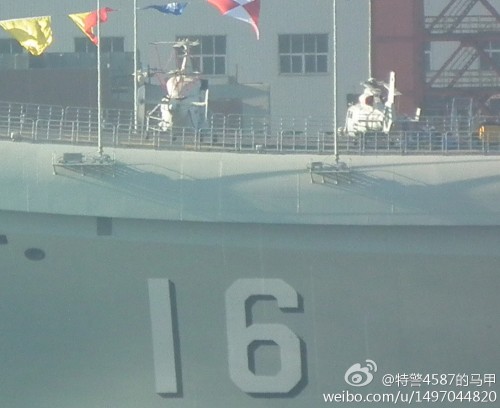
Ka-28, Z-9 on board Varyag


China PLA has methods to shooting down stealth USAF planes like the B-2, F-22 and F-35

China has already carried out military drills taking "shooting down stealth planes, cruise missiles and armed helicopters; anti-precision strikes, anti-electronic interference and anti-reconnaissance" as contents at the end of 20th century.

learn more