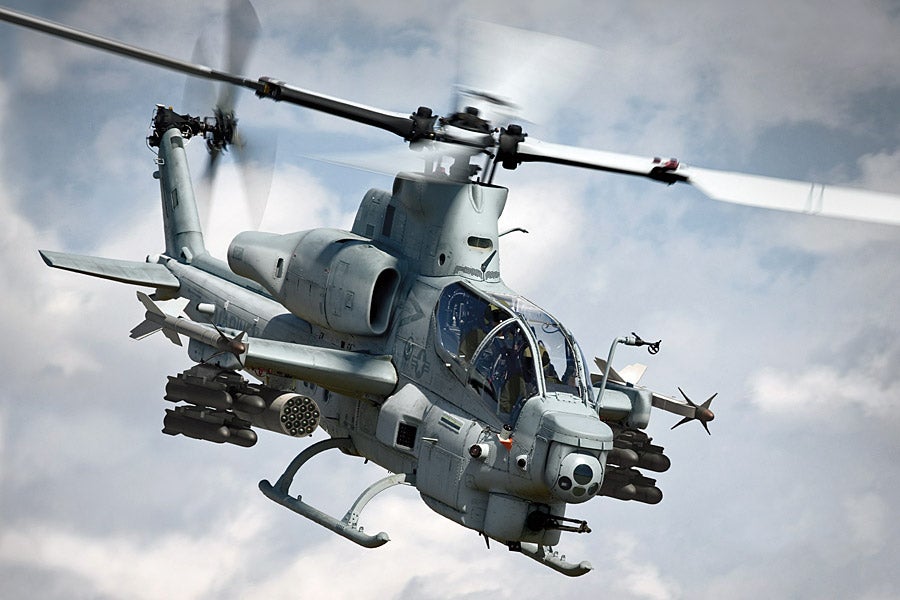
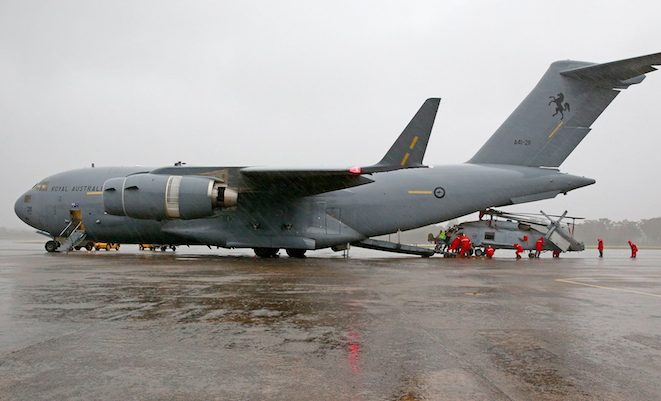
Australia has deployed its Airbus Tiger Armed Reconnaissance Helicopter (ARH) overseas for the first time, with a detachment participating in joint training exercises with Malaysia.
Four Australian Army Tiger ARHs were airlifted to the Royal Malaysian Air Force (TUDM) air base at Subang on a Royal Australian Air Force (RAAF) Boeing C-17A Globemaster III strategic airlifter on 21 April, before embarking for training exercises aboard the HMAS Canberra landing helicopter dock (LHD) amphibious assault ship.
Australia operates 22 Tiger ARH helicopters, with deliveries running from December 2004 through to December 2011. The ARH is a hybrid variant of the Tiger that is based on the French HAP (Hélicoptère d'Appui et de Protection), with an undernose Giat 30-781 30 mm cannon, roof-mounted sight, and provision for underwing 70 mm rocket pods, but with added anti-tank capability.
Apart from being the first overseas deployment of the Tiger, the exercises aboard HMAS Canberra mark a major milestone for the helicopter given that until very recently Australian auditors were recommending that it not be operated aboard ships due to performance limitations.
Gareth Jennings- Jane's 360
Translate
Showing posts with label ROYAL AUSTRALIAN NAVY. Show all posts
Apr 28, 2019
Dec 30, 2018
Australia’s first Hobart-class destroyer completes weapons, systems evaluation
Australia's first-of-class air warfare destroyer HMAS Hobart has successfully demonstrated its ability to conduct co-operative fleet-area air defence operations.
The trials validate the Royal Australian Navy's capacity to interoperate with the US Navy in high-intensity combat operations
The trials, which included a variety of combat scenarios including evasive manoeuvres against anti-ship missiles, fighter aircraft, and surface combatants, were completed in late-2018 at an undisclosed location off the US West Coast.
In November 2018, Hobart also demonstrated its ability to establish secure data links with the USN's Arleigh Burke-class destroyer USS John Finn.
Australia's Hobart class is derived from the Spanish Navy's (Armada Española's) Alvaro de Bazan-class frigate.
Ridzwan Rahmat - janes
The trials validate the Royal Australian Navy's capacity to interoperate with the US Navy in high-intensity combat operations
The trials, which included a variety of combat scenarios including evasive manoeuvres against anti-ship missiles, fighter aircraft, and surface combatants, were completed in late-2018 at an undisclosed location off the US West Coast.
In November 2018, Hobart also demonstrated its ability to establish secure data links with the USN's Arleigh Burke-class destroyer USS John Finn.
Australia's Hobart class is derived from the Spanish Navy's (Armada Española's) Alvaro de Bazan-class frigate.
Ridzwan Rahmat - janes
Etiquetas:
ALVARO DE BAZAN,
AUSTRALIA,
HOBART CLASS,
ROYAL AUSTRALIAN NAVY,
SPAIN,
US NAVY
Jan 10, 2017
Spanish frigate 'Cristobal Colón' deploys to Australia for AWD support
Spanish Navy’s Álvaro de Bazán-class frigate Cristóbal Colón is scheduled to embark on a long-term deployment to Australia on January 9.
Under an agreement between the two navies, the Aegis-equipped frigate will spend 120 days in Australia where it will help train future Australian Hobart-class destroyer sailors of the Australian Navy.
By integrating into the Australian Navy fleet, Cristóbal Colón will provide dedicated training and familiarisation opportunities for the crews of Australian destroyers Hobart, Brisbane and Sydney.
NUSHIP Hobart, the first of three destroyers, will start category 5 sea trials in mid-January 2017 and will be assisted in the process by ESPS Cristóbal Colón.
If everything goes according to plan, the Spanish frigate is expected to return to Ferrol, Spain in early August 2017.
This is not the first time a Spanish Navy ship is integrating into the Royal Australian Navy. Back in 2013, Spain sent its replenishment ships ESPS Cantabria to Australia where it remained for eight months.
navaltoday
Under an agreement between the two navies, the Aegis-equipped frigate will spend 120 days in Australia where it will help train future Australian Hobart-class destroyer sailors of the Australian Navy.
By integrating into the Australian Navy fleet, Cristóbal Colón will provide dedicated training and familiarisation opportunities for the crews of Australian destroyers Hobart, Brisbane and Sydney.
NUSHIP Hobart, the first of three destroyers, will start category 5 sea trials in mid-January 2017 and will be assisted in the process by ESPS Cristóbal Colón.
If everything goes according to plan, the Spanish frigate is expected to return to Ferrol, Spain in early August 2017.
This is not the first time a Spanish Navy ship is integrating into the Royal Australian Navy. Back in 2013, Spain sent its replenishment ships ESPS Cantabria to Australia where it remained for eight months.
navaltoday
Etiquetas:
Armada Española,
AUSTRALIA,
CRISTOBAL COLON,
F-100,
RAN,
ROYAL AUSTRALIAN NAVY,
SPAIN,
SPANISH NAVY
May 7, 2016
Australia is spending $640 million on naval supply ships made in Spain
The Turnbull government’s massive spend on Australia’s naval capability continued today after signing a deal to spend $640 million on two naval replenishment ships built in Spain .
Unlike recent announcements by the prime minister about building submarines and other ships in Australia, today’s decision to give the contract to Madrid-based Navantia was low key.
Defence minister Marise Payne confirmed Navantia as the preferred tenderer, beating South Korea’s Daewoo, for the two auxiliary oiler and replenishment (AOR) vessels in March.
Australia’s current supply ship, HMAS Success, launched in 1984, will reach its end of life in 2021, and needs to be replaced urgently.
The navy’s other supply ship, HMAS Sirius, is a former commercial oil tanker commissioned in 2006 and does not have the capability for other supplies. Navantia, which build the Royal Australian Navy’s two newest vessels, the landing helicopter dock ships, Canberra and Adelaide, will build two 19,500-tonne dual tanker and supply ships.
The contract stipulates that $130 million of the build will involve local industry for combat and communication systems, and elements of the onboard cranes. And an initial $250 million, five-year sustainment contract, also signed with Navantia, will be undertaken in Australia.
businessinsider
Unlike recent announcements by the prime minister about building submarines and other ships in Australia, today’s decision to give the contract to Madrid-based Navantia was low key.
Defence minister Marise Payne confirmed Navantia as the preferred tenderer, beating South Korea’s Daewoo, for the two auxiliary oiler and replenishment (AOR) vessels in March.
Australia’s current supply ship, HMAS Success, launched in 1984, will reach its end of life in 2021, and needs to be replaced urgently.
The navy’s other supply ship, HMAS Sirius, is a former commercial oil tanker commissioned in 2006 and does not have the capability for other supplies. Navantia, which build the Royal Australian Navy’s two newest vessels, the landing helicopter dock ships, Canberra and Adelaide, will build two 19,500-tonne dual tanker and supply ships.
The contract stipulates that $130 million of the build will involve local industry for combat and communication systems, and elements of the onboard cranes. And an initial $250 million, five-year sustainment contract, also signed with Navantia, will be undertaken in Australia.
businessinsider
Dec 13, 2015
Navantia to Manage Australia’s AWD Destroyer Program
Navantia has signed a contract with Australian shipbuilder ASC for providing management services to AWD program. The signing took place in Sydney.
Navantia has been working in three important programs for the ADF since 2007, namely the Air Warfare Destroyers (AWDs), Landing Helicopter Docks (LHDs), and the LHD Landing Craft (LLC), under different contractual schemes to deliver to the best of its ability. ASC has signed a contract with Navantia whereby Navantia will provide the Shipbuilding Management Services (SMS) for the AWD Program.
Navantia will bring it significant experience in AWDs to support ASC in building the AWDs. Navantia is fully committed in delivering this key capability to the Royal Australian Navy, as it has already done with the two LHDs, HMAS CANBERRA and HMAS ADELAIDE, this last unit being commissioned into the RAN on the 4th of December.
defense-studies
Navantia has been working in three important programs for the ADF since 2007, namely the Air Warfare Destroyers (AWDs), Landing Helicopter Docks (LHDs), and the LHD Landing Craft (LLC), under different contractual schemes to deliver to the best of its ability. ASC has signed a contract with Navantia whereby Navantia will provide the Shipbuilding Management Services (SMS) for the AWD Program.
Navantia will bring it significant experience in AWDs to support ASC in building the AWDs. Navantia is fully committed in delivering this key capability to the Royal Australian Navy, as it has already done with the two LHDs, HMAS CANBERRA and HMAS ADELAIDE, this last unit being commissioned into the RAN on the 4th of December.
defense-studies
Etiquetas:
AUSTRALIA,
AWD,
HMAS CANBERRA,
NAVANTIA,
RAN,
ROYAL AUSTRALIAN NAVY,
SPAIN
Nov 28, 2015
NAVANTIA Delivers Final Batch of Four Landing Crafts to Australia
Navantia has the pleasure in delivering to the Commonwealth in Sydney the final batch of four LLCs. This is a major achievement, where Navantia has played an important role – that of Prime Contractor for the first time in an Australian program. Since 2007, Navantia has been working in three important programs for the ADF, namely the Air Warfare Destroyers (AWDs), Landing Helicopter Docks (LHDs), and the LHD Landing Craft (LLCs), under different contractual schemes to deliver to the best of its ability.
On 16th December 2011, Navantia signed a contract with the then Defence Materiel Organisation (DMO) under JP 2048 Phase 3 to build and deliver twelve LHD Landing Craft (LLCs) to the Commonwealth. All twelve have now been delivered to HMAS WATERHEN in Sydney on or ahead of schedule and to budget. The LLCs were built and tested in Cádiz, Spain, and shipped out to Australia.
Navantia understands that the first eight units are in operation with the RAN and are performing to the full satisfaction of Navy, having achieved various missions during sea trials with HMAS CANBERRA, which has also been commissioned into the RAN. Her sister ship, HMAS ADELAIDE, is due to be commissioned in Sydney on 4th December 2015.
On 16th December 2011, Navantia signed a contract with the then Defence Materiel Organisation (DMO) under JP 2048 Phase 3 to build and deliver twelve LHD Landing Craft (LLCs) to the Commonwealth. All twelve have now been delivered to HMAS WATERHEN in Sydney on or ahead of schedule and to budget. The LLCs were built and tested in Cádiz, Spain, and shipped out to Australia.
Navantia understands that the first eight units are in operation with the RAN and are performing to the full satisfaction of Navy, having achieved various missions during sea trials with HMAS CANBERRA, which has also been commissioned into the RAN. Her sister ship, HMAS ADELAIDE, is due to be commissioned in Sydney on 4th December 2015.
Etiquetas:
AUSTRALIA,
HMAS CANBERRA,
NAVANTIA,
RAN,
ROYAL AUSTRALIAN NAVY,
SPAIN
Oct 24, 2015
Flight trials of Australian Army CH-47D with HMAS Canberra
Australia is using an Army CH-47D Chinook to do First of Class Flight Trial with HMAS Canberra in Jervis Bay.
alert5
Etiquetas:
AUSTRALIA,
CANBERRA,
CH-47D,
HMAS CANBERRA,
RAN,
ROYAL AUSTRALIAN NAVY
Oct 16, 2015
Canada's Navy In Talks To Rent Spanish Replenishment Ship 'Cantabria'
Spain and Canada are negotiating a mutual logistic arrangement (MLSA) to deploy a Spanish replenishment ship with the Canadian fleet in the North Atlantic.
The ship deployed "during some periods of 2016" could be the auxiliary oiler and replenishment ship (AOR) Cantabria or Patiño. The logistic arrangement is "to cover the Canadian navy's temporary need of logistic support vessels."
The Cantabria or Patiño would support training for the Royal Canadian Navy’s Atlantic fleet starting in January. "No end date for the use of that support ship has been established," said Royal Canadian Navy spokeswoman. Negotiations are still ongoing and the MLSA is not yet finalized.
But starting on Oct. 18, Royal Canadian Navy sailors will be serving on the Spanish Navy supply ship Cantabria. Twenty Eight canadian sailors will be on the ship to conduct training during NATO's Trident Juncture 15 exercise.
The Spanish AOR Cantabria deployed with the Royal Australian Navy in 2013. The government of Australia paid the expenses of that deployment during the year.
defensenews
The ship deployed "during some periods of 2016" could be the auxiliary oiler and replenishment ship (AOR) Cantabria or Patiño. The logistic arrangement is "to cover the Canadian navy's temporary need of logistic support vessels."
The Cantabria or Patiño would support training for the Royal Canadian Navy’s Atlantic fleet starting in January. "No end date for the use of that support ship has been established," said Royal Canadian Navy spokeswoman. Negotiations are still ongoing and the MLSA is not yet finalized.
But starting on Oct. 18, Royal Canadian Navy sailors will be serving on the Spanish Navy supply ship Cantabria. Twenty Eight canadian sailors will be on the ship to conduct training during NATO's Trident Juncture 15 exercise.
The Spanish AOR Cantabria deployed with the Royal Australian Navy in 2013. The government of Australia paid the expenses of that deployment during the year.
defensenews
Etiquetas:
Armada Española,
AUSTRALIA,
CANADA,
CANTABRIA,
ROYAL AUSTRALIAN NAVY,
SPAIN,
SPANISH NAVY
May 6, 2015
Australia commissions first two CH-47Fs Chinook
The first two of seven CH-47F heavy-lift helicopters for the 5th Aviation Regiment of the Australian Army were commissioned in a ceremony at RAAF Townsville on 5 May.
The remaining Chinooks will be delivered by the end of July. Initial operating capability (IOC) would be achieved by December 2015 and full operating capability (FOC) by January 2017.Although the new aircraft are being received in a common configuration with the US Army's baseline CH-47Fs, they also incorporate optional Boeing-designed rotor brakes and ship tie-down adaptors to enhance operations from the Royal Australian Navy's (RAN's) two Canberra class landing helicopter docks (LHDs).
janes
The remaining Chinooks will be delivered by the end of July. Initial operating capability (IOC) would be achieved by December 2015 and full operating capability (FOC) by January 2017.Although the new aircraft are being received in a common configuration with the US Army's baseline CH-47Fs, they also incorporate optional Boeing-designed rotor brakes and ship tie-down adaptors to enhance operations from the Royal Australian Navy's (RAN's) two Canberra class landing helicopter docks (LHDs).
janes
Etiquetas:
AUSTRALIA,
AUSTRALIAN ARMY,
BOEING,
CANBERRA,
CANBERRA CLASS,
CH-47,
CH-47F,
CHINOOK,
HMAS CANBERRA,
NUSHIP CANBERRA,
RAAF,
RAN,
ROYAL AUSTRALIAN AIR FORCE,
ROYAL AUSTRALIAN NAVY,
UNITED STATES,
USA
Mar 1, 2015
AH-1Z Propossed as Maritime Attack Platform for Australian Navy Assault Ships
Bell is pitching its AH-1Z Viper helicopter to the Australian Defence Force (ADF) to be utilised as a maritime attack platform aboard its two landing helicopter dock (LHD) amphibious assault ships.
However there is no formal Australian requirement, Bell is briefing the ADF on the Viper's capabilities ahead of an expected decision on whether to upgrade its Airbus Helicopters Tigers to a maritime configuration.
The AH-1Z is already doing all of the missions that the ADF is doing [with the Tiger], and more. It can carry 16 Hellfire [air-to-surface missiles] plus two Sidewinder [air-to-air missiles], and has the cost-per-flight-hour figures that the ADF has been looking for.
While the Australian Army does currently field 22 Tiger helicopters, a decision is expected to be made under Phase 3 of the Project AIR 87 Tiger Armed Reconnaissance Helicopter (ARH) procurement programme on whether to upgrade these helicopters to be able to operate from the decks of the Royal Australian Navy's (RAN's) two Canberra-class LHDs (HMAS Canberra was recently commissioned, while the future HMAS Adelaide is currently under construction in Spain).
The AH-1Z has been built to be resistant to corrosion; its engines are the same as those fitted to the MH-60R maritime helicopter as already selected by the RAN; it has folding [main rotor] blades; there are heavy-duty tie-down points; and its systems are shielded so as to be 'ship-safe'." .
As well as being physically better-suited to the maritime domain, the AH-1Z has the benefit of being in operational service with the US Marine Corps (USMC). With the USMC now regularly rotating through Darwin, the ADF is going to be operating alongside the AH-1Z more and more, and so there are obvious advantages of interoperability and support to be had should Australia choose to also procure the helicopter.
The discussions with the ADF is still in a very informal stage.
janes
However there is no formal Australian requirement, Bell is briefing the ADF on the Viper's capabilities ahead of an expected decision on whether to upgrade its Airbus Helicopters Tigers to a maritime configuration.
The AH-1Z is already doing all of the missions that the ADF is doing [with the Tiger], and more. It can carry 16 Hellfire [air-to-surface missiles] plus two Sidewinder [air-to-air missiles], and has the cost-per-flight-hour figures that the ADF has been looking for.
While the Australian Army does currently field 22 Tiger helicopters, a decision is expected to be made under Phase 3 of the Project AIR 87 Tiger Armed Reconnaissance Helicopter (ARH) procurement programme on whether to upgrade these helicopters to be able to operate from the decks of the Royal Australian Navy's (RAN's) two Canberra-class LHDs (HMAS Canberra was recently commissioned, while the future HMAS Adelaide is currently under construction in Spain).
The AH-1Z has been built to be resistant to corrosion; its engines are the same as those fitted to the MH-60R maritime helicopter as already selected by the RAN; it has folding [main rotor] blades; there are heavy-duty tie-down points; and its systems are shielded so as to be 'ship-safe'." .
As well as being physically better-suited to the maritime domain, the AH-1Z has the benefit of being in operational service with the US Marine Corps (USMC). With the USMC now regularly rotating through Darwin, the ADF is going to be operating alongside the AH-1Z more and more, and so there are obvious advantages of interoperability and support to be had should Australia choose to also procure the helicopter.
The discussions with the ADF is still in a very informal stage.
janes
Etiquetas:
AH-1Z,
AUSTRALIA,
CANBERRA,
HMAS CANBERRA,
ROYAL AUSTRALIAN NAVY,
SPAIN,
TIGER,
UNITED STATES,
USA
Dec 17, 2014
Royal Australian Navy prepares for March 2015 flight trials on first-of-class LHD HMAS Canberra
The Royal Australian Navy (RAN) will commence first-of-class flight trials on board its newly-commissioned landing helicopter dock (LHD) vessel HMAS Canberra in March 2015.
The ship was commissioned on 28 November and is expected to be cleared to operate the MRH-90 multirole helicopter, the S-70B-2 Seahawk, and the CH-47F Chinook.
Commander Michael Waddell, Officer in Charge of the RAN's Aircraft Maintenance and First deck-handling trials took place on 26 November while the ship was alongside at the RAN's Fleet Base East in Sydney, with an MRH-90 and an S-70B-2, and did not involve flight operations.
The actual flight trials while the ship is at sea will be conducted for about eight weeks from early March 2015.
The trials in March 2015 will only involve the MRH-90 and the S-70B-2.
There are no plans currently to embark any other aircraft on the LHDs besides the MRH-90, the S-70B-2, the Tiger Armed Reconnaissance Helicopter, and the CH-47F. The Tiger and the CH-47F will undergo sea trials on board Canberra in 2016.
Although the Canberra class is currently only intended to operate rotary-wing aircraft, the retention of the ski-ramp forward (a legacy of the design's antecedents in Spain's Juan Carlos I strategic projection ship) has raised the possibility that the ships could, in due course, operate fixed-wing short take-off and vertical landing (STOVL) aircraft.
In May 2014, a spokesman for Defence Minister told that the country will consider acquiring the STOVL variant of the Lockheed Martin F-35 Lightning II Joint Strike Fighter.
janes
The ship was commissioned on 28 November and is expected to be cleared to operate the MRH-90 multirole helicopter, the S-70B-2 Seahawk, and the CH-47F Chinook.
Commander Michael Waddell, Officer in Charge of the RAN's Aircraft Maintenance and First deck-handling trials took place on 26 November while the ship was alongside at the RAN's Fleet Base East in Sydney, with an MRH-90 and an S-70B-2, and did not involve flight operations.
The actual flight trials while the ship is at sea will be conducted for about eight weeks from early March 2015.
The trials in March 2015 will only involve the MRH-90 and the S-70B-2.
There are no plans currently to embark any other aircraft on the LHDs besides the MRH-90, the S-70B-2, the Tiger Armed Reconnaissance Helicopter, and the CH-47F. The Tiger and the CH-47F will undergo sea trials on board Canberra in 2016.
Although the Canberra class is currently only intended to operate rotary-wing aircraft, the retention of the ski-ramp forward (a legacy of the design's antecedents in Spain's Juan Carlos I strategic projection ship) has raised the possibility that the ships could, in due course, operate fixed-wing short take-off and vertical landing (STOVL) aircraft.
In May 2014, a spokesman for Defence Minister told that the country will consider acquiring the STOVL variant of the Lockheed Martin F-35 Lightning II Joint Strike Fighter.
janes
Etiquetas:
AUSTRALIA,
CANBERRA,
F-35,
HMAS CANBERRA,
MRH90,
RAN,
ROYAL AUSTRALIAN NAVY,
S-70B
Nov 29, 2014
RAN commissions first-of-class Canberra
The sealift capability of the Royal Australian Navy (RAN) has been dramatically increased by the commissioning of the 27,800-tonne landing helicopter dock (LHD) HMAS Canberra in Sydney on 28 November.
Based on the design of the Spanish Navy's aircraft carrier Juan Carlos , the 231 m Canberra can embark, transport, and deploy more than 1,000 troops and their equipment from alongside or by helicopter and landing craft.
Canberra , the RAN's largest-ever ship, will be joined in 2016 by sister ship Adelaide . The hulls of both ships were constructed by Navantia at its Ferrol facility in northwest Spain and subsequently transported by heavy-lift ship to BAE Systems in Melbourne for addition of the superstructure, fitting out, and systems integration.
Design changes for the RAN included upgrades to air conditioning, Australian explosives standards in the magazines, enhanced firefighting and medical facilities, and four Typhoon remote-controlled 25 mm weapons systems at each corner of the hull for close-in defence. The Australian-developed Nulka hovering anti-missile decoy will be fitted at a later date.
The flight deck is configured for simultaneous operation of four medium-sized helicopters, such as the NHIndustries NH90 (MRH90 in Australian service) or the Sikorsky S70A-9 Black Hawk, or four Boeing CH-47D/F Chinooks. Up to eight medium helicopters can be accommodated in the hangar, and up to 18 can be carried if the light vehicle deck is also utilised.
The four Navantia-built LCM-1E watercraft carried by each LHD can transport a maximum load of 54 tonnes via the ship's well deck.
The ship will then spend four weeks in the Coral Sea on hot weather trials, followed by four weeks off Tasmania for the cold weather equivalent. Amphibious development trials will subsequently take place off Townsville, Queensland.
These are expected to involve the so-called Amphibious Ready Element, a 350-strong infantry company with supporting elements and enablers that will be on 48 hours' notice to deploy.
An Amphibious Ready Group - a battalion-based combat team with enablers that will involve about 2,000 troops and require both LHDs to transport - is scheduled to be operational by 2017.
Initial operational capability (IOC) for Canberra is expected to be reached in 2016, enabling the ship to participate in that year's Rim of the Pacific (RIMPAC) exercise.
RAN Canberra retain the ski-jump ramp of the Juan Carlos design, and earlier this year Prime Minister ordered an assessment of the benefits of the F-35B short take-off and vertical landing (STOVL) variant of the Lightning II Joint Strike Fighter and modifying the LHDs to operate them.
Although the assessment is intended to help inform the Defence White Paper and Force Structure Review expected in mid-2015, the general reaction from senior defence sources has been that additional capability would not be justified by the time, cost, and risk involved.
janes
Based on the design of the Spanish Navy's aircraft carrier Juan Carlos , the 231 m Canberra can embark, transport, and deploy more than 1,000 troops and their equipment from alongside or by helicopter and landing craft.
Canberra , the RAN's largest-ever ship, will be joined in 2016 by sister ship Adelaide . The hulls of both ships were constructed by Navantia at its Ferrol facility in northwest Spain and subsequently transported by heavy-lift ship to BAE Systems in Melbourne for addition of the superstructure, fitting out, and systems integration.
Design changes for the RAN included upgrades to air conditioning, Australian explosives standards in the magazines, enhanced firefighting and medical facilities, and four Typhoon remote-controlled 25 mm weapons systems at each corner of the hull for close-in defence. The Australian-developed Nulka hovering anti-missile decoy will be fitted at a later date.
The flight deck is configured for simultaneous operation of four medium-sized helicopters, such as the NHIndustries NH90 (MRH90 in Australian service) or the Sikorsky S70A-9 Black Hawk, or four Boeing CH-47D/F Chinooks. Up to eight medium helicopters can be accommodated in the hangar, and up to 18 can be carried if the light vehicle deck is also utilised.
The four Navantia-built LCM-1E watercraft carried by each LHD can transport a maximum load of 54 tonnes via the ship's well deck.
The ship will then spend four weeks in the Coral Sea on hot weather trials, followed by four weeks off Tasmania for the cold weather equivalent. Amphibious development trials will subsequently take place off Townsville, Queensland.
These are expected to involve the so-called Amphibious Ready Element, a 350-strong infantry company with supporting elements and enablers that will be on 48 hours' notice to deploy.
An Amphibious Ready Group - a battalion-based combat team with enablers that will involve about 2,000 troops and require both LHDs to transport - is scheduled to be operational by 2017.
Initial operational capability (IOC) for Canberra is expected to be reached in 2016, enabling the ship to participate in that year's Rim of the Pacific (RIMPAC) exercise.
RAN Canberra retain the ski-jump ramp of the Juan Carlos design, and earlier this year Prime Minister ordered an assessment of the benefits of the F-35B short take-off and vertical landing (STOVL) variant of the Lightning II Joint Strike Fighter and modifying the LHDs to operate them.
Although the assessment is intended to help inform the Defence White Paper and Force Structure Review expected in mid-2015, the general reaction from senior defence sources has been that additional capability would not be justified by the time, cost, and risk involved.
janes
Etiquetas:
Armada Española,
AUSTRALIA,
CANBERRA CLASS,
JUAN CARLOS I,
RAN,
ROYAL AUSTRALIAN NAVY,
SPAIN,
SPANISH NAVY
Nov 18, 2014
Think Thank says Australian F-35B purchase wouldn't make sense
Acquiring F-35B (STOVL) fighters to operate from the Royal Australian Navy's (RAN's) two 27,800-tonne Canberra class landing helicopter dock (LHD) amphibious ships would not be justified, a leading think-tank has concluded.
This issue could be addressed in a Defence White Paper expected around mid-2015. However, the Australian Strategic Policy Institute (ASPI) said the benefits of such a capability would be marginal at best and would not be justified by the costs.
The study pointed out that the LHDs - the first of which will be commissioned early in 2015 and the second in 2016 - could not carry a full complement of helicopters and amphibious troops with their vehicles and equipment and simultaneously deploy a useful number of STOVL aircraft and additional support aircraft.
Even in a STOVL-only configuration an LHD would face challenges in generating enough F-35B sorties continuously to protect itself and ships in company against a capable adversary, the study said.
janes
This issue could be addressed in a Defence White Paper expected around mid-2015. However, the Australian Strategic Policy Institute (ASPI) said the benefits of such a capability would be marginal at best and would not be justified by the costs.
The study pointed out that the LHDs - the first of which will be commissioned early in 2015 and the second in 2016 - could not carry a full complement of helicopters and amphibious troops with their vehicles and equipment and simultaneously deploy a useful number of STOVL aircraft and additional support aircraft.
Even in a STOVL-only configuration an LHD would face challenges in generating enough F-35B sorties continuously to protect itself and ships in company against a capable adversary, the study said.
janes
Etiquetas:
AUSTRALIA,
CANBERRA CLASS,
F-35,
F-35B,
HMAS CANBERRA,
JSF,
RAN,
ROYAL AUSTRALIAN NAVY
Nov 17, 2014
RAN Receives First MH-60R
Torrential rain and gale force winds failed to stop the delivery of the Royal Australian Navy's first MH-60R Seahawk 'Romeo' naval combat helicopter to HMAS Albatross, Nowra on 14 October.
The next-generation maritime combat helicopter was transported by Royal Australian Air Force C-17 heavy lift aircraft from the US Navy Air Station in Jacksonville, Florida, where Royal Australian Navy aircrew have been building their operational experience alongside United States Navy Romeo squadrons.
The Romeos will fly as part of 725 Squadron and will provide ongoing anti-surface warfare and anti-submarine capability to the fleet. Carrying both Mk54 torpedos and Hellfire air-to-surface missiles, it will be able to operate from Navy's Anzac Class frigates and the new Hobart Class air warfare destroyers.
A total of 24 Romeo variants are scheduled for delivery to the fleet in the future.
defense-studies
The next-generation maritime combat helicopter was transported by Royal Australian Air Force C-17 heavy lift aircraft from the US Navy Air Station in Jacksonville, Florida, where Royal Australian Navy aircrew have been building their operational experience alongside United States Navy Romeo squadrons.
The Romeos will fly as part of 725 Squadron and will provide ongoing anti-surface warfare and anti-submarine capability to the fleet. Carrying both Mk54 torpedos and Hellfire air-to-surface missiles, it will be able to operate from Navy's Anzac Class frigates and the new Hobart Class air warfare destroyers.
A total of 24 Romeo variants are scheduled for delivery to the fleet in the future.
defense-studies
Oct 29, 2014
Peruvian Navy to acquire Super Seasprite helos from Canada
Peru has awarded General Dynamics Canada a contract to upgrade four Kaman SH-2G Super Seasprite helicopters - formerly in service in the Royal New Zealand Air Force (RNZAF) - with integrated mission systems and to overhaul a fifth prior to delivery to the Peruvian Navy.
The upgrades will offer "enhanced surveillance and search-and-rescue capabilities" by leveraging technology developed by GD Canada for the Royal Canadian Air Force's (RCAF's) Sikorsky CH-148 Cyclone anti-submarine warfare (ASW), surveillance, and search-and-rescue helicopter. The RCAF is replacing its ageing Sikorsky SH-3 Sea Kings with Sikorsky CH-148 Cyclones.
The contract was signed on 9 October.
The SH-2G acquisition marks an important boost for the Peruvian Navy's embarked ASW capabilities, which currently consists of only two Sikorsky SH-3D and two AB 212ASW helicopters, all four with more than 30 years in service.
These incoming SH-2Gs had been in service with the RNZAF since 2001 before being acquired by General Dynamics Air Canada.
Meanwhile, the RNZAF Super Seasprite fleet is being replaced by eight former Australian SH-2G(I), the first of which performed its maiden flight last April.
janes
The upgrades will offer "enhanced surveillance and search-and-rescue capabilities" by leveraging technology developed by GD Canada for the Royal Canadian Air Force's (RCAF's) Sikorsky CH-148 Cyclone anti-submarine warfare (ASW), surveillance, and search-and-rescue helicopter. The RCAF is replacing its ageing Sikorsky SH-3 Sea Kings with Sikorsky CH-148 Cyclones.
The contract was signed on 9 October.
The SH-2G acquisition marks an important boost for the Peruvian Navy's embarked ASW capabilities, which currently consists of only two Sikorsky SH-3D and two AB 212ASW helicopters, all four with more than 30 years in service.
These incoming SH-2Gs had been in service with the RNZAF since 2001 before being acquired by General Dynamics Air Canada.
Meanwhile, the RNZAF Super Seasprite fleet is being replaced by eight former Australian SH-2G(I), the first of which performed its maiden flight last April.
janes
Etiquetas:
AUSTRALIA,
CANADA,
CH-148,
CYCLONE,
KAMAN,
NEW ZEALAND,
PERU,
PERUVIAN NAVY,
RAN,
RCAF,
ROYAL AUSTRALIAN NAVY,
ROYAL NEW ZEALAND NAVY,
SH-2 SEASPRITE
Navantia gets deal to study frigates for Australia
Navantia, the Spanish state-owned ship builder, announced on 23 October that it had signed a deal to study the SEA 5000 future frigate programme.
The contract is designed to support research into adding radar systems to its F-105 frigate as Australia prepares to buy eight ships, and is looking at using assistance from Navantia to build the ships domestically instead of reaching a deal with an overseas supplier. The UK's Type 26 frigate and Italian variant of the FREMM are considered likely overseas competition.
The contract is for nine months of work.
janes
The contract is designed to support research into adding radar systems to its F-105 frigate as Australia prepares to buy eight ships, and is looking at using assistance from Navantia to build the ships domestically instead of reaching a deal with an overseas supplier. The UK's Type 26 frigate and Italian variant of the FREMM are considered likely overseas competition.
The contract is for nine months of work.
janes
Oct 19, 2014
First RAN MH-60R Romeo helicopter arrives in Australia
The first of the Royal Australian Navy’s 24 MH-60R Seahawk ‘Romeo’ combat helicopters arrived at HMAS Albatross, Nowra, earlier this week.
The first Romeo and a non-flying MH-60R ‘Bromeo’ maintenance training aid airframe, which will be used to train aircrew and maintainers, were transported aboard a Royal Australian Air Force C-17A Globemaster from NAS Jacksonville, Florida, where they had been operated by NUSQN 725.
australianaviation
The first Romeo and a non-flying MH-60R ‘Bromeo’ maintenance training aid airframe, which will be used to train aircrew and maintainers, were transported aboard a Royal Australian Air Force C-17A Globemaster from NAS Jacksonville, Florida, where they had been operated by NUSQN 725.
australianaviation
Oct 13, 2014
Navantia signed a contract with Australia for the analysis of two logistics ships
Navantia signed a contract with the BMD of Australia to carry out a risk assessment, technically called Desing Risk Reduction Study (RRDS ), a new logistics ship AOR Australian.
Company officials explained that this study will last for approximately eight months and to analyze the feasibility of a redesigned combat supply ship ( BAC ) based on the specific requirements of the ship from Australian Cantabria , designed and built by Spanish public shipyards for the Spanish Armada .
Navantia has been shortlisted, along with South Korea's DSME as a possible supplier of ships.
In the Australian market, recently the Commonwealth of Australia has accepted the Canberra , first of two amphibious ships ALHD built by Navantia and the company BAE Systems .
The BAC Cantabria , delivered by Navantia in 2010, was deployed for several months in Australia with a mission to integrate and operate with the Royal Australian Navy (RAN).
infodefensa
Company officials explained that this study will last for approximately eight months and to analyze the feasibility of a redesigned combat supply ship ( BAC ) based on the specific requirements of the ship from Australian Cantabria , designed and built by Spanish public shipyards for the Spanish Armada .
Navantia has been shortlisted, along with South Korea's DSME as a possible supplier of ships.
In the Australian market, recently the Commonwealth of Australia has accepted the Canberra , first of two amphibious ships ALHD built by Navantia and the company BAE Systems .
The BAC Cantabria , delivered by Navantia in 2010, was deployed for several months in Australia with a mission to integrate and operate with the Royal Australian Navy (RAN).
infodefensa
Oct 6, 2014
Australia has Formally Accepted HMAS Canberra ALHD
Australia has signed on October 3 acceptance of ALHD Canberra, first of two LHD ships Navantia has built for Australia based on the LHD Juan Carlos I designed for the Spanish Navy.
The contract, signed in 2007, includes the construction of 85% of the two ships in the shipyards of Navantia in Ferrol and completion in Australia by BAE Systems.
The ship was transferred to Australia in August 2012 and will be definitely delivered to the Australian Navy on 28 November.
defense-studies
The contract, signed in 2007, includes the construction of 85% of the two ships in the shipyards of Navantia in Ferrol and completion in Australia by BAE Systems.
The ship was transferred to Australia in August 2012 and will be definitely delivered to the Australian Navy on 28 November.
defense-studies
Etiquetas:
AUSTRALIA,
CANBERRA,
CANBERRA CLASS,
HMAS CANBERRA,
JUAN CARLOS I,
LHD,
NAVANTIA,
RAN,
ROYAL AUSTRALIAN NAVY,
SPAIN
Sep 25, 2014
Spanish firm Navantia called in to salvage Australian Air Warfar Destroyer program
The Australian government will install a senior team of shipbuilders from Spanish firm Navantia to work on the Air Warfare Destroyers as it attempts to salvage the troubled $8.5 billion project.
The move is one of the first steps in the government’s recovery plan for what Defence Minister David Johnston has described as a “disgraceful mess of a project” and a “skunk” that has been plagued with cost overruns of more than $500 million and delays of up to two years.
Additional personnel from systems contractor Raytheon are also expected to be embedded into the workforce. Navantia, which was excluded from the original AWD Alliance consortium and blamed for many of the project’s initial design flaws, will provide direction for the workforce alongside ASC.
The move comes after a government review by former US secretary of navy Don Winter and Australian shipbuilder John White reportedly recommended installing BAE Industries to take control of the project.
Government sources say the move is a small step in a “long, tortuous and complex” process that may yet see BAE take on a greater role.
Navantia and BAE are jockeying for work on the Future Frigate program to replace the navy’s eight Anzac-class frigates. BAE is understood to be reluctant to take over the AWD project without a guarantee of work on the Future Frigate program for which it wants to build its Type-26 global combat ship. Navantia wants to build a Future Frigate based on the AWD hull.
theaustralian
The move is one of the first steps in the government’s recovery plan for what Defence Minister David Johnston has described as a “disgraceful mess of a project” and a “skunk” that has been plagued with cost overruns of more than $500 million and delays of up to two years.
Additional personnel from systems contractor Raytheon are also expected to be embedded into the workforce. Navantia, which was excluded from the original AWD Alliance consortium and blamed for many of the project’s initial design flaws, will provide direction for the workforce alongside ASC.
The move comes after a government review by former US secretary of navy Don Winter and Australian shipbuilder John White reportedly recommended installing BAE Industries to take control of the project.
Government sources say the move is a small step in a “long, tortuous and complex” process that may yet see BAE take on a greater role.
Navantia and BAE are jockeying for work on the Future Frigate program to replace the navy’s eight Anzac-class frigates. BAE is understood to be reluctant to take over the AWD project without a guarantee of work on the Future Frigate program for which it wants to build its Type-26 global combat ship. Navantia wants to build a Future Frigate based on the AWD hull.
theaustralian
Subscribe to:
Posts (Atom)